
3 AI Search Visibility Metrics & KPIs You Need to Track
 Iosif Merman7 min readJuly 30, 2026
One growth marketer posted last quarter that his brand hit a 97% AI search visibility score. Then he opened his analytics and saw no extra traffic & no conversions tied to it. A near-perfect number that meant nothing.
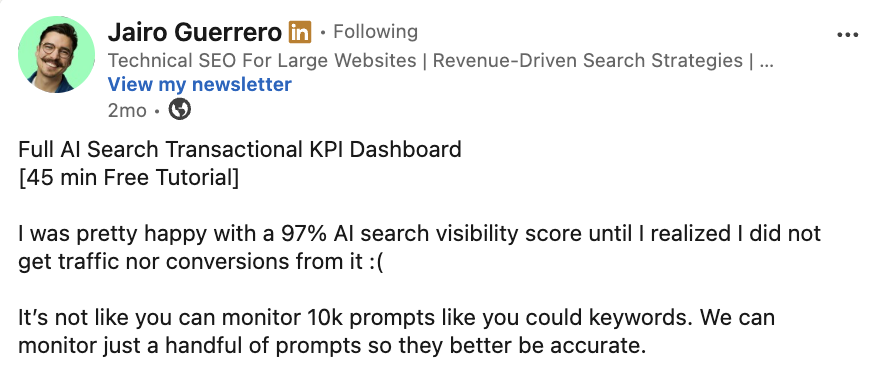
That gap is the measurement problem in one sentence. Teams check whether they “show up” in ChatGPT and Google's AI Overviews, screenshot a high percentage, and stop there. The percentage never connects to a decision or a dollar.
The stakes are no longer optional. AI Overviews appeared on about 6.5% of Google queries in January 2025, peaked near 24.6% in July, and settled around 15.7% by November, based on Semrush's study of more than 10 million keywords. And when an AI Overview shows up, the first organic result loses roughly 58% of its clicks, according to Ahrefs' December 2025 analysis of 300,000 keywords. Visibility inside the answer now decides whether you get the click at all.
So measurement matters. The trouble is what most dashboards measure: raw mention counts, sentiment scores, prompt volume. Those are inputs. You need outcomes. Three KPIs actually move a plan forward, and each one answers a specific question your team is already arguing about.
Metric 1: Share of Voice across a fixed prompt set
Start with the metric everyone thinks they already track, and almost everyone tracks wrong.
Share of voice answers one question: of the prompts your buyers actually type, how often does the AI answer name or cite you versus your competitors? The word that does the work there is denominator.
“Visibility score” with no defined prompt set is a number floating in space. Share of voice against 80 buying-intent prompts is a position you can defend or lose.
Here's why the prompt set has to be fixed and yours. In e-commerce, 80% of the sources cited in AI Overviews don't rank in the top organic results. You can hold a share of voice in AI answers while ranking nowhere, and you can rank first while the model cites someone else entirely. The two systems pull from different signals, so you have to measure the AI one directly.
How to build it:
- Pick 50 to 200 prompts that match real buying questions in your category.
- Run them on a schedule across the engines your audience uses: ChatGPT, Gemini, Google AI Overviews, Perplexity.
- For each prompt, log whether you were mentioned, whether a competitor was, and who got cited as the source.
Share of voice is your share of those results.
Do it manually and it eats a day every week, and the answer drifts because you can't keep the prompts and timing identical by hand. This is the job a tracker exists for.
Findrix runs the same prompt set on a fixed cadence across the major AI engines and returns your share of voice next to named competitors, so week-over-week movement reflects the market rather than your testing noise.
The decision this metric drives: it shows which rival owns which prompts. When a competitor takes the answer for “best [category] for [use case],” that prompt becomes your next content or PR target. Share of voice is the map of where to attack.
Metric 2: Citation prominence and source ownership
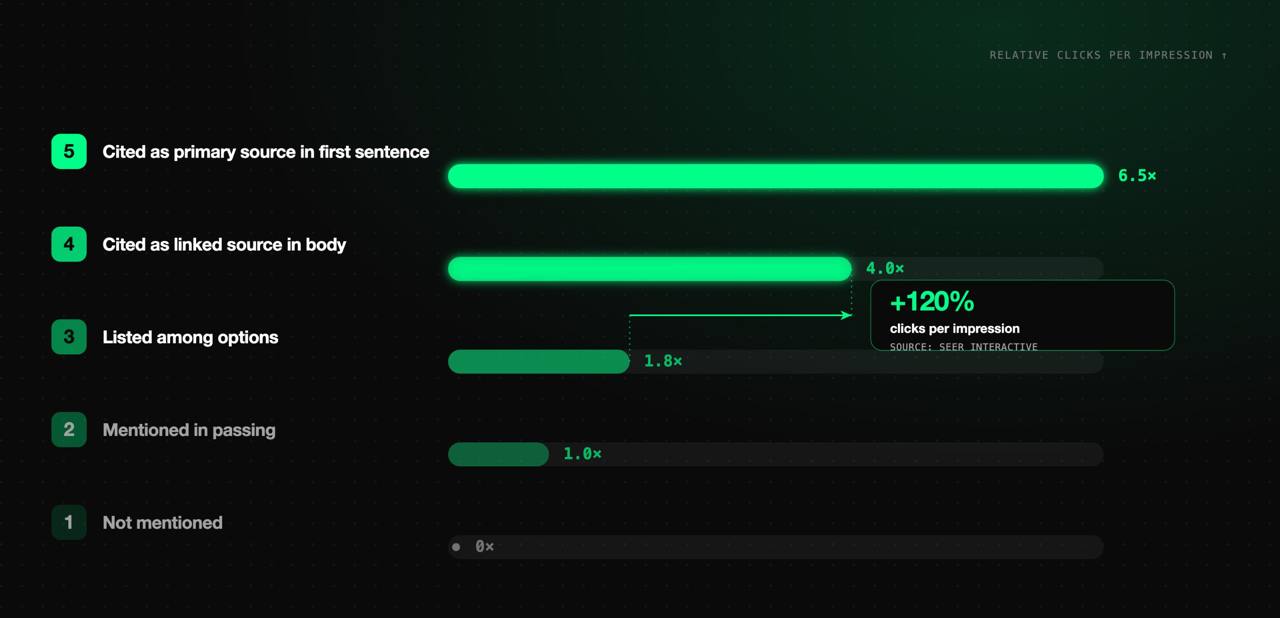
Getting named in an AI answer feels like winning. Often it isn't, because there are three different things people lump under “visibility,” and only one of them earns a click.
A model can mention your brand in passing. It can list you among five options. Or it can cite you as the linked source for the claim it just made. Those are not the same outcome.
The cited source is the one a reader clicks when they want to verify or go deeper, and that click is where AI visibility turns into traffic.
The data backs the distinction. Brands cited as sources in AI Overviews earn about 120% more organic clicks per impression than uncited brands on the same query, per Seer Interactive. So two brands can both “appear,” and one gets double the clicks because it owns the citation. Position inside the answer compounds this: a reference in the first sentence carries more weight than a name buried in paragraph four.
Citations also concentrate hard. Across 46 million AI Overview citations analyzed by Surfer SEO, YouTube took 23.3% and Wikipedia 18.4%. That concentration means a small set of sources absorbs most of the linked slots. To break into that set, you need the formats models reuse: clear definitions, direct answers near your headings, and third-party mentions. On that last point, brand search volume, not backlinks, is now the strongest predictor of whether a brand gets cited, according to Previsible. People searching your name teaches the model you're an entity worth quoting.
So track three things per appearance, not one:
- Mention or no mention,
- Cited source or not,
- Where in the answer you land.
Trackers like Findrix separate these automatically. It flags whether you were the linked source or a passing reference and shows your position in the response, which turns “we appear sometimes” into “we own the citation on 12 prompts and get name-dropped on 30.”
The decision this metric drives: chase the cited-source slot, not the mention. If you're mentioned but never linked, the fix is content format and brand authority, not more keywords.
Metric 3: AI-attributed conversions and revenue
This is the metric that closes the 97%-to-zero gap. Share of voice and citation ownership tell you the AI engines respect you. Neither tells you whether that respect pays. For that, you follow the session to the outcome.
Set it up in GA4 with a custom channel. Create a definition that buckets sessions from chatgpt.com, perplexity.ai, gemini.google.com, claude.ai, and openai.com into a single “AI Referral” channel. Now you can watch session volume, conversion rate, pages per session, and revenue per session for AI traffic on its own, separate from organic and paid.
What you'll likely see is the opposite of the usual story. Across 94 ecommerce brands tracked through 2025, ChatGPT traffic converted at 1.81% versus 1.39% for non-branded organic search, about 31% higher, per Visibility Labs. Those visitors also read more: 2.3 pages per session against 1.2 for Google organic, in Seer Interactive's case study. The volume is still small, but it's climbing fast. The same 94-brand dataset showed ChatGPT sessions growing 1,079% over the year, from about 1,500 to 18,000 monthly.
One caveat decides whether your numbers are honest. GA4 undercounts AI's real influence, because plenty of people get a recommendation in ChatGPT and then search your brand on Google before buying. That sale lands in branded organic, and AI never gets credit.
The fix is a post-purchase survey: a single “how did you first hear about us?” question at checkout, which catches the conversions attribution misses.
Once conversions are flowing through a clean channel, you can connect them back to the first two metrics. Findrix ties its citation and share-of-voice data to the prompts that sit upstream of AI referral sessions, so you can see which answers are actually feeding the pipeline rather than just raising a score. That's the line a CFO will fund: not “our visibility is up,” but “the prompts we now own drove X sessions and Y revenue.”
The decision this metric drives: it tells you whether to keep investing in AI search at all, and where. A high score with no revenue means your prompts are wrong or your funnel leaks. Revenue with a mediocre score means you've found the prompts that matter and should double down.
How the three fit together
Run them as a weekly loop, in order. Define the prompt set and measure share of voice. That's the map. Check who owns the citation on the prompts you care about. That's the quality of your position. Then connect both to AI-attributed conversions, which tells you whether any of it pays.
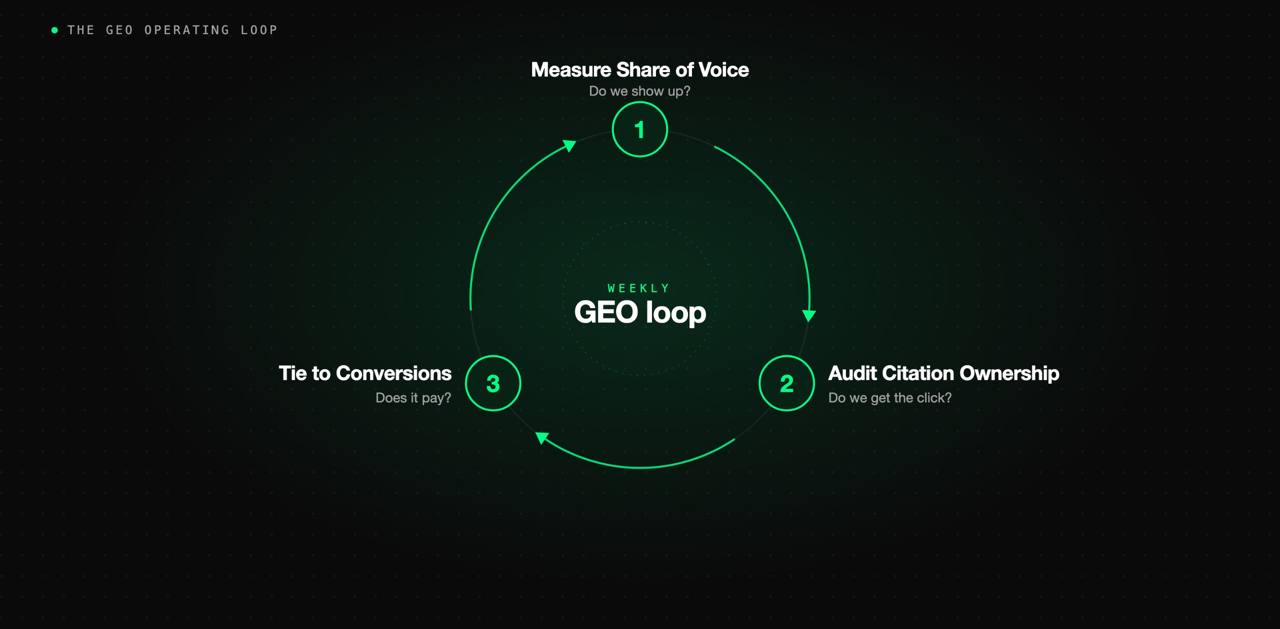
Each metric catches what the one before it misses. Share of voice without citation ownership flatters you with mentions that never click. Citation ownership without revenue data leaves you optimizing for a screenshot. Revenue without the first two leaves you guessing which prompts to defend. Tracked together, they turn AI search from a vibe into a system.
Findrix is an action-based AI visibility and GEO platform that turns real-time tracking and analysis of a brand's presence across AI answers and search into a shorter, structured path from an AI visibility gap to an implemented fix and measures what changed afterward. It is built for brand managers, marketing leaders, and agencies running AI search for their clients.
The brands that win the next two years of search won't be the ones with the highest visibility score. They'll be the ones who can name the prompts they own and the revenue those prompts produce.
Frequently asked questions
Is AI visibility replacing rankings as the main KPI?
Not replacing but runs alongside rankings. Classic rankings still drive most traffic, and just over half of Google queries still return standard organic results. But on queries that trigger an AI Overview, the top result can lose around 58% of its clicks, so for those queries AI visibility is the KPI that explains your traffic. Track both, and segment your keywords by whether they trigger an AI answer.
What's the difference between AI search visibility and SEO?
SEO decides where your page ranks in the list of blue links. AI search visibility decides whether a model names or cites you inside its generated answer. They pull from overlapping but distinct signals. In ecommerce, 80% of AI-cited sources don't rank in the top organic results, so a page can rank first yet never appear in the AI answer, and vice versa.
How do you measure the share of voice in AI search?
Pick a fixed set of buying-intent prompts (50–200), run them on a schedule across ChatGPT, Gemini, Perplexity, and Google AI Overviews, and log how often you're cited or mentioned versus competitors. Your share of those results is your share of voice. The fixed prompt set is what makes the number comparable week to week. Without it, you're measuring noise.
What counts as a good AI search visibility score?
There's no universal benchmark, and chasing a high absolute number is the trap that leaves teams with a 97% score and zero revenue. A useful score is relative and tied to outcomes: your share of voice versus named competitors on prompts that drive conversions. Rising share on revenue-linked prompts beats a high score on prompts nobody buys from.
Can you track your brand's visibility in ChatGPT specifically?
Yes. You can run your prompt set directly in ChatGPT and log mentions and citations, and you can isolate ChatGPT referral sessions in GA4 with a custom channel to see conversions. Dedicated trackers like Findrix automate the prompt runs across ChatGPT and other engines so you're not doing it by hand every week.
How often should you measure these KPIs?
Weekly for share of voice and citation ownership, since AI answers shift as models and content update. Monthly is enough for the revenue view, which needs accumulated sessions to be statistically meaningful. Early in 2025 some brands logged only 15–37 AI-attributed conversions a month, too few to read into until volume built up.
Run a free Findrix audit and see which AI engines cite you.
Run free audit