

 Deutsch
 Français
 Español
 Português (Brasil)
 Italiano
What is GEO? Generative Engine Optimization Explained (And How It Differs From SEO + AEO)
 Yosif Merman11 min readJuly 1, 2026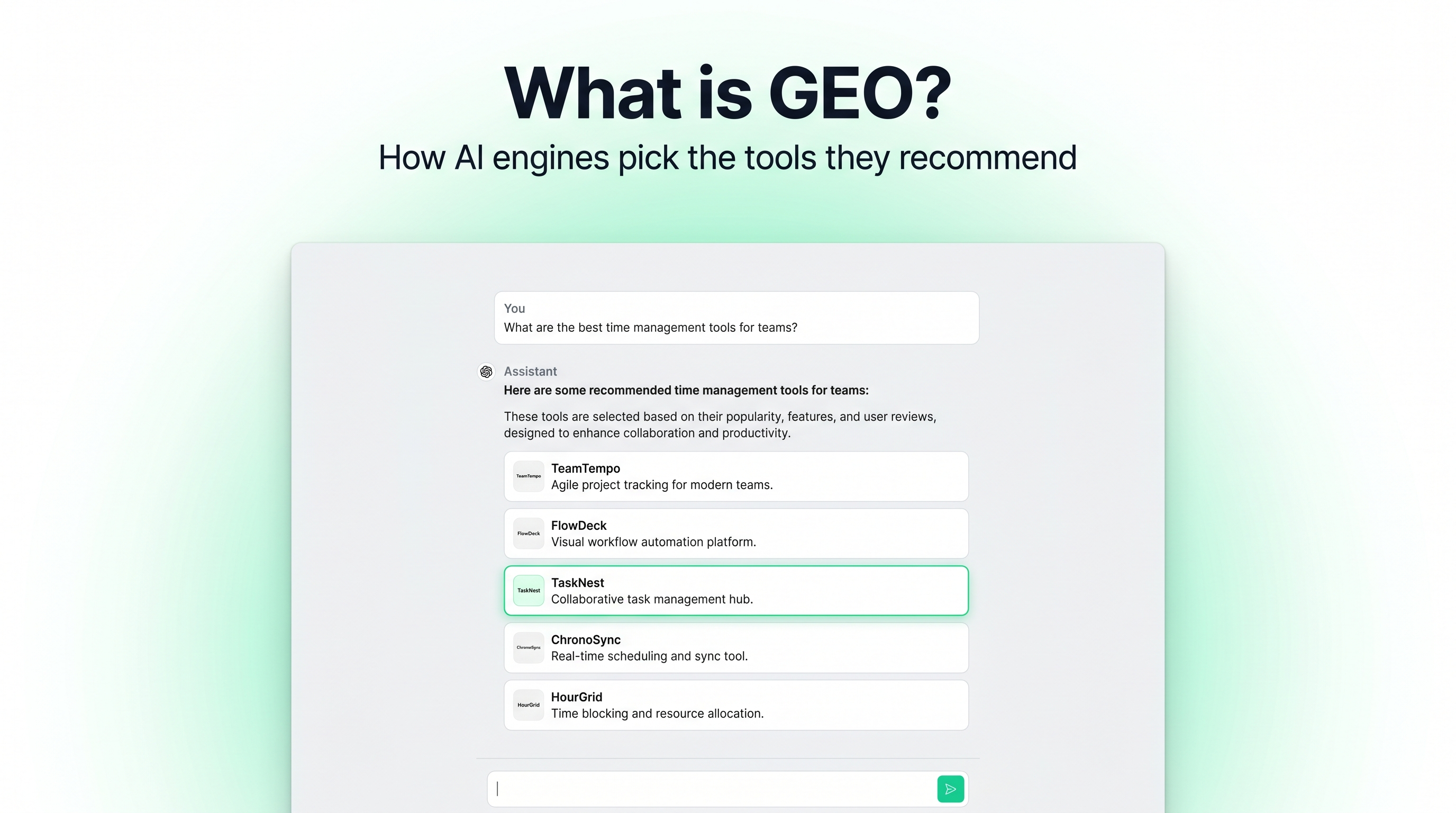
TL;DR — GEO in 60 seconds
GEO (Generative Engine Optimization) is the discipline of making your brand appear inside answers from large language models such as ChatGPT, Perplexity, Gemini, Google AI Overviews, and Microsoft Copilot.
When a buyer asks ChatGPT "best CRM for agencies of 5–10 people," the model returns a direct answer with 2–4 named brands and zero or a handful of links. GEO is the work of becoming one of those named brands.
GEO ≠ SEO. SEO optimizes for ranking in Google's blue links. GEO optimizes for getting cited inside an AI-generated answer. AEO is a subset of GEO focused on Answer Engines like Google AI Overviews and Perplexity. GEO is the broader discipline covering every generative AI surface.
In this guide
What is GEO: the full definition
Generative Engine Optimization (GEO) is the discipline of optimizing your brand's presence inside the answers returned by generative AI engines such as ChatGPT, Perplexity, Google AI Mode, Google AI Overviews, Gemini, Microsoft Copilot, and Anthropic Claude.
This term was coined in 2024 academic research and adopted by the marketing category over the following 18 months, as AI search began materially eroding Google's referral traffic.
GEO covers three coordinated activities:
- Detection — tracking how AI engines describe your brand, which prompts mention you, which sources they cite, and where competitors are recommended instead of you.
- Optimization — adjusting your content, technical site structure, and third-party brand mentions so AI engines have a clear, consistent, citable picture of your brand.
- Execution — shipping the structural and content fixes into your live site so the next AI crawl reads the updated answer.
GEO in marketing
GEO in marketing is what happens when your buyers stop Googling and start asking. 66% of UK B2B decision-makers now use ChatGPT, Copilot, or Perplexity to research suppliers (Magenta Associates).
Search used to surface a list; the buyer clicked through and decided. AI assistants skip the list and make a recommendation directly. If your brand isn't in those recommendations, you're out of the funnel before the conversation starts.
Generative Engine Optimization covers four things:
- tracking where your brand gets mentioned in AI responses,
- improving your citation rate across models,
- attributing pipeline to AI channels that don't show up in standard analytics,
- making structural changes that help AI engines extract and cite your content accurately.
The starting point is understanding where you stand right now.
GEO vs SEO vs AEO: what is the difference?
The single most common question in this category: how is GEO different from SEO? And how does AEO fit in?
The short answer:
- SEO optimizes for ranking inside Google's blue links.
- GEO optimizes for being cited inside an AI-generated answer.
- AEO is a subset of GEO focused specifically on answer-engine surfaces (Google AI Overviews, Perplexity, ChatGPT Search).
The full breakdown
| Discipline | Full name | Optimizes for | Where the user sees it | Status in 2026 |
|---|---|---|---|---|
| SEO | Search Engine Optimization | Ranking position in Google / Bing / DuckDuckGo organic results | A list of blue links on a SERP | Mature category, losing share to AI search |
| AEO | Answer Engine Optimization | Being cited as the direct answer in AI answer engines | A single AI-generated paragraph with 2–4 source links | Emerging category, subset of GEO |
| GEO | Generative Engine Optimization | Being named and recommended inside generative AI responses across all surfaces | An AI answer naming 2–4 brands, with or without links | Fastest-growing category in marketing tech |
GEO vs SEO: where they diverge
The mechanical difference: SEO assumes the user clicks through to your site. GEO assumes the user reads the answer and doesn't click.
SEO success means your page ranks #1 on Google. GEO success means ChatGPT mentions your brand by name in its answer, whether or not the user ever visits your site. The two disciplines measure different things, optimize for different signals, and require different tactics.
| Dimension | SEO | GEO |
|---|---|---|
| Primary metric | Organic ranking position + click-through rate | Citation rate, mention rate, share of voice in AI answers |
| Optimization target | Keyword density, backlinks, page speed, schema | Brand-name density, atomic facts, third-party mentions, structured FAQ |
| Where the user reads it | On your site, after clicking a blue link | Inside the AI chat, often without clicking anywhere |
| Time to first result | 3–6 months | 4–8 weeks |
| Single-query reproducibility | High — same query returns the same SERP | <1% — same query returns near-identical results <1% of the time |
| Where buyers research in 2026 | Declining 25% by 2026 (Gartner) | Where 66% of B2B decision-makers are now (Magenta Associates) |
GEO vs AEO: where they overlap
Answer Engine Optimization (AEO) is a subset of GEO. AEO focuses on a specific surface — engines that deliver direct answers with citations (Google AI Overviews, Perplexity, ChatGPT Search). GEO covers AEO plus the broader generative surfaces (ChatGPT conversational mode, Gemini chat, Claude, Meta AI) where citations may or may not appear as clickable links.
In practice, most teams use the terms interchangeably. Tools that call themselves "AEO platforms" and tools that call themselves "GEO platforms" do roughly the same work. The distinction matters more academically than operationally.
Where SEO still matters inside GEO
The most overlooked fact in this category: SEO is not dead, and it's a partial input to GEO success.
- 87%of ChatGPT citations come from Bing's top 10. If your site doesn't rank in Bing, ChatGPT can't find you.
- 17%of AI Overview citations come from Google's organic top 10, and another 54% from positions 11–100. AI Overviews still pull from organic search — just more broadly.
- 83%of ChatGPT Shopping carousel sources come from Google Shopping organic ranking. Not ranking there means invisible in ChatGPT Shopping.
How GEO actually works (the mechanics)
LLMs cite brands through two mechanisms operating in parallel: parametric memory (what the model learned during training) and retrieval-augmented generation (what the model fetches at query time).
Parametric memory: brand awareness as a ranking signal
When ChatGPT was trained on internet content from 2021–2025, it absorbed information about millions of brands. The brands mentioned most often, in the most authoritative contexts, with the most consistent positioning, became "memorized" inside the model's parameters.
When a user asks a category question, ChatGPT first searches its parametric memory. If your brand is well-represented there, you appear in the answer even when the model isn't actively retrieving live web data.
This is why brand awareness is the largest single GEO ranking factor. Empirical analysis of citation patterns shows roughly 62% of citation weight comes from brand awareness (parametric memory + third-party mentions), and 48% comes from on-page content optimization (schema, structure, atomic facts, freshness).
Most brands invest these in exactly the wrong ratio.
Retrieval-augmented generation: live signals
When the model needs current information, it queries external sources at runtime. ChatGPT Search queries Bing. Perplexity queries the open web. Google AI Overviews query Google's index. Each engine has its own retrieval pipeline.
This is where structural site signals matter — schema markup, FAQ blocks, atomic-fact sentences, content freshness, llms.txt, and robots.txt allowlisting of AI crawlers.
The empirical citation weight breakdown
| Factor | Approx. weight in citation decisions |
|---|---|
| Brand awareness (parametric memory + third-party mentions on Reddit, YouTube, Wikipedia, industry blogs) | 62% |
| Content optimization (schema, atomic facts, FAQ blocks, freshness, structural signals) | 48% |
The weights don't sum to 100 because the factors overlap and reinforce each other. A brand with strong awareness and weak content still gets cited. A brand with weak awareness and perfect content rarely does.
The mention-rate multiplier
When AI engines mention your brand by name inside an answer, the citation rate — the chance the answer also links to your site — jumps from 10.6% to 53.1%: a five-fold increase.
The 8 surfaces where GEO citations happen
Most teams underestimate how many surfaces a single AI engine actually has. The eight that matter in 2026:
For most B2B SaaS and DTC categories, ChatGPT plus Perplexity plus the Google AI surfaces (AI Overviews + AI Mode) drive 80%+ of measurable AI-sourced traffic. Gemini matters in late-funnel research. Copilot matters in Microsoft 365–heavy enterprises. Claude is long-tail unless you sell to developers.
What gets you cited: the third-party signal
The largest citation source in the entire AI landscape is third-party content where someone else mentions you.
Reddit + YouTube together = 56% of all LLM citations. Reddit alone is 40.1%. YouTube is 16%. Together they dominate.
Wikipedia, industry blogs, podcasts, and review sites round out the rest. The brand mentioned on the right Reddit thread or in the right YouTube video gets cited more reliably than the brand with the perfect on-page content.
The implication for budget allocation: PR, community marketing, podcast appearances, and review-site monitoring matter more in GEO than they did in classic SEO. Brand mentions on external sites are now compounding distribution assets.
| Source | Share of AI citations |
|---|---|
| 40.1% | |
| YouTube | 16% |
| Wikipedia | ~10% (estimated) |
| Industry blogs + media | ~15% (estimated) |
| Your own site | ~5% (estimated) |
| Other UGC + podcasts + review sites | ~14% (estimated) |
What is GEO in marketing?
In marketing terms, GEO is the discipline that replaces classic SEO as the top-of-funnel discovery channel for B2B and DTC categories where buyers research in AI assistants.
GEO sits inside the broader marketing stack:
| Marketing function | Classic version | GEO-era version |
|---|---|---|
| Top-of-funnel awareness | Brand advertising + content marketing → Google organic | Brand mentions in third-party UGC + atomic-fact content → AI citation |
| Demand capture | Google Ads + organic ranking | AI engine citations + branded search lift |
| Comparison content | Listicles, "best X for Y" articles | Comparison content that AI cites; competitor monitoring tools |
| Reputation management | Reviews + PR | AI sentiment monitoring + structured Wikipedia / Wikidata presence |
| Analytics | Google Analytics organic source | Branded search lift + server-side AI attribution via CAPI |
The strategic change: marketing teams that allocated 90% of SEO budget to content production now need to reallocate toward brand mentions in third-party media and structural fixes that AI engines can extract.
10 common implementation mistakes when doing GEO
- Single-run rank tracking presented as authoritative data. ChatGPT returns identical results for the same query <1% of the time. Any tool that shows you one number per prompt is showing you one sample of a distribution.
- No confidence intervals on share-of-voice numbers. "Your share of voice is 17.3%" without a confidence interval and sample size is decoration, not data.
- Week-over-week deltas without paired bootstrap. Most weekly dashboards display noise as a trend.
- No threshold for hallucination classification. AI engines hallucinate. Tools that don't filter this skew every metric upward.
- No multiple-comparison correction. Tracking 100 prompts weekly = 100 simultaneous hypothesis tests. Without correction, the real false-discovery rate over a year approaches 40%.
- No stratification by engine, geography, or prompt category. Aggregate numbers hide where the actual movement is happening.
- Cherry-picked case studies instead of systematic data. "Brand X grew 300%" without methodology is sales theatre.
- Position rankings reported without weighting. Position 1 and position 5 are not equally cited. DCG-equivalent weighting is required.
- No test-retest reliability coefficient. "Stability" claims without statistical reliability are guesses.
- No dark-funnel attribution. 85–93% of the path from AI citation to conversion is invisible to standard analytics. Tools that report only what GA4 sees miss most of the impact.
How to start GEO: run your first audit
Most companies have no idea where they stand in AI search. ChatGPT, Perplexity, and Gemini are already answering your buyers' questions — the question is whether your brand appears in those answers, or your competitor does.
A GEO audit gives you the baseline. Here's how to run yours.
Build your query set
Start with 15–20 prompts that mirror how your buyers actually talk to AI — not your brand name, but the problems they bring to it. Think: "best tools for [use case]", "how do I [job to be done]", "alternatives to [competitor]", "what is the best [category] software". These are the moments that define your AI visibility.
Check what the models say right now
Open ChatGPT, Perplexity, and Gemini. Run each query. For every response, note three things: does your brand appear, where in the response (first mention vs. buried), and what sources are cited. Do this manually for your top 5 queries — it takes 20 minutes and immediately shows how invisible or visible you are.
Audit what gets cited
AI models don't make things up from nothing. They pull from content they've indexed and trust. Screenshot every citation. You'll likely see a pattern: third-party review sites, competitor blog posts, or G2-style listicles. If your site isn't in those citations, that's the gap — not your product, your content.
Map competitor share of voice
Tally how often each competitor shows up across your query set. Even a rough count tells you who owns the conversation, which competitors dominate specific use cases, and where you have realistic room to break in. This isn't vanity — share of voice in AI search directly correlates with pipeline.
Turn gaps into a fix list
By now you'll see the pattern. Maybe you're missing a structured comparison page. Maybe your use-case content is too thin to cite. Maybe a third-party listicle ranks you fifth out of five. Each gap maps to a specific fix: create this page, update that post, pitch this outlet. One audit usually surfaces 3–5 high-priority actions you can start this week.
The manual version works. But it doesn't scale — AI answers change, competitors move, new queries emerge. Findrix tracks your visibility across AI models automatically, monitors competitor mentions in real time, and surfaces which pages drive citations, so you always know where you stand.
Frequently asked questions
What does GEO stand for?
GEO stands for Generative Engine Optimization – the discipline of making your brand appear inside answers from generative AI engines like ChatGPT, Perplexity, Gemini, and Google AI Overviews.
What is the difference between SEO and GEO?
SEO optimizes for ranking in Google's blue links – the user clicks through to your site. GEO optimizes for being cited inside an AI-generated answer – the user reads the answer and may never click anywhere. SEO measures organic ranking and click-through. GEO measures citation rate, mention rate, and share of voice inside AI answers. Both still matter: SEO is now a foundation layer that GEO builds on, since 87% of ChatGPT citations come from Bing's top 10 and most AI Overview citations come from Google's organic top 100.
What is GEO vs AEO?
AEO (Answer Engine Optimization) is a subset of GEO focused on answer-engine surfaces specifically – Google AI Overviews, Perplexity, ChatGPT Search. GEO is the broader discipline covering all generative AI surfaces, including conversational mode in ChatGPT, Gemini chat, Claude, and Meta AI. In practice, most tools and most marketing teams use AEO and GEO interchangeably. The distinction is more academic than operational.
What is the difference between AEO and GEO?
AEO targets answer engines that deliver direct answers with citations (AI Overviews, Perplexity). GEO targets all generative AI surfaces including conversational chats that often don't include clickable citations. Both share the same optimization tactics: brand-name density in atomic facts, structured FAQ blocks, third-party mentions, content freshness, schema markup, and robots.txt allowlisting AI crawlers.
What is GEO in marketing?
In marketing, GEO is the discipline that replaces classic SEO as the top-of-funnel discovery channel for categories where buyers research in AI assistants. 66% of UK B2B decision-makers now use ChatGPT, Copilot, or Perplexity to research suppliers (Magenta Associates). GEO covers brand-mention tracking, AI citation rate optimization, dark-funnel attribution, and structural site changes that make AI engines able to extract and cite your brand.
What is GEO in SEO?
GEO is often grouped under SEO in agency taxonomies because the disciplines share many tactics (schema, on-page content, technical site signals, third-party mentions). However, GEO and SEO are distinct disciplines targeting different surfaces. SEO targets organic search engine result pages (SERPs). GEO targets AI-generated answers inside chat interfaces. Most modern SEO agencies now offer GEO services as a separate line item.
Are GEO and SEO the same thing?
No. SEO optimizes for ranking in search engines like Google. GEO optimizes for being cited inside AI-generated answers from generative engines like ChatGPT, Perplexity, and Gemini. They share some tactics – both benefit from authoritative content, good site structure, and third-party mentions – but the success metrics, the surfaces they target, and the strategic priorities differ. Most teams in 2026 do both
How do you do GEO?
Three layers. First, run an audit to confirm your foundation is intact (robots.txt allows AI bots, content extractable, Wikipedia article exists, Wikidata QID assigned). Second, allocate roughly 62% of effort to brand awareness – third-party mentions on Reddit, YouTube, Wikipedia, industry blogs – and 48% to on-page content optimization (atomic facts with brand name, FAQ blocks, schema, freshness). Third, ship fixes regularly. Tools like Findrix automate the third step by drafting and pushing fixes directly into your CMS. Measure citation rate, mention rate, share of voice, and branded search lift.