

 Deutsch
 Français
 Español
 Português (Brasil)
 Italiano
AI Search Optimisation: How to Optimise for AI Search in Australia
 Yosif Merman13 min readOctober 21, 2026
TL;DR
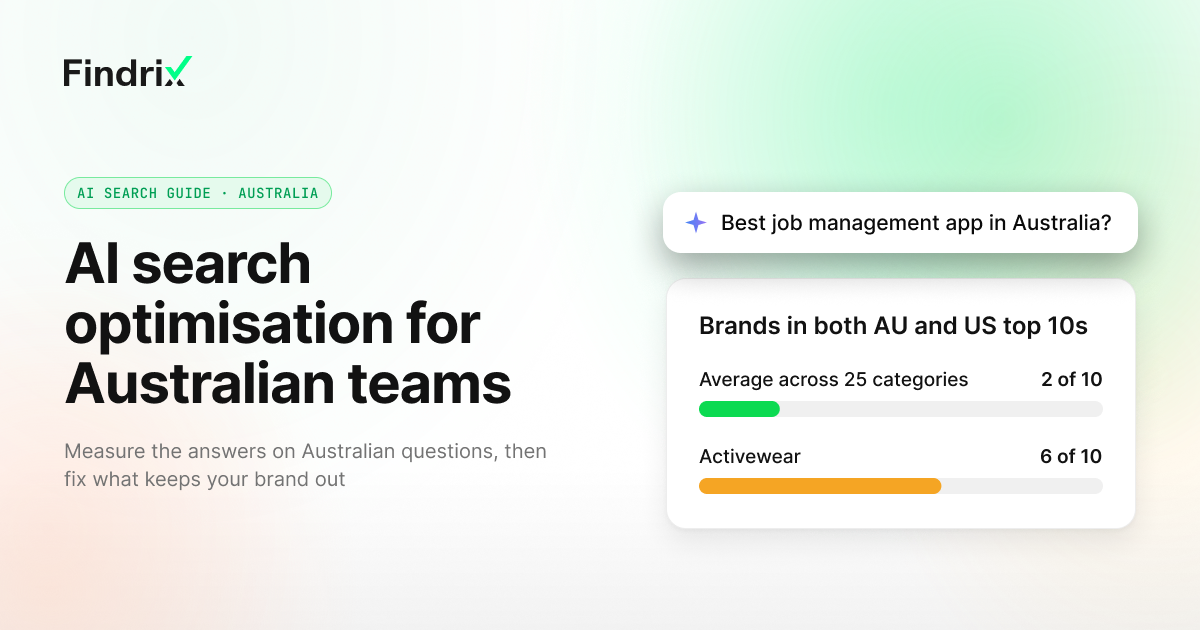
AI search optimisation is the work of getting your brand named and cited when ChatGPT, Perplexity, Gemini, Google AI Overviews and AI Mode answer a buyer's question. For an Australian business it starts with measuring the answers on Australian questions, then fixing whatever the measurement shows is holding you back: pages the engines cannot read, sources that cite competitors, wrong facts, or weak comparisons. Findrix measures each engine separately and turns those findings into fixes. Updated October 2026.
Key takeaways
- An Australian and an American buyer asking about the same category mostly see different brands: across 25 categories in Findrix Radar, ChatGPT's two top-10 lists shared 2 brands on average.
- For Google AI Overviews and AI Mode, Google's own guidance (updated July 2026) says AI search optimisation is still SEO. Other assistants build answers from other sources, so the work does not stop at Google.
- What to fix first depends on what the measurement finds. A brand the engines cannot read needs different work from a brand they describe wrongly.
- Off-site work happens one URL at a time: the specific comparison page, thread or listing the engine cites for your buyers' questions.
What AI search optimisation is
AI search optimisation is the practice of making AI engines mention your brand, describe it correctly and cite your pages when buyers ask them for a recommendation. The buyer types "best family lawyer in Parramatta" or "job management software for electricians", gets one written answer with a handful of names in it, and often never opens a search results page.
You will also see the work called generative engine optimisation (GEO) and answer engine optimisation (AEO). The terms overlap heavily, and we cover the differences in our Australian guide to GEO and our AEO explainer. This guide is the practical one: how to find out where you stand, what to fix first, and what the work looks like on a real category.
Australian buyers see a different market
Before changing anything, check how far the Australian answer sits from the American one.
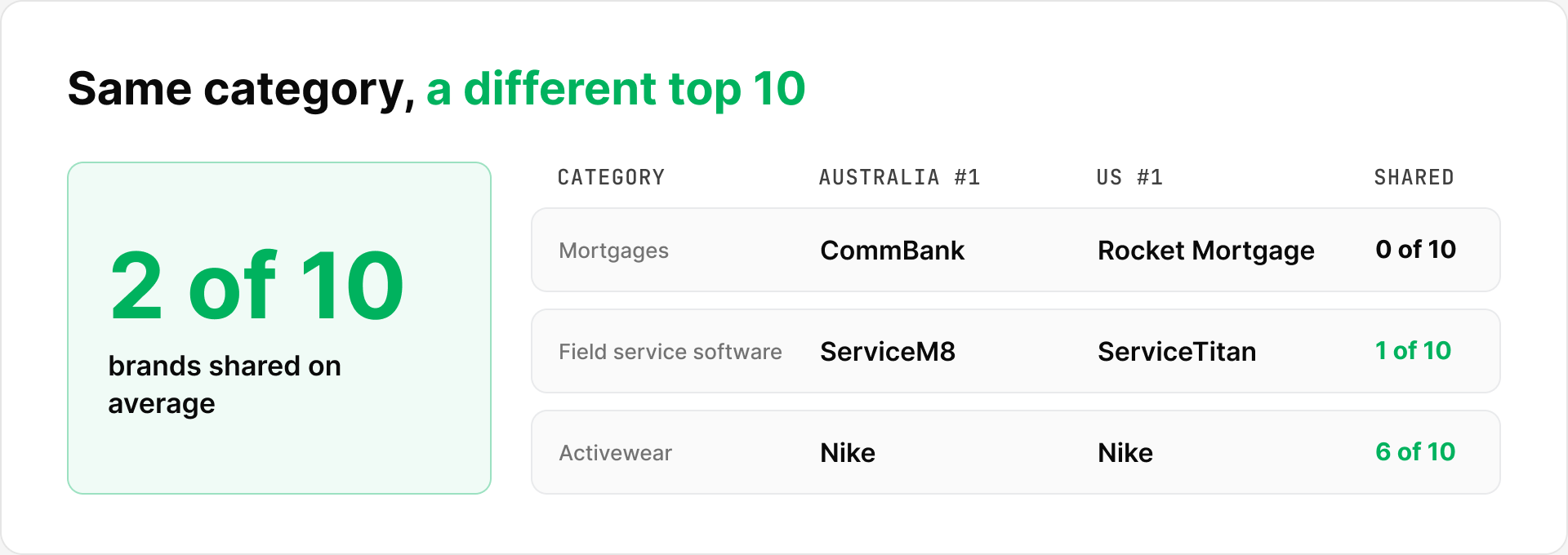
Findrix Radar measures who AI engines recommend, market by market. We took the 25 categories Radar measures in both Australia and the United States and compared ChatGPT's top 10 brands by mention rate in each country (measurements frozen in September 2026, each buyer question asked three times).
| Category | Top brand in Australia | Top brand in the US | Brands in both top 10s |
|---|---|---|---|
| Mortgages | Commonwealth Bank | Rocket Mortgage | 0 of 10 |
| Sports nutrition | Bulk Nutrients | Naked Nutrition | 0 of 10 |
| Field service software | ServiceM8 | ServiceTitan | 1 of 10 |
| Roofing | BlueScope Colorbond | GAF | 1 of 10 |
| Facial skincare | La Roche-Posay | CeraVe | 5 of 10 |
| Activewear | Nike | Nike | 6 of 10 |
Across all 25 categories the two top-10 lists shared 2 brands on average, and the median was 1. The leader was the same brand in 2 categories out of 25. In 7 categories, including mortgages, wealth management, family law and personal injury law, not one brand appeared in both lists. Global consumer brands overlap the most, and even in those categories the leader differed in three of the four with the highest overlap.
One caveat on reading this. Radar's question sets are written for each market, so the comparison shows what a buyer in each country is told, not a pure effect of geography. That is still the practical point: if your prompts, your rank tracker or your audit run on US settings, they describe a market you do not sell into. Everything below assumes Australian questions.
What Google says, and where that advice stops
Google's guide to optimising for its generative AI features was last updated in July 2026, and its position is direct: AI Overviews and AI Mode run on Google's core ranking and quality systems, so optimising for them is still SEO. The guide lists what you do not need for Google Search, including llms.txt and other AI-specific files, splitting content into small chunks, rewriting pages in special phrasing for AI, and special schema markup.
That advice is accurate for Google, and we follow it in this guide. Its scope is Google Search. ChatGPT, Perplexity and the other assistants your buyers use pull their sources from other places with their own crawlers, so an Australian team doing only Google SEO is working on some of the engines its buyers ask and leaving the rest to chance.
Where each engine gets its sources
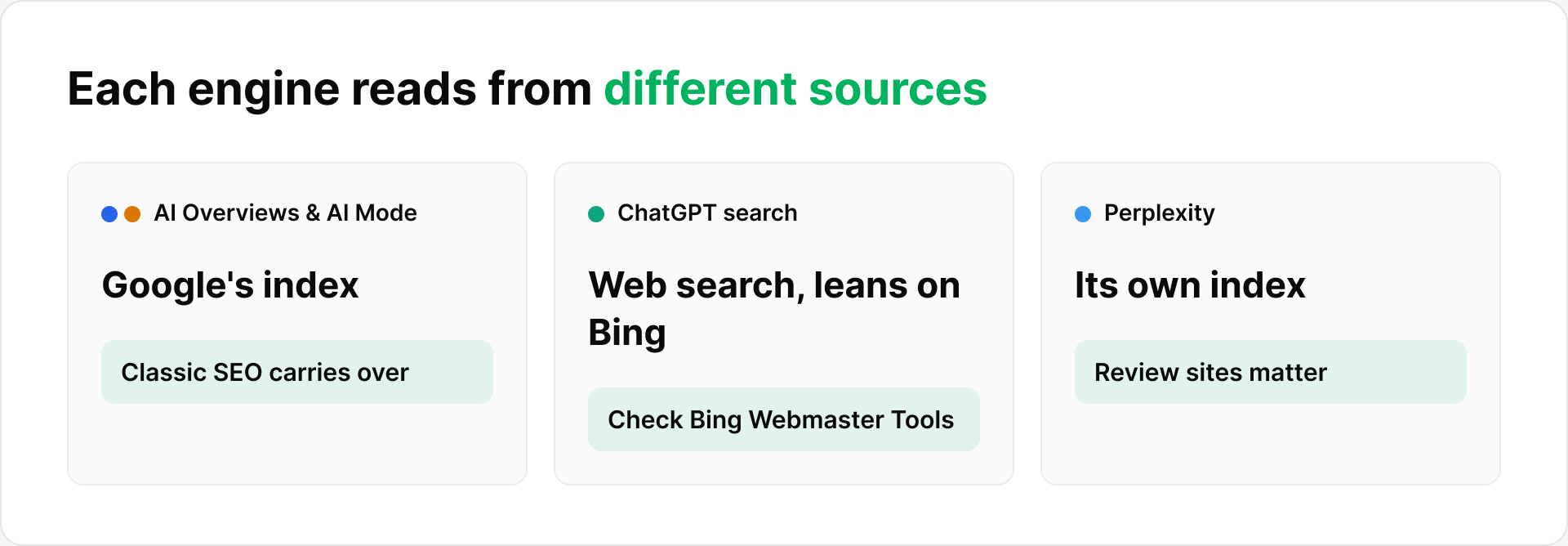
| Engine | Where the sources come from | What that means for you |
|---|---|---|
| Google AI Overviews and AI Mode | Google's index and ranking systems (Google's own guidance) | Classic Google SEO carries over directly |
| ChatGPT search | Searches the web; some observations suggest it leans on Bing's results | Checking how your site appears in Bing is cheap, so don't skip it |
| Perplexity | Its own index and crawler | Review platforms can carry real weight: in Findrix's September 2026 measurement of Australian field service software, Capterra and G2 ranked 5th and 6th among Perplexity's cited domains |
The engines also disagree with each other inside Australia. In the Australian AI Source Index, only 3 of the top 20 cited domains for B2B software appeared in all three measured engines (ChatGPT, Google AI Mode and AI Overviews). This is why Findrix reports every engine separately and never averages them into one score: the fix that moves Perplexity may do nothing for ChatGPT.
Step 1: Measure where you stand
Write down the questions your buyers ask before they choose a provider, in their words and with the Australian context they would add: a city, "in Australia", a local regulation, a local competitor. Ask them in ChatGPT, Perplexity and Google, and record which brands are named, in what order, and which pages are cited.
Twenty questions is a reasonable manual start. Answers vary between runs, so ask each one more than once before you treat a result as real. The full method, with a stable question set, repeats and the metrics to track, is in the measurement section of our GEO guide. If you would rather skip the spreadsheet, the Findrix free AI visibility audit runs 40 buyer questions across ChatGPT, Gemini and Google AI Mode and sends the report in about ten minutes.
Worked example, part 1. To make the steps concrete, we will follow one company through this guide. Call it Wattle Field: an illustrative Brisbane vendor of job management software for trades, not a real business and not a real audit. The competitors and sources in the example come from Findrix's measurements of the Australian field service software category in September 2026.
Wattle Field writes 20 questions such as "best job management app for electricians in Australia" and "simPRO alternatives for a small plumbing business". In the real category, ChatGPT names ServiceM8 and simPRO in about half of its answers, and Tradify and Jobber in about a quarter. In Perplexity, Jobber is the brand named most often. Wattle Field appears in none of the answers.
What to fix first
Most guides give the steps in a fixed order: technical work, then content, then third-party sources. With limited time, the order should come from what the measurement found. Match your main finding to a row and start there.
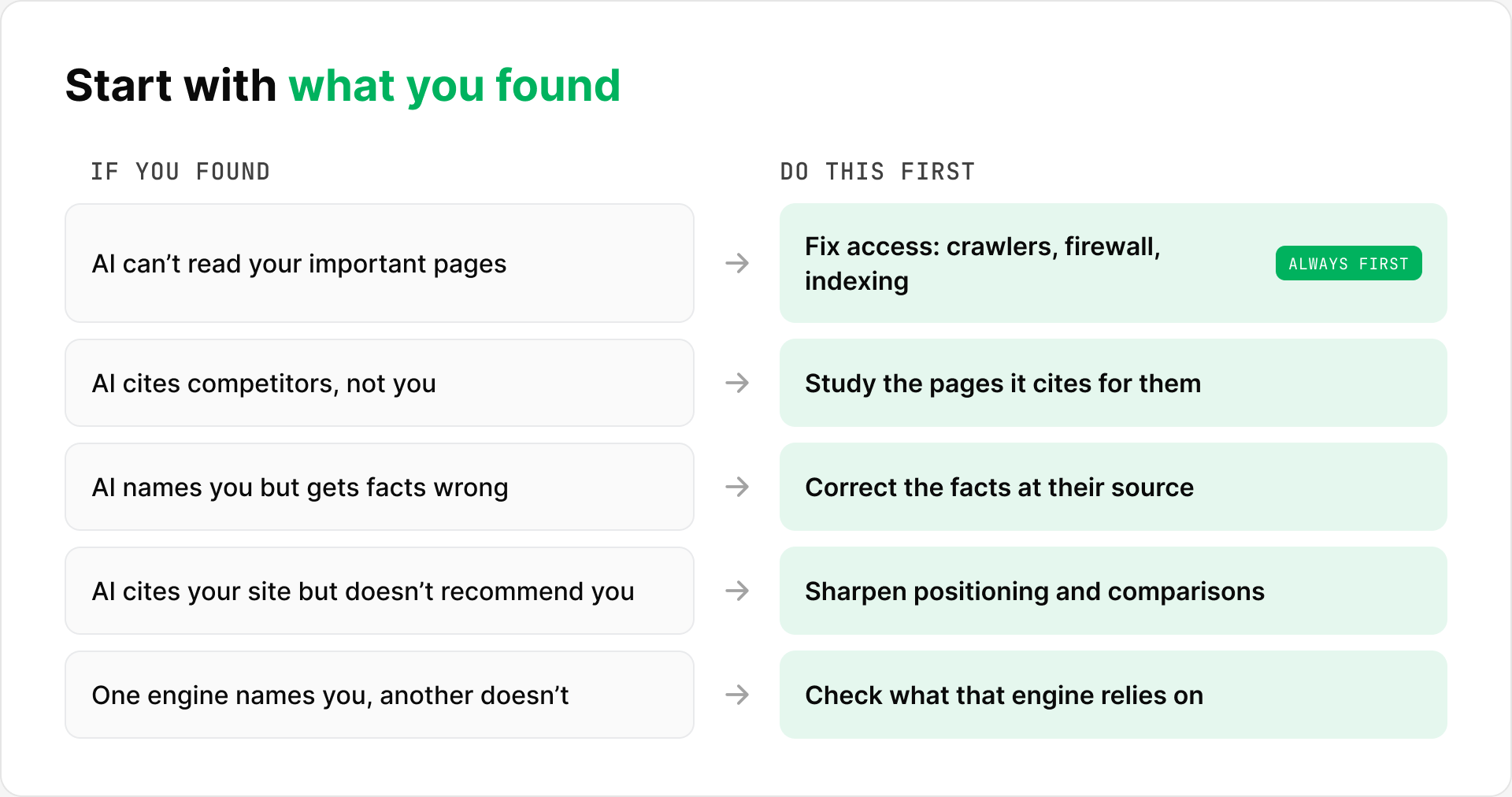
| What you found | What to do first |
|---|---|
| The engines cannot read your important pages | Fix access: crawlers, firewall, indexing |
| The engines cite competitors and not you | Study the sources and content they cite for those questions |
| The engines name you but describe you wrongly | Correct the facts at their source |
| The engines cite your site but do not recommend your brand | Work on positioning and comparison arguments on the cited pages |
| One engine names you and another does not | Look at what that engine relies on: its index, its sources, the review sites it favours |
Most brands will see more than one row. Start with the row that covers the most buyer questions, and treat access as the exception: if the engines cannot read the site, nothing else on this list can work yet.
Worked example, part 2. Wattle Field's site passes the access checks, and nobody describes the brand wrongly, because nobody mentions it. Its main finding is row two: competitors are cited and Wattle Field is not. So it starts with the cited sources and its own content, and leaves fact correction for later.
Step 2: Fix your own site
Can the engines read it?
Three checks matter for every marketing team, even without a developer on hand. Make sure your robots.txt and your firewall let AI crawlers in (bot protection in Cloudflare or another firewall can block them even when robots.txt allows them). Make sure the site is verified in both Google Search Console and Bing Webmaster Tools. And make sure the main text of each page is in the page's HTML, not loaded later by scripts. Everything else on the technical side, from canonical tags to page speed, is covered by Findrix Site Check, which runs 29 checks and explains each failure in its guides.
Structured data (schema) helps a machine identify your business without guessing and makes pages eligible for rich results in Google. Google says there is no special markup for AI, so add it for clean identification and do not expect it to lift AI visibility on its own.
Does the content answer the buyer's question?
This is where most of the work usually sits. Go back to the questions where competitors were named and ask, for each one, whether any page on your site answers it.
- Answer the question near the top of the page in a short, self-contained passage that still makes sense if quoted alone.
- Name the brand in the sentence. "Wattle Field schedules jobs…" can be attributed to you. "We schedule jobs…" cannot.
- Keep facts identical everywhere: prices, service areas, integrations, licences.
- Put comparisons in HTML tables, so the numbers are text a crawler can read.
- Back claims with a named source and a date.
Worked example, part 3. Wattle Field's site has a features page and a pricing page. It has nothing that answers "job management app for electricians", no page on how it compares with simPRO or ServiceM8, and its pricing page lists plans without saying they are in Australian dollars and include GST. Those three gaps line up with the questions where competitors were named, so they become the first three pages to write or rewrite.
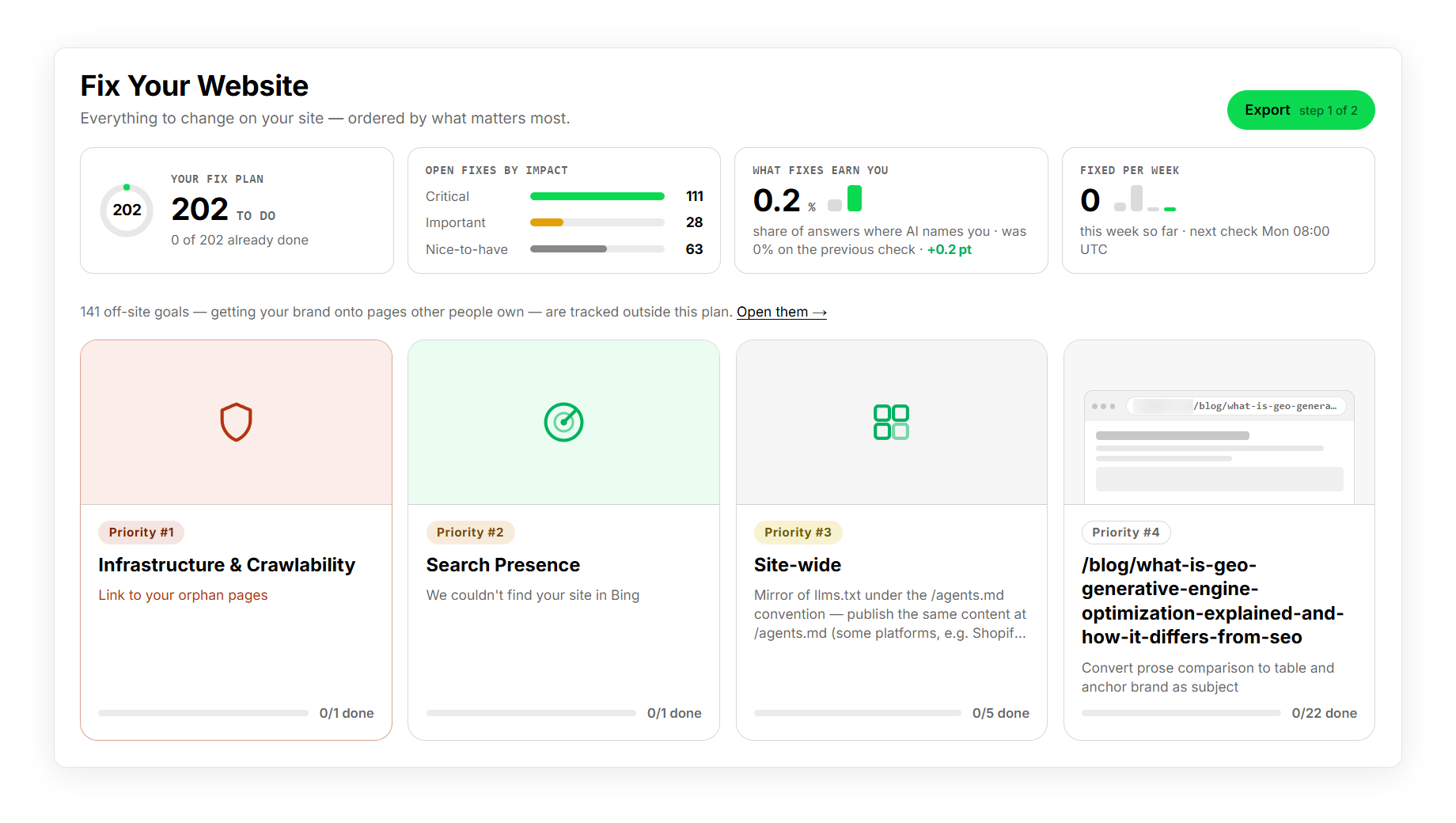
Findrix Fix Your Website turns findings like these into ready-to-apply changes written out in full. On Shopify and WordPress they can be applied through a connected store or site; on other platforms you apply them by hand with the platform guide.
Step 3: Win the citations competitors already have
Whatever your category, a familiar set of platforms will show up in the citations: vendor comparison pages, Reddit, YouTube, review platforms such as Google reviews, ProductReview.com.au and capterra.com.au, business directories and trade media. Knowing the platform is the starting point. What the engine cites is a specific URL: a comparison page, a thread from a given year, a "best X in Australia" list with a publish date. That page is what you work on.
For each cited page, the useful questions are concrete. Which URL is it? Which buyer questions does it appear for, and in which engines? Which competitors are already on it, and how: in a list, in an editorial review, or as a paid placement? Can you realistically get there?
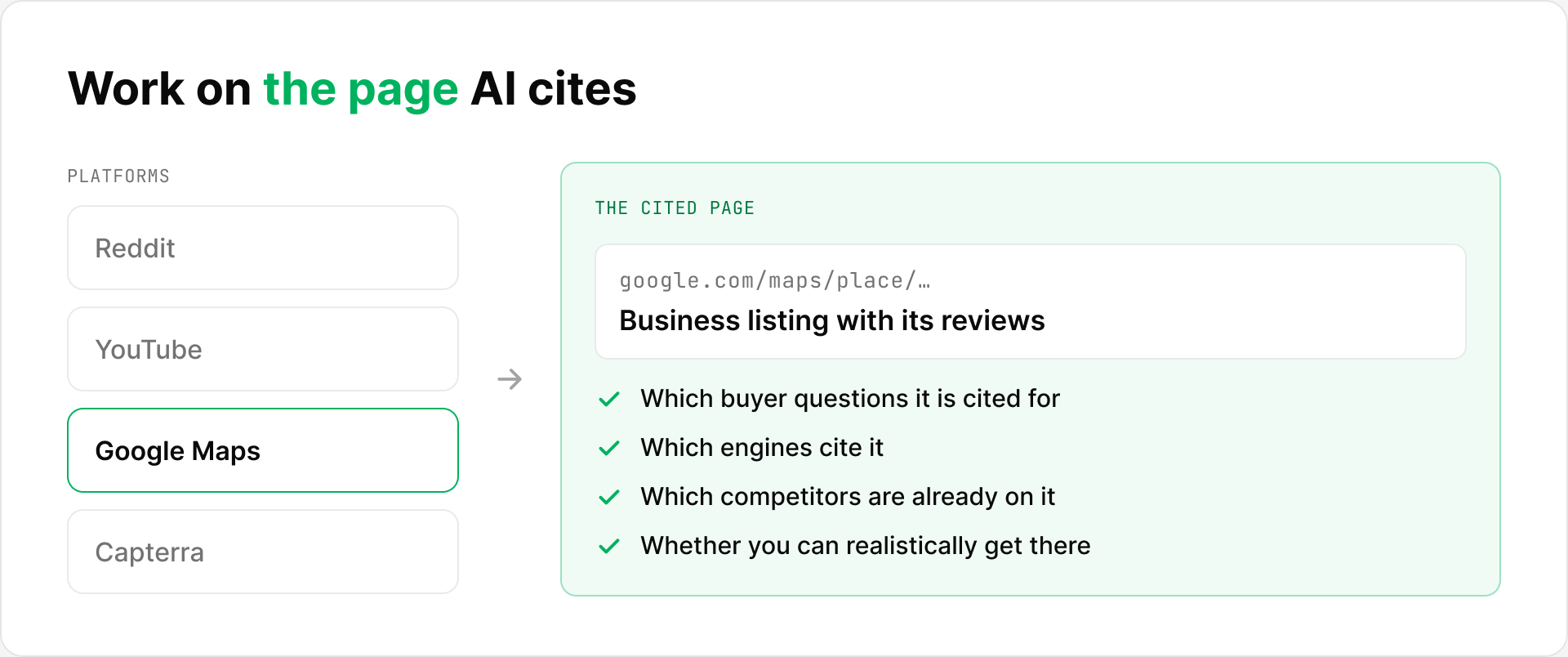
The most important source can sit on a platform you would not think to check. In one Findrix measurement for a UK wedding planner, the most-cited source in ChatGPT's answers was the business's Google Maps listing with its reviews, cited more often than the planner's own site. For that business, the listing and its reviews were the first page to work on.
The Australian mix depends heavily on the category. In the Australian AI Source Index (September 2026), .au domains made up 85–88% of cited sources for clinics, home services and finance, and 33% for B2B software. A plumber's list of pages to win will be mostly local directories, review listings and local media. A software company's will include global review platforms and vendor comparison pages.
Worked example, part 4. In the real category, 9 of ChatGPT's 10 most-cited domains are vendor websites, while Perplexity leans more on review platforms, with Capterra and G2 in its top six. For Wattle Field that splits the work in two. For ChatGPT, its own site has to carry the argument, so it publishes honest comparison pages against the brands buyers ask about. For Perplexity, it builds out its Capterra and G2 profiles, which currently have three reviews between them, and asks existing customers to review it there.
Findrix shows which sites each engine relies on in your category, and for pages where competitors appear it records the exact URL and the type of mention: sponsored, in a list or editorial. Its competitor view also lists the comparison pages the engines cite. For Reddit specifically, our guide on posting without getting banned covers how to take part without it reading as marketing.
Step 4: Correct what AI gets wrong about you
A wrong fact about your brand can come from anywhere. Your own site is a common source: an old price on a forgotten landing page, two service pages that list different areas, a page that contradicts itself, an outdated media release. Third-party pages are another: a directory listing from three years ago, a review site with the wrong founding date, a comparison article describing a plan you no longer sell. And sometimes the engine states a fact without citing anything, which usually means it is coming from what the model learned in training.
The fix follows the same path each time. Find the answers that contain the wrong fact, trace them to the source the engine relied on, correct it at that source (on your own page, or by asking the publisher to update theirs), and check the next measurement to see whether the answer changed. Where no source is cited, make sure the correct version is stated clearly and identically everywhere an engine might look.
Worked example, part 5. Three months after the new pages go live, Wattle Field starts appearing in answers. One Perplexity answer says it has no iOS app. The app launched last year, and the claim traces to a 2023 review on a comparison site that was never updated. Wattle Field sends the publisher the launch date and the App Store link, and fixes its own FAQ, which still says "iOS coming soon".
Findrix Fix Wrong Info counts how many answers state something false or unsupported about the brand and shows which sources feed it. It checks your own site against the brand's confirmed facts and flags pages that disagree with each other, and for third-party pages it drafts the correction request to the publisher.
What you can skip
Some popular advice costs time and changes little.
- llms.txt for Google. Google does not use it. Other services may read it, and it does no harm, but it is not a substitute for anything in Step 2.
- Chopping pages into small chunks. Google says its systems understand pages with several topics, and there is no ideal page length.
- Rewriting everything "for AI". Google says its AI systems understand synonyms and meaning, so special phrasing and long-tail keyword stuffing add nothing.
- Buying mentions. Google says inauthentic mentions are less useful than they look, and its spam systems are built to filter them.
- Treating schema as the main lever. It helps machines identify you, and a page still needs content that answers the question.
Where Findrix fits
Findrix is an action-based AI visibility and GEO platform that turns ongoing tracking and analysis of a brand's presence across AI answers and search into fast optimization, built for brand managers, marketing leaders, and agencies running AI search for their clients.
Each row of the "what to fix first" table maps to a part of the product:
| What you found | Where Findrix picks it up |
|---|---|
| The engines cannot read your pages | Site Check runs 29 checks; Fix Your Website prepares the changes |
| Competitors are cited and you are not | The source map and competitor view show the sites, comparison pages and URLs behind those answers |
| You are described wrongly | Fix Wrong Info traces the claim to its source and drafts the correction |
| Your site is cited but the brand is not recommended | AI Visibility flags answers that cite your site without naming you, and shows which brand each engine ranks higher and in what words |
| One engine names you and another does not | Every engine is measured and reported separately, with its own sources |
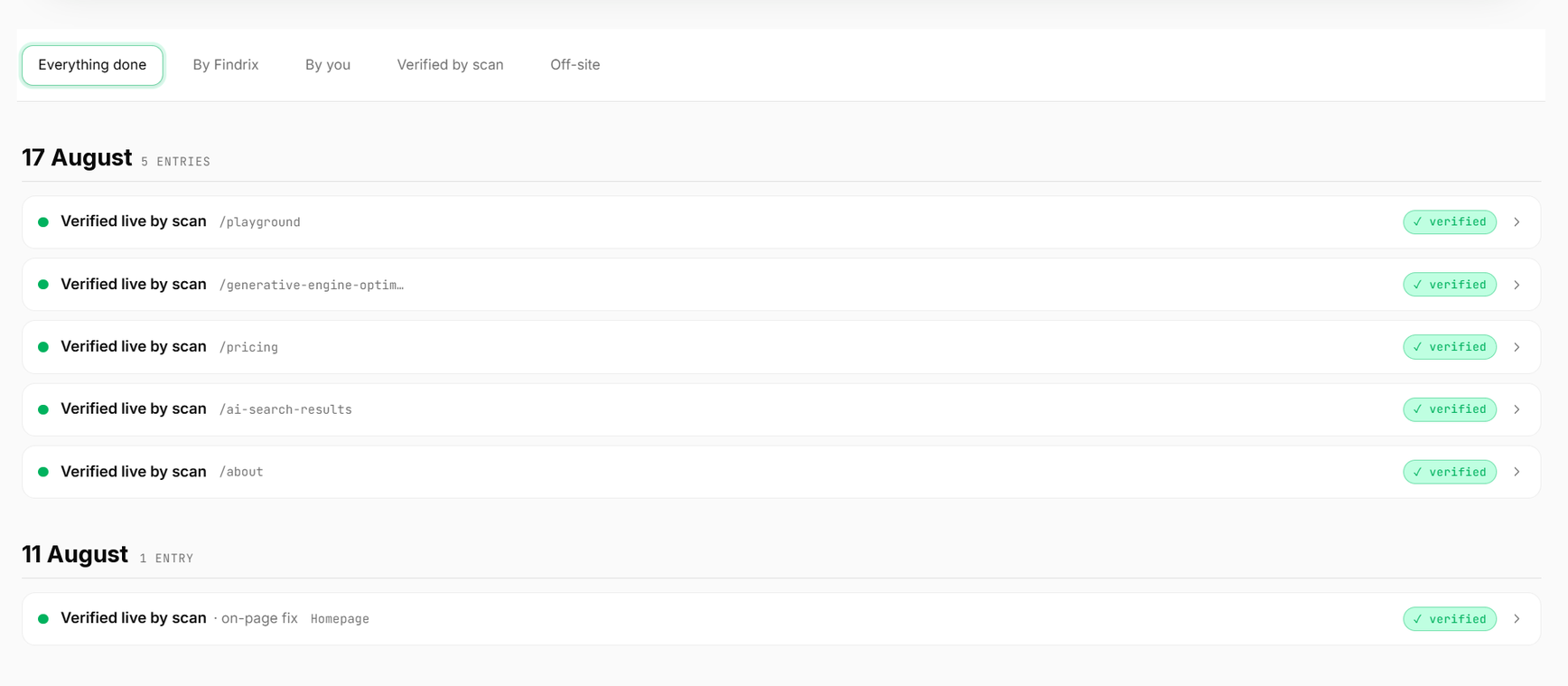
Each measurement asks every question several times, so a change can be told apart from normal variation, and the work log records what was changed so the next report shows whether the picture moved. Findrix connects the work to the measurement. You can see where your brand is missing, what needs to change, and whether your visibility improved after those changes.
Run a free AI visibility audit
See what ChatGPT, Gemini and Google AI Mode tell Australian buyers about your category: 40 buyer questions, your share of voice against competitors, the sources behind the answers and the first fixes to make.
Frequently asked questions
How do I optimise my website for AI search?
Start by measuring what AI engines say on the questions your buyers ask, then fix what the measurement shows. If the engines cannot read your pages, fix crawler access, firewall settings and indexing first. If they cite competitors instead of you, write pages that answer those questions directly, name your brand in the sentence, and work on the specific third-party pages the engines cite.
Is AI search optimisation different from SEO?
For Google AI Overviews and AI Mode, Google says it is still SEO, because those features use Google's core ranking systems. ChatGPT, Perplexity and other assistants draw on other sources, so review platforms, Bing visibility and the specific third-party pages each engine cites matter as well.
What should I fix first?
It depends on what you find. Pages the engines cannot read come first, because nothing else works until they can. After that, work on whichever finding covers the most buyer questions: competitors cited instead of you, wrong facts about your brand, your site cited without your brand being recommended, or one engine that leaves you out.
Do I need an llms.txt file?
Not for Google, which says it does not use llms.txt. Some other services may read it and it does no harm, but it will not make up for crawler access or content that answers the question.
How long does AI search optimisation take to work?
Fixes to your own pages can show up after the engines next crawl them, which can take weeks. Results that depend on third-party pages and reviews build up more slowly. Measure on the same questions and engines each time so you can tell a real change from normal variation between answers.
How do I check if ChatGPT mentions my business in Australia?
Ask ChatGPT the questions your buyers ask, with Australian context such as a city or "in Australia", several times each, and note which businesses are named and which pages are cited. Results on US settings can look different: across 25 categories in Findrix Radar, the Australian and American top 10s shared 2 brands on average. The Findrix free audit runs 40 such questions across three engines.
Read next
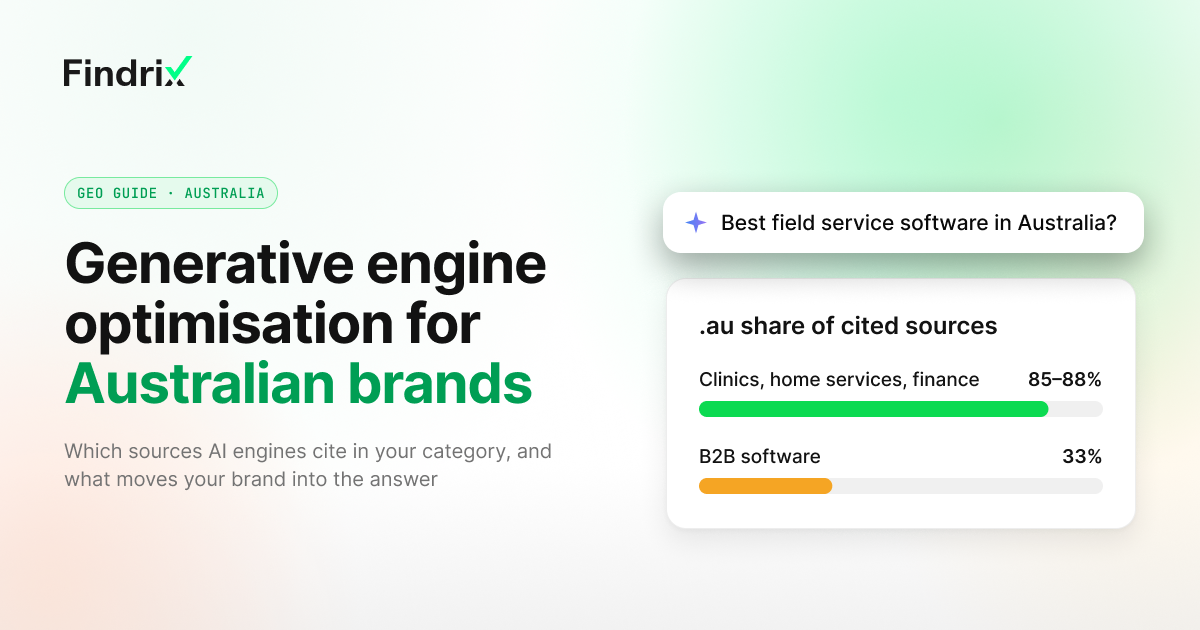
Generative Engine Optimisation: The Australian Guide to Getting Found in AI Search
An Australian prompt doesn't guarantee Australian sources. This guide uses our own AI search data to show what ChatGPT, Gemini and Perplexity actually cite, and what Australian businesses can do to get named in the answer.
AI Share of Voice: How to Measure and Interpret It
AI Share of Voice compares your brand's mentions to competitors' in AI answers – but tools calculate it differently. See Findrix's method and formula.