

 Deutsch
 Français
 Español
 Português (Brasil)
 Italiano
Generative Engine Optimisation: The Australian Guide to Getting Found in AI Search
 Yosif Merman15 min readOctober 20, 2026
TL;DR
- Generative engine optimisation (GEO) is about how often and how accurately AI engines such as ChatGPT, Gemini, Perplexity and Google AI Overviews name your brand. Being cited as a source and being named in the answer are separate outcomes and need to be measured separately.
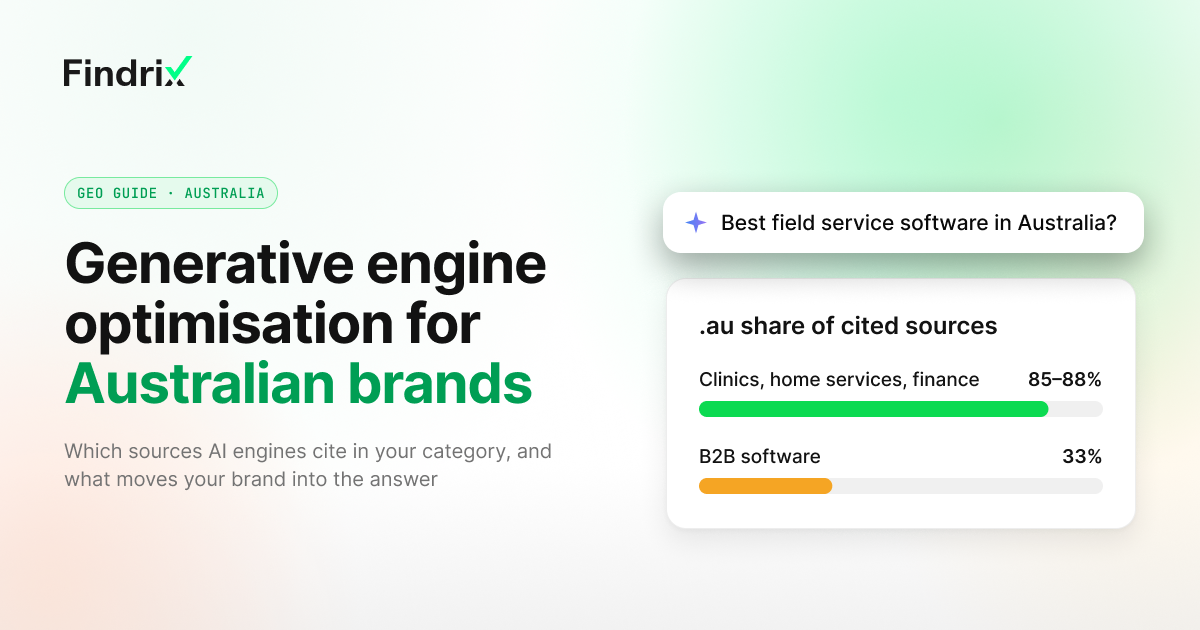
- An Australian prompt does not guarantee Australian sources. In our data, .au domains made up 85–88% of cited sources for clinics, home services and finance, but 33% for B2B software.
- Each engine relies on its own sources. In Australian field service software, nine of ChatGPT’s ten most-cited domains were vendor websites, while Perplexity’s top ten also included Capterra and G2.
- Visibility improves when your positioning is explicit, your content answers the questions buyers ask AI, you publish original evidence, you are present on the sites your target engines cite, and your pages can be crawled and accessed.
- Measure on a fixed prompt set, report each engine separately, and repeat the same measurement after each change to see what the work achieved.
Key takeaways
- GEO measures how often and how accurately AI engines such as ChatGPT, Gemini, Perplexity and Google AI Overviews name your brand. Being cited as a source and being named in the answer are separate outcomes.
- An Australian prompt does not guarantee Australian sources: .au domains made up 85–88% of cited sources for clinics, home services and finance, but 33% for B2B software.
- Each engine has its own source mix. In Australian field service software, nine of ChatGPT's ten most-cited domains were vendor websites, while Perplexity's top ten included Capterra and G2.
- Visibility improves with explicit positioning, content that answers buyers' real questions, original evidence, presence on the sites your engines cite, and pages that can be crawled.
- Measure on a fixed prompt set, report each engine separately, and repeat the same measurement after every change.
Generative engine optimisation (GEO) is the process of improving how often and how accurately your brand appears in answers generated by AI search engines such as ChatGPT, Gemini, Perplexity and Google AI Overviews.
For Australian businesses, there’s an extra complication: an Australian query doesn’t necessarily produce an Australian source ecosystem.
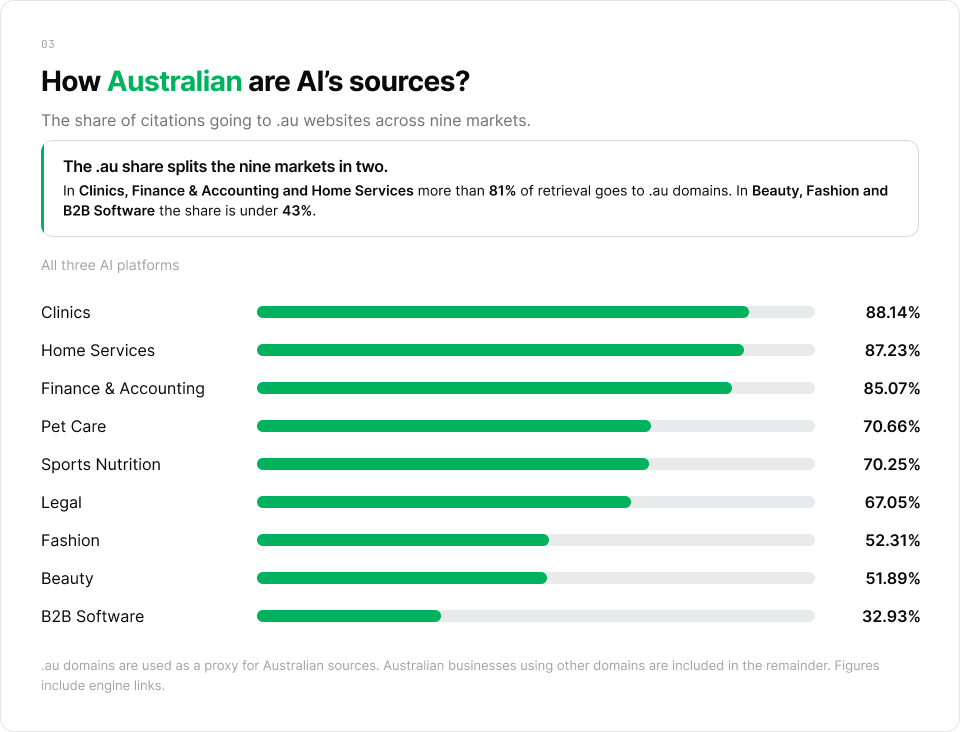
Our Australian-locale data shows how wide that gap can be. In our Australian AI Source Index, .au domains made up 85–88% of the sources ChatGPT, Google AI Mode and AI Overviews cited in clinics, home services and finance, but 33% in B2B software. A separate category-level view of ChatGPT, which counts every cited URL, shows wider extremes: 97.2% .au for conveyancing questions and 22.8% for activewear. Australian GEO starts with understanding the sources that shape answers in your category and engine.
That means GEO in Australia isn’t simply a matter of adding Australian keywords to your pages. You need to know which sources AI engines actually rely on in your category, which brands they already associate with it, and where your own website can realistically influence the answer.
In this guide, we’ll use our own Australian AI search data alongside practical examples to explain how generative engine optimisation works, what affects visibility, and what Australian businesses can actually do to improve it.
What is generative engine optimisation?
Generative engine optimisation is the practice of improving a brand’s visibility in AI-generated answers.
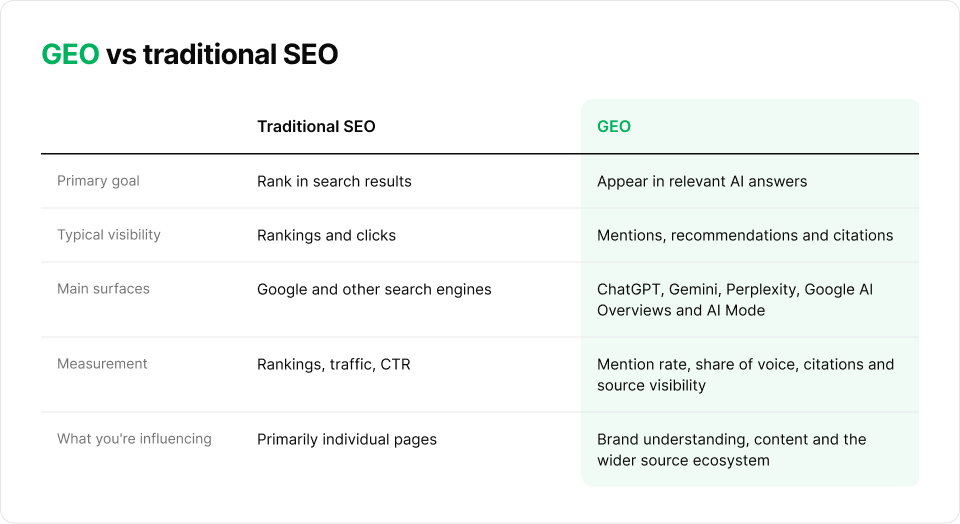
Traditional SEO asks questions such as:
- Does our page rank for the query?
- How much organic traffic does it receive?
- What is its click-through rate?
GEO adds a different set of questions:
- Does ChatGPT mention our brand when a buyer asks for recommendations?
- Does Gemini associate us with the right product category?
- How often do we appear compared with competitors?
- Which websites does Perplexity cite when answering questions about our market?
- Is our own website being used as a source?
- When an AI engine does mention us, does it describe us accurately?
The distinction matters because ranking first in Google and appearing in an AI-generated answer are not the same outcome.
A buyer searching Google for a field service management platform might see ten blue links and decide which ones to investigate. Often they also go to the second page of results, rephrase the query and try several variations of the same search. Ask an AI engine the same question and it can do much of that filtering itself, returning a shortlist of products and explaining the differences between them. That answer is also highly personalised. The question itself looks different, usually a full sentence with context rather than a few keywords, and the engine can draw on the person's earlier conversations. A marketing manager and a CMO asking about the same category can get different answers, and a logistics manager can get a completely different one.
Your website is no longer competing only for a ranking. Your brand is competing to become part of the answer.
GEO does not replace SEO
AI systems still need information they can discover, understand and retrieve, so many fundamentals overlap. Clear site architecture, accessible pages, strong content and authority still matter.
What changes is the final objective and, therefore, what you need to measure. GEO covers how brands are mentioned, recommended and cited in answers written by generative AI. In practice the techniques overlap, and the main difference is what you measure.
How does GEO actually work?
When someone asks an AI engine a question, it can build the answer in two ways.
The first is to answer from what the model already knows. A large language model learns from a huge body of text during training, and that knowledge is stored in the model itself. This is called parametric knowledge. It reflects the web as it was up to the training cut-off, and it does not come with sources you can see.
The second is to search the web before answering. This approach is known as retrieval-augmented generation (RAG), and it is how ChatGPT search, Perplexity, Gemini and Google AI Overviews produce answers with cited sources. Many answers combine the two: the model's own knowledge shapes which brands it considers, and retrieved pages add current details and citations.
Suppose someone in Australia asks: “What is the best field service management software for a plumbing company?” With web search switched on, the answer is built in several steps.
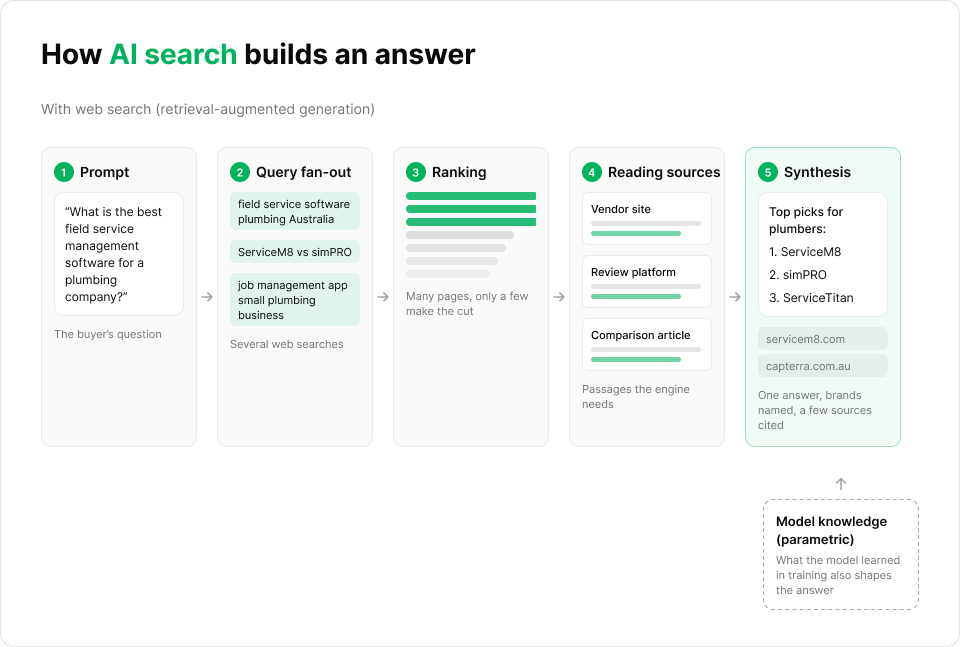
Your brand can drop out at any of these steps. Your pages may not rank for the fan-out queries; they may rank but not be read; or they may be read and used without your company being named. The reverse also happens: the model can name your brand from its own knowledge or from a third-party review, even when your domain is not among the cited sources.
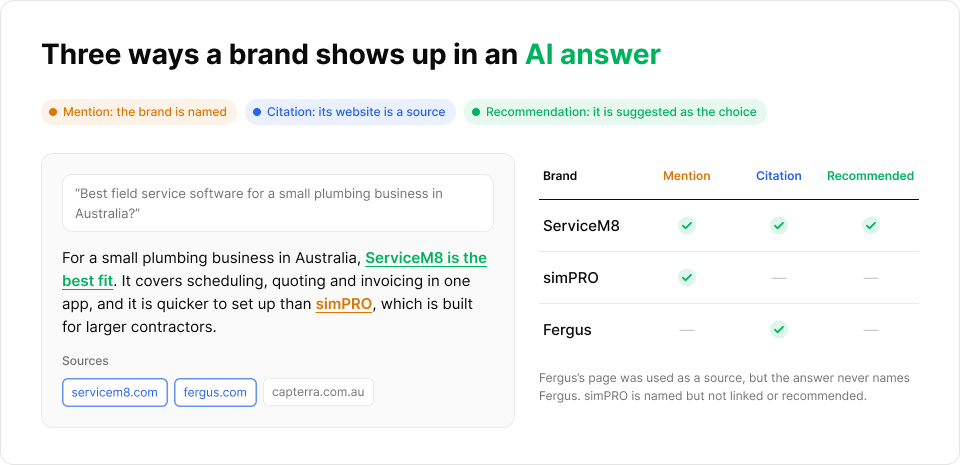
Here is how that can play out for one brand:
- A buyer asks ChatGPT for the best field service software for a small plumbing business in Australia.
- ChatGPT searches the web, and one of the pages it reads is your pricing page. It uses that page to explain what this kind of software usually costs.
- The final answer may name you. Or it may recommend ServiceM8 and simPRO and leave you out, even though your page helped shape the answer.
That creates two separate GEO questions:
- Are AI engines finding and using information about you?
- Is that information actually translating into brand visibility?
This is why counting citations alone gives an incomplete picture of GEO performance.
Different engines can build different answers
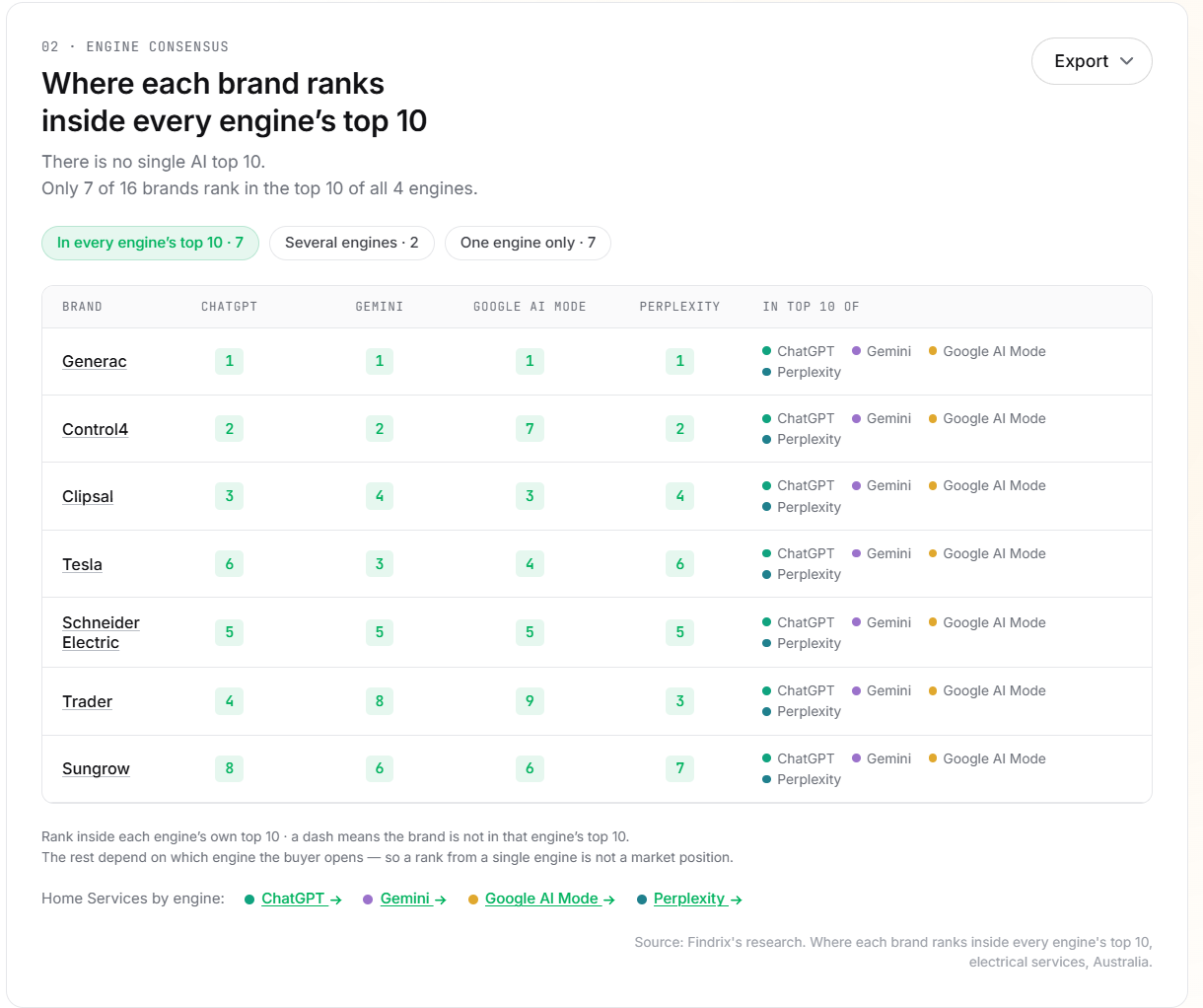
There is another complication: there is no universal AI search result.
ChatGPT, Gemini and Perplexity do not necessarily rely on the same sources for the same question. They can also produce different competitive sets.
A company can therefore have strong visibility in one engine and almost none in another.
For GEO measurement, that distinction is critical. Combining every engine into one visibility score can hide exactly where a brand is strong or weak.
Why knowing your source mix matters
So far, this guide has looked at how AI engines build answers in general. For an Australian business, the practical question is which websites those answers draw on. It is tempting to assume that an Australian buyer gets an answer built from Australian sources, so a strong local site and local directories would be enough. We checked that assumption against our own data.
We used two Findrix datasets. The Australian AI Source Index covers 23,396 prompts across ChatGPT, Google AI Mode and Google AI Overviews in nine Australian markets, counting each domain once per question. Our September 2026 golden set adds fixed sets of Australian buyer prompts for each category, each asked three times in several engines, including ChatGPT (gpt-5.5) and Perplexity (sonar-pro); for field service software, that was 400 prompts per engine. These are exploratory observations, not a representative survey of Australian searches. Our methodology page explains how we collect and score AI answers.
The share of .au sources depends on the category. Every prompt set was written for Australian buyers, yet .au domains made up most of the cited sources for clinics, home services and conveyancing, and a minority for B2B software and activewear. These figures measure domain suffixes, not publisher nationality.
The sources also change with the engine. In Australian field service software, nine of ChatGPT’s ten most-cited domains were vendors’ own websites, led by servicem8.com, simprogroup.com and servicetitan.com, with no G2 or Capterra. In Perplexity, Capterra ranked fifth and G2 sixth by number of cited URLs.
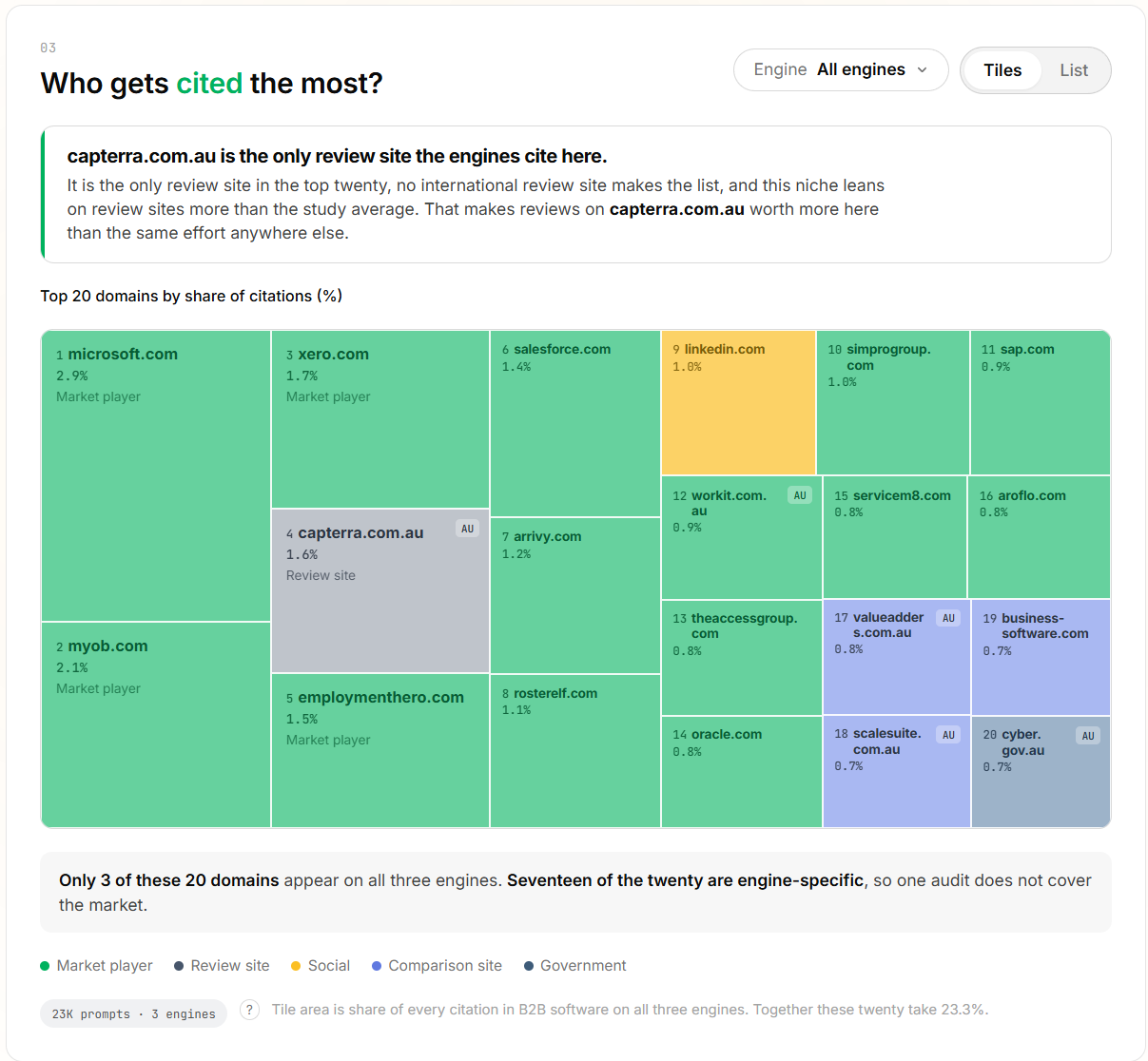
Zoom out to Australian B2B software as a whole and the split holds. Of the 20 domains cited most often across ChatGPT, Google AI Mode and Google AI Overviews, only 3 appear in all three engines. Capterra.com.au is the only review site on the list, and no international review site makes it.
So adding “Australia” to a page title is not a local GEO strategy. The useful questions are much more specific:
- Which domains actually influence AI answers in this Australian category?
- How many of them are Australian?
- Which international sources repeatedly appear?
- Does the source mix change by engine?
- Which competitors are being recommended?
- What information are those sources providing that ours is not?
Findrix runs this analysis on your own prompt set. It ranks the sources feeding AI answers in your market, including those that never mention you, so you can see where a pitch or a profile update would matter. It also flags pages that AI cites as a source without naming your brand.
What actually improves visibility in generative engines?
There is no single GEO ranking factor that determines whether an AI engine mentions a brand.
Instead, several layers influence whether a system can find information about a company, understand what it does, retrieve relevant evidence and ultimately include it in an answer.
1. Make your positioning explicit
An AI system should not need to reconstruct your positioning from five different pages.
If your homepage says you “transform the way modern teams work” but never clearly explains the product category, customer or use case, you are leaving important interpretation work to the model.
Explicit statements are more useful:
“Field service management software for Australian plumbing, electrical and HVAC businesses.”
That sentence establishes the category, audience and market immediately.
This matters beyond homepages. Product pages, comparison pages, documentation and company descriptions should reinforce a consistent understanding of what the brand is and where it belongs.
2. Answer the questions buyers actually ask AI
Traditional keyword research is still useful, but AI search introduces a much wider variety of commercial questions.
Buyers don't only ask: “field service software Australia”
They ask: “What's the best field service software for a plumbing business with 20 technicians?” Or: “Which Australian alternative to ServiceTitan works well for a small HVAC company?” Or: “Compare ServiceM8 and Simpro for a growing electrical contractor.”
These prompts contain constraints, context and comparison intent.
A useful GEO content strategy therefore maps not only keywords but the questions buyers ask while evaluating a category.
Your content then needs to provide information capable of answering those questions.
3. Publish evidence worth retrieving
Generic claims are easy to reproduce and difficult to attribute. “AI search is changing marketing” adds very little information to the web. A proprietary dataset showing how ChatGPT and Perplexity source Australian software recommendations adds something new.
Useful evidence can include original research, benchmarks, customer data, surveys, documented experiments, detailed comparisons, case studies, named primary sources and transparent methodology.
This is useful for human readers for the same reason it is useful in GEO: it gives the page information that other pages do not already contain.
4. Understand the source ecosystem around your category
Your own site is only part of the picture.
If the engines you care about repeatedly retrieve information from review platforms, industry publications or particular comparison sites, those domains become part of your GEO environment.
But our Australian data also shows why a generic recommendation such as “get mentioned on Reddit, G2 and Forbes” is too simplistic. The relevant sources differ by engine and category.
Start with the evidence: identify which domains actually appear around your commercial prompts, then decide where greater presence would matter.
5. Remove technical barriers
None of the above is particularly useful if important content cannot be reliably discovered or accessed.
Technical GEO therefore overlaps substantially with technical SEO.
Pages should be crawlable and indexable, important information should exist in accessible page content, internal linking should make relationships between pages clear, and unnecessary technical barriers should not prevent retrieval.
Technical accessibility is the foundation. It is not, by itself, a complete GEO strategy.
Example: an Australian field service software company
Say your company sells field service management software in Australia, and ChatGPT never names you when someone asks for the best field service management software for Australian electricians. All five principles apply, but the answers themselves tell you where to start.
- See which competitors appear. In our data, ChatGPT named ServiceM8 and simPRO in roughly half of its answers. If you are not named, you are competing for a place on a shortlist that already exists.
- Find the sites ChatGPT relies on. In this category they were mostly vendors’ own websites, so competitors’ product, pricing and comparison pages are what the engine reads about the market.
- Check whether your own pages are cited. If they are cited but your brand is not named, work on how the page describes you (principle 1). If they are not cited at all, start with coverage and access (principles 2 and 5).
- Look for missing use cases and comparisons. If no page of yours answers a question like “field service software for a five-person electrical business” or compares you with simPRO, the engine has nothing of yours to use for those prompts (principles 2 and 3).
- Fix the gaps and measure again on the same prompts and engines, so any change in visibility can be traced to the work.
Run the same prompts in Perplexity and step 2 changes: Capterra and G2 sit in its top ten, so your profiles on those platforms become part of the work (principle 4).
Finding: ChatGPT cites your pricing page for “field service software for a small plumbing business” but never names your brand. Fix: open the page with one plain sentence on what you sell and who it is for, such as “Field service management software for Australian plumbing, electrical and HVAC businesses.”
Findrix writes these fixes out in full rather than as general advice: the sentence to change on a product page, the content to add, the technical issue to correct or the third-party site to pitch. It only proposes changes and never edits your site, so your team reviews and applies each one.
How do you measure GEO performance?
You cannot improve GEO reliably if the measurement changes every time you run it.
AI responses are probabilistic. Wording can change between runs, and different engines behave differently. A useful measurement system therefore needs a stable set of prompts and separate reporting for each engine.
Mention rate
How often does your brand appear across the relevant prompt set?
With one valid response per prompt, a brand appearing for 18 of 100 prompts has an 18% mention rate. In this golden set, repeated responses are handled by calculating the fraction mentioning the brand within each surviving prompt, then averaging those fractions across prompts. It is not a pooled percentage of all responses.
Share of voice
How much of the competitive visibility across those prompts belongs to your brand compared with alternatives?
Define the denominator before comparing share of voice. In this golden set, each prompt with k detected brands allocates 1/k to each; the result is averaged over prompts containing at least one detected brand. It describes the tracked brand set, not the whole market.
Citation rate
What proportion of valid answers cite your website? This requires answer-level records. The golden-set export instead reports citation counts and shares of cited URL occurrences, which cannot be treated as an answer-level citation rate or as proof of uncited retrieval.
This needs to be kept separate from mention rate. A cited website and a named brand are not the same thing.
Source visibility
Which external domains repeatedly influence the answers in your category?
This is where source analysis becomes actionable. A source appearing once is less interesting than one repeatedly shaping responses across high-intent prompts.
Performance by engine
Finally, keep ChatGPT, Gemini, Perplexity and other engines separate.
A blended “AI visibility” number can look reassuring while hiding a major gap. If your brand appears frequently in ChatGPT but rarely in Gemini, that difference is itself useful information.
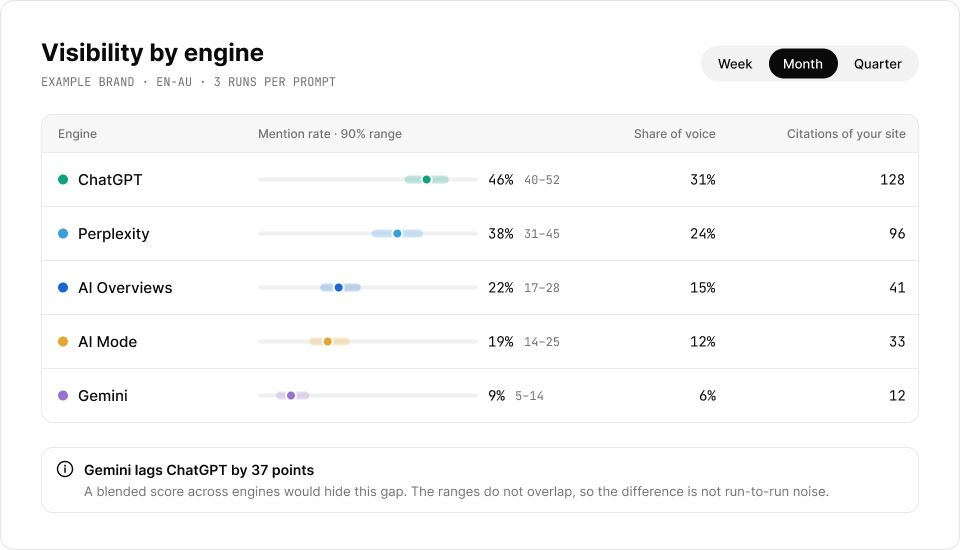
Findrix tracks the same prompt set in ChatGPT, Gemini, Perplexity, Google AI Overviews and Google AI Mode, reports each engine separately and shows visibility metrics with confidence ranges, so you can tell a real change from normal variation between runs.
How to build a GEO strategy for an Australian business
You don't need to optimise your entire website before you can learn something useful.
Start with measurement.
Identify the questions your buyers actually ask
Build a set of commercial prompts covering discovery, comparisons, alternatives, use cases and buying constraints.
Keep the prompt set stable
If the questions change every week, you cannot tell whether visibility changed because of your work or because you changed the test.
Run the prompts across the AI engines that matter
Measure ChatGPT, Gemini, Perplexity and other relevant engines independently rather than assuming they behave alike.
Record brands and sources
Which competitors appear? How frequently? Which domains are cited? Is your website being used even when your brand isn't mentioned?
Find the gaps
You might discover that AI engines misunderstand your positioning, competitors have stronger comparison content, your site lacks evidence around an important buying question, or a third-party source repeatedly influencing the category barely mentions you.
Make targeted changes
Fix the gaps you can actually connect to observed behaviour rather than working through a generic list of “GEO best practices”.
Run the same measurement again
GEO becomes useful when you can compare visibility before and after the work.
Doing this manually is possible. It becomes difficult to reproduce once you're tracking dozens of prompts across several engines and trying to separate changes from normal response variation.
Findrix is an action-based AI visibility and GEO platform that turns ongoing tracking and analysis of a brand's presence across AI answers and search into fast optimization, built for brand managers, marketing leaders, and agencies running AI search for their clients.
Frequently asked questions
What does GEO stand for in marketing?
GEO stands for generative engine optimisation. It describes the practice of improving how a brand, product or website appears in answers generated by AI systems such as ChatGPT, Gemini and Perplexity.
What is generative engine optimisation?
Generative engine optimisation is the process of increasing and improving a brand's presence in AI-generated answers. This includes whether the brand is mentioned, how it is described, how frequently it appears compared with competitors and whether its website is used as a source.
Is GEO different from SEO?
Yes, although they overlap. SEO primarily focuses on visibility in traditional search results and the organic traffic generated from them. GEO focuses on visibility inside generative answers, where an AI system can select, compare and describe brands before the user ever visits a website. Many SEO fundamentals still support GEO, including crawlability, clear content and authority.
What's the difference between GEO and AEO?
Answer engine optimisation (AEO) focuses on making information suitable for direct answers. Generative engine optimisation has a broader focus on how brands and information appear within answers produced by generative AI systems. In practice, many of the techniques overlap.
Does GEO work differently for Australian businesses?
The underlying principles are the same, but the competitive and source environment can differ. Our Australian-locale research shows a substantial contrast in .au citation share across categories, alongside different source rankings for ChatGPT and Perplexity in field service software. Australian GEO therefore needs category-specific and engine-specific measurement. Australian businesses therefore need to measure the source and competitive landscape of their own category rather than assuming a generic global GEO strategy will represent their market accurately.
How do you measure visibility in ChatGPT and other AI engines?
Start with a stable set of relevant buyer prompts and track each engine separately. Useful metrics include brand mention rate, share of voice, citation rate and the domains most frequently used as sources. Repeating the same measurement over time makes it possible to identify whether visibility changed after optimisation work.
How long does generative engine optimisation take?
There is no universal GEO timeline. Different AI systems discover, retrieve and refresh information differently, and responses themselves vary between runs. The time required also depends on the problem being addressed: clarifying information on an existing page is fundamentally different from building authority around a category where a brand currently has little presence. For that reason, GEO should be measured as a repeated before-and-after process rather than against a fixed promise such as “rank in ChatGPT within 30 days.”
Read next
Findrix vs Semrush: Category-Wide AI Data or a Controlled GEO Workflow?
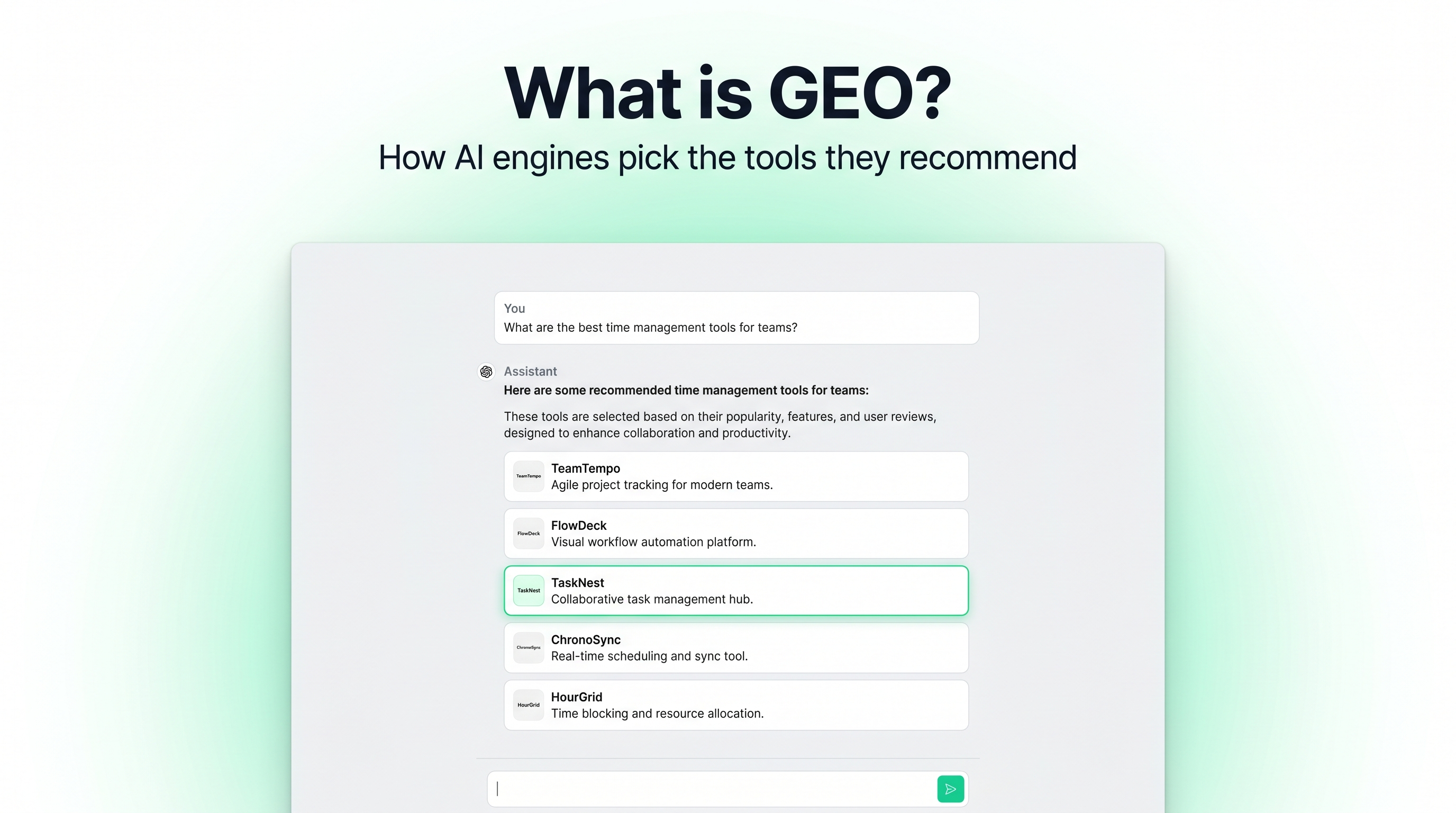
What is GEO? Generative Engine Optimization Explained (And How It Differs From SEO + AEO)
GEO is how brands get cited inside ChatGPT, Perplexity, and Gemini answers. Definitive guide to Generative Engine Optimization, GEO vs SEO vs AEO, and how to start.