

 Deutsch
 Français
 Español
 Português (Brasil)
 Italiano
Findrix vs Semrush: Category-Wide AI Data or a Controlled GEO Workflow?
 Evgeniya Zemlyanskaya13 min readSeptember 1, 2026
TL;DR
Choose Semrush for broad discovery inside an established SEO stack. Choose Findrix for a market-specific baseline, visible answer variation and a controlled path from gap to fix and remeasurement. Both plans start at $99 a month, but they're built for different jobs.
Disclosure: I'm the Product Marketing Lead at Findrix, so this is not an independent review. We could not test Semrush's paid AI Visibility Toolkit because it does not offer a free trial. Semrush product, methodology, and pricing information was last checked on August 31, 2026.
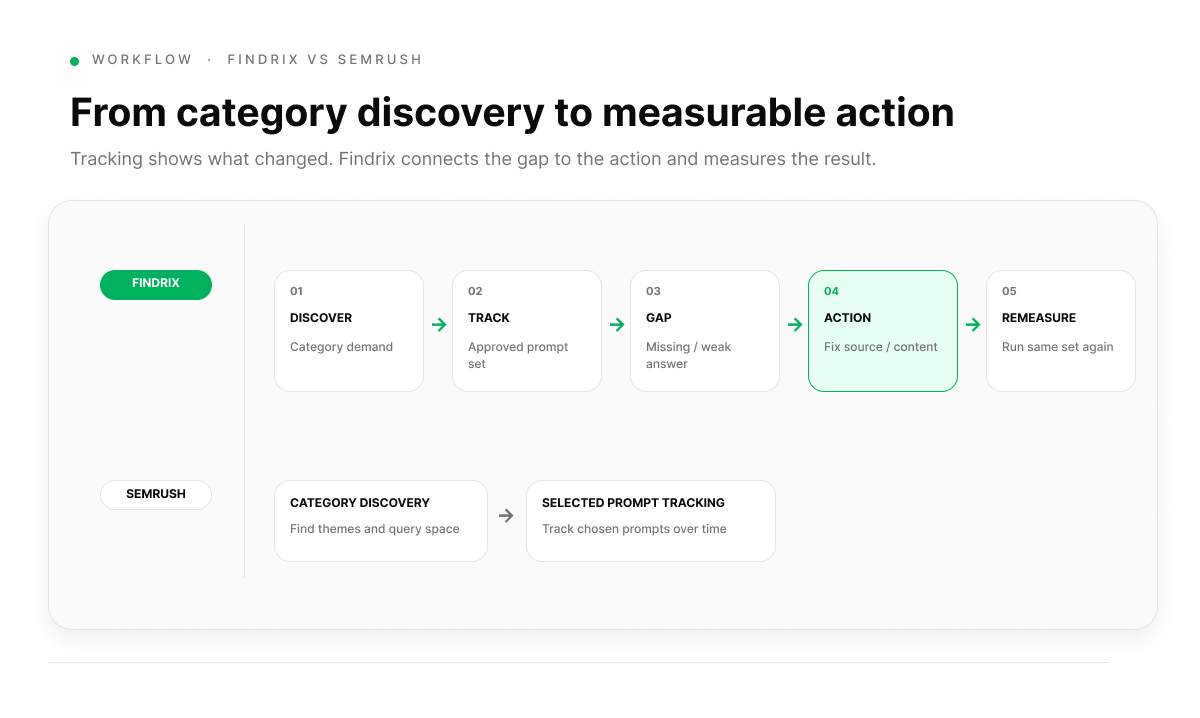
Semrush starts with a 317M+ prompt-and-response database for category discovery. When a team wants to define its own measurement set, it moves into a separate Prompt Tracking module, with 25 custom prompts on the $99 Base plan.
Findrix starts with the controlled set itself. The team reviews the prompts and competitors that count, then uses that boundary to identify recurring brands, owned pages and external sources and turn the resulting gaps into recorded, measurable work.
Findrix is an action-based AI visibility and GEO platform that turns ongoing tracking and analysis of a brand's presence across AI answers and search into a shorter, structured path from an AI visibility gap to an implemented fix, and measures what changed afterward. It is built for brand managers, marketing leaders, and agencies running AI search for their clients.
Choose Findrix or Semrush?
Choose Findrix if:
- You need to define and approve the prompts and competitors that represent your actual market.
- You need more than 25 custom prompts without moving above $99 per month.
- You want to see which brands, owned pages and external sources recur inside that controlled set.
- You need repeated measurement that reduces answer noise and shows the observed range before treating a change as progress.
- You want a structured path from a measured gap to a ready-to-apply fix, a work record and remeasurement.
Choose Semrush if:
- You need to explore prompts, topics, competitors and demand across a broad category before deciding what to track.
- You already run SEO and content workflows in Semrush.
- You need regional AI-search data and the connection between AI visibility and traditional search.
- Daily tracking matters more than seeing an observed range around supported metrics.
- A mature, integrated SEO and reporting stack is more valuable than a GEO-specific operational workflow.
How we compared the platforms
We reconstructed Semrush's paid workflow from its public documentation, pricing, methodology pages and free reports. Where behavior or measurement conditions are not documented, we do not infer them.
Findrix product details come from the current product and documented methodology. We do not treat planned features as available features.
Findrix vs Semrush at a glance
| Semrush AI Visibility Toolkit | Findrix | |
|---|---|---|
| Starting point | Category-wide AI-search database | Reviewed, market-specific prompt set |
| Main job | Discover demand, topics, competitors and opportunities | Measure and operate a defined GEO program |
| Starting price | $99/month per domain, billed annually | From $49/month per site, no annual lock-in |
| Custom prompts at $99/month | 25 | 100 |
| Tracking cadence | Daily | Weekly |
| Measurement surfaces | Prompt Tracking: ChatGPT Search, Google AI Mode, Google AI Overviews and Gemini. Perplexity is available in Brand Performance. | Presence: ChatGPT, Google AI Overviews and Perplexity. Growth adds Gemini and Google AI Mode. Claude and Grok are add-ons. |
| Variation | Historical and directional trends | Repeated runs and observed ranges on supported metrics |
| After a gap is found | Strategic Opportunities → Prompt Tracking, Site Audit or another Semrush toolkit | Keep the gap, fix, work record and remeasurement connected |
| Broader stack cost | Semrush One: $199–$549/month on monthly billing | No additional stack required for the core GEO workflow |
| Free trial | No | 7 days |
Plans, limits and product coverage can change. Check the current Semrush AI Visibility Toolkit and Findrix pricing pages before purchasing.
Semrush's 317M+ database is not the same product as its custom prompt tracker
The largest number in Semrush's offer describes its discovery layer. Semrush says its prompt database contains more than 317 million prompts and responses across ChatGPT, Gemini, Google AI Overviews and Google AI Mode. Teams use it to explore topics, compare brands, inspect cited sources and estimate demand before deciding what to track.
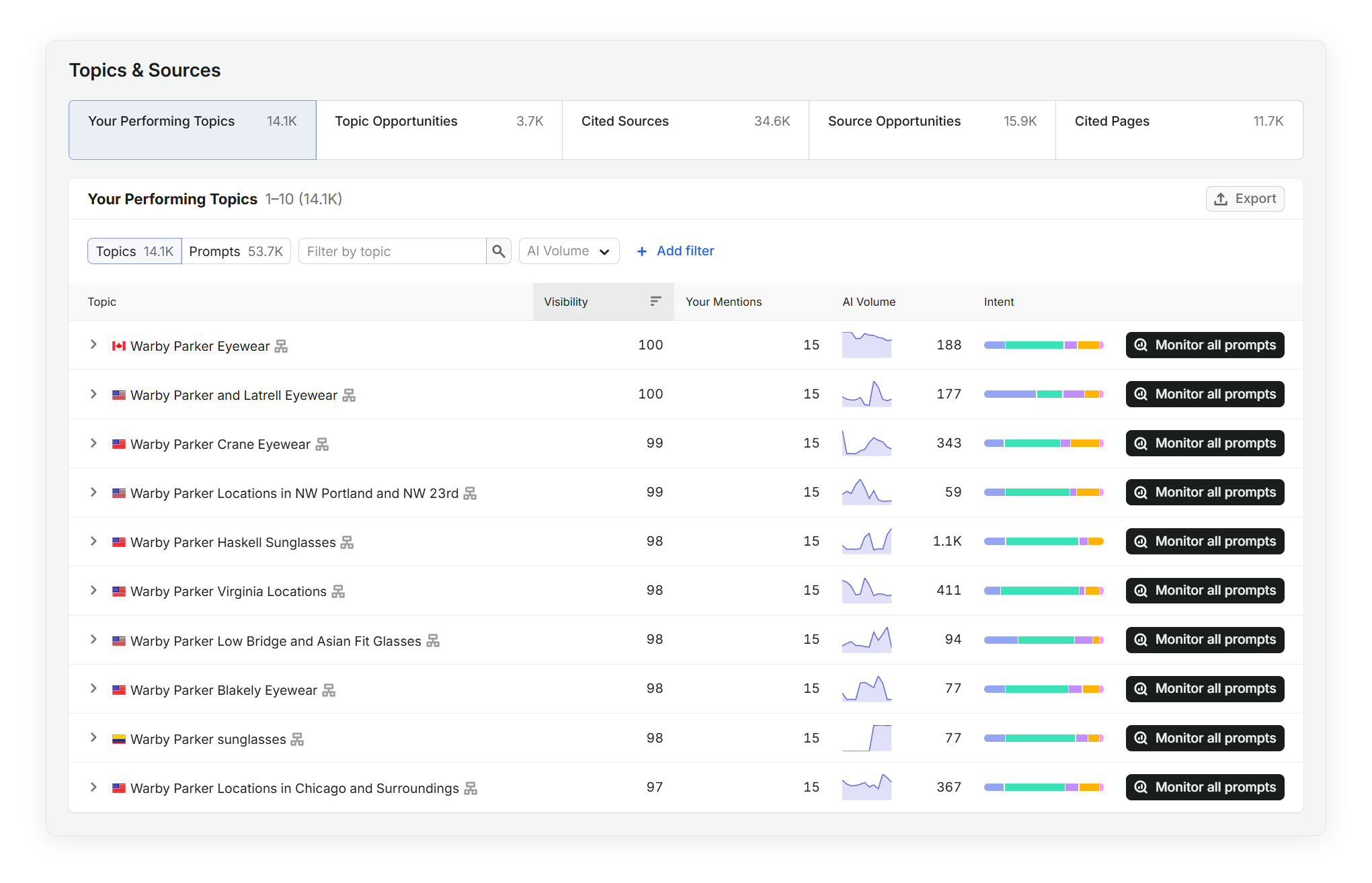
The free Warby Parker example shows the upside. Captured on Aug 30, 2026, the snapshot surfaces the following:
- 53.7Kprompts captured
- 14.1Kperforming topics
- 3.7Ktopic opportunities
- 34.6Kcited sources
- 15.9Ksource opportunities
- 11.7Kcited pages
Each topic includes a "Monitor all prompts" action that routes discovered demand into tracking.
With Semrush, category coverage is an input the buyer inherits. It may map closely to the market, as in the Warby Parker example, or miss the buying questions and competitive set that matter to a narrow B2B product. Buyers only discover which case they are in after inspecting the database.
Findrix starts from the opposite premise: the measurement set is built and approved around the market the team intends to track. Discovery asks what may exist across a category; custom measurement asks how a predefined set of commercially important prompts changes over time under a stable setup.
In our customer-discovery interviews, B2B SaaS respondents said Semrush's broad data did not always map closely enough to the products, buyers and competitive sets they needed to analyze. This qualitative evidence is not a representative benchmark, but it illustrates the coverage risk for narrow categories.
When buyers want to choose their own stable set, they move into Prompt Tracking. The standalone $99 toolkit includes 25 tracked prompts; another 50 cost $60 per month. Findrix makes the approved set the foundation of the product: Growth measures 100 prompts across five AI surfaces, with competitors, sources, factual discrepancies, recommendations and remeasurement connected to that same boundary.
How does each platform decide what belongs in your market?
Semrush starts with a pre-existing market database. It identifies related topics, prompts, brands and sources at category scale. This is useful when the team does not yet know the boundaries of the opportunity.
But semantic proximity is not always commercial competition. In one free Semrush check we ran, the platform on which a product operated was initially selected as the product's main competitor. The user could replace it, so this was not a permanent limitation. It did show why an automatically inferred category can differ from the market a team actually sells into.
Findrix creates a market-specific starting set around the brand's buyers, use cases, decision criteria, buying stages and geography. The team can review and edit both prompts and competitors before the set becomes the measurement baseline.
Findrix also filters near-duplicate prompts before the set becomes the baseline. Different phrasings of the same underlying question do not count as separate coverage simply because the wording changes. The 100 prompts on Growth are designed to represent distinct measurement points, not a smaller set padded with near-identical variations.
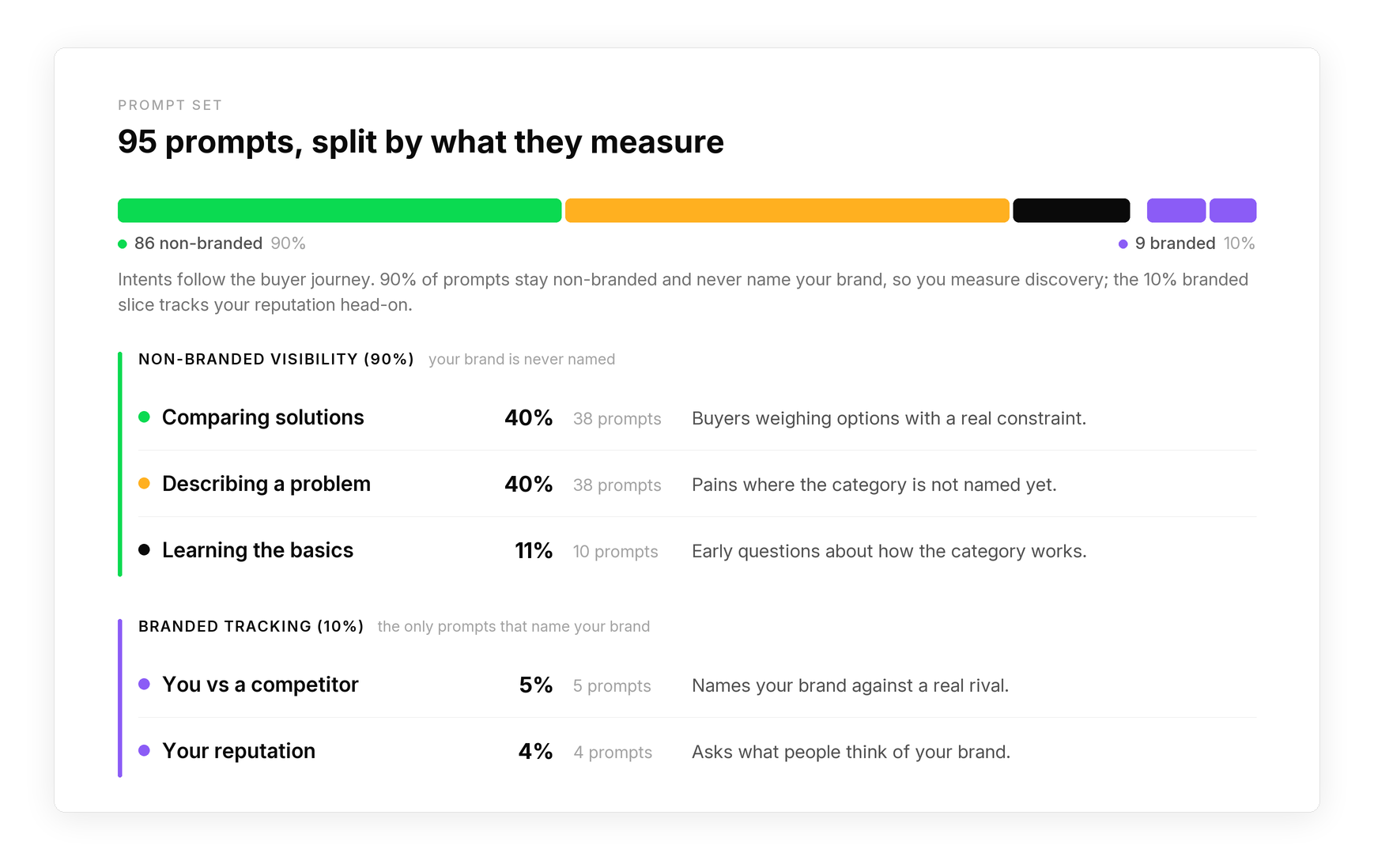
An example Findrix prompt set breaks down like this:
- 86non-branded prompts measuring discovery across the buyer journey
- 9branded prompts tracking competitor comparisons and reputation
That review matters for narrow or overlapping categories, multiple buyer segments, platform partners that are not competitors, legacy competitors and regional markets that a single global category cannot represent.
Semrush is stronger at showing what may exist around the category. Findrix is designed to establish which part of that landscape should count in the team's measurement program.
Want to test this on your own market? Run a free Findrix audit to see where your brand appears, which competitors show up instead and which gaps deserve attention first.
A controlled set reveals the network inside the answers
Mention rate answers one question: how often did the brand appear? It does not explain why the answer looked that way or where the team can intervene.
Findrix uses the approved prompt set to connect four layers of the answer environment. Across one approved B2B prompt set, Findrix separated tracked competitors from brands discovered in the answers, identified owned pages that were not being cited, and connected recurring external sources to the prompts where competitors appeared.
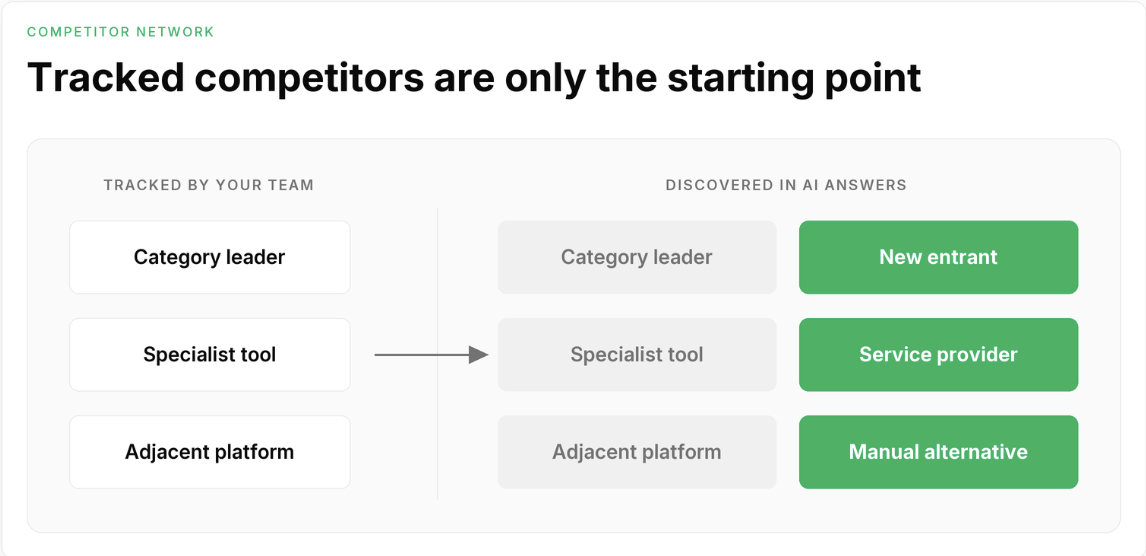
The competitor network
Findrix distinguishes between competitors the team chose to track and competitors discovered in the measured answers. This shows not only whether the brand lost visibility, but who appeared instead, on which prompts and around which buyer criteria.
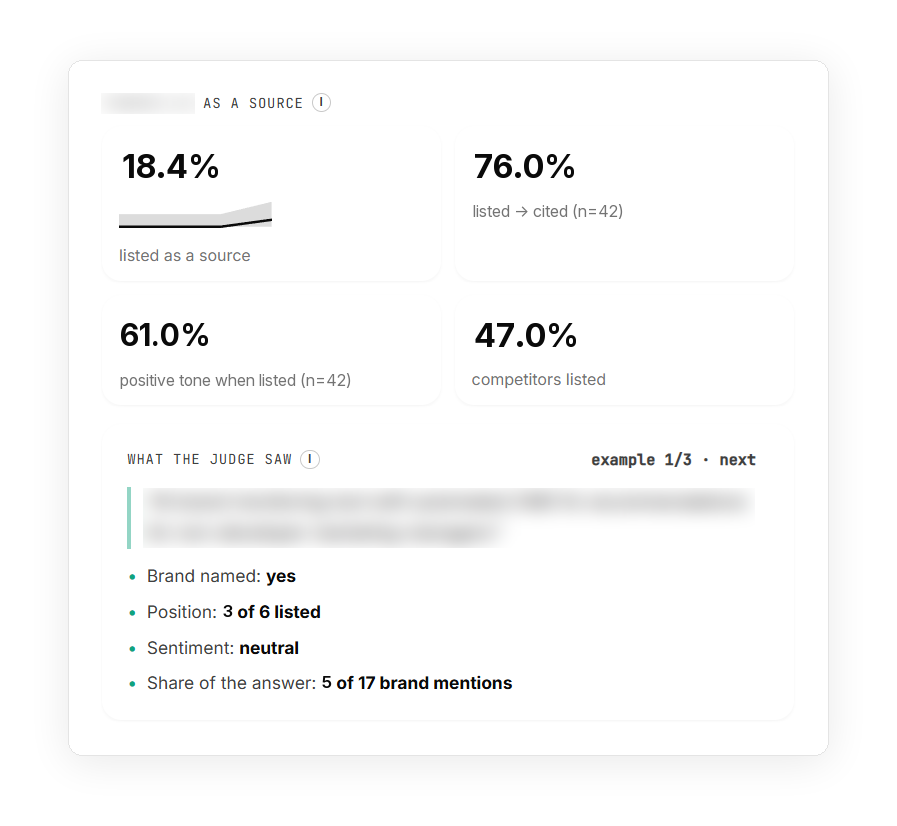
Owned-source participation
The platform shows which pages on the customer's own site are cited and where the brand appears without its site participating in the answer. That creates two different problems:
- the brand is absent because its own content does not answer the relevant question;
- the brand is present, but the answers cite third-party pages rather than the brand's own site.
Those cases require different work. A single visibility score hides the distinction.
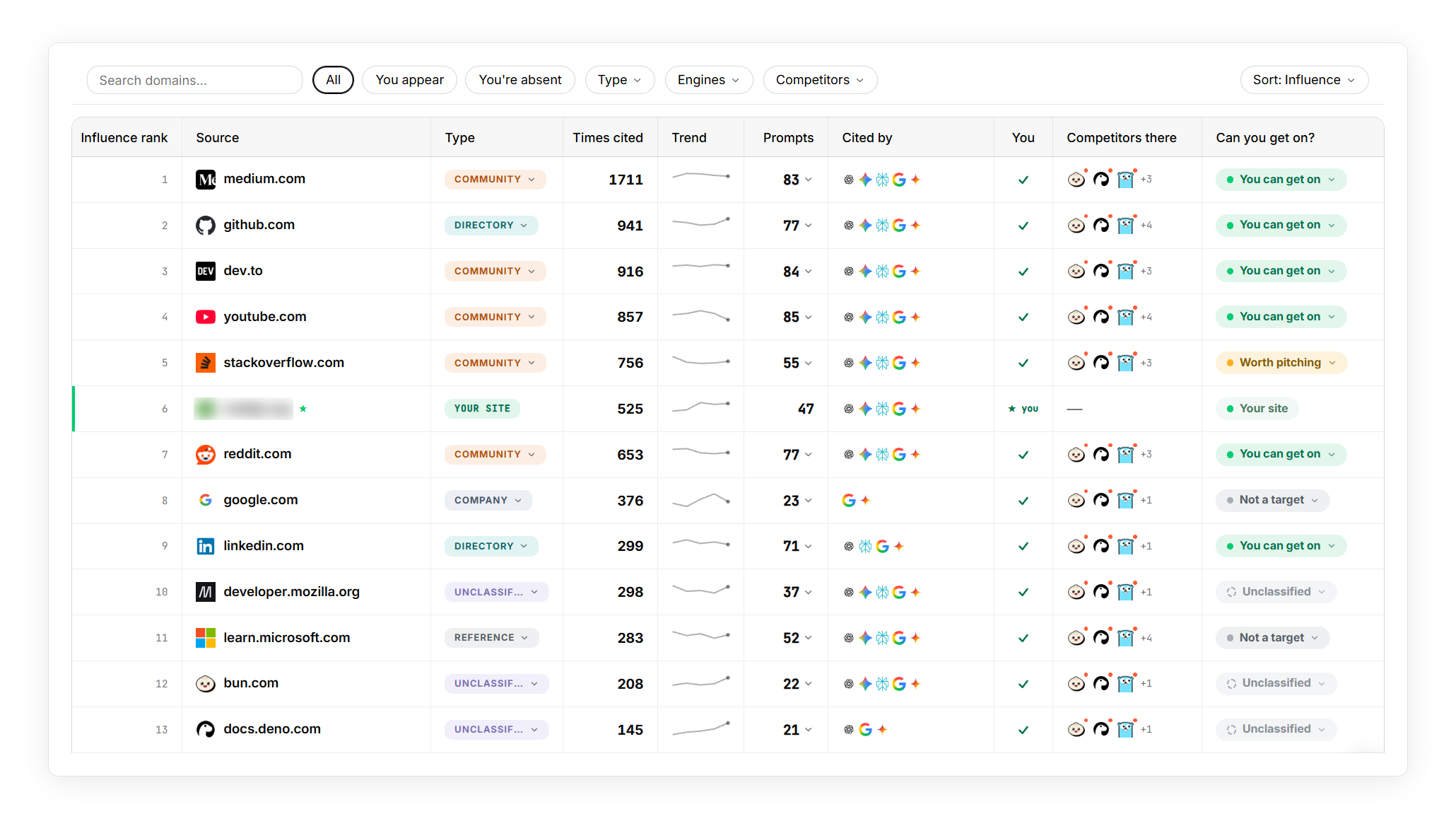
The external-source landscape
Findrix identifies the domains and individual pages that recur across the measured answers. The team can see which sources appear around competitor recommendations, which already mention the customer and where relevant coverage is missing. This does not prove that a particular page caused a model to recommend a brand. Citation and recurrence are observable; model causality is not. The operational value comes from connecting the source to the prompts, competitors and engines where it appears.
Facts and preference
Findrix also examines what AI systems say about the brand and how they explain their recommendations. The team can identify outdated claims, factual discrepancies and buying criteria on which a competitor is preferred.
Semrush also shows sources — the difference is what happens around them
The Visibility Overview report includes cited domains, individual cited pages, full responses, topic opportunities and source opportunities. It can show prompts where competitors appear but the analyzed brand does not. Users can inspect the full answer and the sources attached to it.
Semrush also provides direct transitions between parts of the workflow. A marketer can discover a prompt, send it to Prompt Tracking, use content tools and return to daily monitoring. Semrush's broader SEO, content, site-audit and reporting stack is a material advantage for teams already working there.
Both products provide source context. Semrush discovers opportunities across several reports and routes them into a wider marketing stack. Findrix keeps the prompt, competitor, owned page, external source, detected gap and subsequent work tied to the same controlled measurement boundary.
A source becomes actionable when it recurs across relevant prompts, appears around a competitor, connects to an important buying criterion or behaves differently across AI surfaces.
Can you tell whether the result changed — or the answers merely varied?
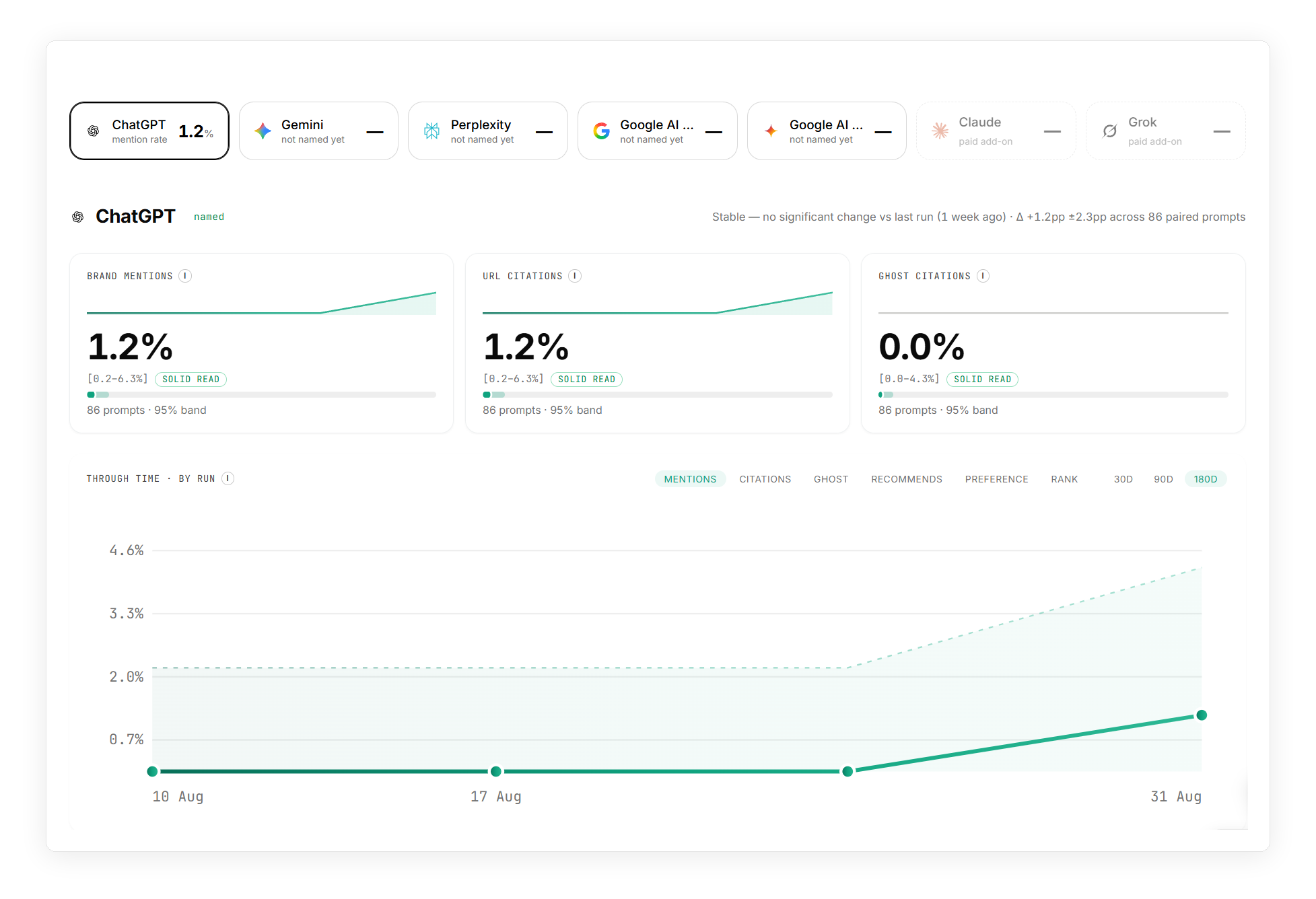
AI-answer volatility is the noise an AI visibility platform must control. Its job is to collect enough observations under a stable measurement setup to reduce that noise to an acceptable level, then show the uncertainty that remains. Otherwise, a change in one answer can be mistaken for meaningful progress.
Semrush provides daily tracking, historical comparisons and trend reporting. That makes it well suited to directional monitoring and detecting a sudden drop. However, in the public methodology we reviewed, we did not find an explanation of how Prompt Tracking reduces or quantifies answer volatility: there is no documented repeat count per prompt, no observed range around the metrics and no published account of how one-off answer changes are prevented from moving the reported score.
One B2B SaaS respondent switched AI visibility platforms and received results so different that the team questioned which number it could trust. That does not prove either tool wrong: different prompt sets, AI surfaces, locations, run counts and aggregation rules can produce different numbers. It shows why buyers need to know how a product controls answer noise before treating its score as evidence.
Findrix reduces noise by repeating prompts, keeping the approved set stable and measuring each AI surface separately. Repetition limits the effect of one-off answers; observed ranges on supported metrics show the uncertainty that remains. The goal is to distinguish persistent movement from ordinary answer variation, not to pretend variation can be eliminated.
Suppose mention rate moves from 31% to 33%. A conventional trend line makes the second number look better. But if normal variation across the underlying answers is wider than two percentage points, the team does not yet have evidence of meaningful movement.
The range does not prove that a particular action caused a change. It answers a narrower and necessary question: was the observed movement larger than the variation in the answers being measured?
What happens after a gap is found?
Semrush identifies strategic opportunities, source gaps, missing prompts and content opportunities, then routes them into Prompt Tracking, Content Toolkit, Site Audit and the wider Semrush environment. That is a strong fit when AI visibility is part of a broader SEO and content operation.
Findrix keeps the work inside a narrower GEO loop: measure → improve → remeasure. The type of gap determines the next action:
| Gap found in the answers | Work that follows |
|---|---|
| A relevant owned page is not participating | On-site content or technical fix |
| An external source repeatedly supports a competitor | Off-site placement or source work |
| AI repeats an incorrect or outdated claim | Fact correction |
| A competitor wins on a buying criterion | Positioning or content change |
| Results differ materially by AI surface | Engine-specific prioritization |
Findrix Actions provides ready-to-apply text, markup or page-level recommendations, together with the reason for the change and guidance for applying it. The customer reviews and implements the work; Findrix does not automatically publish changes to the site.
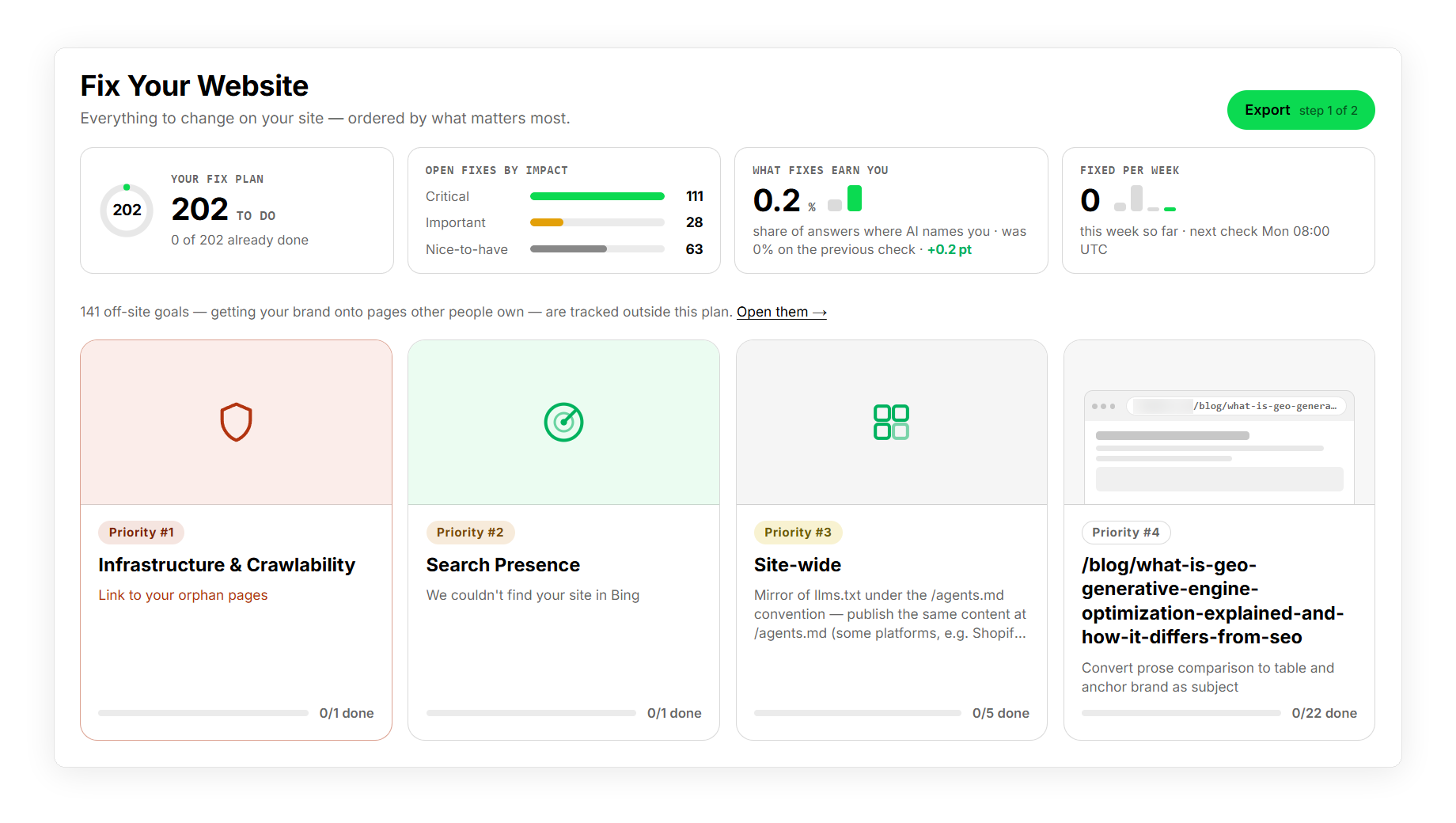
Completed work is recorded in Work Log. The next measurement cycle then shows whether the relevant answers, sources or supported metrics moved.
Semrush routes opportunities into a wider marketing stack, with Semrush One priced from $199 to $549 per month on monthly billing. Findrix keeps the detected gap, ready-to-apply work and subsequent measurement in one operational record.
What does each $99 plan actually buy?
Both plans are presented at $99 per month, but the commitment differs. Semrush's standalone toolkit is billed annually; Findrix Growth has no annual lock-in.
Semrush AI Visibility Toolkit: $99/month
The current Base toolkit includes:
- access to the category-wide AI Visibility database
- one Brand Performance domain
- 25 custom prompts in Prompt Tracking
- 300 daily AI Analysis queries
- 1,000 daily Prompt Research queries
- AI Search Site Audit checks for up to 100 pages
- 10 CSV exports per day
- daily custom-prompt tracking
- no free trial
Additional capacity is sold separately: another Brand Performance domain costs $99 per month, while 50 additional prompts cost $60 per month. Semrush One bundles increase prompt limits alongside the wider SEO toolkit.
Findrix Growth: $99/month
Growth includes:
- one site
- 100 reviewed prompts
- weekly measurement
- five AI surfaces: ChatGPT, Google AI Overviews, Perplexity, Gemini and Google AI Mode
- repeated runs and observed ranges on supported metrics
- editable tracked competitors plus competitors discovered in the answers
- visibility, preference, source and factual analysis
- Site Check
- ready-to-apply Actions
- work on brand facts and product positioning in AI-generated answers
If discovery is the main job, prompt limits understate Semrush. If controlled measurement is the job, Findrix provides four times the custom-prompt capacity at the same advertised monthly rate, without Semrush's annual commitment.
Findrix vs Semrush: which should you choose?
Choose Semrush if you are still exploring the market. Its discovery database, regional coverage and connection to the broader SEO stack make it stronger for finding topics, prompts, competitors and opportunities across a category.
Choose Findrix if the measurement boundary itself matters. It is designed for teams that need to agree on the prompts and competitors that count, see which brands and sources recur inside that market, interpret movement against answer variation and connect each intervention to the original gap.
Semrush maps AI-search demand across the category. Findrix maps the brands, owned pages and external sources that recur in or are cited by answers inside the market your team has chosen to measure.
Run a free Findrix audit
See whether the questions that matter to your buyers are represented in your measurement set. The free audit shows where your brand appears, which competitors show up instead and which gaps are worth reviewing first.
Read next
Findrix vs LLM Pulse: Which AI Visibility Platform Fits Your Team?
This in-depth, hands-on comparison of Findrix and LLM Pulse across two B2B SaaS projects in August 2026. It covers prompt-set quality, branded vs non-branded rates, entry and Growth pricing, measurement confidence, Preference Score and brand-claim analysis, source intelligence, and the path from a finding to reviewed work and remeasurement.
Findrix vs Otterly AI (2026): Pricing and Key Differences
Choose Otterly for low-cost daily AI monitoring. Choose Findrix for defensible measurement, ready fixes, and verification. Compare pricing and features.
Findrix vs Peec AI: Pricing, Features, and Key Differences
Compare Findrix and Peec AI on pricing, engines, multi-region tracking and execution. See which platform fits teams that need fixes ready to apply, not another reporting layer.