

 Deutsch
 Français
 Español
 Português (Brasil)
 Italiano
Findrix vs Otterly AI (2026): Pricing and Key Differences
 Evgeniya Zemlyanskaya14 min readAugust 20, 2026
TL;DR
Choose Otterly AI to start monitoring a small prompt set cheaply and track it daily; choose Findrix for a 100-prompt set at a lower comparable price, visible measurement uncertainty, and a structured path from a visibility gap to a reviewed fix. Otterly starts at $29 per month for 15 prompts across four core AI engines, runs daily, and includes a useful AI Prompt Research tool. Findrix Growth costs $99 per month for 100 prompts across five core engines and adds engine-level confidence intervals, AI Preference Score, a Fact Checker, written fixes, and a Work Log that connects completed work to later measurement. The practical split is monitoring frequency versus decision support.
Findrix vs Otterly AI: the full comparison at a glance
| Dimension | Findrix | Otterly AI |
|---|---|---|
| Product model | Connected measure → act → verify workflow | Monitoring-first analytics and recommendation workflow |
| Best fit | Marketing teams without a dedicated GEO specialist; agencies responsible for improving results | Solo marketers and SEO teams that need frequent monitoring and already have execution resources |
| Starting price | $49/month per site for Presence | $29/month for Lite |
| Comparable 100-prompt plan | Growth: $99/month | Standard: $189/month |
| Prompts | 60 on Presence; 100 on Growth; 180 on Authority | 15 on Lite; 100 on Standard; 400 on Premium |
| Core AI engines | Growth: ChatGPT, Gemini, Perplexity, Google AI Overviews, Google AI Mode | ChatGPT, Google AI Overviews, Perplexity, Microsoft Copilot |
| Additional engines | Claude and Grok add-ons | Claude, Gemini, and Google AI Mode add-ons |
| Tracking cadence | Weekly | Daily |
| Prompt research | Buyer-situation prompt set built, de-duplicated, and approved before tracking | AI Prompt Research from SEO keywords, a URL, or brand and industry context |
| Measurement uncertainty | 95% confidence intervals for supported metrics; engines reported separately | Daily values and trends; no visible confidence interval found in the public methodology reviewed |
| Position and preference | Measures position and AI Preference separately | Average Brand Position is converted into "Likelihood to Buy" inside Brand Visibility Index |
| Brand fact checking | Dedicated factual-discrepancy and source-correction workflow | Sentiment, citation analysis, recommendations, and GEO audits; no equivalent dedicated factual workflow found in the self-serve product reviewed |
| Source intelligence | Owned-source gaps, niche source map, and ranked external placement opportunities | Cited URLs, Domain Ranking, citation analysis, and prompt-level response detail |
| Action workflow | Work queues for technical, on-page, new content, fact correction, and off-site work | Recommendations move through Suggested, To-Do, and Archive |
| Verification | Completed work is recorded and checked in later runs of the same fixed prompt set | Completed recommendations create an archive; no separate outcome callback was visible in the product tested |
| Reporting and integrations | Dashboard and PDF reporting; multi-site management, portfolio reporting, team access, white-label branding, and per-client authorization | CSV/PDF exports on all plans; Looker Studio, API, MCP, and Agent Analytics on Standard+ |
| Free access | Free audit; 7-day paid-plan trial | Free trial without a credit card |
The core difference
Otterly AI is the lower-cost entry into AI search monitoring.
Its $29 Lite plan tracks 15 prompts daily across four core engines and includes prompt research, citations, Domain Ranking, a GEO Audit, and three recommendations per week. It is a credible fit for a narrow category, a single campaign, or a team testing whether AI visibility deserves a larger budget.
Findrix is an action-based AI visibility and GEO platform that turns real-time tracking and analysis of a brand's presence across AI answers and search into a shorter, structured path from an AI visibility gap to an implemented fix, and measures what changed afterward. It is built for brand managers, marketing leaders, and agencies running AI search for their clients.
The products optimize for different operating rhythms. Otterly is monitoring-first: collect frequently, inspect reports, and route recommendations through the team's existing SEO, content, or PR process. Findrix is decision-and-action-first: approve the measurement scope, distinguish signal from noise, diagnose the gap, prepare the response, record what was applied, and check the affected prompts again.
Daily monitoring is valuable during launches, reputation incidents, and fast-moving markets. Weekly measurement is a reasonable trade when the team works in weekly optimization cycles and needs a defensible decision more than another point on the chart.
Setup and economics
Setup and time to the first actionable result
Otterly has a strong setup bridge for marketers coming from SEO. Its AI Prompt Research tool generates prompt ideas from an SEO keyword, a URL, or a brand and industry description. You can then add the selected prompts to a Brand Report and start monitoring them daily. The workflow is easy to understand because the mental model is already familiar: discover queries, group them, track performance, and inspect the pages and domains associated with the result.
Keywords, website copy, and a brand description are useful seeds, not evidence of how buyers actually prompt an AI. Seer's UX research across seven studies and 387 real prompts found keyword and search-style prompts falling from 18% to 3%, while task-delegation prompts rose from 10% to 37%. The sample is small, but the direction matters: people increasingly ask AI to narrow options, make decisions, and complete tasks rather than restating search queries.
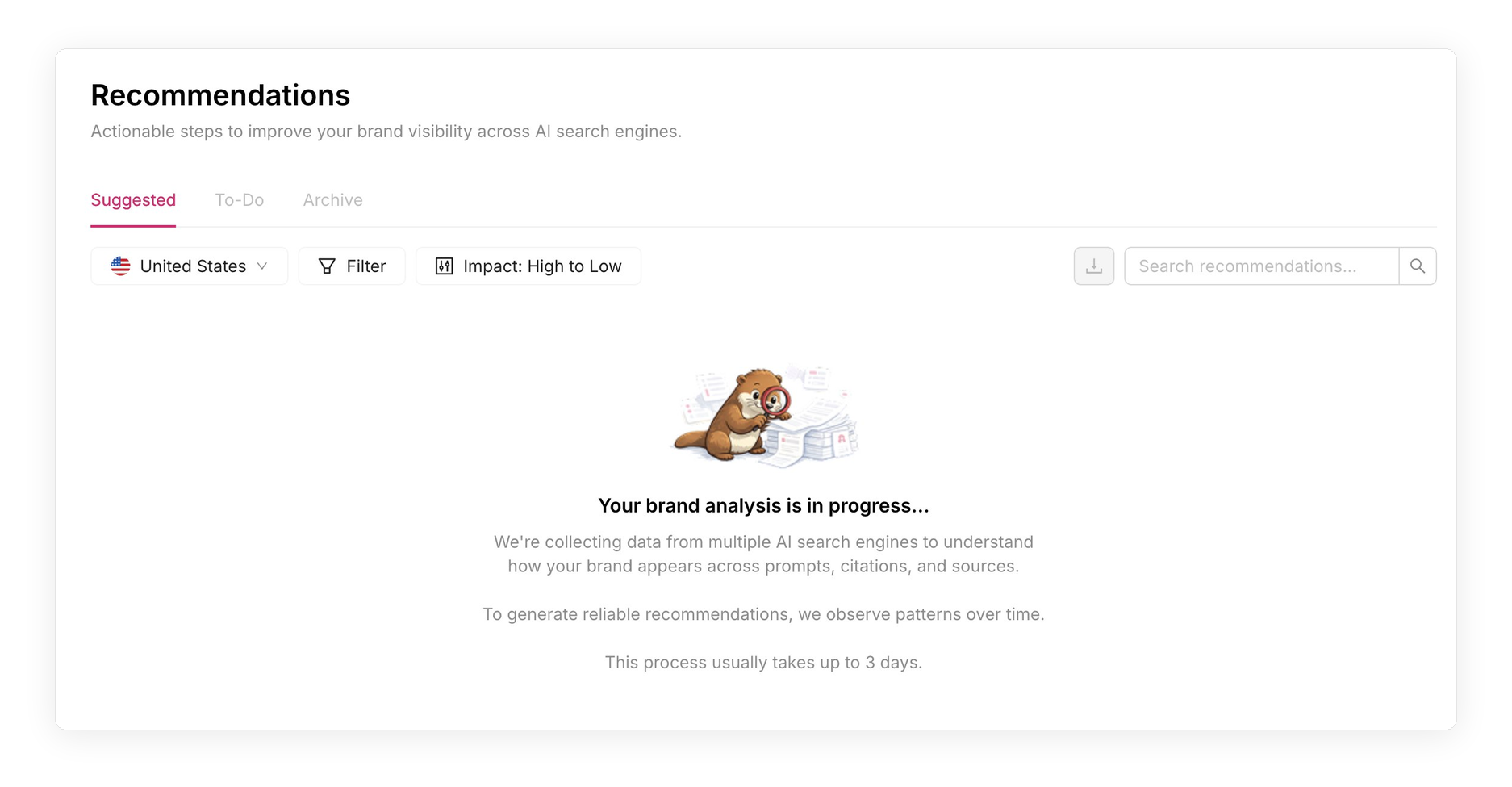
Monitoring starts quickly, while the optimization layer can take longer. In the self-serve product we tested, the Recommendations screen said reliable recommendations could take up to three days. Until then, the dashboard collected data but the action section remained empty.
The delay creates a clear trade-off: fast monitoring with slower time to action. Lite also caps recommendations at three per week; Standard removes the cap at $189 per month.
Findrix is designed to surface the initial gaps and next steps in the first analysis. It pre-fills the brand context and proposed market questions, asks the user to approve the scope, and organizes findings into work types. The trade-off is that it does more methodological work upfront and tracks weekly rather than daily.
Prompt research, working coverage, and what the plans really cost
Fifteen prompts can cover a narrow topic, a launch message, or a shortlist of commercial questions. They rarely represent a broad market across multiple personas, awareness stages, use cases, and comparison situations. One easy-to-generate topic can dominate the dashboard while entire buying situations remain invisible.
For this comparison, 70–100 materially different prompts is a practical working range. Narrow categories may need fewer and multi-product or multi-market companies more. This lets us compare plans that can support the same job.
At that scope, Otterly Lite is no longer the relevant plan. Otterly Standard includes 100 prompts for $189 per month. Findrix Growth includes 100 prompts across five core AI engines for $99 per month. Otterly still runs them daily; Findrix runs them weekly and adds the written-fix workflow. The buyer is choosing both a price and a measurement cadence.
The prompt-building philosophies also differ. Otterly's research tool is useful for discovery. It converts SEO keywords, extracts topics from a URL, and generates ideas from brand and industry context. The attached Intent Volume estimate then helps prioritize the candidates.
The name deserves one qualification. Otterly states that AI platforms do not disclose their usage data, so Intent Volume is an estimate based on Google search volume and displayed on a five-level scale. It can help a marketer decide which topics look more promising. It is not an observed count of how often people submit a prompt inside ChatGPT, Gemini, or Perplexity. B2B research and private or sensitive questions can also be poorly represented by public search behavior.
Findrix uses buyer-question coverage instead of a synthetic demand number. It removes near-duplicates and asks the user to approve a fixed prompt set, so a new question cannot masquerade as brand movement.
Can you trust what the dashboard says?
Daily tracking vs trustworthy movement
Daily tracking is one of Otterly's clearest wins. If a competitor launches on Tuesday, a reputation problem breaks on Wednesday, or a new model starts citing a bad source, a daily tracker can show the change before a weekly run. Otterly also lets teams inspect results by prompt and engine, read the underlying responses, and export the data into reporting workflows.
Generative answers vary even when the prompt, brand, and model appear unchanged. A movement from 42% coverage to 47% can be a useful signal, normal model variation, or a category-wide shift affecting every competitor. In the public Otterly methodology and self-serve outputs we reviewed, we found daily metrics and trend lines but no visible confidence interval, margin of error, or separate read on whether a period-over-period change exceeded expected variation.
Findrix's methodology controls the baseline before it interprets the trend:
- The fixed prompt set is approved before tracking, so a new question cannot masquerade as movement.
- Near-duplicate formulations do not receive extra voting power.
- Engines remain in separate lanes rather than disappearing into one blended figure.
- Before the first report, Findrix calibrates how much answers in the category move on their own.
- Supported metrics show a 95% confidence interval next to the headline number and label the strength of the read in plain language.
- Movement inside the expected band remains stable rather than being celebrated as growth.
- The competitive field is measured too, so a model update lifting the whole category is not credited to one brand's latest page edit.
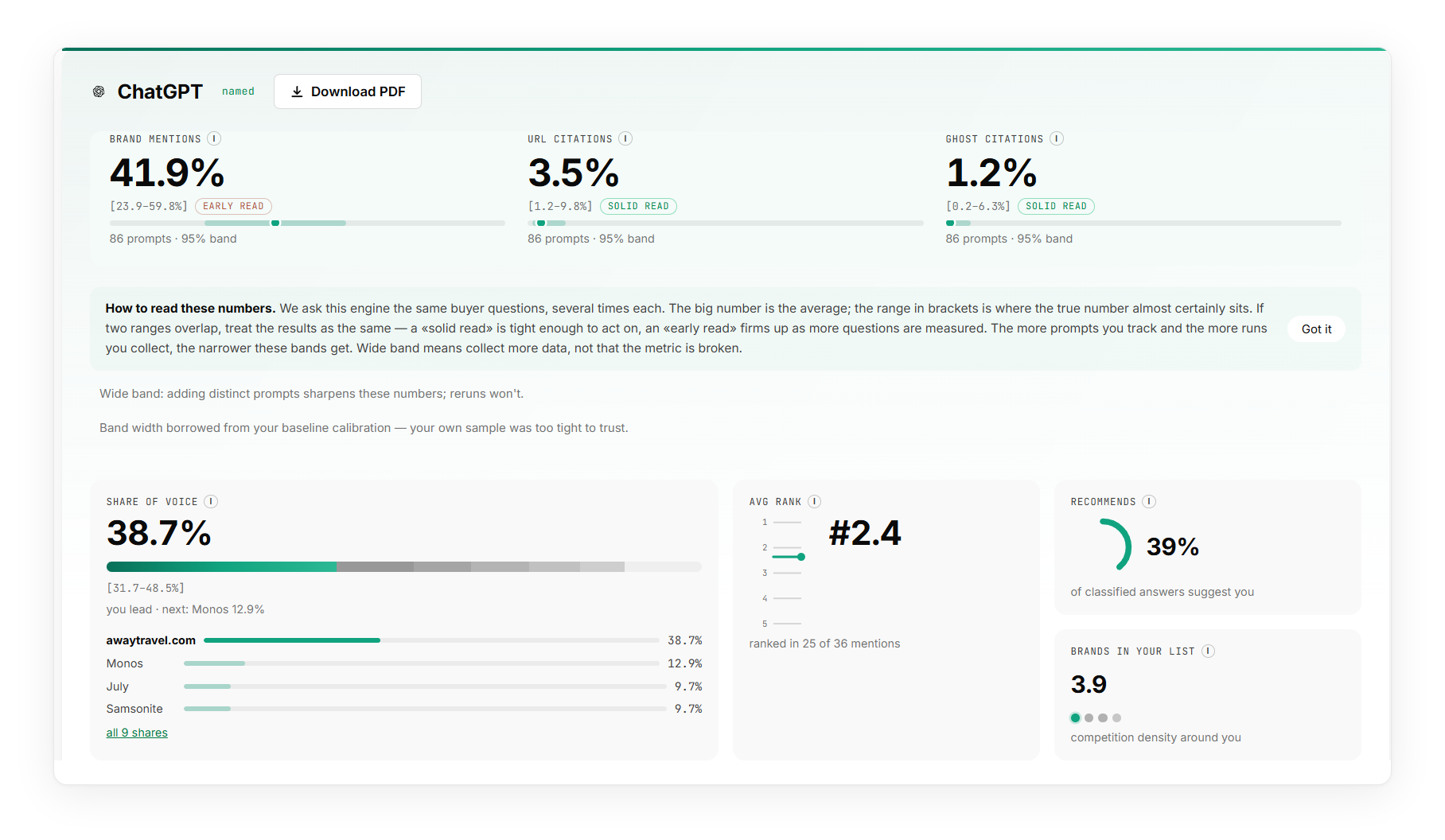
Cadence and certainty solve different problems. Daily tracking helps a team notice events sooner; a controlled baseline and visible uncertainty show whether the movement is large enough to act on or report as a win.
Mentioned, ranked, or actually preferred?
Visibility, position, and preference are three different questions.
- Visibility asks whether the brand appeared.
- Position asks where it appeared when several brands were named.
- Preference asks whether the engine actually selected the brand as the best overall option or the best fit for a particular use case.
Otterly measures the first two. Its Brand Coverage reports the share of tracked answers that mention the brand, while Average Brand Position reports where the brand appears inside those answers. Both are useful diagnostics.
Otterly's Brand Visibility Index relabels average position as "Likelihood to Buy." The published formula converts position one into 100%, position two into 77.5%, and position three into 55%, with a 10% floor for lower positions.
The formula transforms rank into a percentage. First position can increase prominence and attention, but it does not show that the engine endorsed the brand, matched it to the buyer's constraints, or influenced a purchase. A neutral list can name one brand first and recommend another in the conclusion.
Findrix measures position too, but keeps it separate from AI Preference Score. Preference asks what happened when the engine compared or recommended options: was the brand selected, called best overall, or named the best fit for a specific situation? The result is broken down by engine and withheld or labeled cautiously when the available evidence is thin.
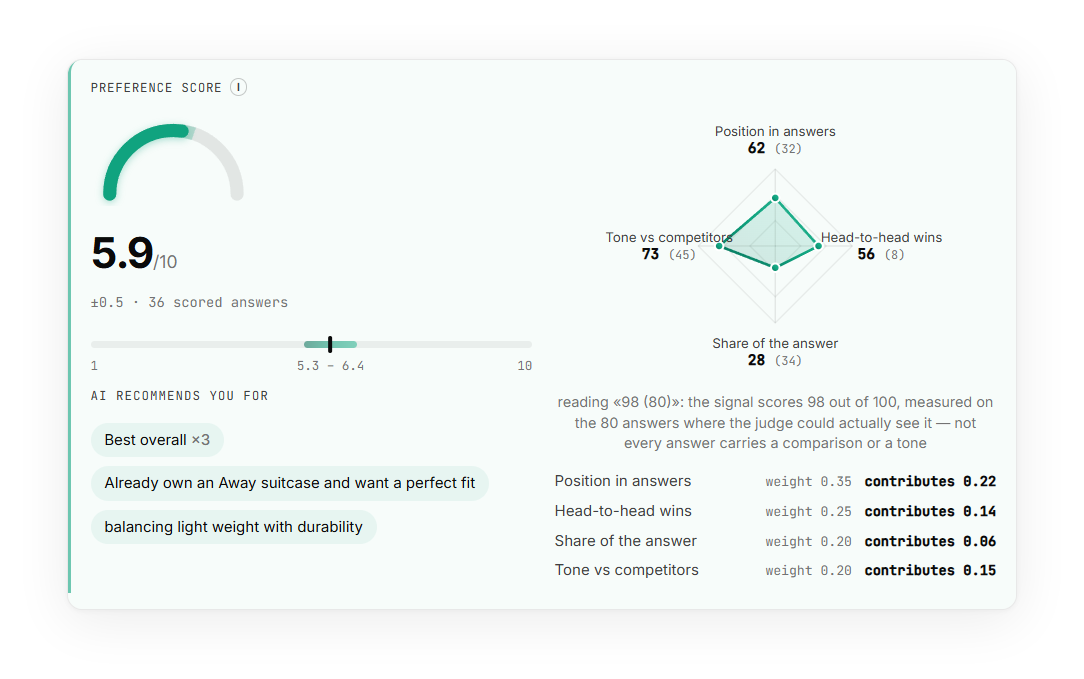
A visibility gap points toward missing category coverage and sources. A preference gap points toward weak differentiation, insufficient proof, or a mismatch between the product's strengths and the use cases AI associates with it.
Being mentioned is not the same as being chosen. Otterly measures whether and where a brand appears; Findrix separately measures whether an engine explicitly recommends the brand as the best overall option or the best fit for a specific use case.
From diagnosis to work
AI visibility work happens across three layers
AI visibility work spans brand authority, owned sources, and factual accuracy.
- Brand authority. The goal is for the company to enter the consideration set and earn explicit recommendations. That can require stronger differentiation, independent evidence, external coverage, and presence in the sources buyers and AI engines already trust.
- Owned sources. The website needs to give engines clear, crawlable, current information they can use and cite. That includes crawlability, structured data, content clarity, and coverage of the questions buyers ask.
- Factual accuracy. The facts AI repeats about the brand need to stay correct across both owned and third-party sources — from pricing and features to geography and positioning.
Otterly covers all three layers through Brand Coverage, Average Brand Position, Domain Coverage, Domain Ranking, citations, and sentiment, and GEO Audit results. Its prompt-level detail lets a marketer open the underlying answer and see which competitors and sources appeared. It also provides content and crawlability checks.
Findrix makes the three objects explicit and routes them differently. Brand visibility and AI Preference show whether the company enters and wins the consideration set. Owned-source analysis shows whether the company's own pages support the answers. The Fact Checker compares claims in AI responses and cited sources with the brand's approved facts, then flags wrong, vague, or outdated information.
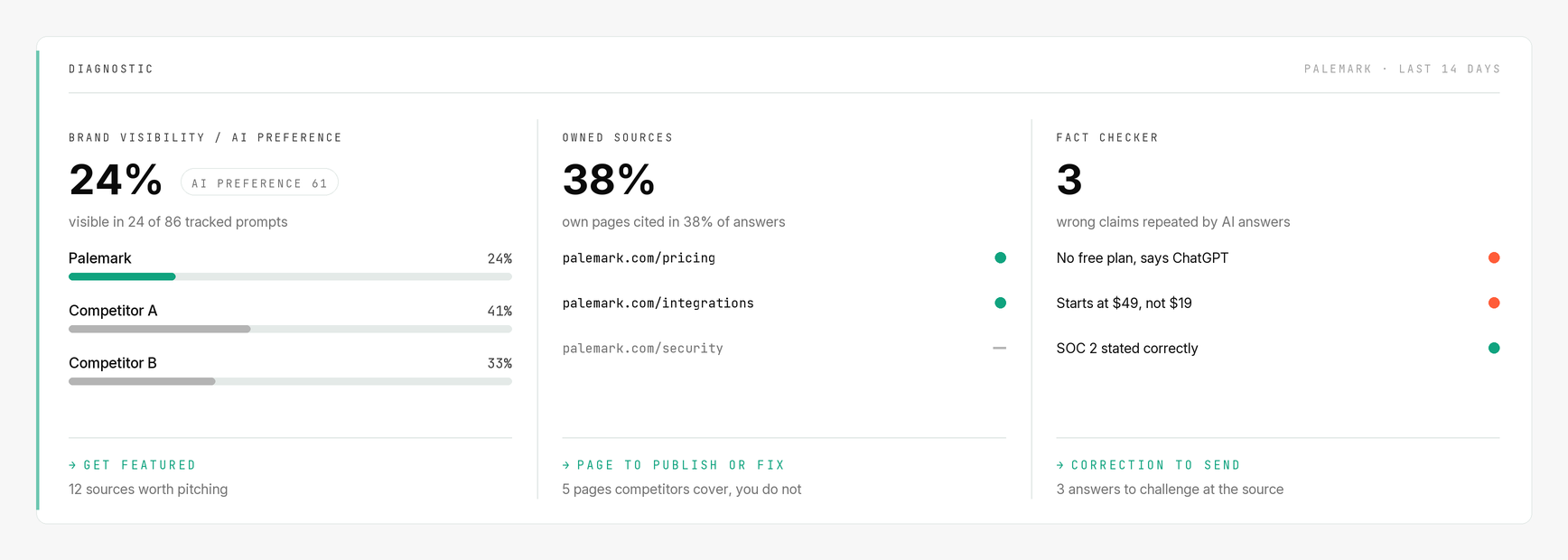
Sentiment and factual accuracy answer different questions. A positive answer can promise a feature the product does not have; a negative answer can accurately describe a real limitation. Teams still need to know whether AI has the facts right.
In the self-serve Otterly product and public methodology we reviewed, we found sentiment and citation analysis but no dedicated factual-discrepancy workflow. A marketer can spot wrong statements by reading raw answers; Findrix treats factual correction as a recurring job with its own diagnosis and next step.
Source gaps: a list of citations or a plan of influence?
Otterly is good at showing what AI already cites. Its citation reports expose individual URLs, domains, positions, prompt context, competitors mentioned on the page, and how often a source appeared. Domain Ranking makes the dominant sources easy to spot. For a team with an established digital PR or link-building process, that is useful raw material.
The next task is finding an attainable opportunity among the Reddit threads, affiliate publishers, industry directories, and competitor pages shaping the answer.
Findrix turns source analysis into a four-step workflow:
Map the category
See the domains influencing the category in "Where AI gets its answers."
Compare owned coverage
Check where the brand's own pages contribute and where competitors have better coverage in Owned Sources.
Find the omissions
Identify sources that repeatedly appear for relevant prompts but omit the brand, down to individual pages and community threads.
Rank and route
Prioritize the placements worth reviewing and send each gap to the right type of work.
Placements and inclusion in AI responses remain outside Findrix's control. Publishers, editors, communities, and site owners make their own decisions; the product narrows the landscape and prepares the next step.
Actions: recommendation, implementation, and verification
Otterly has moved beyond a passive dashboard. Its Recommendations workflow surfaces prioritized suggestions inside the Brand Report. A user can accept a suggestion, move it into To-Do, assign a status, add internal notes, complete it, and retain the finished item in Archive. That creates a shared action plan and a useful record for reporting.
In the product we tested, the recommendation remained a written suggestion. Marking it complete changed its workflow state, but we did not find a separate outcome callback tied to the affected prompts or an explicit test of whether the observed movement exceeded normal variability.
Findrix separates recurring GEO work into technical changes, on-page improvements, new-page opportunities, fact corrections, and off-site work. Site recommendations name the affected page and the proposed change. Growth and Authority provide written fixes and copy-paste instructions; the user reviews the work and chooses who applies it. Findrix never edits the site automatically.
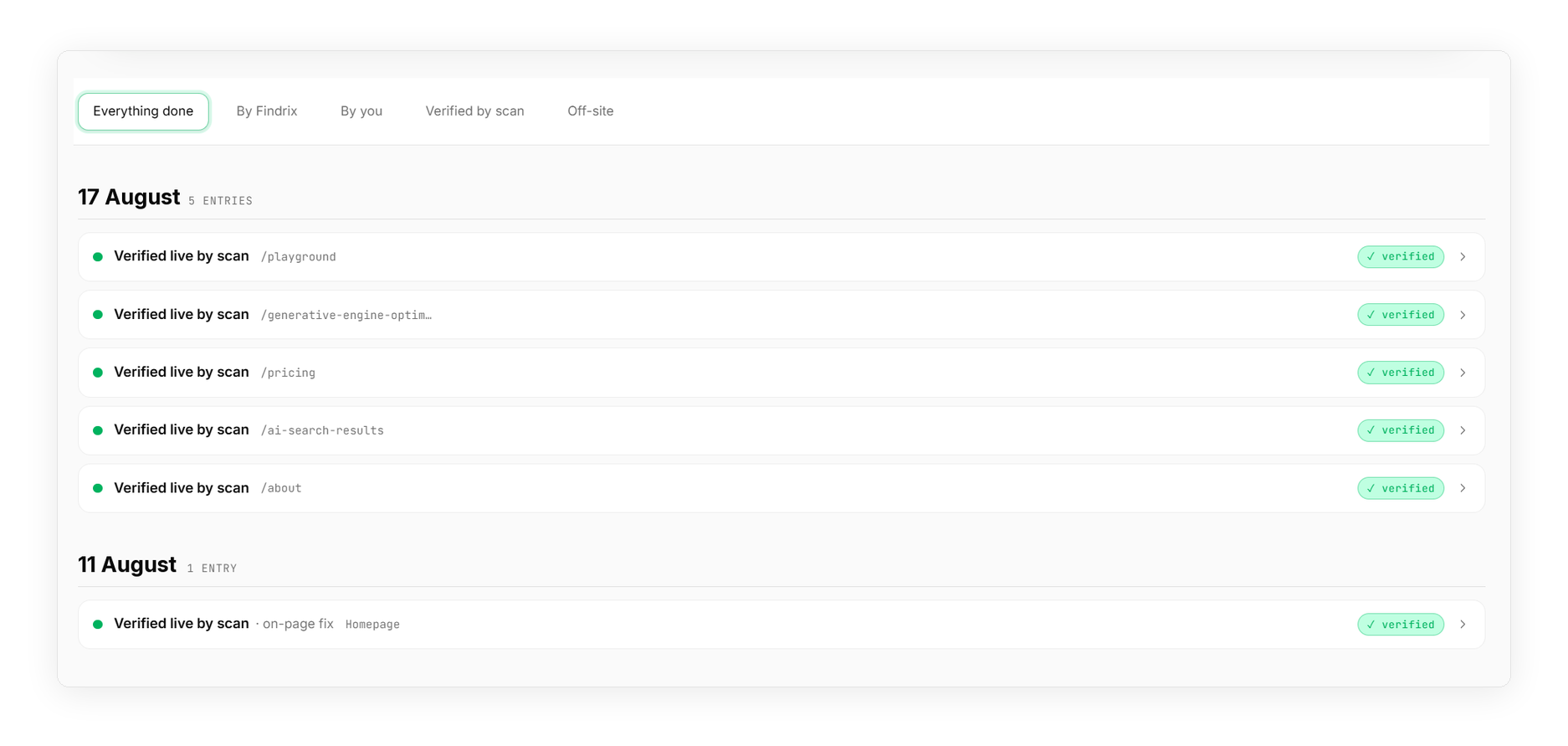
Once a supported change is completed, the Work Log preserves what changed and which prompts it was intended to affect. The same fixed prompt set runs again in the next weekly cycle, and Findrix checks the affected questions against the calibrated noise range and the movement of the wider category.
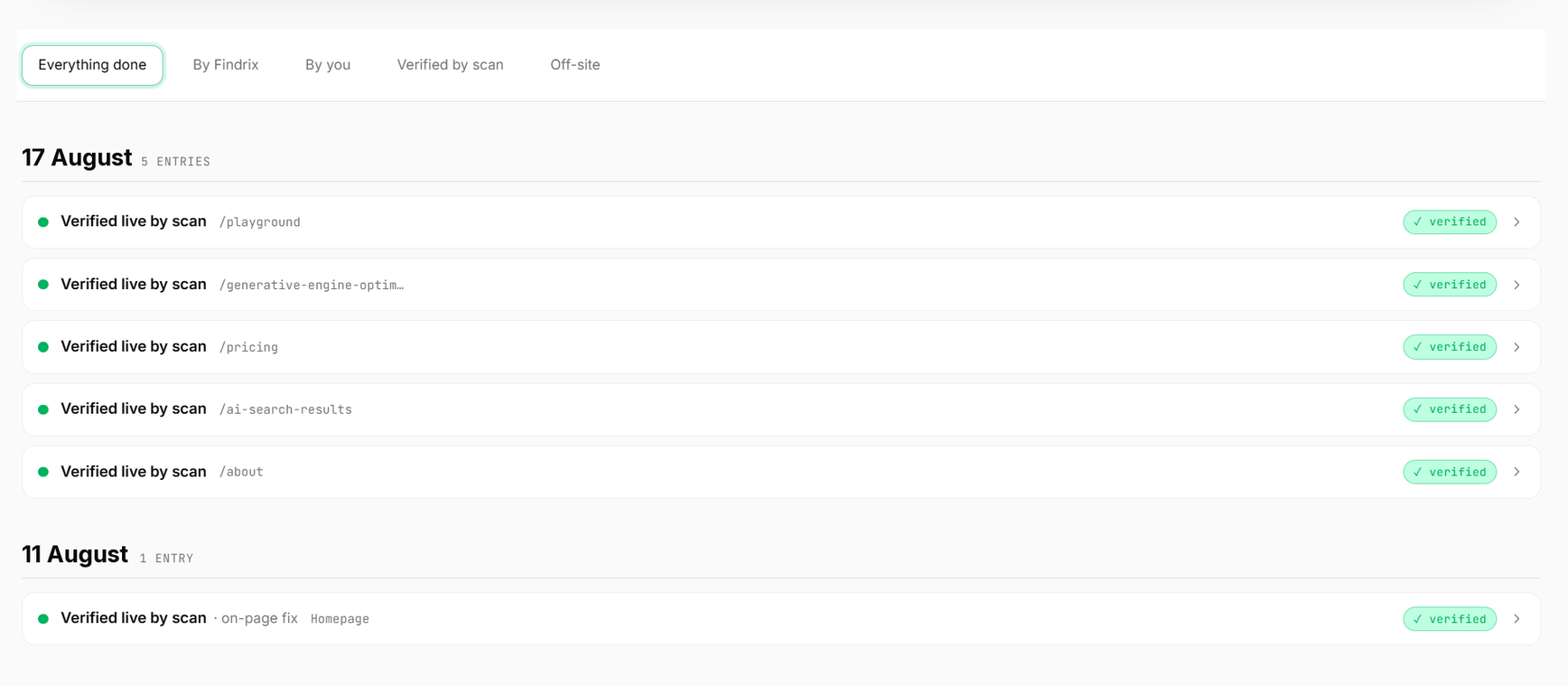
The next run provides evidence consistent with the change, while competitors, engine updates, or new sources may also affect the result. A green chart after a change is evidence. It is not a receipt proving what caused it.
Which platform fits an agency?
The right agency choice depends on what the client pays the agency to deliver.
Otterly fits agencies selling monitoring and reporting. Standard provides unlimited workspaces and brand reports plus Looker Studio, API, MCP, and Agent Analytics. Approved Agency Partners receive 150 prompts on Standard, separate client environments, pitch workspaces, branded Looker Studio reporting, and consolidated billing. Agencies with strategists, writers, PR specialists, and developers can use it as a flexible, frequent data layer.
Findrix fits agencies selling a repeatable measure-to-fix service. It applies the same measurement controls across clients, distinguishes movement from expected variability, prepares the next action, and records completed work before the next run. That reduces the labor required to turn a dashboard into a client recommendation and explains why each change was prioritized.
Findrix includes multi-site management, per-site billing, and a dedicated agency cabinet with portfolio reporting, expanded team access, white-label branding, and per-client authorization.
Who should choose which product?
Choose Findrix if
- AI visibility sits with a founder, marketing lead, brand team, or agency rather than a dedicated GEO specialist.
- You need to know whether a change is large enough to trust before you report it as growth.
- You want visibility, position, and explicit AI preference kept separate.
- You need to distinguish a brand-authority gap from an owned-site or factual-accuracy problem.
- You want technical, content, factual, and external-source work organized into separate queues.
- You want the proposed change written, reviewed by a person, and checked in a later run of the same fixed prompt set.
- Your agency needs a repeatable working method across client sites.
Choose Otterly AI if
- You need the lowest-cost entry, and 15 carefully selected prompts cover a narrow category, campaign, or lightweight experiment.
- Daily tracking is a real operational requirement for launches, incidents, or a fast-moving category.
- Your team already knows how to execute SEO, content, and digital PR recommendations.
- You want to generate prompt ideas from SEO keywords, URLs, and brand and industry context.
- You need unlimited brand reports and team members, with unlimited workspaces on Standard and Premium.
- You need CSV and PDF exports on every plan, or Looker Studio, API, MCP, and Agent Analytics on Standard and above.
- You value frequent monitoring and flexible reporting more than visible confidence intervals or a predefined remediation workflow.
Final verdict
Choose Otterly AI for inexpensive daily monitoring when the team already knows how to act on the findings. Choose Findrix for a defensible baseline, separate preference measurement, and a shorter path from a gap to a reviewed change and later verification.
Run a free Findrix audit
Check how your site is prepared for AI search and review the highest-priority technical, content, and source gaps before choosing a paid platform. The audit returns the initial results in about a minute.
Frequently asked questions
Is Findrix an Otterly AI alternative?
Yes. Both products monitor brand visibility, competitors, citations, position, and sentiment across AI engines. Findrix is the stronger Otterly alternative for teams that want visible measurement uncertainty, separate AI Preference measurement, factual-discrepancy workflows, and written fixes connected to later verification. Otterly remains stronger for inexpensive daily monitoring and reporting integrations.
Why does Otterly AI start at $29?
Otterly Lite costs $29 per month because it is designed for a narrow 15-prompt monitoring set. It includes four core engines, daily tracking, unlimited brand reports and team members, one workspace, GEO audits, exports, and three recommendations per week. Teams needing 100 prompts move to Standard at $189 per month.
Is daily AI tracking better than weekly tracking?
Daily tracking is better for launches, incidents, and categories that can change materially within a week. Weekly tracking can be sufficient for a normal optimization cycle, especially when the platform uses the same fixed prompt set and shows whether movement exceeds normal answer variability. Frequency and measurement confidence are separate qualities
How does Otterly calculate Likelihood to Buy?
Otterly derives Likelihood to Buy from Average Brand Position inside its Brand Visibility Index. Its published formula converts position one into 100%, position two into 77.5%, and position three into 55%, with a 10% floor. The metric describes a transformed ranking position; it is not an observed purchase-conversion rate.
Is Otterly Intent Volume real AI search volume?
No. Otterly says AI search platforms do not disclose query usage, so Intent Volume is an estimate based on Google search volume and presented on a five-level scale. It is useful as a directional prioritization signal, not as a count of actual prompts submitted to AI engines.
Does Otterly provide recommendations?
Yes. Otterly provides prioritized recommendations that users can move from Suggested to To-Do, track with statuses and notes, and retain in Archive after completion. Lite includes three recommendations per week; Standard and Premium include unlimited recommendations.
Which platform is better for agencies?
Otterly is better for agencies that sell frequent monitoring, reporting, and custom execution through an existing team. Findrix is better for agencies that want a standardized path from a defensible measurement to a prepared fix and a later check of what changed. Findrix includes multi-site management, per-site billing, and a dedicated agency cabinet for portfolio reporting and client access.