

 Deutsch
 Français
 Español
 Português (Brasil)
 Italiano
Findrix vs LLM Pulse: Which AI Visibility Platform Fits Your Team?
 Evgeniya Zemlyanskaya16 min readAugust 26, 2026
Disclosure: The author is Product Marketing Lead at Findrix. We conducted an extensive hands-on test of LLM Pulse across two B2B SaaS projects selected to test different conditions: one was an established product with an unusual USP, a non-obvious competitor set, and a specialized prompt space; the other was a newer product with limited existing online visibility. We also reviewed LLM Pulse's public documentation and current pricing. Findrix details are based on the company's current product documentation and pricing.
Findrix is an action-based AI visibility and GEO platform that turns real-time tracking and analysis of a brand's presence across AI answers and search into a shorter, structured path from an AI visibility gap to an implemented fix, and measures what changed afterward. It is built for brand managers, marketing leaders, and agencies running AI search for their clients.
Findrix and LLM Pulse both go well beyond a basic mention tracker. LLM Pulse combines broad monitoring with prompt research, source and platform intelligence, technical GEO reports, prioritized recommendations, and an AI writer. Findrix combines monitoring with a more developed statistical measurement methodology: a controlled prompt set, calibration for normal run-to-run variation, engine-level 95% confidence ranges, and separate branded and non-branded rates. It adds Preference Score and brand-claim analysis, then carries a validated finding into reviewed work and targeted remeasurement.
The practical split is this: LLM Pulse is the better fit when monitoring breadth, entry-level capacity, traffic and crawler signals, and platform-specific intelligence are the priority, and the team already knows how to validate the measurement and manage the work around it. Findrix is the stronger default when the team needs the product to determine which movement is credible, explain what sits behind it, and provide a clear workflow and next step without requiring a long investigation of the data. It then carries the finding into reviewed work and targeted remeasurement.
Findrix vs LLM Pulse at a glance
| Area | Findrix | LLM Pulse |
|---|---|---|
| Best fit | Teams shortening the path from an AI visibility gap to a reviewed fix — and checking what changed afterward | Broad monitoring, research, diagnostics, and adjacent signals |
| Entry monitoring | $49/month per site; 60 prompts across three core engines | €49/month per project; 50 prompts across five models; excludes Sentiment, Owned Media, AI Traffic Analytics, and the Agent |
| Default prompt view | Branded prompts tracked separately from non-branded rates | Branded and reputational prompts included; Brand Type filter can isolate non-branded |
| Movement | 95% confidence ranges and interpretation against run-to-run variation | Position-weighted scores and trends; no visible uncertainty range in tested UI |
| Preference and claims | Preference Score plus Brand Image in AI and factual-claim checks | Position, visibility, sentiment, tags, reputation, and raw responses |
| Working workflow and price | Growth: $99/month; 100 prompts across five core engines, written fixes, owner, Work Log, and targeted remeasurement | Growth: €99/month; 150 prompts across two projects, adding Sentiment, Owned Media, AI Traffic, and the Agent; recommendations and GEO Writer are available on Starter |
| Technical GEO | Site checks and implementation-oriented fixes | Detailed readiness, crawlability, schema, content, and discoverability reports |
| Sources and outreach | Influence Map to exact answer, opportunity, contact, and draft pitch | Strong citation, URL, YouTube, Reddit, and source reporting |
| Traffic and bots | Not a core product layer | AI Traffic from Growth; aggregated Agent Analytics from Scale |
| API and exports | Available on all plans | MCP and exports on all plans; API/Data Studio/CLI on Scale |
How we compared the platforms
We reviewed the current self-serve products on August 24, 2026, using the same types of questions for both platforms: what enters the measurement, how far a user can investigate an aggregate change, what the product recommends, what it can carry into execution, and what can be checked after implementation.
For LLM Pulse, we tested two B2B SaaS projects under different starting conditions: one was an established product with an unusual USP, a non-obvious competitor set, and a specialized prompt space; the other was a newer product with limited existing online visibility. Each project used a category-specific prompt set and competitor list. We reviewed onboarding and prompt generation, responses, citations, sentiment, source intelligence, recommendations, GEO Writer output, technical GEO reports, traffic and crawler sections, exports, and current pricing.
A product screen can show what a feature does, but it cannot prove that a recommendation caused a later visibility movement. Where the evidence supports a workflow claim but not a causal or cost-saving claim, we make that distinction.
Your prompt set determines your visibility score
A dashboard can calculate the wrong market perfectly. If the prompt set does not reflect how buyers ask questions, the rest of the measurement is precise but not valid.
LLM Pulse leaves much of prompt-set design to the user. Its Suggested view returned 20 prompts in our test, and users can regenerate them, add prompts manually or in bulk, import CSVs, and generate ideas from Google Search Console, People Also Ask, Reddit, topics, and keywords. This is flexible, but it assumes the user can define the right buyer questions, competitive boundary, branded split, and level of specificity. We did not find a duplicate or near-duplicate guardrail before prompts entered the recurring set.
That matters twice. First, near-duplicates consume the paid prompt allowance without adding a materially new buyer question. Second, they give one topic multiple votes in prompt-normalized metrics: because Mention Rate and AI Visibility Score are calculated across tracked prompt-model evaluations, repeated variations can inflate or depress headline visibility depending on how the brand performs on that duplicated topic. The dashboard then reflects the composition of the prompt set as much as the brand's actual market visibility.
For a B2B SaaS product built inside the Atlassian ecosystem, suggestions drifted into broad project-management and roadmap queries, while the competitor list included mass-market leaders such as Monday and Asana. The prompts were category-related but did not consistently represent the market in which the product actually competes.
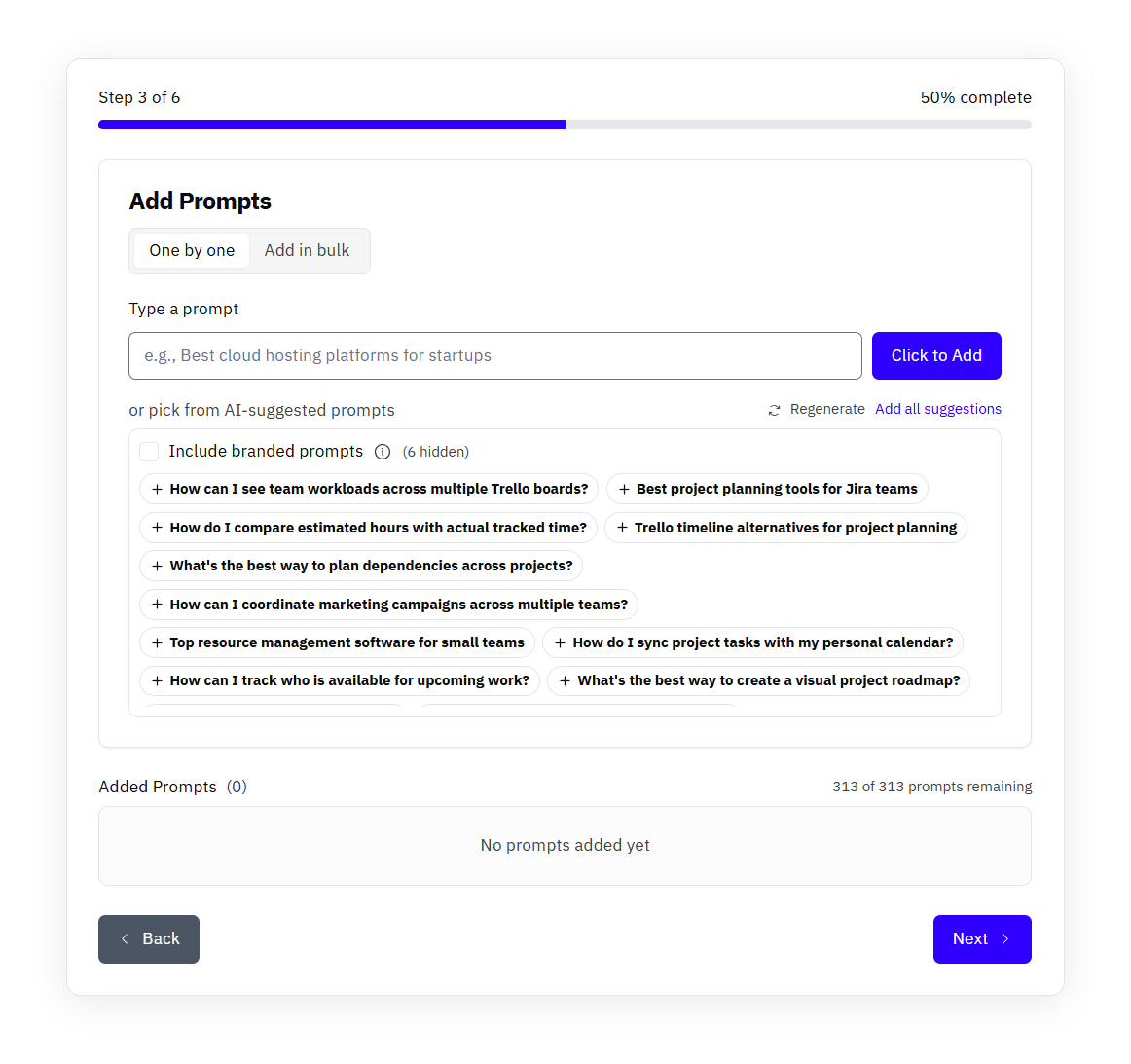
A generous prompt allowance can therefore be spent on duplicate, weak, or wrongly scoped questions. The dashboard may show a specialist brand near zero against broad-market leaders without revealing that the benchmark itself was poorly drawn.
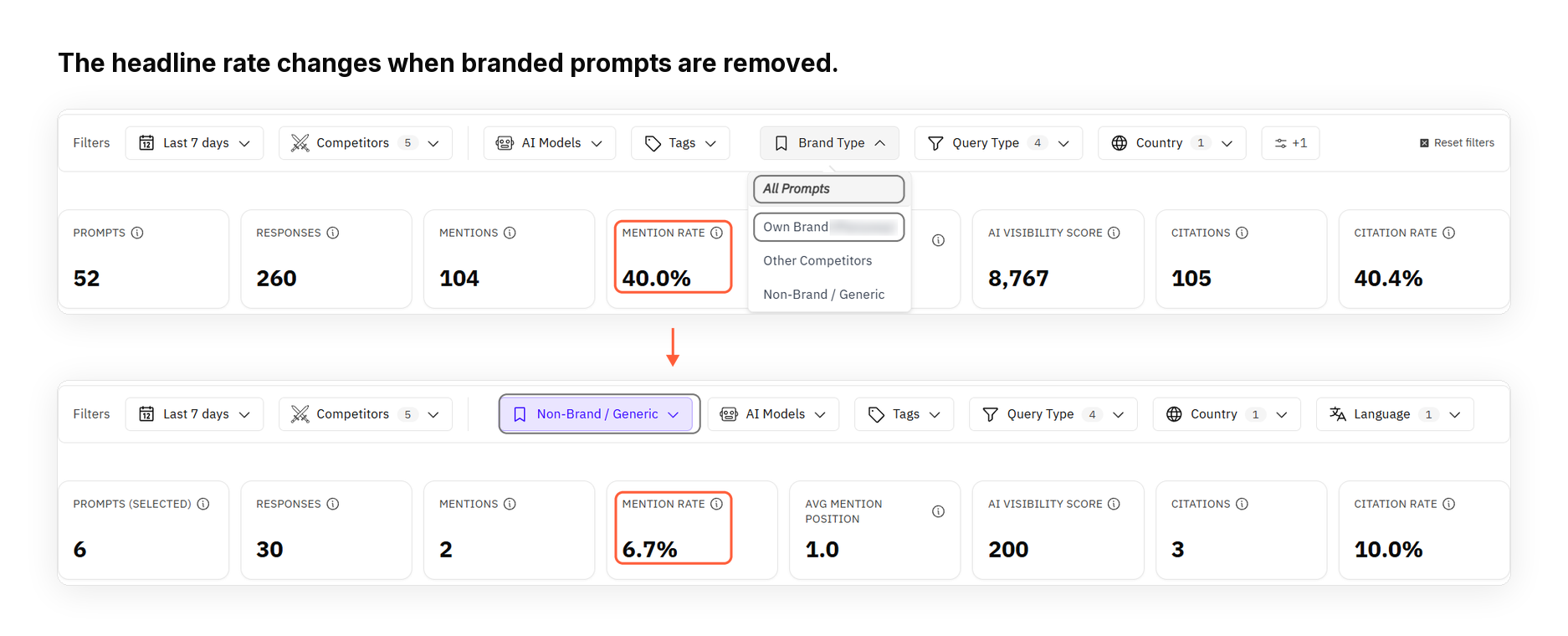
Branded prompts create a second distortion. In our LLM Pulse trial, branded and reputational prompts were included in the aggregate view by default. The Brand Type filter can isolate non-branded prompts, but users must know to apply it before interpreting the headline number.
In one project, an apparently healthy aggregate mention rate was largely carried by reputational prompts. The default number looked stronger than the brand's actual non-branded discovery visibility.
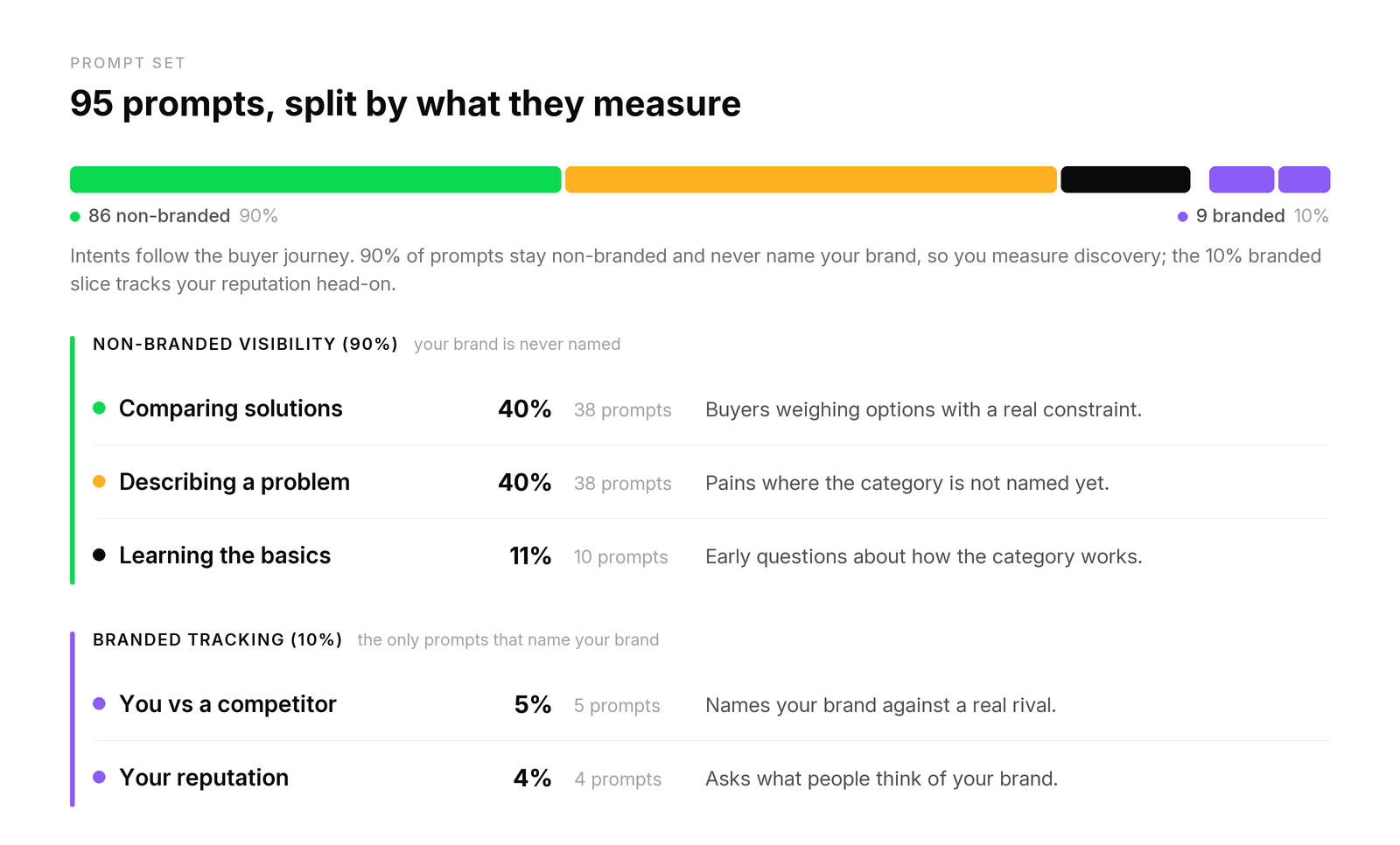
Findrix puts more methodology into setup. It builds the proposed prompt set from personas, ICPs, buying contexts, and the actual competitive boundary; blocks duplicates and near-duplicates; keeps branded prompts separate from non-branded rates; and locks the approved recurring set. The marketer does not need to arrive with a finished GEO measurement methodology. For an SMB without a dedicated GEO specialist, that is part of the product value: the software should help identify the first problems worth fixing, not require the buyer to become a GEO analyst before the dashboard is trustworthy.
Pricing and monitoring coverage
On monthly billing, LLM Pulse Starter costs €49 per month and includes one project, 50 prompts, and five models. But it excludes sentiment, owned-media analysis, AI traffic analytics, and the Agent. Growth costs €99 per month with those core functions and 150 prompts pooled across two projects; Scale costs €299 per month for 450 prompts across five projects plus advanced testing, reporting, ads, and API. Annual billing reduces those monthly equivalents to €40.83, €82.50, and €249.17 respectively.
Findrix's public monthly plans cost $49, $99, and $199 per site and are structured around a different job: shortening the path from a visibility gap to a reviewed fix and remeasurement. For agencies, custom plans start at 250 prompts in a shared pool that can be distributed freely across clients and their sites. Pricing is available on request; contact team@findrix.ai for an agency offer.
For agencies, both products offer a shared prompt pool across multiple client sites. The practical comparison is therefore usable functionality, effective prompts per client, and measurement quality — not access to pooled allocation itself. LLM Pulse gives teams more prompt capacity and flexibility; Findrix puts more control around which questions enter recurring measurement and how much confidence to place in the resulting movement. On public self-serve plans, the entry-price advantage belongs to LLM Pulse; the stronger path from measurement to a decision and completed work belongs to Findrix.
Can you trust a movement on the dashboard?
AI answers vary from run to run. A move from 42% to 47% can be a real change, ordinary model variation, or a consequence of changing the prompt set.
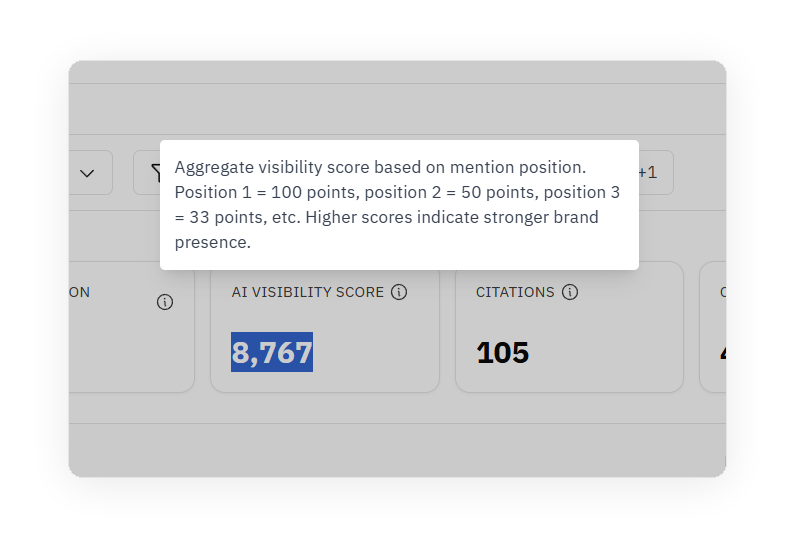
LLM Pulse explains its AI Visibility Score clearly: position one receives 100 points, position two 50, position three 33, and so on. In the product we tested, each weekly prompt-model evaluation contributed a single answer to the displayed result. We found detailed filters and drill-downs, but no visible confidence interval, margin of error, or significance layer around a movement.
A change on the LLM Pulse chart was displayed as a point estimate without a visible range showing normal answer variance. The user must decide whether the movement is meaningful.
Findrix runs a calibration set before recurring measurement to estimate normal run-to-run variation and improve the quality of the measurement design. On supported metrics it then shows a 95% confidence range and interprets movement against that baseline. A decline can be marked "not proven yet" when it remains inside the expected range instead of being reported as a loss.
This does not make Findrix infallible, and a confidence range is not proof of causality. It makes the result easier to defend before an agency reports a win, changes strategy, or asks a client to fund more work.
What sits behind a visibility change?
Both products let a user drill from a headline number into the underlying answers. LLM Pulse aggregates the data into distinct metrics:
- Mention Rate — the share of evaluated responses that mention the brand.
- AI Visibility Score — a position-weighted mention rate.
- Share of Voice — the brand's share of mentions across the selected competitor set.
- Citation Rate — the share of responses that cite the tracked domain.
- Sentiment — the tone of answers that mention the brand.
Its response table is strong: prompt, model, full answer, sentiment, mention position, top mentions, top citations, date, and tags sit in one exportable view. But these metrics answer presence, prominence, competitive exposure, citation, and tone. They do not answer whether the model prefers the brand or whether its claims are correct.
Share of voice is not preference
LLM Pulse defines Share of Voice as the brand's mentions divided by total mentions across the brand and selected competitors. That is a valid exposure metric, but it does not tell a marketer whether the model actually prefers the brand. It changes with the prompt set and competitor set, and it can be inflated when branded or reputational prompts are included in the default aggregate.
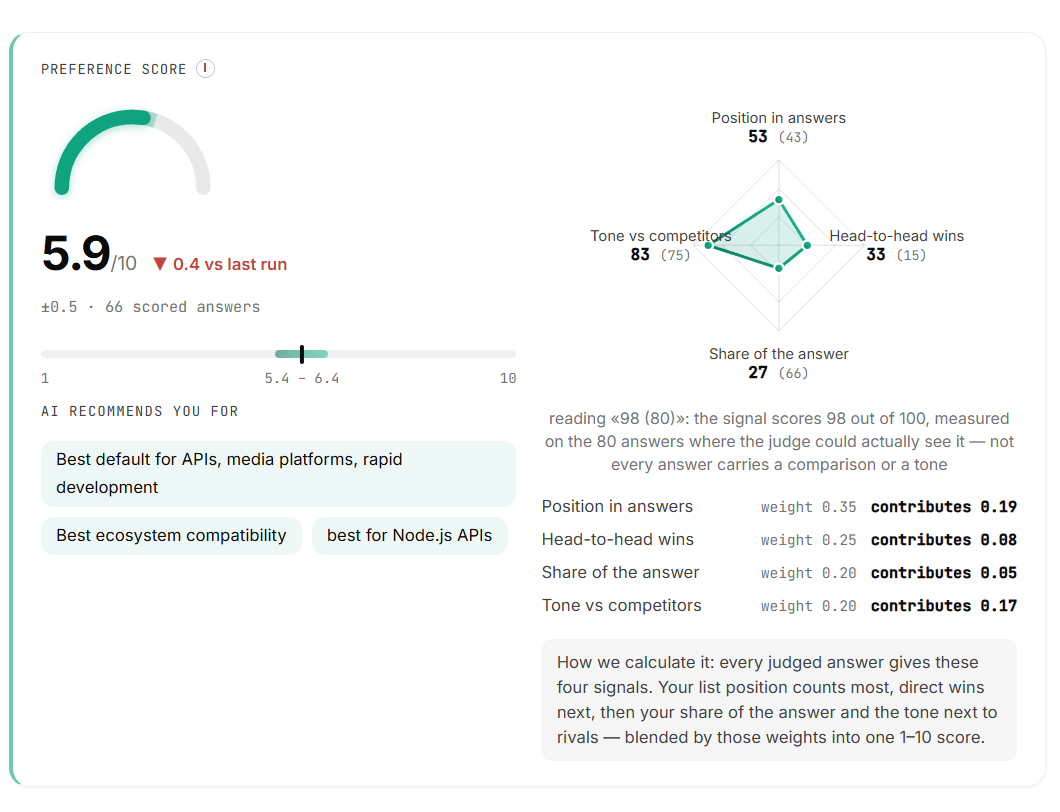
Findrix also measures mentions, positions, citations, sentiment, and competitive share. Its Preference Score asks a different question: once the brand appears, does the model choose it? The score separates position in answers, head-to-head wins, favorable answers, and tone versus competitors, with visible weights and contributions.
Brand perception is more than positive or negative
Findrix's Brand Image in AI creates a snapshot of what models appear to know about the brand and where they place it across buying categories and USP attributes. A marketer can define the perception the brand is trying to own — cheapest or premium, powerful or easy to use, stylish or functional — and the categories, use cases, and ICPs in which it should win. Findrix then shows where models rank the brand first, where they do not, and which confirmed claims support that placement.
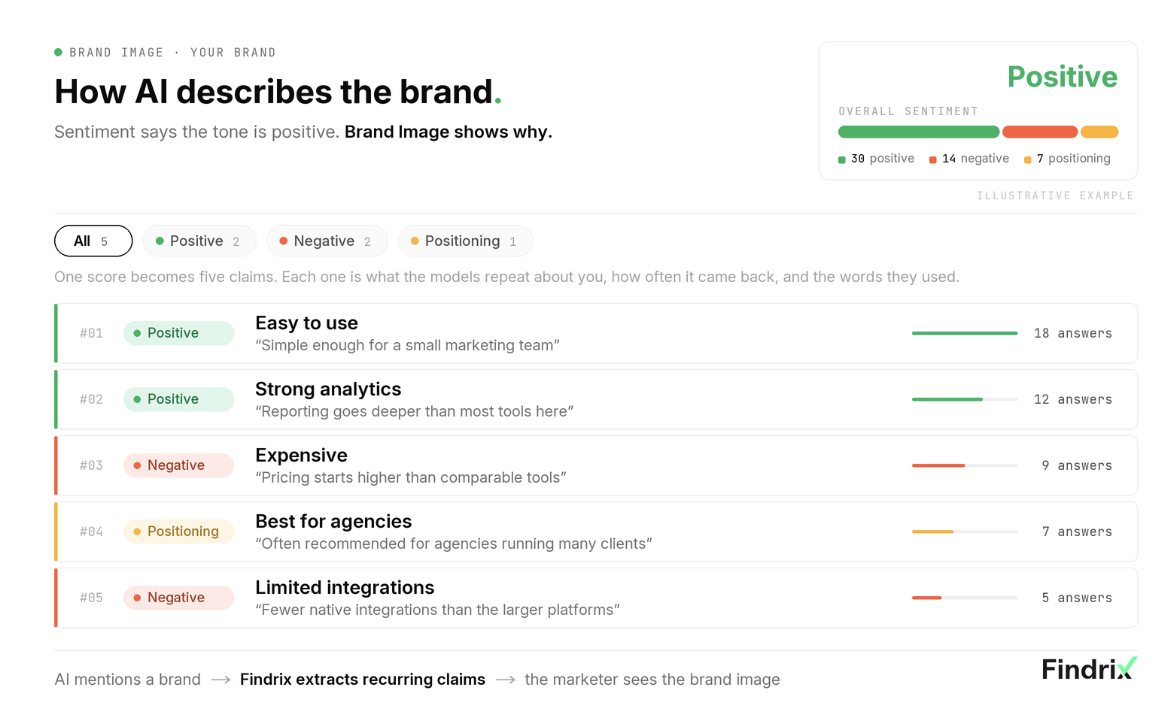
This turns brand monitoring into a positioning question: not only "are we visible?" but "are models choosing us for the reasons and buyers we actually target?"
Sentiment is not factual accuracy
A positive answer can still contain the wrong price, feature, audience, or positioning claim. Findrix compares answer claims with confirmed brand information in its Data Room, surfaces mismatches, and routes wrong information into a correction workflow.
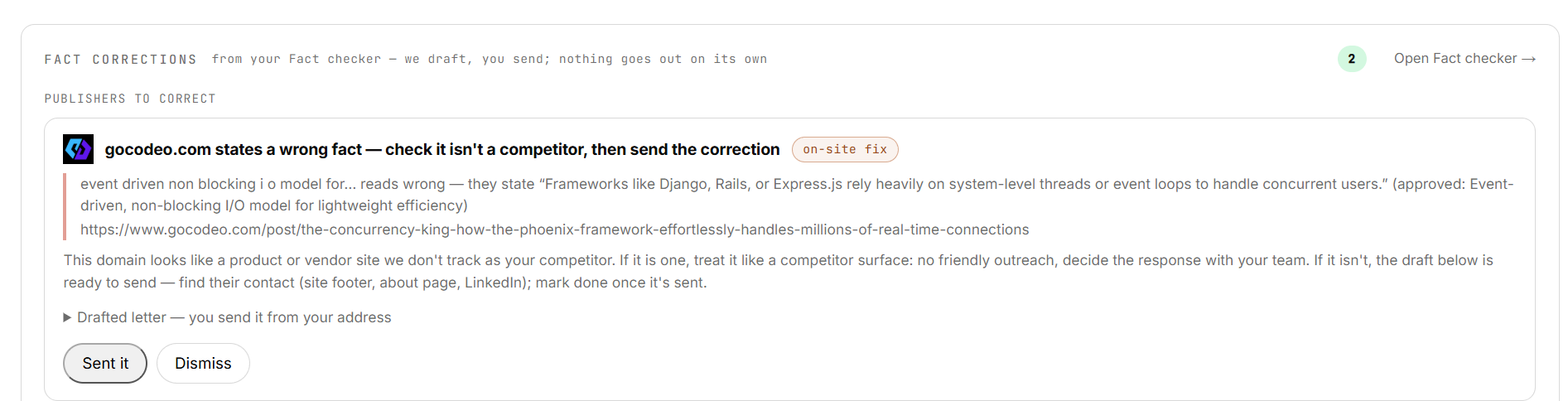
LLM Pulse provides sentiment, reputation views, tags, and raw responses, which can surface a problematic answer for manual review. In the product we tested, we did not find an equivalent claim-by-claim layer tied to a confirmed brand record.
From a finding to reviewed work
LLM Pulse has a substantial recommendation layer. It covers owned content, social and UGC, PR and citation building, sentiment and reputation, and technical GEO reports. Recommendations include priorities, action items, source prompts and citations, and can be completed or archived. GEO Writer can turn one into generated content.
The recommendations and reports were useful starting points, but not safe to execute without review. The schema report treated the Findrix homepage as an Article, the content report interpreted "TL;DR" as a five-character lead paragraph, and some recommendations applied general best practice without showing that the change would improve AI visibility. The tested account also generated a bounded recommendation set rather than an open working queue.
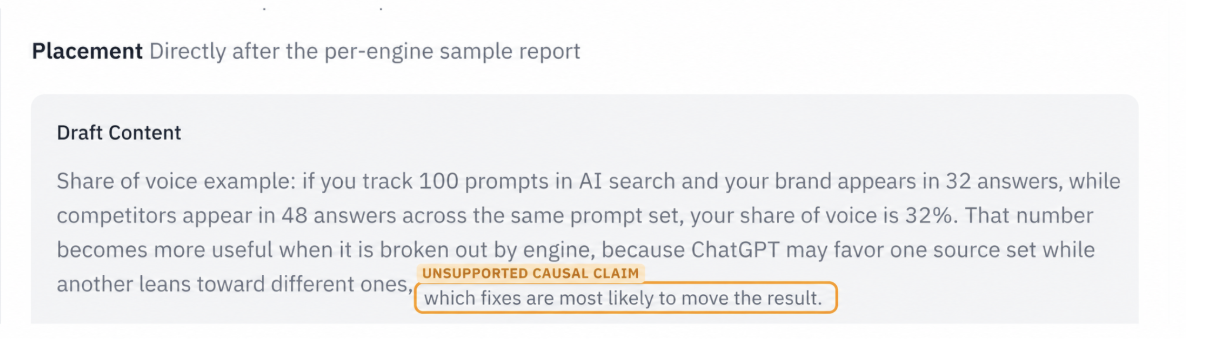
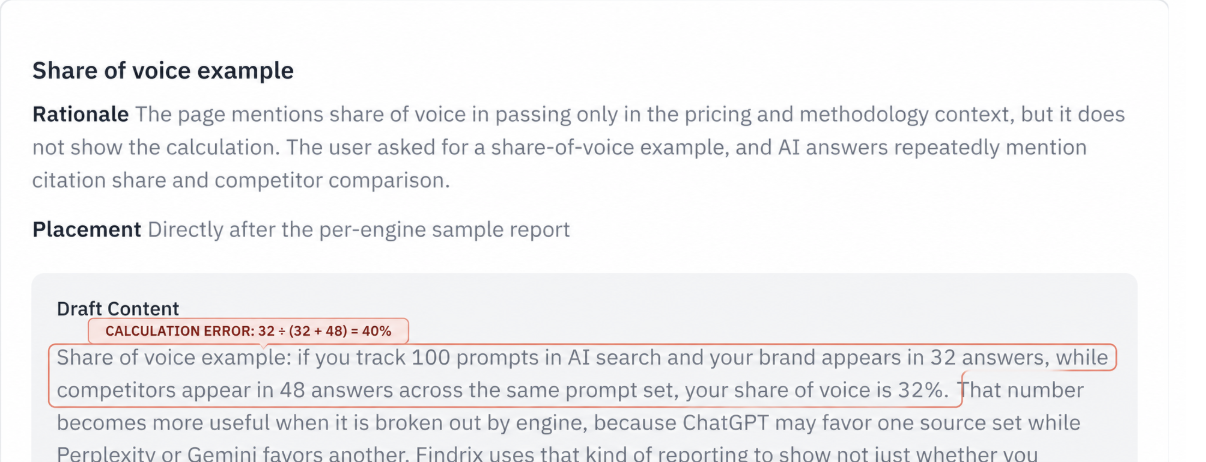
The GEO Writer output worked better as an editorial brief than as publication-ready copy. In the generated rewrite, it invented a per-engine sample report — for example, "ChatGPT, 8 brand mentions, 3 competitor mentions, 2 citations" — without underlying data. It also said that 32 brand appearances versus 48 competitor appearances produced 32% share of voice; under the denominator described in the same output, the result would be 40%. The draft then called fixes "most likely to move the result" without evidence. These are publication-blocking factual errors, not cosmetic edits: GEO copy can create new claims for models to repeat.
Findrix's advantage is not "recommendations versus no recommendations." It is the workflow around them. Findrix maintains a working recommendation queue, connects a validated gap to a proposed change and owner, keeps review before implementation, records completed work in the Work Log, and targets the affected area for remeasurement. The practical gain is fewer manual joins: the team does not have to reconstruct the path across a monitoring dashboard, a separate audit brief, a task tracker, an outreach sheet, and the next report. Findrix keeps the finding, reviewed work, ownership, completion record, and follow-up measurement in one operating path.
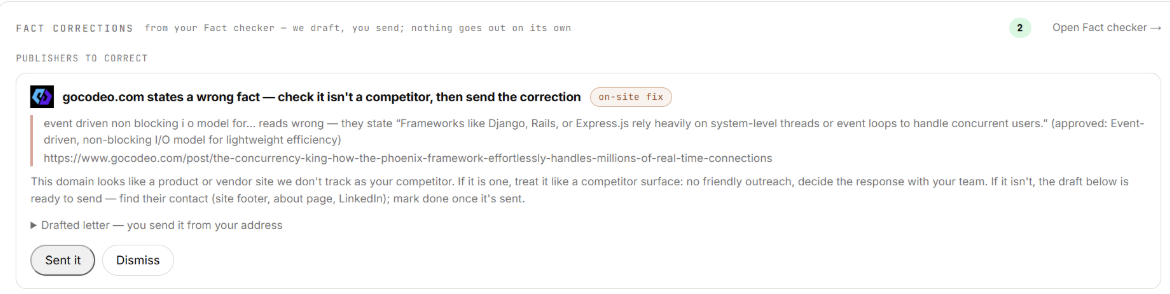
The same difference appears in off-site work. LLM Pulse can recommend pitching a person and provide an opportunity brief. Findrix continues from the influential source to available contact details and a draft pitch; the user still reviews and sends it.
Remeasurement is evidence, not automatic causality
Findrix remeasures completed work on the stable prompt set, creating a clearer before-and-after record. It still does not prove that one edit caused the change: model updates, competitor actions, and source changes can happen at the same time.
The defensible claim is narrower. Findrix reduces the disconnected steps between a validated finding, reviewed work, and the next measurement. Whether that lowers an agency's total cost-to-serve still requires time data or client cases.
Sources: platform intelligence or a faster decision?
LLM Pulse has strong source intelligence. It shows top citations, URL reports, cited pages, exact answers, and model-level response data. Its YouTube Intelligence and Reddit Intelligence organize citations by channel, video, subreddit, author, and thread views. Its Google Search Console connection can turn existing queries into tracked prompts. For teams that need platform-native monitoring, this breadth is a real advantage.
Some aggregate views are less actionable on their own. The Reddit subreddit table, for example, links to the subreddit rather than making the exact cited thread obvious in that view. The response and citation sections can still be used to investigate further, so this is a navigation limitation, not an absence of evidence.
Findrix's Influence Map is organized around the next decision. It groups sources by type and share of influence, then combines how often a source is cited, its trend, affected prompts, engines, whether the brand is already present, whether competitors are present, and an action label such as "You can get on," "Worth pitching," "Not a target," or "Competitor's site."
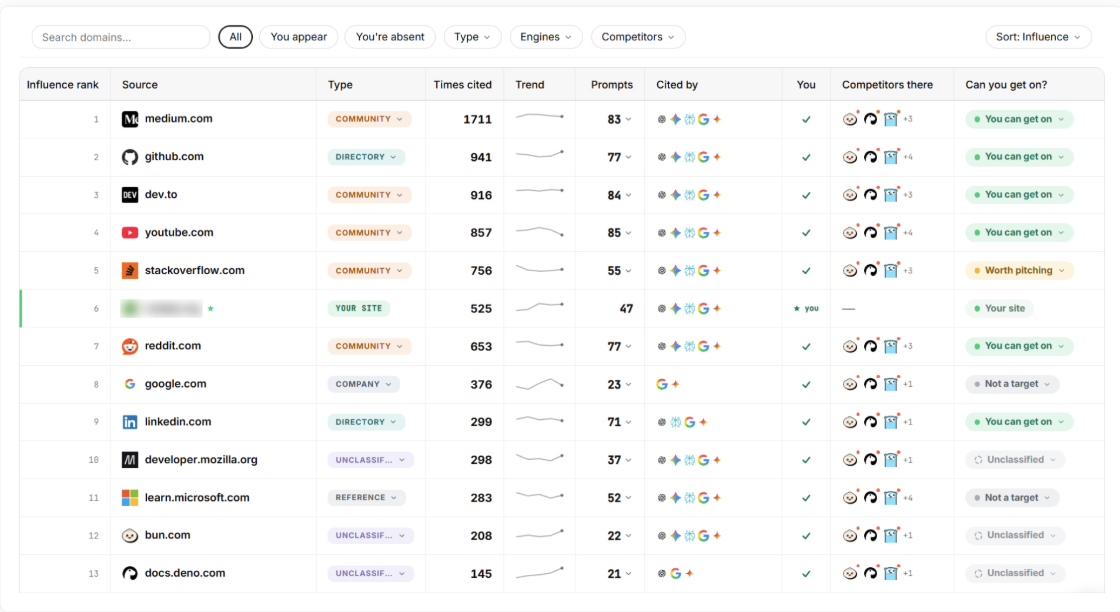
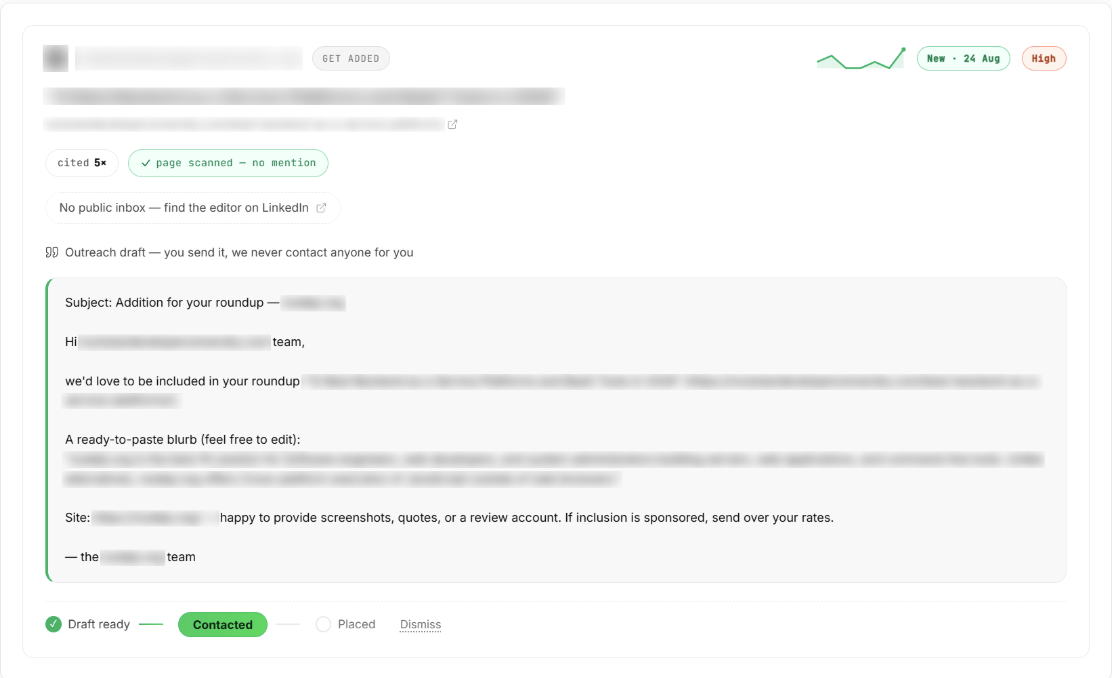
A user can expand a source into the exact buyer question, cited page and title, citation count, engine, and the answer that used it. For addressable opportunities, Findrix continues into contact discovery and a draft pitch. The limitation is that not every source is confidently classified; the product should not be presented as if all source decisions are automatic.
Who should choose which platform?
Findrix is the stronger choice when the team needs more than a monitoring surface: it needs a controlled path from a valid prompt set to an interpretable movement, reviewed work, and remeasurement. That makes the difference most consequential for teams that cannot afford to build a GEO measurement method around the software.
For an SMB without a dedicated GEO analyst, Findrix removes much of the methodology the buyer would otherwise have to supply. The marketer does not need to decide alone how many prompts are enough, clean near-duplicates, remember to separate branded visibility, judge whether a movement is normal variation, or translate every audit finding into a work brief. The practical job is simpler: identify the first problems worth fixing, review the proposed work, assign or implement it, and check the affected area afterward.
For an agency, Findrix acts as an evidence and delivery layer underneath the agency's own method. It creates a traceable record of what was measured, which movement was strong enough to act on, what was approved, who owned the work, what was completed, and what was remeasured. Preference and claim analysis, source-to-outreach work, the Work Log, and targeted follow-up give the agency a stronger basis for explaining both the recommendation and the result to a client. Agency plans are quote-based; contact team@findrix.ai to size the shared prompt pool for the agency's client portfolio.
For an in-house marketing team, Findrix is the better fit when the work includes correcting how models describe the brand, understanding why competitors are preferred, coordinating fixes across owners, and verifying the affected area afterward. It is designed to reduce the number of manual joins between measurement, decision, production, and follow-up.
Choose LLM Pulse when lower-cost monitoring breadth is the primary job and the team already has the expertise and process to validate the prompt set, interpret movements, review generated recommendations, and manage implementation separately. Its five entry-plan models, larger research surface, technical reports, traffic and crawler context, and platform intelligence are real advantages for that motion.
The practical verdict is not breadth versus depth. LLM Pulse gives teams more prompt capacity and flexibility; Findrix puts more control around which questions enter recurring measurement and how much confidence to place in the resulting movement, then carries the finding further into reviewed work.
For SMBs that do not want to become GEO analysts and agencies that must defend the work to clients, Findrix is the stronger operating choice.
Frequently asked questions
Is LLM Pulse only a monitoring tool?
No. It also includes recommendations, GEO Writer, technical reports, source and platform intelligence, and prompt research. LLM Pulse wins on breadth; Findrix distinguishes itself through the controlled path from validated measurement to reviewed work and remeasurement.
Does LLM Pulse separate branded and non-branded prompts?
Yes, through the Brand Type filter. They remain in the aggregate by default, so users must apply the filter for a non-branded competitive rate. Findrix excludes branded prompts from its non-branded headline.
Does LLM Pulse show how its AI Visibility Score is calculated?
Yes. It is an aggregate prominence score based on mention position: position one receives 100 points, position two 50, position three 33, and so on.
Which tool explains why a brand is preferred?
Findrix. Preference Score and Brand Image in AI connect position, head-to-head wins, tone, claims, and USP or use-case categories. We did not find an equivalent preference and claim-positioning layer in LLM Pulse.
Which tool is better for agencies?
Findrix fits agencies accountable for a defensible result and the path through implementation and remeasurement. LLM Pulse fits agencies prioritizing broad monitoring, reporting, technical audits, traffic, crawlers, and research.