

 Deutsch
 Français
 Español
 Português (Brasil)
 Italiano
Findrix vs Peec AI: Pricing, Features, and Key Differences
 Evgeniya Zemlyanskaya16 min readAugust 11, 2026
TL;DR
Choose Findrix when your team needs to automate the path from an AI visibility gap to production-ready changes; choose Peec AI when daily monitoring and reporting are the main deliverables.
In this 2026 comparison, Findrix and Peec AI track brand visibility, citations, sentiment and share of voice across ChatGPT, Perplexity, Gemini, Google AI Overviews and Google AI Mode. Findrix adds confidence intervals and drafted fixes across content, technical issues, brand facts and outreach, while Peec AI emphasizes daily reporting and prioritized Actions.
Findrix is an action-based AI visibility and GEO platform that turns ongoing tracking and analysis of a brand's presence across AI answers and search into fast optimization, built for brand managers, marketing leaders, and agencies running AI search for their clients.
Disclosure: The author is Product Marketing Lead at Findrix. Peec AI's features and pricing were reviewed using its public documentation, pricing pages, and a hands-on product test. Findrix details are based on the company's current product documentation and pricing.
Findrix vs Peec AI in 60 seconds
Choose Findrix if your team needs to automate the path from an AI visibility gap to a production-ready change. Choose Peec AI if daily monitoring and reporting are the main deliverables. The practical differences are how much confidence you can place in the reported movement and how much work remains between spotting a gap and publishing the response.
They both track AI visibility. Peec focuses on daily monitoring, share of voice, sentiment and citations. Findrix combines monitoring with implementation-ready drafts that the user reviews, adjusts and publishes.
Findrix tracks five major engines: ChatGPT, Perplexity, Google AI Overviews, Gemini and Google AI Mode, with Claude and Grok as add-ons. It drafts work across four areas: factual accuracy in AI answers, on-site content, technical changes and off-site mentions. The user reviews each draft and routes implementation to the appropriate owner. Entry is $49/mo, Growth at $99/mo adds the drafted fixes, and the trial runs 7 days.
Choose Findrix if your team wants to cut the manual work and time between detecting an AI visibility gap and getting the fix ready for production. Choose Peec if daily monitoring and reporting are the main deliverables and your team already has the resources to act on them. For agencies, the split is by what you are paid for: if the audit report is the deliverable, Peec fits; if you are on the hook to move the client's metric and defend it, Findrix fits.
Findrix vs Peec AI: the full comparison at a glance
Key plan and workflow differences.
| Capability | Findrix | Peec AI |
|---|---|---|
| Entry price | $49/mo per site (Presence) | $95/mo (Starter) |
| Mid-tier | $99/mo (Growth) | $245/mo (Pro) |
| Top self-serve | $199/mo (Authority) | $495/mo (Advanced) |
| Engines at top self-serve | 5: ChatGPT, Google AI Overviews, Perplexity, Gemini, Google AI Mode, plus Claude and Grok as add-ons | 3 models, even on Advanced; more only via paid add-on or Enterprise |
| Engine add-on cost | Claude +$24 to $69/mo, Grok +$29 to $89/mo | $35 to $165/mo per extra model |
| Prompts tracked | 60 to 180 on public plans; higher volumes available on custom plans | 50 to 350 on public plans; custom limits available on Enterprise |
| Uncertainty shown | Yes, confidence ranges on supported visibility metrics | No. Every metric is a single number: we found no confidence interval in the product we tested, and none in Peec's public methodology |
| Multi-region | Included. Findrix separates country- and language-specific visibility so local retrieval differences are not hidden inside one global score. | Starter: 1 country per project; Pro and Advanced: 3. Supported countries and languages do not add to the plan price |
| Action layer | Fixes drafted across off-site, on-site, new content and technical patches, grounded in your Findrix Data Room (facts + USP), written and ready for you to apply | Actions: a scored, prioritized to-do of opportunities; by Peec's own account it does not write the content for you |
| Technical site audit | Crawler access and on-page readiness: robots.txt, schema and structured data, with the fix queued for you | Crawler access only: robots.txt checks across 40+ AI bots and AI-crawler logs, observed not fixed |
| MCP integration | Coming | Yes; connects Peec data to Claude or Cursor |
| Free trial | 7-day trial and free audit | 7-day free trial, card required |
| Team seats | Unlimited | Unlimited |
| Best for | Teams that want implementation-ready drafts | Teams with execution resources in place |
Pricing checked on August 7, 2026. Monthly billing, excluding VAT. Peec may display localized pricing.
What matters when comparing AI visibility tools
AI search is already shaping product research. In Semrush's 2026 buyer-journey study, 48% of U.S. consumers who have tried AI use it daily, 55% use it for product research at least weekly, 43% have discovered a new brand through an AI tool, and 77% combine AI with traditional search. Measurement is less mature: only 9% of marketing leaders say they can track everything that matters in AI answers. The category is still early enough for brands to build a citation advantage before measurement practices mature.
The category went from a handful of tools to a crowd almost overnight: G2's answer-engine-optimization category listed 462 by mid-2026. Feature lists often look similar, but pricing, trial terms, measurement methods, included engines and execution workflows differ materially. Those are the fields teams need to compare before buying.
Methodology: where Peec's measurement base is weaker
A useful dashboard must separate repeatable signals from one-off model outputs.
Peec's public prompt documentation describes a straightforward workflow. Its suggestion engine generates prompts from a website, industry context and prompts already in the project; users can also add prompts manually or via CSV. Once accepted, prompts enter a 24-hour cycle. Visibility is calculated as the share of tracked responses that mention the brand.
This is useful for monitoring a chosen prompt list. It does not, however, establish that the resulting score represents the wider market. Peec explains how prompts are generated and organized, but its public methodology does not describe how the final set is tested for coverage across buyer contexts. Nor does it disclose repeated-run calibration, uncertainty ranges or a threshold for distinguishing a real change from normal model variation. A daily cadence produces more observations; by itself, it does not make the measurement more reliable.
For an agency, this decides whether the reported number is defensible in front of a client. No one reviews a client's visibility prompt by prompt every day; the client's real question is whether a change is genuine. Findrix answers it with a calibrated Golden Set, a reported uncertainty range and movement read against the niche, so an agency can show a client the change is real, not model noise.
Prompt Volume does not resolve this limitation. Peec presents it as a relative 1-to-5 score combining search trends, AI conversation data and external signals. It is not an observed count of how often buyers submit a specific prompt to an AI engine, and Peec does not publish enough information about its sampling, weighting or validation to treat it as one.
Findrix starts from a different measurement objective. It does not attempt to reproduce every way buyers might speak to an AI assistant. That universe is unobservable and constantly changing. Instead, Findrix uses a stable, user-approved Golden Set to sample the category across materially different buying contexts until additional prompt variations stop materially changing the measured picture.
The goal is not maximum prompt volume, but sufficient coverage without redundant noise. A large cluster of near-duplicates can still produce a misleading dashboard.
Before reporting a trend, Findrix checks whether the benchmark provides adequate coverage and whether observed movement can be distinguished from normal model variation. It reports an uncertainty range and interprets brand movement against the behavior of the wider niche. Findrix published the principles and outputs; the exact construction and validation procedure remains proprietary.
Peec measures performance across the prompts selected for the project. Findrix also tests whether its benchmark covers enough of the niche to support comparison and whether an observed change exceeds the model's normal noise. It reports each engine separately, does not present estimated Prompt Volume as observed demand and starts a new trend whenever the approved prompt set changes. Read the full Findrix methodology.
Metrics and measurement design
Both Findrix and Peec AI tools report share of voice, sentiment, position and citations. The useful distinction is how those metrics support the next decision.
What Findrix tracks
- Visibility and share of voice, how often you appear and how you stack up (both tools)
- Sentiment and position, tone and rank inside the answer (both tools)
- 95% confidence ranges on supported visibility metrics (Findrix)
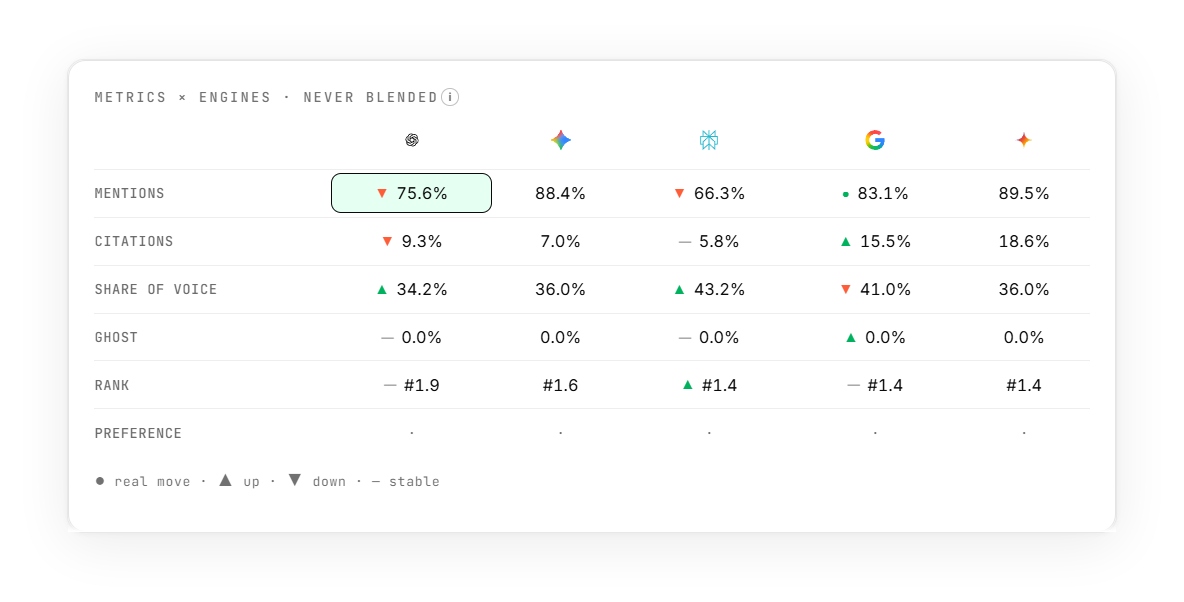
- Every metric kept per engine, never blended into one average (Findrix)
- Visibility by buying stage, split across the funnel (Findrix)
- Preference Score, how strongly a model favors you once you appear (Findrix)
- Facts and Positioning, every answer graded against your Findrix Data Room (Findrix)
- Source map and winnable prompts, which domains a model trusts and where no one is named yet (Findrix)
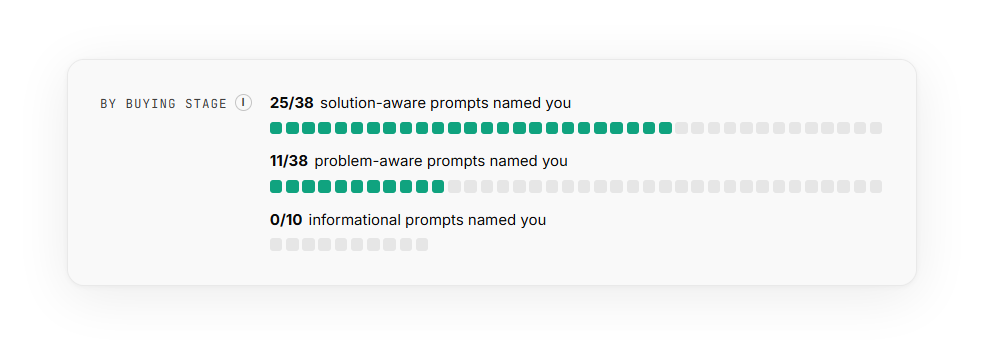
Findrix also segments visibility by buying stage. In one DTC luggage brand run, the brand appeared in 25 of 38 solution-aware prompts, 11 of 38 problem-aware prompts and 0 of 10 informational prompts. This helps a team distinguish commercially relevant recommendation queries from broader informational coverage. In our hands-on test, Peec's self-serve product did not include an equivalent buying-stage visibility view.
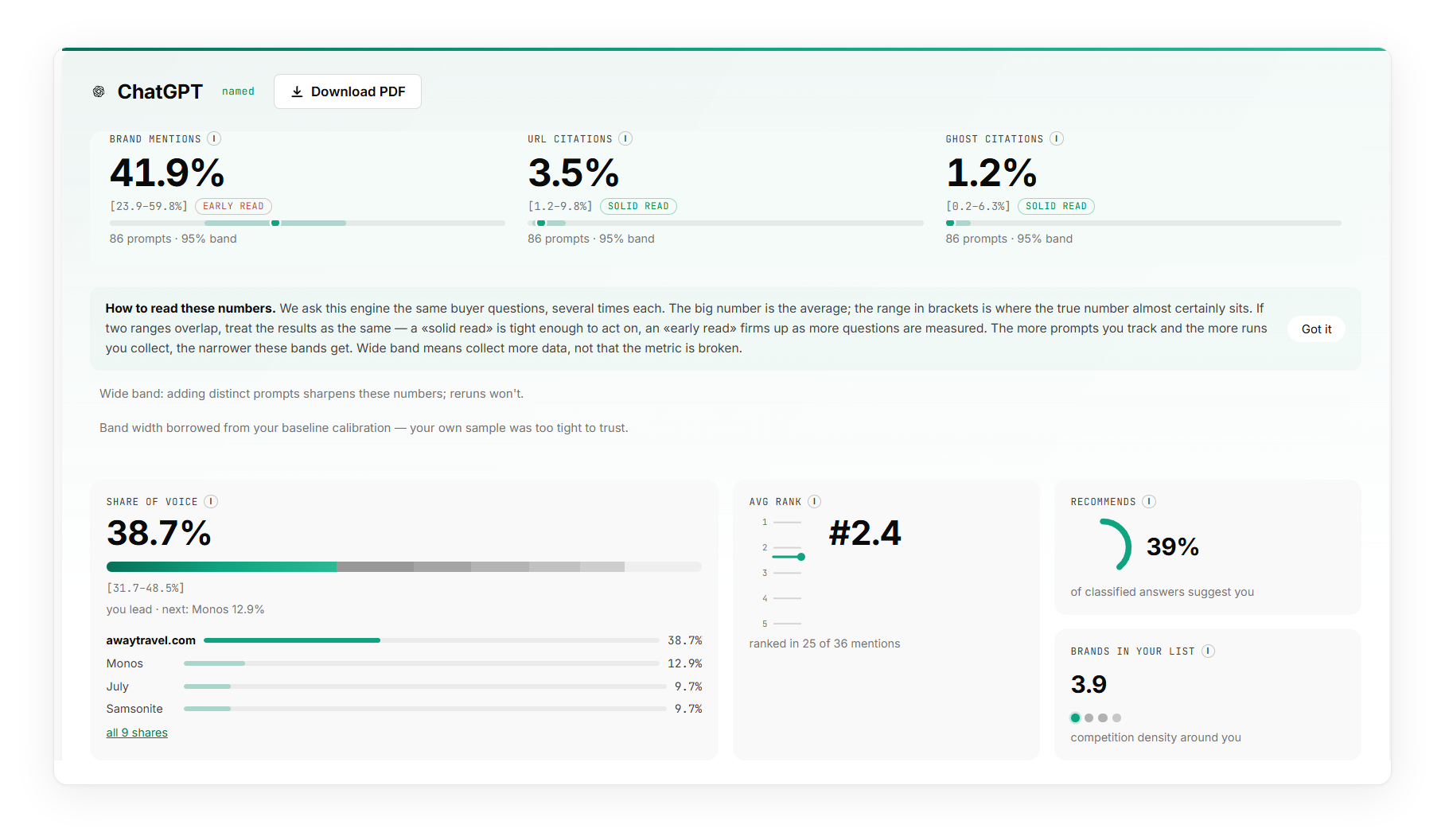
Findrix reports a confidence interval alongside each metric. On the same run, ChatGPT brand mentions were 41.9%, with a confidence interval of 31.2% to 52.5% while the model was still calibrating. Answers can vary with phrasing, context, geography and time; the range helps the team distinguish likely movement from normal variation.
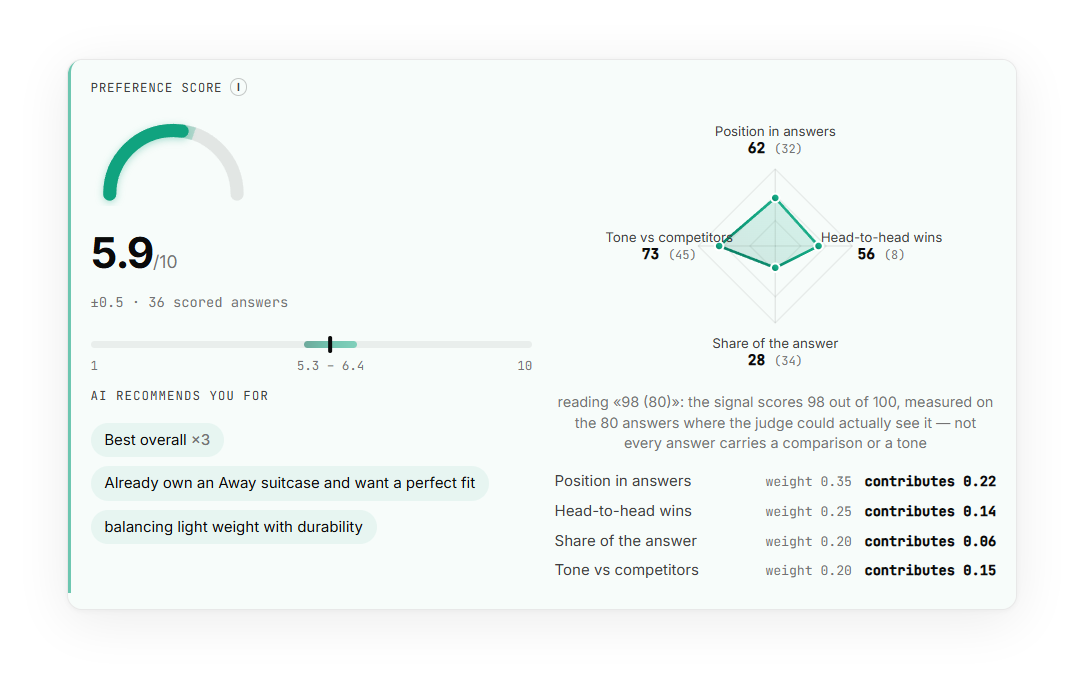
In our hands-on test, Peec's self-serve product did not include a metric equivalent to Findrix's Preference Score. Sentiment describes the tone of a mention; Preference Score estimates how strongly a model favors a brand once it appears. Findrix withholds the score until enough mentions have been evaluated and labels thin samples accordingly.
Working with the raw answers
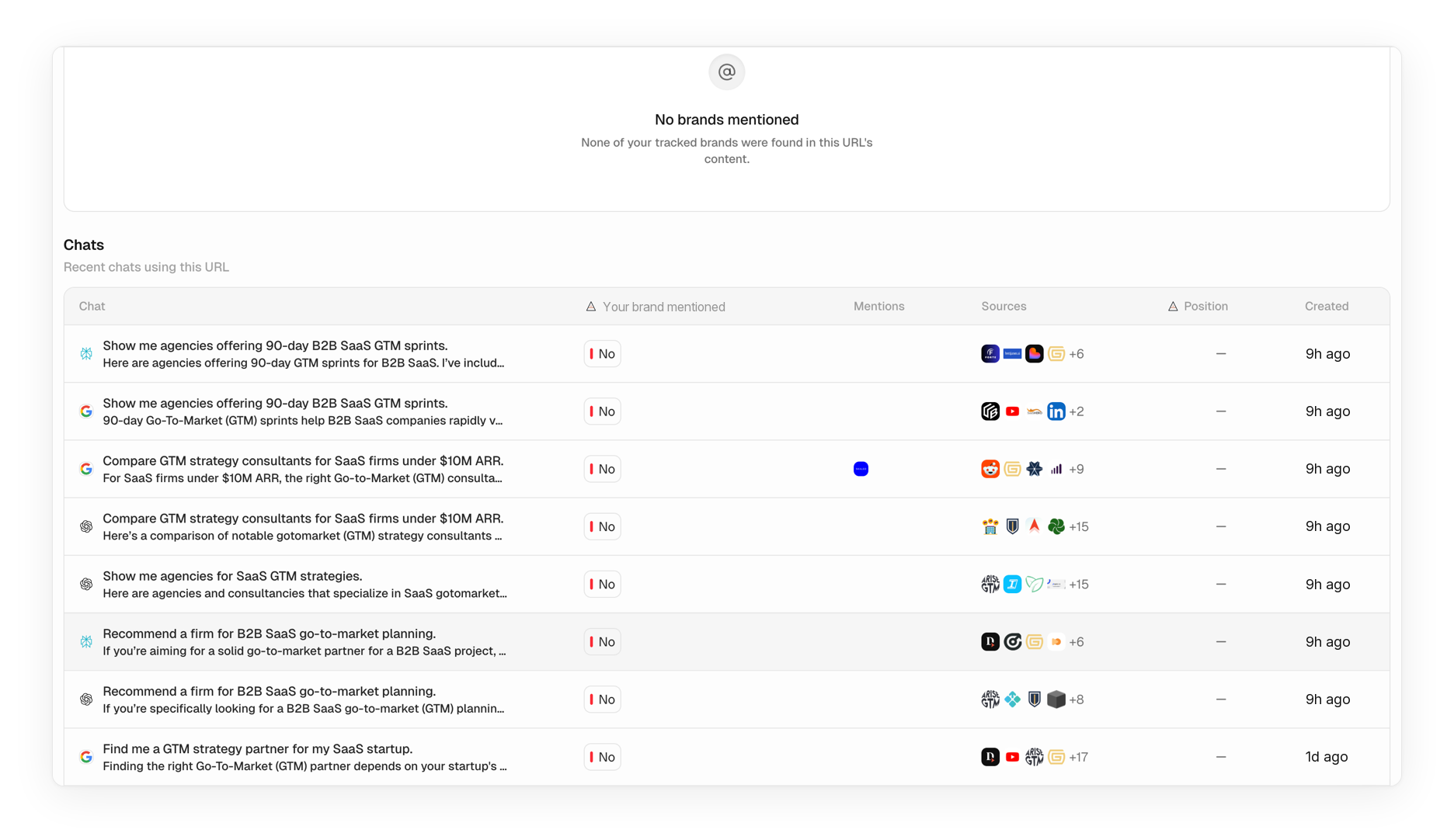
Both tools Findrix and Peec AI expose the model's verbatim answers. In Peec's Recent chats you open a response, read it in full, and see which competitors got named alongside you, a useful way to find the prompts worth writing content for.
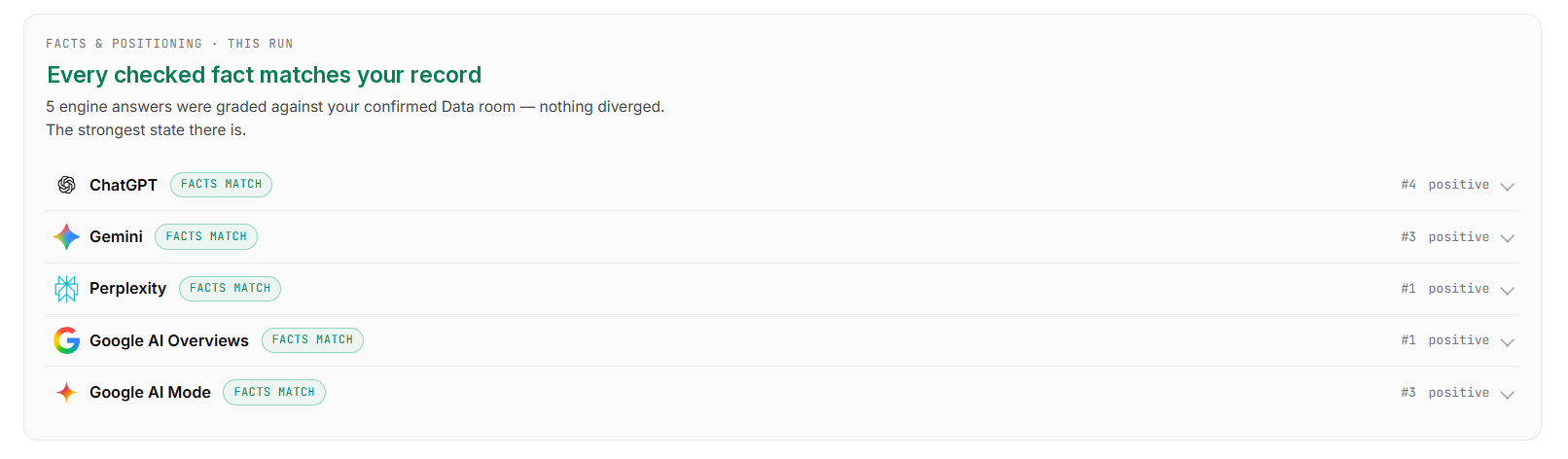
Findrix starts in the same place and adds one check on every prompt: Facts and Positioning. Each engine's answer is graded against your confirmed facts in the Findrix Data Room, so you catch the moment a model invents a spec, misquotes your pricing, or frames you incorrectly, not just whether your name showed up. You see it per engine on the run: where you rank, whether the tone is positive, and whether each engine's facts about you hold up, with a flag when something diverges. In our hands-on test, Peec's self-serve product did not include an equivalent check against a customer-approved fact base.
For an established brand, a wrong price or specification can be more damaging than a missing mention.
Peec AI: strengths and limitations
Peec AI is a Berlin-based monitoring platform. You connect a brand, choose three models from its lineup (ChatGPT, Google AI Mode, Google AI Overviews, Copilot, Perplexity and Gemini), and Peec runs the prompts daily. The dashboard reports share of voice, sentiment, position, cited sources and competitor performance.
Looker Studio reporting is listed on Advanced ($495/mo on monthly billing). Peec also offers an MCP server for accessing data in Claude or Cursor, plus a robots.txt checker covering 40+ AI bots and AI-crawler logs.
Peec fits teams that need monitoring and already have the people to act on the findings.
Pricing caveats
Three things worth knowing before you buy.
First, additional-model pricing. Every self-serve tier includes three models. One additional model costs $35/mo on Starter, $85/mo on Pro, or $165/mo on Advanced. The full math is in the pricing section below.
Second, Peec Starter includes one country per project, while Pro and Advanced include three. Peec says supported countries and languages do not add to the plan price. Confirm that the plan's country allowance covers the markets you need to track.
Third, Actions stops at recommendations, and Peec's own documentation says so clearly. Actions clusters gaps into a prioritized to-do, separates owned and earned media, and scores each opportunity. It does not write content: "it doesn't write content for you... we suggest options. You decide what to build." Some recommendations therefore require separate content, PR or community work.
Findrix: from measurement to implementation
Findrix tracks ChatGPT, Google AI Overviews and Perplexity from Presence, adds Gemini and Google AI Mode on Growth, with Claude and Grok as add-ons. Multi-region is in from the entry tier. Sentiment, source breakdown, competitor share of voice, the buying-stage split and the Facts and Positioning check all sit in the base dashboard.
How much work remains between identifying a visibility gap and publishing the response? Both products (Findrix and Peec AI) can turn findings into tracked actions. Peec Actions prioritizes owned- and earned-media opportunities, from product pages and comparison content to publishers and forums. In the self-serve product we tested, Peec Actions identified what may be worth creating but did not draft the content itself. Findrix works across four areas:
- Facts. The Facts and Positioning check grades every answer against your Findrix Data Room, so when a model gets a spec or a claim wrong, you catch it and correct the record.
- Technical. Crawlability, schema, site structure and targeted page updates, such as refreshing a date or restructuring a section for clearer machine interpretation.
- Content patches. The edit itself, in text: a rewritten H2, an added section, a comparison block, a TL;DR at the top, with the exact copy and where it goes. And when a whole page is missing, a first draft of it.
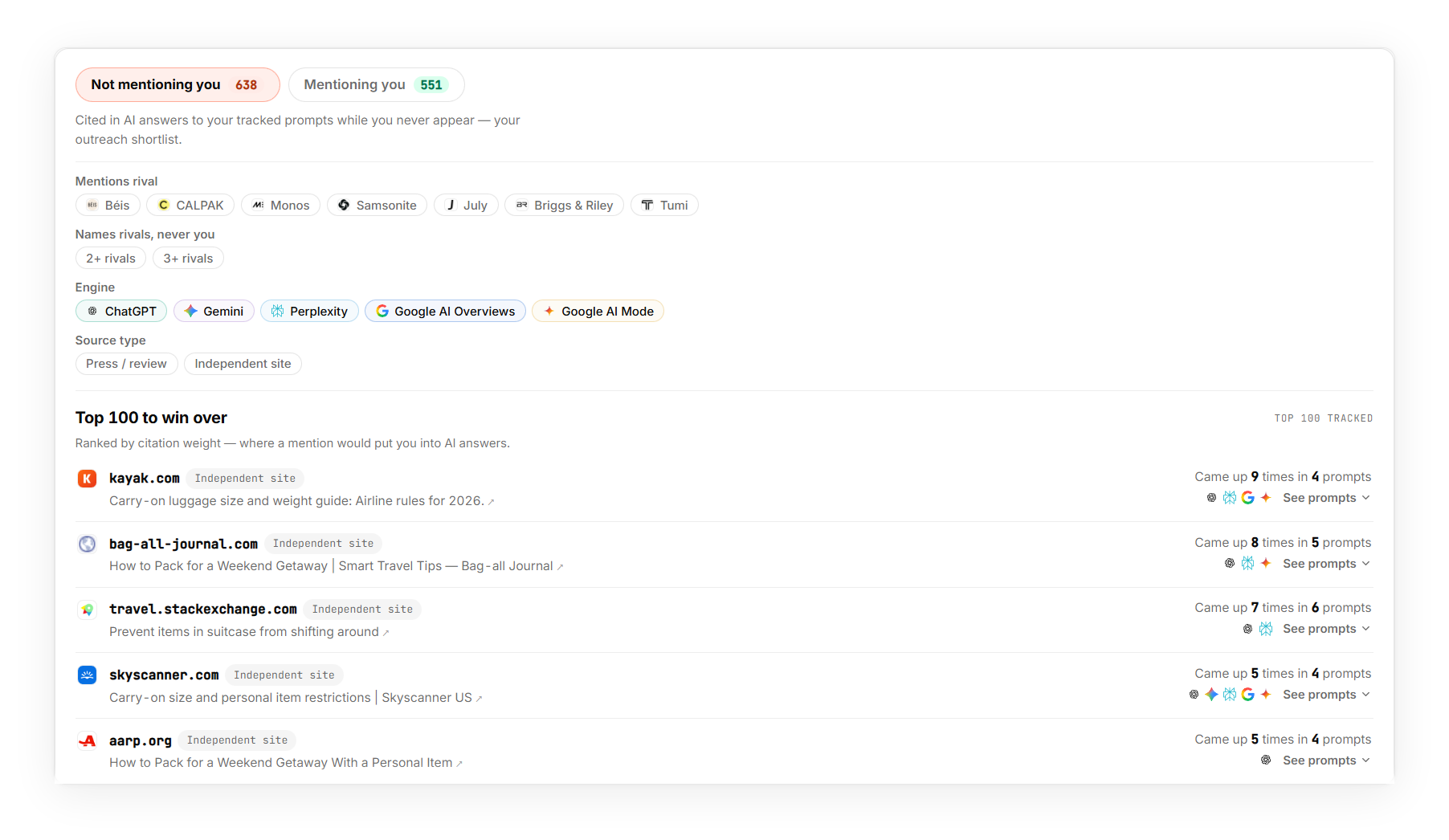
- Outside platforms. Findrix ranks attainable off-site mentions from the sources cited for relevant prompts, prepares an outreach draft and finds available contact emails for the team to review and use.
Findrix grounds each draft in the Findrix Data Room: confirmed facts, positioning, USP and ICP. This reduces generic output, but it does not remove the need for human review.
Findrix produces an implementation-ready draft that the user reviews, adjusts and publishes. Content and technical changes remain in the workflow until the user marks them Done in the cabinet, creating a record of what was implemented before the next measurement.
Findrix trade-offs
Two things to know before buying.
- Findrix is a newer product. Smaller customer base, fewer public case studies. If your procurement process depends on a longer track record and a larger library of customer evidence, Findrix may not yet clear that bar.
- The written fixes start at Growth ($99/mo), not Presence. If you only need monitoring and a prioritized fix-list, Presence at $49/mo covers it. But the written, ready-to-apply copy for unclaimed prompts starts on Growth. Worth knowing before you sign up on the entry tier expecting it.
Pricing: the sticker and the real bill
On monthly billing, Findrix starts at $49 and Peec at $95. Plan economics differ by prompt volume, tracking frequency, included engines and reporting.
Peec Pro includes 150 prompts tracked daily for €205 per month, while Findrix Growth includes 100 prompts tracked weekly for $99 per month. Findrix offers more prompt capacity relative to its listed monthly price, while Peec runs each prompt more frequently. Peec displays localized pricing, so the currency shown depends on the billing region.
Take a brand that needs Peec's core monitoring plus Claude and a Looker Studio connector. Looker Studio is listed on Advanced, so the plan starts at $495; adding Claude for $165 brings the total to about $660 per month. Confirm that the plan's country allowance covers the markets you need to track.
Findrix Growth plus Claude costs about $138 per month and includes five core engines, every region and in-product reporting. It does not include a Looker Studio connector, so this is a comparison of engine coverage and product reporting, not identical BI integrations.
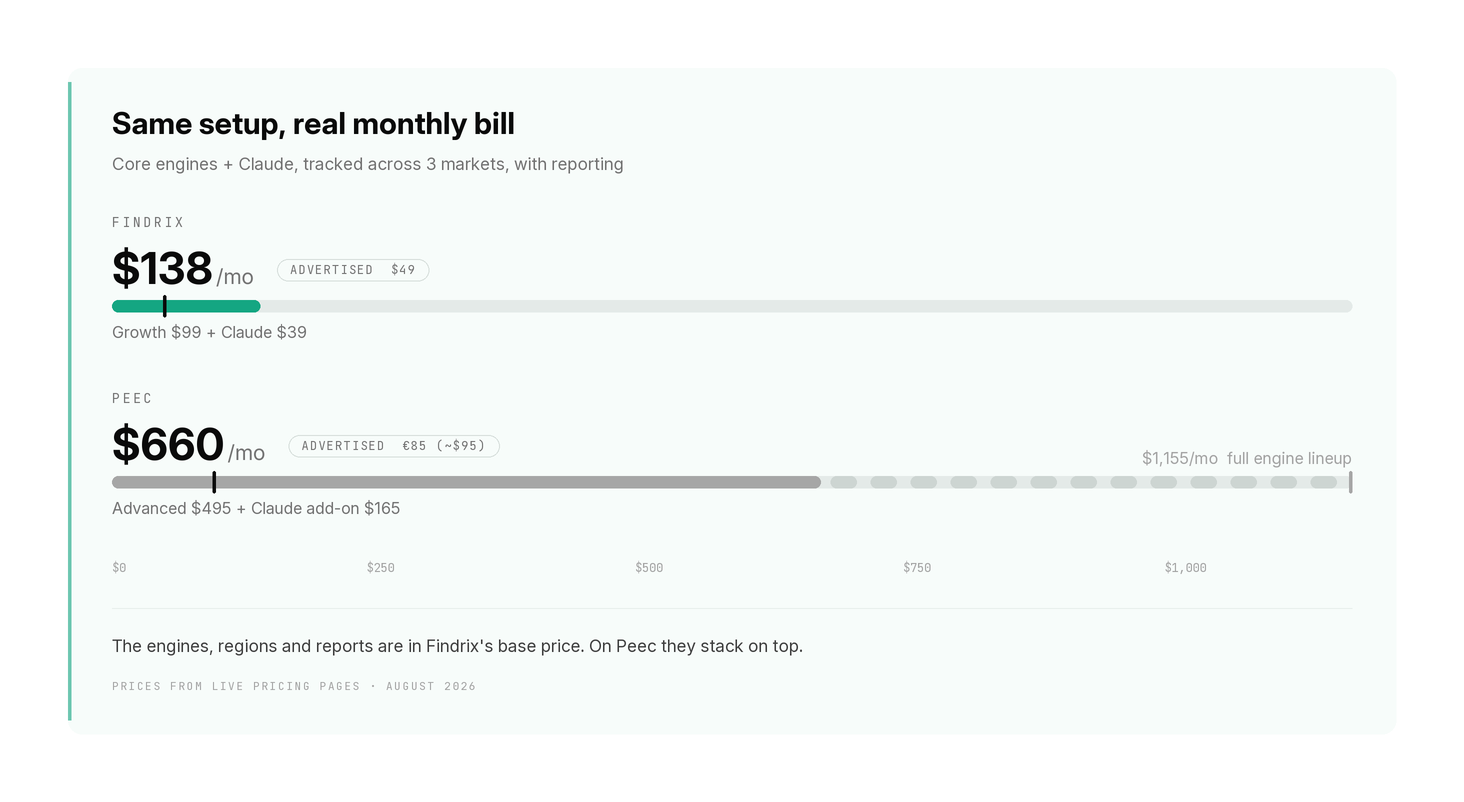
If Looker Studio is a hard requirement, Peec Advanced has the clearer fit. If it is not, Findrix costs less for five core engines, Claude and the implementation workflow.
Example workflow
A marketing lead opens Findrix after the weekly tracking run and sees three types of issues:
- A competitor is recommended for a high-intent category prompt.
- Google AI Overviews cites a competitor page instead of the brand's relevant page.
- An AI answer contains a factual error about the product.
For a content gap, Findrix drafts a page edit and shows where it belongs. For a factual issue, it checks the answer against the Findrix Data Room and flags the discrepancy. For a technical issue, it prepares the recommended change for the responsible teammate. For an off-site gap, it ranks the relevant cited sources, drafts an outreach message and finds available contact emails.
The user reviews and adjusts each draft, routes technical work to the appropriate owner, publishes approved content and marks each implemented content or technical change Done in the cabinet. The team reviews and sends the outreach itself. On the next fixed-set run, it checks whether the answer, facts and citation set changed.
How to choose
| If this is you | Best choice | Because |
|---|---|---|
| You resell visibility audits across many client brands, and the report itself is the deliverable | Peec AI | When the audit report is the product you sell, Peec's multi-client workspaces and centralized billing fit that reporting motion |
| You are an agency paid on outcomes, running GEO-as-a-service | Findrix | You have to move the client's metric and defend it to the client, so you get concrete fixes to apply, the technical layer agencies struggle to staff, and a confidence ranges on supported visibility metrics |
| You sell developer tools where Claude or Grok drive buyer research | Peec AI Enterprise | Enterprise unlocks the full model lineup, up to 11, Claude included |
| You are a B2B SaaS founder tired of waiting on developers to ship fixes | Findrix | Concrete fixes to review and route to the appropriate owner |
| You are a DTC operator losing share in ChatGPT Shopping or Gemini | Findrix | Five core engines are included, with page and technical changes prepared for review |
| You need to track more than one country on an entry plan | Findrix | Multi-region is included on Findrix; Peec Starter includes one country per project, while Pro and Advanced include three |
Findrix for agencies
An agency running GEO-as-a-service carries two jobs a monitoring dashboard leaves open: move the client's metric, and get the client to trust that the number is real. Findrix is built for both, which makes it the fit for agencies measured on the outcome rather than on the report.
Both Findrix and Peec give you the visibility numbers to show a client. Findrix also gives you a stronger basis for interpreting those numbers: confidence ranges on supported metrics, each engine reported separately, and brand movement read against the wider niche instead of in isolation. When a client asks why they should believe the figure, you have a published rationale to point to, not a single day's reading.
The daily-versus-calibrated question matters most here. Running prompts every day produces more observations, not less noise, and no agency reviews a client's visibility prompt by prompt each morning. What the client actually asks is whether a reported change is genuine. Findrix answers that with a stable, approved Golden Set, a reported uncertainty range, and movement interpreted against the niche, so the trend you present is one you can stand behind.
Findrix also shortens the work between spotting a gap and closing it. The drafted fixes across facts, on-site copy, technical patches and off-site outreach are a ready action plan your team reviews, adjusts and applies, plus the technical layer agencies often struggle to staff. Your team still does the work, but with the plan already drafted, each hour they spend returns more client value.
If neither tool fits
- Otterly — low-cost monitoring.
- Profound — enterprise analytics and governance.
- Athena — broader engine coverage.
Run a Free Findrix Audit
The free audit shows where your brand appears, which competitors outrank it and which gaps are worth reviewing first. Findrix produces implementation-ready drafts that you review, adjust and publish, with each completed change tracked before the next measurement.
Frequently asked questions
What is Peec AI?
Peec AI is a Berlin-based AI visibility platform, founded in 2025. It tracks how often your brand shows up in answers from ChatGPT, Perplexity, Gemini, Google AI Overviews, Google AI Mode and Copilot. On monthly billing, brand plans run from $95 a month for 50 prompts on three models to $495 for 350 prompts, five projects and Looker Studio reporting. It is at its best as a reporting dashboard, for teams whose deliverable is the visibility report, with the execution handled elsewhere.
What does Peec AI do?
Peec monitors AI answer engines and reports where your brand appears, how it is described, which sources get cited, and how often competitors show up next to you. It also has Actions, which turns that data into a prioritized, scored to-do of content and channel opportunities, and an MCP server that pipes the data into Claude or Cursor. By Peec's own account, Actions suggests what to work on; it does not write or ship the fix.
Which tool provides ready-to-implement fixes?
Findrix prepares on-site copy, technical recommendations and off-site opportunities for review. Peec Actions provides prioritized opportunities and next steps but, by Peec's own documentation, does not write content. In both cases, a person decides what to implement.
How is Peec AI different from other GEO/AEO tools?
Peec is monitoring-first: its strengths are an MCP integration and Actions, which prioritizes and scores your content opportunities, with writing and shipping the fix handled outside the tool. Both tools serve agencies, and Findrix is the fit for agencies measured on moving the client's metric: it drafts changes across factual accuracy, technical setup, owned pages and off-site sources; the user reviews, adjusts and publishes them; and every number carries a confidence interval you can defend to a client.
How to monitor AI search without Peec AI?
Findrix Presence ($49/mo) covers ChatGPT, Google AI Overviews and Perplexity with weekly tracking and a ranked fix-list. Growth ($99/mo) adds Gemini and Google AI Mode, plus page edits, FAQ blocks, technical recommendations and off-site opportunities for review. Otterly is a lower-cost monitoring option, Athena covers a broader engine set, and Profound is positioned for enterprise teams.