

 Deutsch
 Français
 Español
 Português (Brasil)
 Italiano
How AI Search Engines Retrieve and Cite Sources
 Evgeniya Zemlyanskaya15 min readOctober 29, 2026
TL;DR
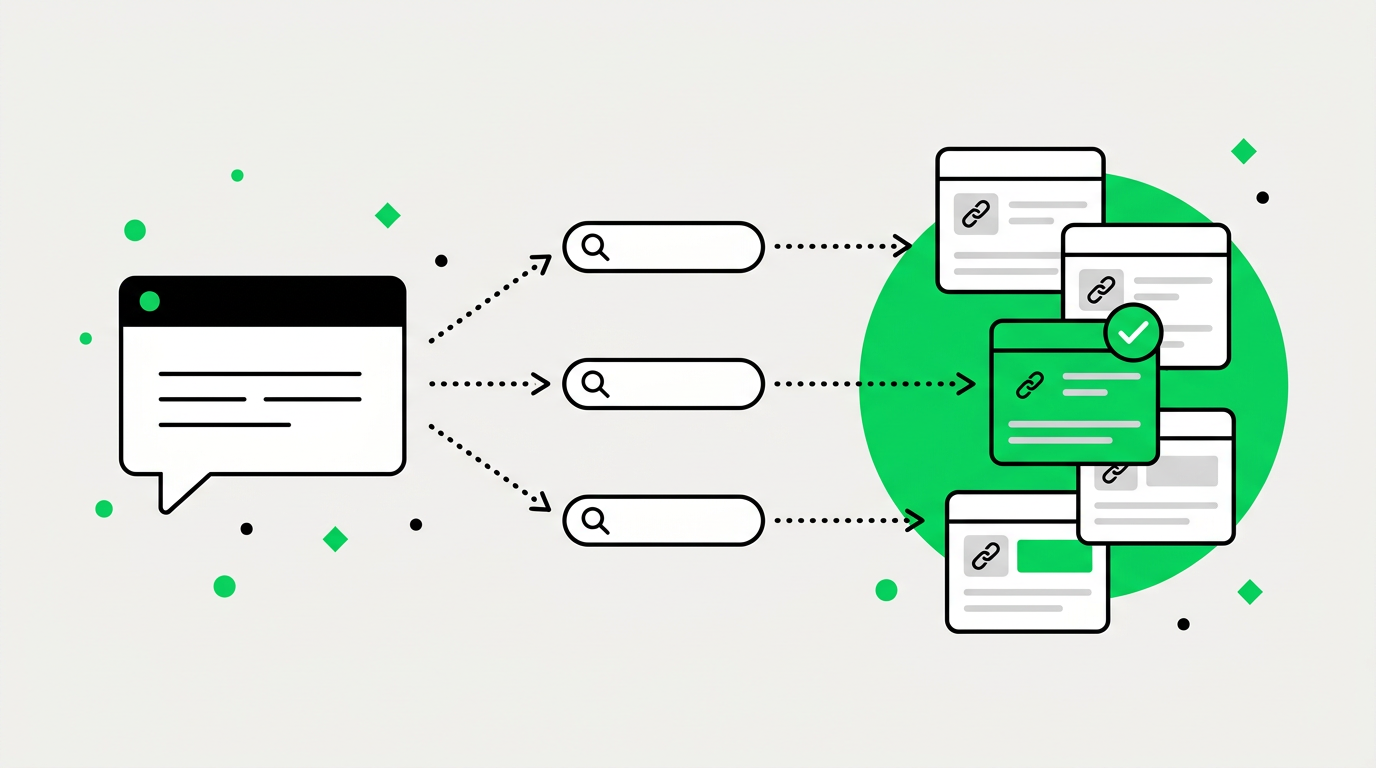
AI search engines answer a buyer's question in six steps: they decide whether to search, fan the prompt out into sub-queries, build a shortlist of pages from their own search pool, select a few, write the answer and attach links. A page can be cited only if it reaches that shortlist, and research finds that reaching it matters about ten times more than page formatting. ChatGPT, Google AI Mode and Gemini use different pools and show links differently: in Findrix Radar's October 2026 data, 95% of cited URLs appeared in only one engine.
Ask ChatGPT, Google AI Mode and Gemini the same buyer question and you will usually get three different source lists. In October 2026, Findrix Radar put 38,400 buyer questions across 39 niches in Australia and the US to all three engines. Of the URLs they cited, 95% appeared in only one engine, and 0.8% appeared in all three. ChatGPT attached 24.6 URLs to an average answer and kept about 65% of them in the Sources panel. Google AI Mode attached 3.7.
That is how AI search engines work in practice: the same chain of steps, run on different source pools and shown to the reader in different ways. A single "AI citations" number mixes all of this together. Each engine has to be read on its own terms.
Why a marketer needs to understand the mechanism
Most AI visibility work starts from a report: how often the brand is mentioned, which pages are cited, how that compares with competitors. Without knowing how the answer was built, that report is easy to misread. A link inside a ChatGPT answer, an entry in its Sources panel and one of four links in AI Mode get counted as the same citation. A strong position in one engine gets taken as a position in all of them, although each searches for a different pool.
The mechanism also shows where effort goes. The evidence points to reaching the engine's shortlist and answering the question in a specific passage, not to FAQ blocks or markup on their own. And because models write brands they already know into their searches, what the market knows about a brand affects what the engine looks for in the first place.
Six steps from a prompt to a cited answer
Every engine that answers with live web sources runs some version of this chain:
- Decide whether to search. The model judges whether the question needs fresh information from the web.
- Fan the prompt out. It rewrites the question into several narrower searches.
- Build a shortlist. Each search returns pages from the pool that engine uses.
- Select. The model chooses a few pages from the shortlist to rely on.
- Write the answer. It composes the text from the selected passages and from what it already knows.
- Attach links. It ties citations to parts of the answer and decides where to show them.
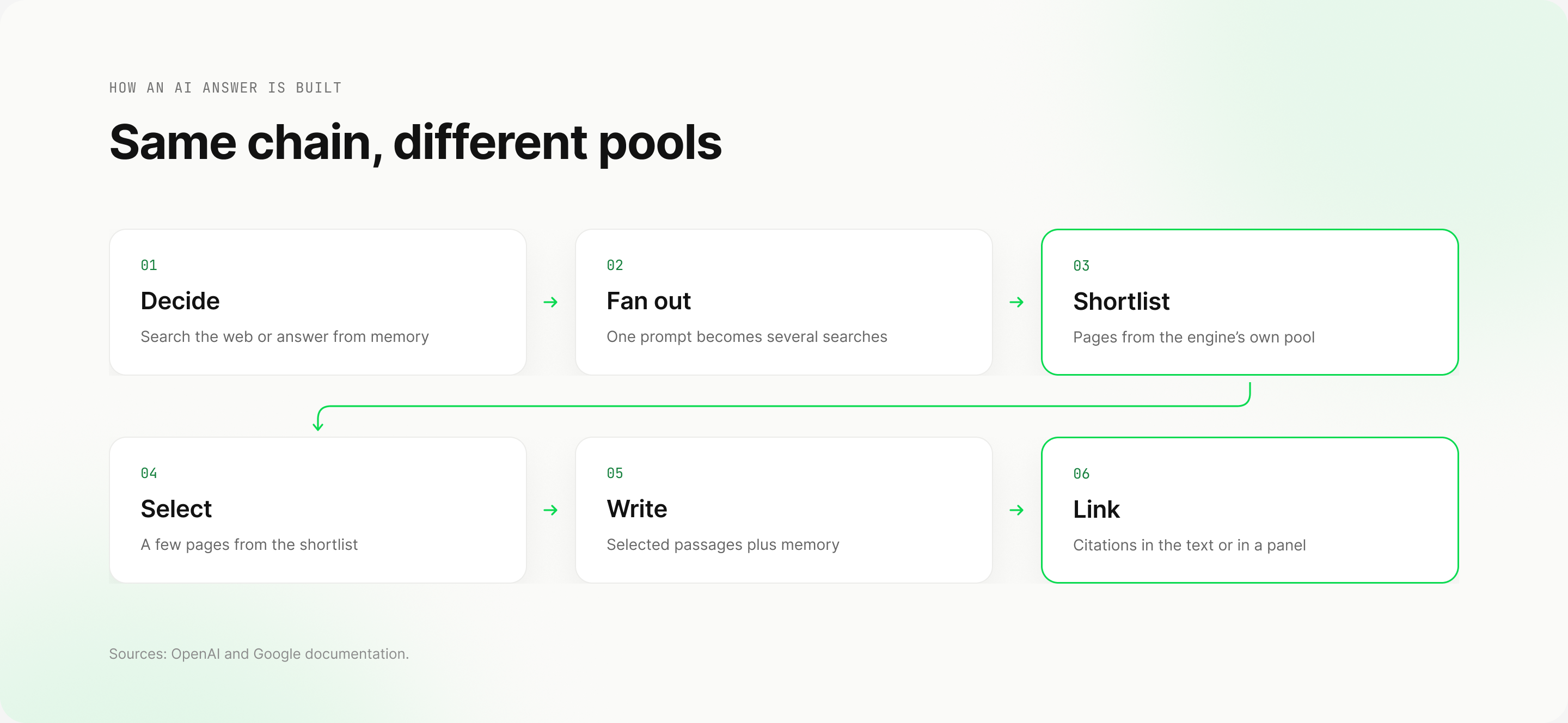
OpenAI and Google document these steps in general terms. Neither publishes the rules inside a step. What follows comes from their documentation, from independent research and from Radar measurements, with each source's limits stated where it is used.
From one prompt to many searches: query fan-out
Where does AI get its information? From two places. The first is what the model learned in training: a fixed snapshot of text that stops at a cutoff date and carries no links. The second is what it finds when it searches the web at the moment of the question. The model decides whether the first is enough. OpenAI says ChatGPT searches automatically when a question might benefit from information on the web; Google's Gemini API documentation describes the same decision. For buyer questions, the second path is almost always switched on.
Across 38,400 buyer questions, 99.9% of ChatGPT answers, 95% of Google AI Mode answers and 87% of Gemini answers contained at least one link. When a buyer is choosing a product, the answer leans on web sources, not only on the model's memory.
The engine does not search the prompt as written. Google describes query fan-out in AI Mode as breaking a question into subtopics and running related searches on them at the same time, across the web index and other data sources such as the Knowledge Graph and shopping data. The scale varies by mode. For Deep Search, Google says the same technique can issue hundreds of searches for one question. For an ordinary answer, no engine publishes how many sub-queries it runs. OpenAI's documentation for ChatGPT Enterprise and Edu says it can turn a request into one or more search queries. A 2026 study that replayed ChatGPT's searches found that the sub-queries change from answer to answer: when the same question was asked twice on the same day, only 2.7% of the searches matched.
What does a sub-query look like? A Google patent application describes how a model can generate several types of query variants from one question. Applied to a buyer prompt, it might produce something like this:
Illustration built from the variant types in Google's patent, not the output of a real engine. Prompt: "Which CRM should a 10-person marketing agency in Sydney use?"
- Broader: best CRM for small marketing agencies 2026
- Narrower: CRM pricing per user Australia
- The buyer's next step: HubSpot vs Pipedrive for agencies
- What the task implies: CRM with client reporting for agencies
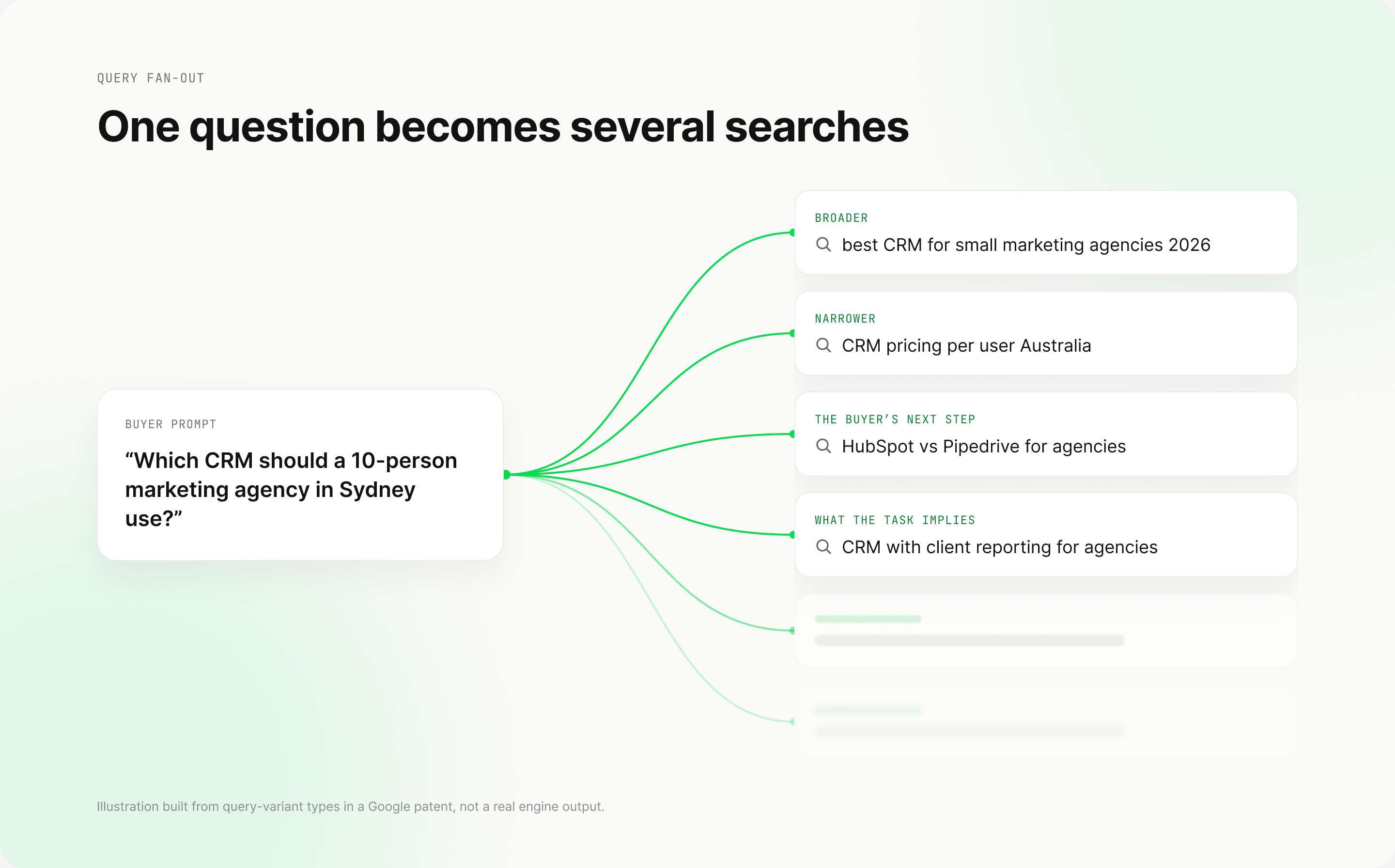
In the patent, the model can generate variants in several passes, and a separate model decides whether enough has been found or another round is needed. The variants can also take into account the time of the search and the task the user seems to be working on. The patent does not prove that AI Mode works exactly this way. It does show why a page written for one keyword can miss most of the searches behind a question. The same study found that a page returned by several of ChatGPT's searches had 10.8 times the odds of being cited.
Retrieval: each engine searches its own pool
Each search returns a set of pages. Together they form the engine's shortlist: the pages it has actually looked at before it writes. The engine cites only from this set.
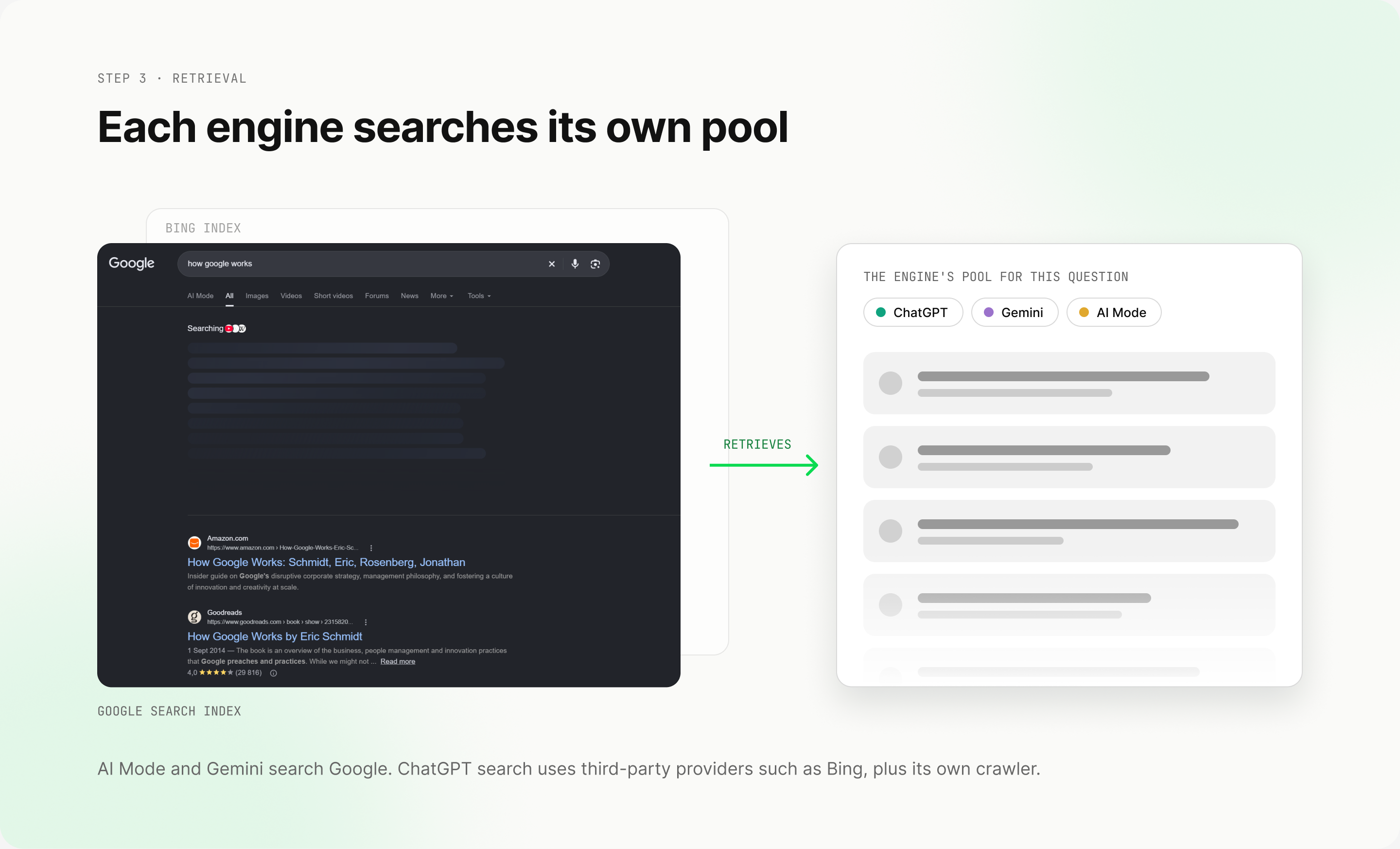
The pools differ by engine. Google says AI Overviews and AI Mode retrieve pages from the Google Search index. A page needs to be indexed and eligible to show a snippet; no special schema or AI text file is required. ChatGPT sends searches to third-party search providers such as Bing and uses OpenAI's own search crawler, OAI-SearchBot. Sites that block OAI-SearchBot do not appear in ChatGPT search answers. OpenAI runs two other bots with different jobs: GPTBot collects training data, and ChatGPT-User visits a page when a user's request calls for it. Blocking one does not block the others. Google draws a similar line: its Google-Extended control covers Gemini apps and training, and Google says it does not affect whether a site is included in Google Search.
| Engine | Where its searches go | Crawler that decides inclusion | What is documented |
|---|---|---|---|
| Google AI Mode and AI Overviews | Google Search index, ranked by Google's core ranking and quality systems | Googlebot; the page must be indexed and snippet-eligible | Fan-out across subtopics and data sources |
| ChatGPT | Third-party search providers such as Bing, plus OpenAI's own crawl | OAI-SearchBot (GPTBot is for training only) | Query rewriting, inline citations and a Sources list |
| Gemini (API) | Google Search, when the model decides a search will help | Not specified for the Gemini app | One or more generated queries; citations tied to text spans |
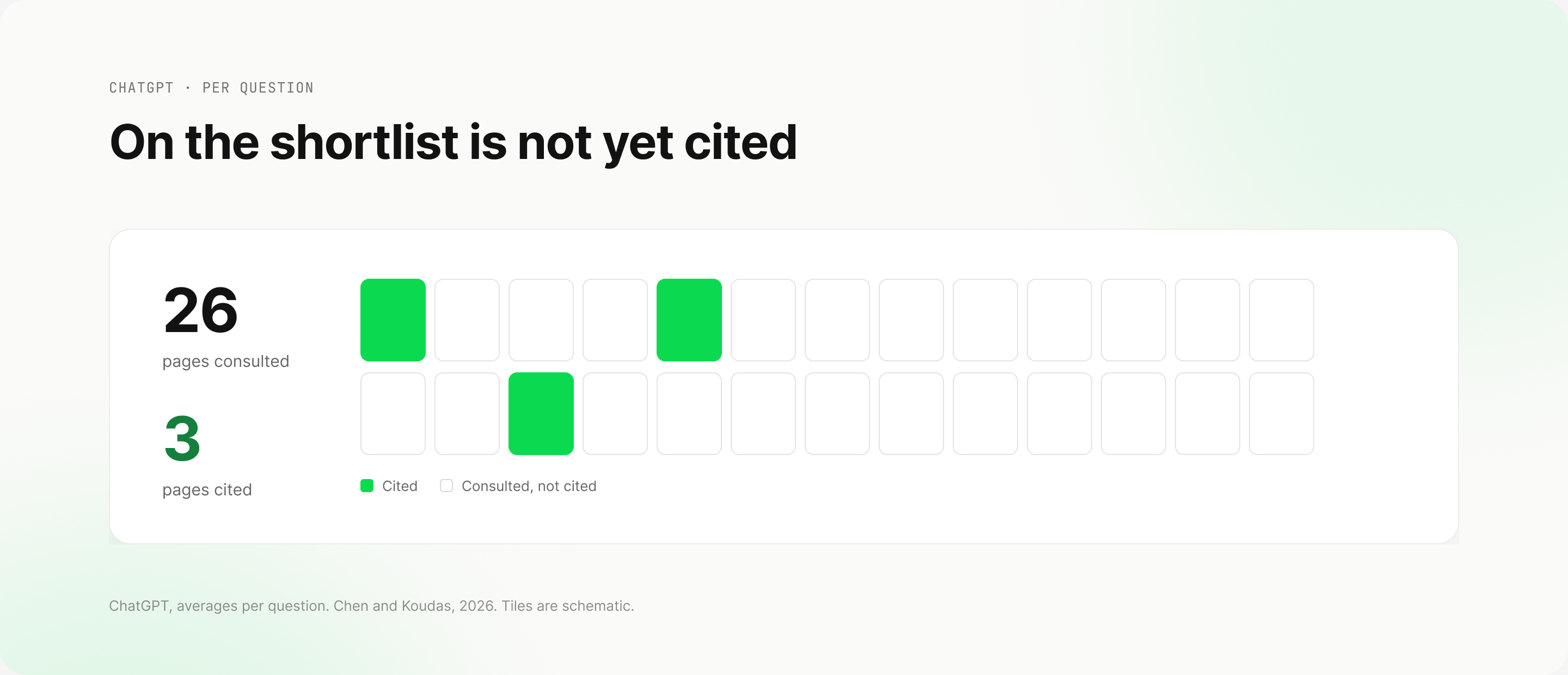
The shortlist is not the Google results a person sees. In the 2026 replay study, ChatGPT consulted 26 pages per question on average and cited 3, close to the 24.6 URLs per answer that Radar measured. 97% of the pages it retrieved were absent from Google's top 50 and 99% from Bing's top 30. Another 2026 study put the overlap between AI-cited domains and Google's top 10 at 4% to 15%, depending on the model.
The authors also checked every one of 22,315 citations against the shortlist. All of them were on it. The reverse does not hold: ChatGPT cited only 43.8% of the pages it ranked first. A page that never reaches the shortlist cannot be cited, however well it is built. Reaching it is necessary, not sufficient.
The shortlist also moves. Because the engine writes new searches for every answer and the underlying search results shift over weeks, the pattern of which pages get cited does not hold still. In the same study, only about 40% of ChatGPT's pattern carried over two weeks later, and 14% after ten weeks. For Gemini the figures were 47% and 29%. A single snapshot of where a brand is cited describes that moment, not a stable position.
Selection: what research has found so far
No engine publishes how it picks sources from the shortlist, so the evidence comes from independent studies. The most detailed is Chen and Koudas (2026): 158,099 answers from ChatGPT, Gemini and Perplexity over 90 days, with pages compared within the same website. The study queried the engines through their APIs (ChatGPT as GPT-5.4 nano with web search, Gemini as Gemini 3.1 Flash Lite with Google Search grounding), so its figures describe these models, not the consumer apps. Six findings:
- The engine cites only from its shortlist. Every cited page had been retrieved first.
- Getting on the shortlist matters about ten times more than page formatting. Retrieval explained about 32% of the differences in which pages were cited; page features explained about 3%.
- A top spot is not a citation. Fewer than half of the first-ranked pages were cited.
- Within one site, the page that answers the question wins. A title and a paragraph that match the buyer's question raised the odds of citation.
- Meaning beats keywords. ChatGPT's ranking followed closeness in meaning more than exact word overlap, though both links were weak.
- About a tenth of the result is chance. The same question cites different pages on different days, so one check proves little.
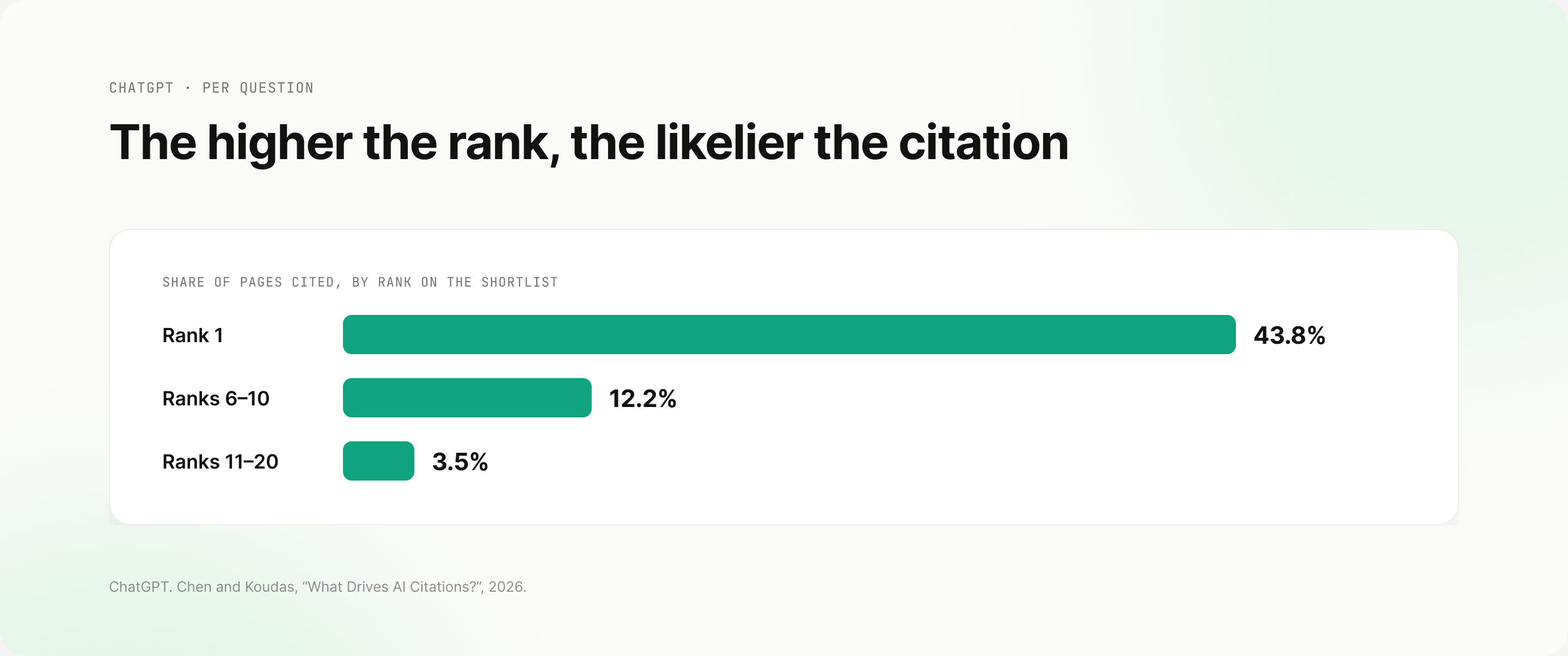
Inside the shortlist, position matters most. ChatGPT cited 43.8% of the pages it ranked first, 12.2% of those ranked 6 to 10 and 3.5% of those ranked 11 to 20. The rank alone explained about 27% of which pages were chosen; adding how well each page matched the question raised that only to about 33%. Most of the selection is already decided by the time the shortlist is ordered.
Engines also weigh outside signals differently. Pages linked from more websites were cited more often, but the effect was much stronger in Gemini (about 34% more citations per step up in referring sites) than in ChatGPT (about 4%). The links were measured after the citations, so the authors do not claim the links caused them.
Why do FAQ blocks and schema still look like they work? Compared across different sites, pages with an FAQ block got 18% more citations. But strong sites that are cited anyway tend to have these features. Compared page against page within the same site, the effect disappeared.
Other studies point the same way:
| Study | What it measured | What it found |
|---|---|---|
| Aggarwal et al., KDD 2024 | 10,000 queries on a test engine and on Perplexity | Adding quotations, statistics and sources raised a page's visibility by up to 40%. In this earlier generation of engines, page wording moved the result |
| Chen, Wang, Chen and Koudas, University of Toronto, 2025 | ChatGPT, Perplexity, Gemini and Claude against Google on "best X" queries | AI search relied on third-party sources far more than Google: about 92% of citations in US consumer electronics. Changing the query language changed the cited domains more than rephrasing |
| Allaham and Diakopoulos, AIES 2026 | 712 real queries on politics, health and the environment in ChatGPT, Copilot, Gemini and Perplexity | A narrow set of domains was cited again and again, next to a long tail of domains cited rarely. About 16% of cited sources showed signs of being AI-generated, so engines do not reliably filter synthetic pages out of the shortlist |
| Findrix Radar, October 2026 | 38,400 buyer questions, three engines | Brands' own sites received 6% to 9% of cited URLs. The top 10 domains in a niche carried 37% of citations, yet a typical niche drew on about 400 domains per engine, and half of them were cited only once |
Together, the studies agree on three things. A page has to reach the shortlist first. After that, a specific paragraph that answers the question counts for more than page formatting. And AI engines rely on third-party sources much more than Google does.
Writing the answer and attaching links
In both the OpenAI and Gemini APIs, a citation is tied to a specific span of the answer text. That makes AI search citations look like footnotes, but a link is not proof that the source supports the sentence. A 2023 Stanford audit of generative search engines found that 74.5% of citations supported the sentence they were attached to. Those were earlier systems, so the figure is a reminder to check, not a current rate.
A citation can even be right and still not be the reason for the sentence. Wallat and colleagues separated two questions: does the cited document support the statement, and did the model actually rely on it? In their experiments with retrieval-based systems, up to 57% of citations failed the second test. The model wrote what it already believed and then attached a document that happened to agree, a pattern the authors call post-rationalization. This is a 2024 preprint in a lab setting, not a measurement of ChatGPT or AI Mode, but it explains why a correct-looking link does not prove where an answer came from.
The link can also arrive without the name. In Radar data, when a niche brand's site was cited in the answer text, the brand itself went unnamed in about 1 in 8 cases: least often in ChatGPT, and roughly twice as often in Google AI Mode and Gemini. The figure is approximate, because a spot check found some errors in matching domains to brands.
The model's memory shapes the answer too. Where does ChatGPT get its information when it writes? Partly from what it already knows. In the replay study, ChatGPT wrote a brand into its own searches 67% of the time when it knew the brand in advance, against 11% when it did not. Websites the model already knew ranked higher in its shortlists and had 1.6 times the odds of being cited at the same rank. 47% of its citations came from websites the model named without searching, and 46% of its mentions of brands the question did not name had no cited page naming that brand: those brands were named from memory.
The models do not know the same markets. In the study's market of small B2B vendors, the model behind Gemini named the tracked vendors for 60% to 96% of the questions without searching, while the model behind ChatGPT named them for only 2% to 16%. The same brand can start from a strong position in one engine and from nothing in another. A known brand is searched for more often, so it has more chances to reach the shortlist.
Memory reaches the ranking itself. In controlled experiments, the authors gave ChatGPT and Gemini products with identical facts and changed only the brand names. The names alone changed the order in which the products were ranked. When a buyer asks for a recommendation, the answer is built from retrieved pages and from what the model already believes about the brands on them.
In the answer, or only in the Sources panel
Where the link sits changes what it is worth.
| Engine | Cited URLs per answer | Where they appear |
|---|---|---|
| ChatGPT | 24.6 | about 65% only in the Sources panel |
| Google AI Mode | 3.7 | not measured separately |
| Gemini 3.1 Flash-Lite | 5.2 | not measured separately |
The ChatGPT pattern follows from how OpenAI builds answers. Its documentation separates inline citations, the most relevant references, from a full list of sources the model consulted, which is often longer. In the ChatGPT interface, that list sits behind the Sources button at the end of the response. ChatGPT sources therefore come in two kinds: links in the text that a reader sees, and entries in a panel that most readers never open.
A brand with ten ChatGPT citations and a brand with two AI Mode citations may have very different visibility. Counted together, those numbers say little. Display also changes fast: in October 2026 Google reported adding more inline links to AI Mode and AI Overviews, so these placement figures describe one month, not a rule.
How Findrix shows each step
Findrix shows the same chain for your own brand, engine by engine:
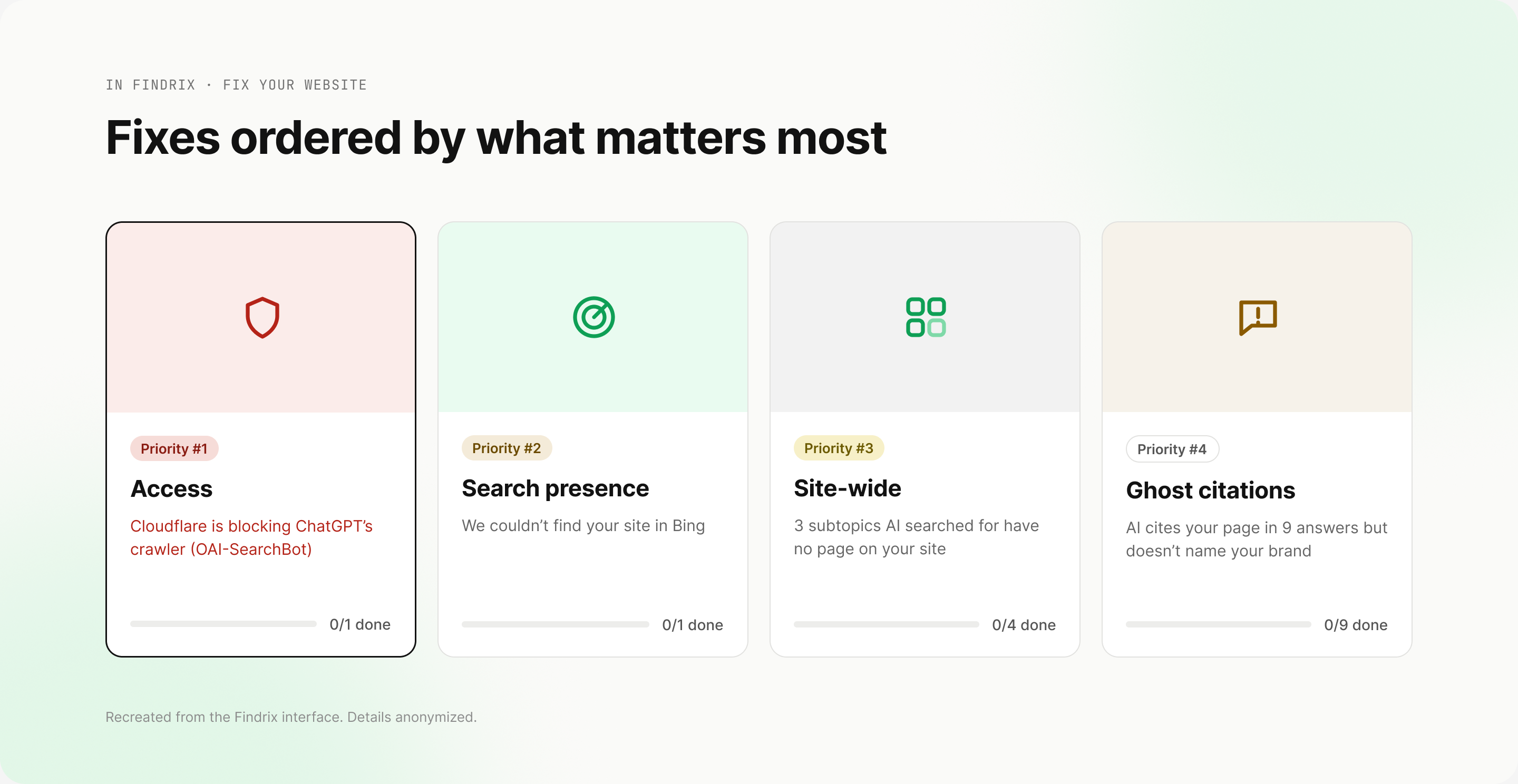
- Access. Site Check runs 29 checks, including whether AI crawlers can reach your pages.
- Fan-out. For any tracked question, Query fan-out shows the searches the engine ran before answering, which subtopics your pages cover and which pages the engine opened.
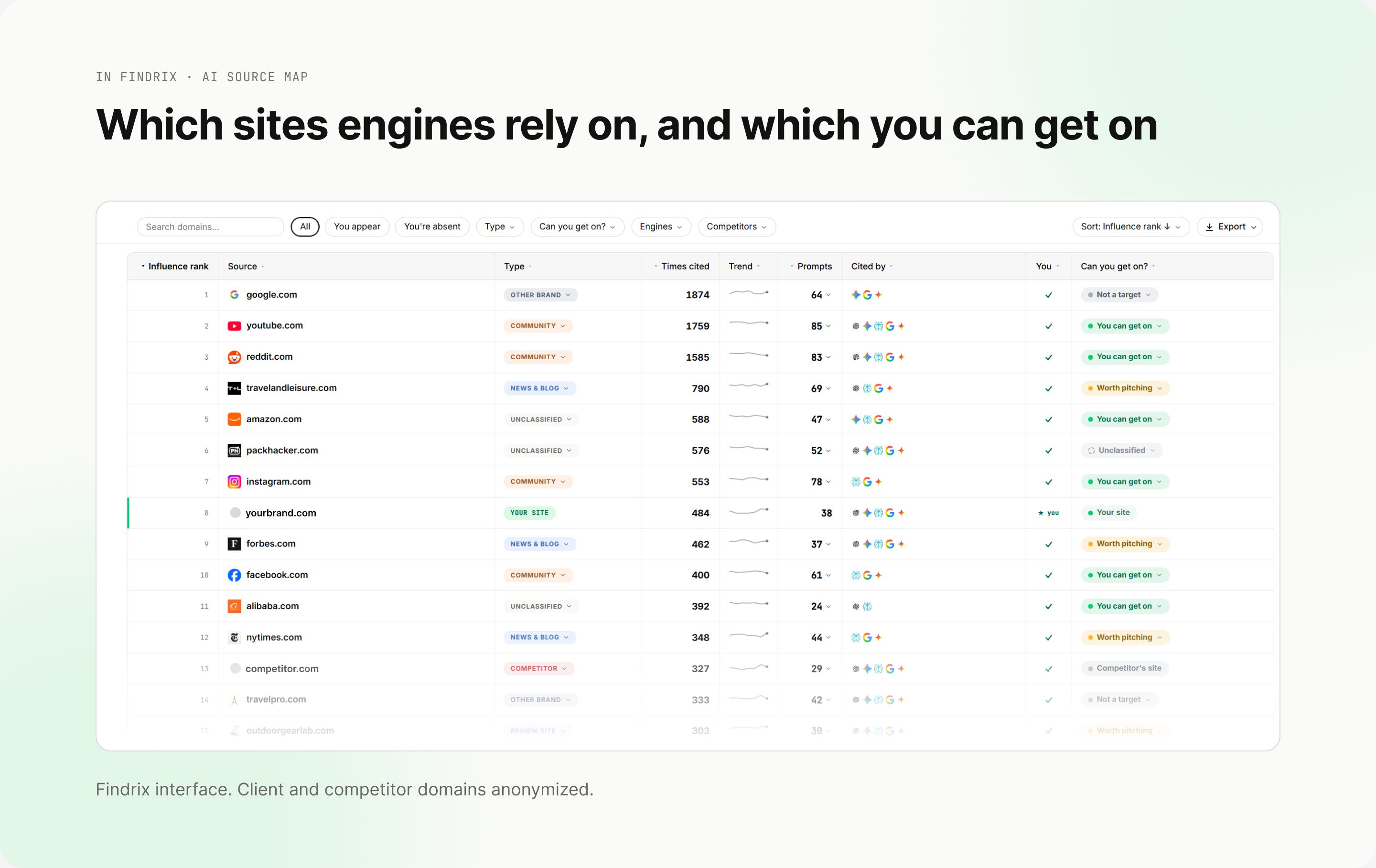
- Shortlist and selection. AI Source Map lists the websites engines rely on in your niche, how often each is cited and whether you or your competitors are named there.
- Answer. Ghost citations shows answers where your site is cited but your brand is not named. Fact checker flags cited sources that contradict your confirmed facts.
Method note. Findrix Radar golden set v2: 38,400 buyer questions in 39 niches, Australia and the US, answers collected 14–19 October 2026, one run per question. Engines: ChatGPT, Google AI Mode and Gemini 3.1 Flash-Lite. Figures describe the distribution across questions, not run-to-run stability.
Sources
- Google Search Central: AI features and your website
- Google Search Central: Optimizing your website for generative AI features
- Google: AI Mode in Search
- Google: AI Mode update, May 2025
- Google: More ways to connect with the web from Search (October 2026)
- Google Search Central: Google common crawlers (Google-Extended)
- OpenAI: Searching the web with ChatGPT
- OpenAI: Web search tool guide
- OpenAI: Overview of OpenAI crawlers
- OpenAI: ChatGPT search for Enterprise and Edu
- Google AI for Developers: Grounding with Google Search
- Chen and Koudas: What Drives AI Citations? (arXiv, 2026)
- Chen, Wang, Chen and Koudas: Generative Engine Optimization: How to Dominate AI Search (arXiv, 2025)
- Chen et al.: cited-domain overlap with Google (arXiv, 2026)
- Aggarwal et al.: GEO: Generative Engine Optimization (KDD 2024)
- Allaham and Diakopoulos: Synthetic Sources? (AIES 2026)
- Wallat, Heuss, de Rijke and Anand: Correctness is not Faithfulness in RAG Attributions (arXiv, 2024)
- Liu, Zhang and Liang: Evaluating Verifiability in Generative Search Engines (Stanford, 2023)
- Google patent application: Generating query variants using a trained generative model
- Findrix Radar
Read next
What is GEO? Generative Engine Optimization Explained (And How It Differs From SEO + AEO)
GEO is how brands get cited inside ChatGPT, Perplexity, and Gemini answers. Definitive guide to Generative Engine Optimization, GEO vs SEO vs AEO, and how to start.
10 Best AI Citation Tracking Tools in 2026: Tested & Compared
Ten AI citation tracking tools compared on three tests: where your brand sits on the AI ladder, how your pages perform, and whether AI matches your ICP.
AI Share of Voice: How to Measure and Interpret It
AI Share of Voice compares your brand's mentions to competitors' in AI answers – but tools calculate it differently. See Findrix's method and formula.