

 Deutsch
 Français
 Español
 Português (Brasil)
 Italiano
10 Best AI Citation Tracking Tools in 2026: Tested & Compared
 Yosif Merman23 min readOctober 27, 2026
TL;DR
The best AI citation tracking tools in 2026 are Findrix, Profound and Peec AI, followed by Scrunch, LLM Pulse, Ahrefs Brand Radar, Semrush, Otterly.AI, Similarweb and LLMrefs. Each was tested on three things: where your brand sits between being cited and being recommended, which of your pages AI cites and which it skips, and whether the questions match your buyers. Findrix is the best fit for teams that have to prove their site works for AI answers. Compared October 2026.
Key takeaways
- In ChatGPT, about 65% of cited links appear only in the Sources panel, not in the answer text. "You were cited" can mean very different things.
- When an AI answer links to a brand's own site, the brand is not named in about 1 in 8 of those answers. That is a ghost citation.
- A citation is not a mention, but it still matters: it is a step toward being recommended, and the most direct measure of whether your site works for AI answers.
- The test for a tool is three things together: it shows how your brand moves up the AI visibility ladder, how well your site works for AI, and whether AI matches your site, your ICP and your brand.
What AI citation tracking is
AI citation tracking records which web pages AI engines link to as sources when they answer a question: which URLs, for which questions, in which engine, and whose pages they are. It tells you whether your site is one of the sources an answer is built from, and whose pages are cited instead.
Not academic citations, not local SEO citations
"Citation tracking" means three different things depending on who searches for it:
- Academic citations. References to research papers, handled by reference managers such as Zotero and Mendeley.
- Local SEO citations. Listings of a business name, address and phone number in directories like Yelp, tracked by local SEO tools.
- AI citations. Links to web pages inside the answers of ChatGPT, Perplexity, Google AI Overviews, AI Mode and Gemini.
This article is about the third.
What counts as a citation in each engine
Each engine shows its sources differently, and a tracker has to read each one on its own terms:
- ChatGPT links sources inside the answer text and also lists them in a separate Sources panel.
- Perplexity attaches numbered footnotes, [1], [2], to sentences in the answer.
- Google AI Overviews and AI Mode show link cards next to or below the generated answer.
- Gemini can show source links alongside parts of the answer.
In the answer, or only in the Sources panel
Where the link sits changes what it is worth. Findrix Radar measured 38,400 buyer questions across 39 niches in Australia and the US in October 2026:
| Engine | Cited URLs per answer | Where they appear |
|---|---|---|
| ChatGPT | 24.6 | about 65% only in the Sources panel |
| Google AI Mode | 3.7 | mostly in or next to the answer |
| Gemini 3.1 Flash-Lite | 5.2 | mostly in the answer |
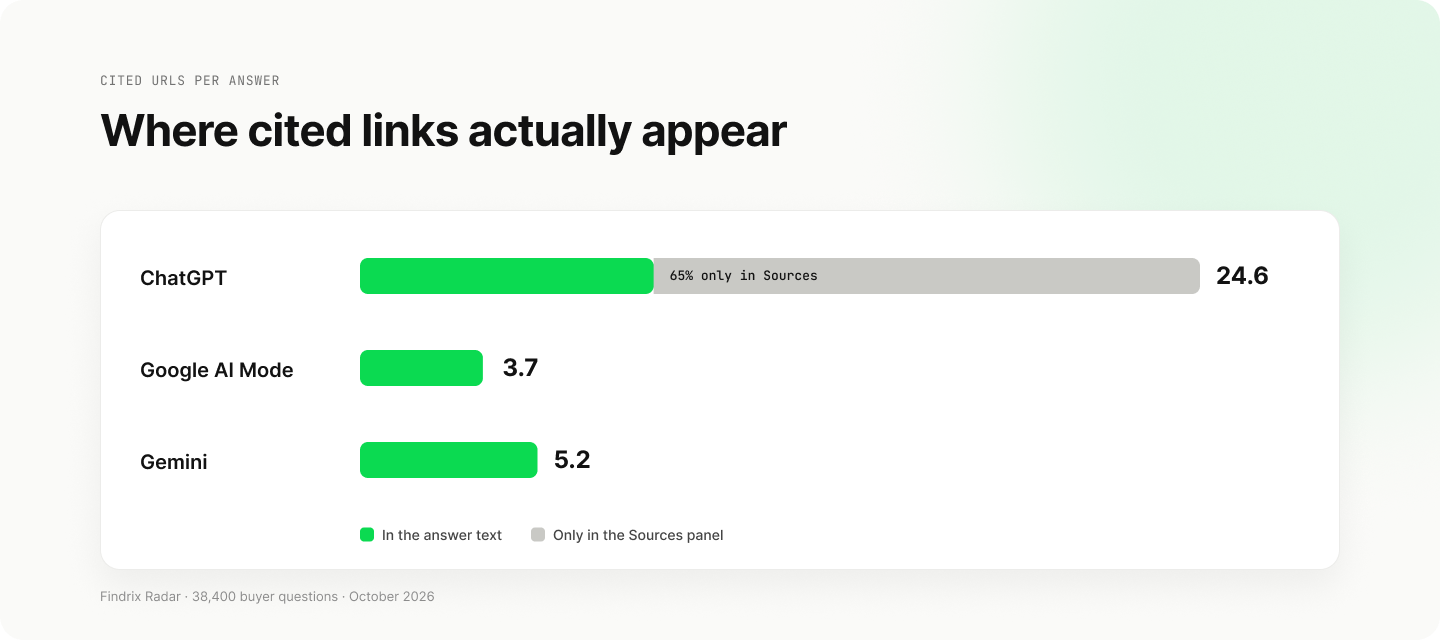
A link in the answer text is read by everyone who reads the answer. A link that exists only in ChatGPT's Sources panel is seen by the few who open it. A tracker that counts both as "cited" gives you a number that looks better than what buyers actually see.
Mention, citation, ghost citation
Three separate things can happen to a brand in one AI answer:
- Mention. The brand is named in the answer text. There may be no link at all.
- Citation. One of the brand's pages is linked as a source.
- Ghost citation. The brand's page is cited, but the brand is not named. The engine used your content and may still recommend a competitor.
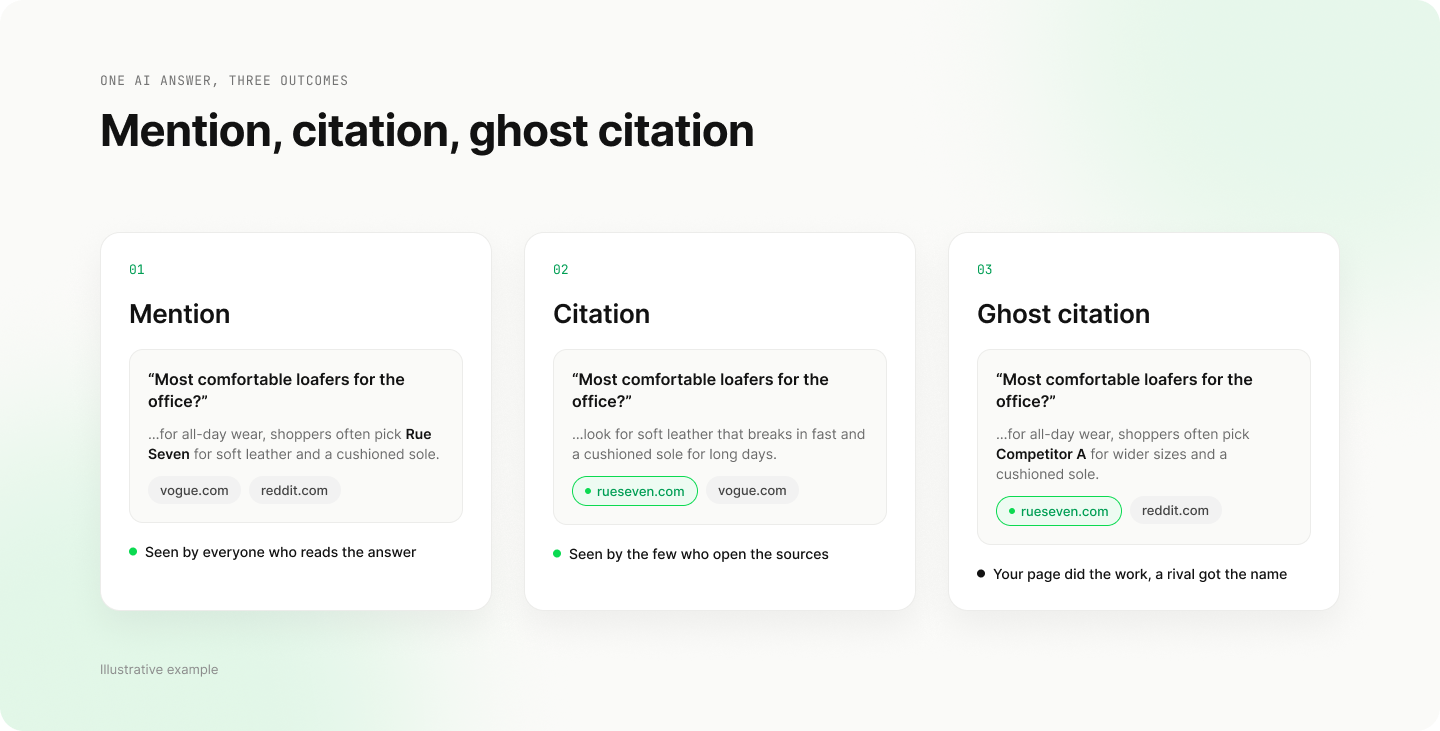
In Findrix Radar, when an answer linked to a niche brand's own site in the answer text, the brand was not named in about 1 in 8 of those answers. The rate differs by engine: about 9% in ChatGPT, 18% in Google AI Mode and 19% in Gemini.
Findrix Radar golden set, version 2: 39 niches, each measured for Australia and the US, 38,400 buyer questions, one run per question. Engines: ChatGPT, Google AI Mode and Gemini 3.1 Flash-Lite. Answers collected 14 to 19 October 2026. Perplexity is not part of this set. Brand-to-domain matching is automated, so ghost citation rates are rounded. Full method: Radar methodology.
Why citations matter: three things they show you
A citation report is only useful if it answers a question you act on. Good citation tracking answers three.
Where your brand stands on the AI warmth ladder
AI engines treat brands at different levels of warmth. A citation is one step on that ladder, not the top:
| Step | What the reader of the answer sees | What it means for the brand |
|---|---|---|
| 1. Ghost citation | nothing: your page is a source, your name is absent | AI took your information and may recommend someone else |
| 2. Citation | a link to your page, in the text or in the Sources panel | you are a source, but few people see your name before they click |
| 3. Mention | your brand name in the answer | everyone who reads the answer sees you |
| 4. Positive mention | your name with a favorable description | AI describes you the way you want |
| 5. Recommendation | advice to choose you | the outcome all the work is for |
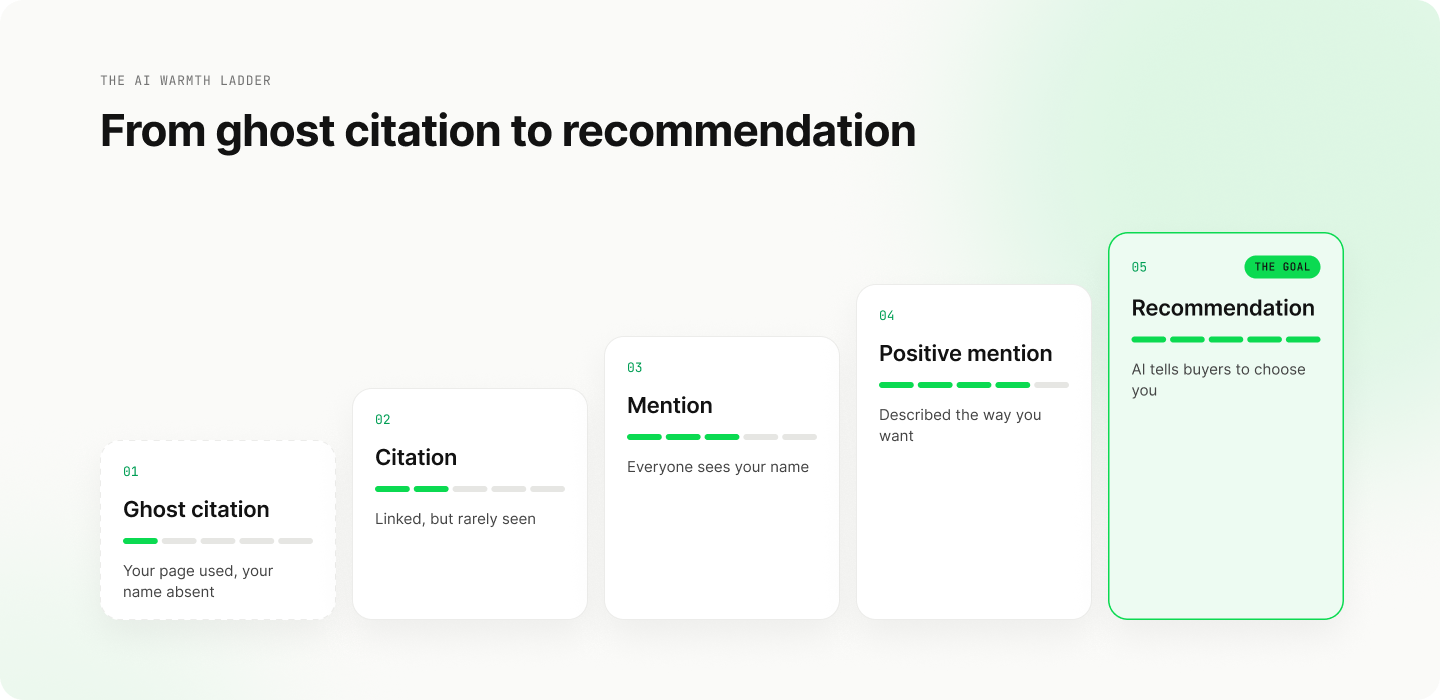
For SEO teams, this order is the shift. In GEO, being mentioned matters more than being cited. In search, the link was the prize, because people clicked through to the page. In an AI answer, people read the answer and often stop there, so the decision forms around which brand the engine named and recommended. The link becomes the input: it shows where the engine got its information. The name and the recommendation in the text are the result. Radar shows how wide the gap is: in ChatGPT, about two thirds of links sit only in the Sources panel, where most readers never look.
That does not make citations unimportant. Each step is how you climb to the next:
- Ghost citation to mention: make the cited page name your brand clearly, so the engine attaches your name to the information it already uses.
- Citation to mention: get onto the third-party pages the engine cites in your category, because that is where it learns which brands to name.
- Mention to positive mention: correct how those sources describe you.
- Positive mention to recommendation: close the selection criteria on which the engine recommends competitors.
A tool that counts only mentions cannot see steps 1 and 2 at all.
How well your site works for AI
Citations are the most direct measure of whether your own pages work for AI answers. In Radar, only 6 to 9% of cited URLs pointed to the sites of brands in the niche; the rest went to third-party pages such as reviews, directories, forums and publishers. A tracker should show your site at three levels:
- Your pages that get cited. Most tools with page-level data show this list. It shows only the winners.
- Your existing pages that do not get cited on questions where they fit the topic, while the engine cites a competitor or a review site. These pages need rework, not new content. To find them, a tool has to know your pages and compare them against citations.
- Topics where you have no page at all, while the engine cites competitors. This is a content gap, fixed with a new page.
And because most citations go to sites you do not own, the tool should also tell you what to do with them: which third-party sources matter in your niche, which name competitors and not you, and which are realistic to get onto.
Whether AI matches your site, your ICP and your brand
A citation count can rise while the business result does not, when AI connects your brand to the wrong buyer. Typical mismatches:
- Your site is cited on questions from an audience you do not sell to, while on your ICP's questions the engine cites competitors.
- Your brand is recommended "for freelancers" when you sell to teams.
- The engine describes you by positioning you dropped a year ago.
A tracker can catch this only if its questions are built around your ICP, not a generic set for your category, and if it shows results by audience or buying stage. The market matters as much as the audience: in Radar, the same engine in the same niche shared on average only 0.5 to 1.9 of its top 10 cited domains between Australia and the US. A tool measuring the wrong country measures someone else's market.
Best AI citation tracking tools compared
| Tool | Best for | Engines | Answer vs Sources panel | Cited but not named | Your pages | ICP-based questions | Starts at |
|---|---|---|---|---|---|---|---|
| Findrix | Teams that have to prove their site works for AI | ChatGPT, AI Overviews, Perplexity; Gemini, AI Mode from Growth; Claude, Grok add-ons | Recorded, available via MCP | Ghost citations (Growth+) | Cited, lost to competitors' content, uncovered subtopics, AI Traffic per page | Generated around your buyers, by buying stage | $49/mo per site |
| Profound | Enterprise programs | Up to 9 on Enterprise; 3 on trial | Not stated | Not described | Owned vs competitor sources | Personas, Enterprise beta | Not published |
| Peec AI | URL-level reporting on a budget | 3 of your choice per plan | Answer text only, panel not split | "Used" metric | Citations per page | Persona-based discovery, country per prompt | ~$95/mo |
| Scrunch | Persona-based tracking | 7 on every plan | Not stated | Presence on cited page | Owned tag; crawled but not cited | Up to 3 personas injected | $250/mo (annual) |
| LLM Pulse | Many engines at a low price | 5 core, more as add-ons | Visible vs background sources | Yes, "cited without being mentioned" | Share of citations to your domain | Countries and languages | €49 (~$58)/mo |
| Ahrefs Brand Radar | Market-wide benchmarks | 6 in the AI Index, Claude via custom prompts | Not stated | "Others only" view | Your cited pages | Fixed index, custom prompts | $129/mo (Lite) |
| Semrush AI Visibility Toolkit | Teams already on Semrush | ChatGPT, AI Mode, Gemini, AI Overviews | Not stated | Not described | Cited Pages tab | 220+ countries | $99/mo |
| Otterly.AI | Low-cost entry | 4 base, 3 add-ons | Not stated | Whether each cited URL names you | Your cited URLs | Country per prompt | $29/mo |
| Similarweb | Similarweb traffic users | ChatGPT, AI Mode, Gemini, Perplexity | Not stated | Not described | Not described | One region and language per campaign | $99 |
| LLMrefs | Many small sites, flat price | 9 included | Not stated | Not described | Not described | Many countries and languages | $79/mo |
Prices as published on vendor pages, checked 27 October 2026.
How we evaluated: three tests, eight questions
Every tool went through the same questions, in the same order. Where a vendor does not publish an answer, the card says so instead of guessing.
Test 1. Can you see where your brand is on the ladder?
- Does it record the exact cited URL per engine, and whether the link sits in the answer or only in the Sources panel?
- Does it separate mentions from citations and catch ghost citations?
- Does it show the top of the ladder: how AI describes you and whether it recommends you?
- Can you tell a real change from run-to-run noise?
Test 2. Can you see how your site works for AI?
5. Does it show your pages that are cited, your pages that are not, and topics with no page?
6. Does it tell you what to do with third-party sources you do not own?
Test 3. Does AI match your site, your ICP and your brand?
7. Are the questions built around your buyers, not a generic category set?
8. Can you measure the market you sell in?
1. Findrix: best fit for teams that have to prove their site works for AI
Findrix is an AI visibility and GEO platform that measures how AI engines see a brand, hands over the fixes, and shows whether the picture moved.
Ladder. Findrix covers every step. AI Visibility reports mentions and citations separately for each engine, and Ghost citations lists answers that use your site as a source without naming you. Higher up, it shows how often each engine actively recommends you, names you the best pick, and where you usually sit in the list, and a Preference score from 0 to 10 rates how favorably each engine speaks of you against competitors. Extra calibration runs after the first measurement set a range around key visibility metrics, so a weekly change is shown against normal noise. Whether a cited link sat in the answer or only in the Sources panel is recorded in the data and available through the Findrix MCP, though the dashboard does not yet surface it as its own view.
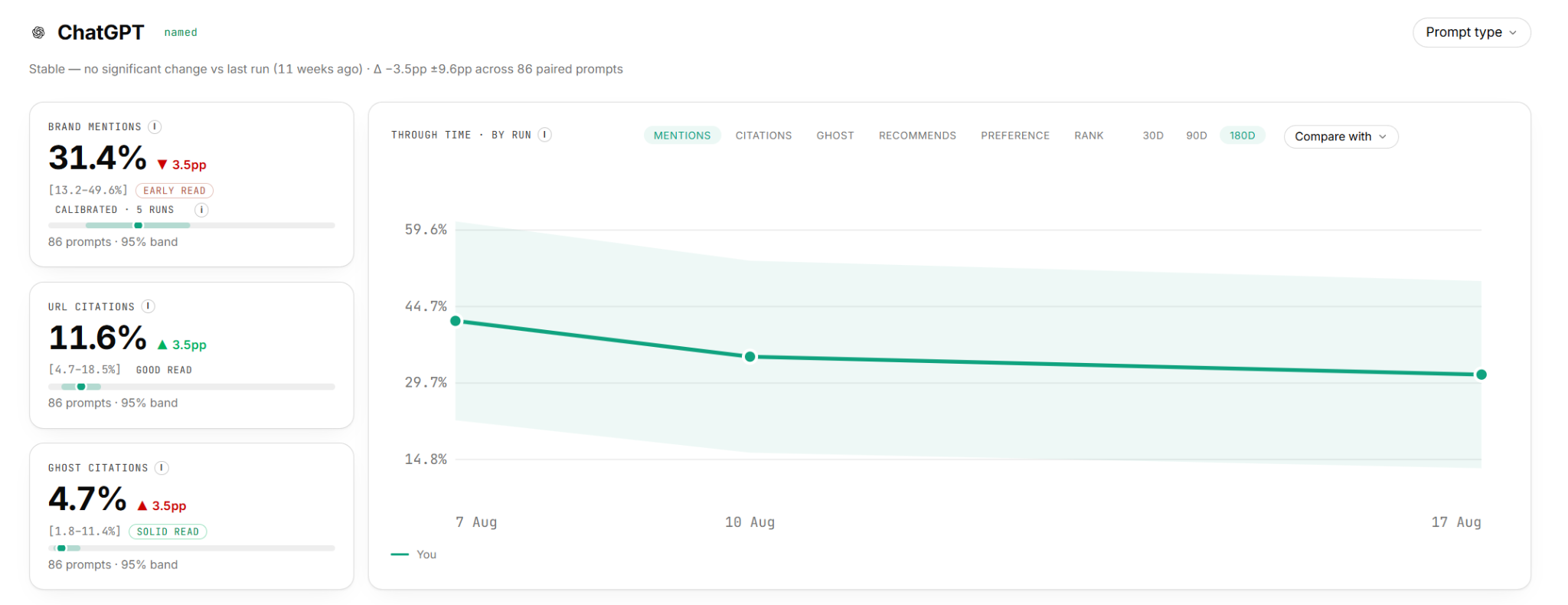
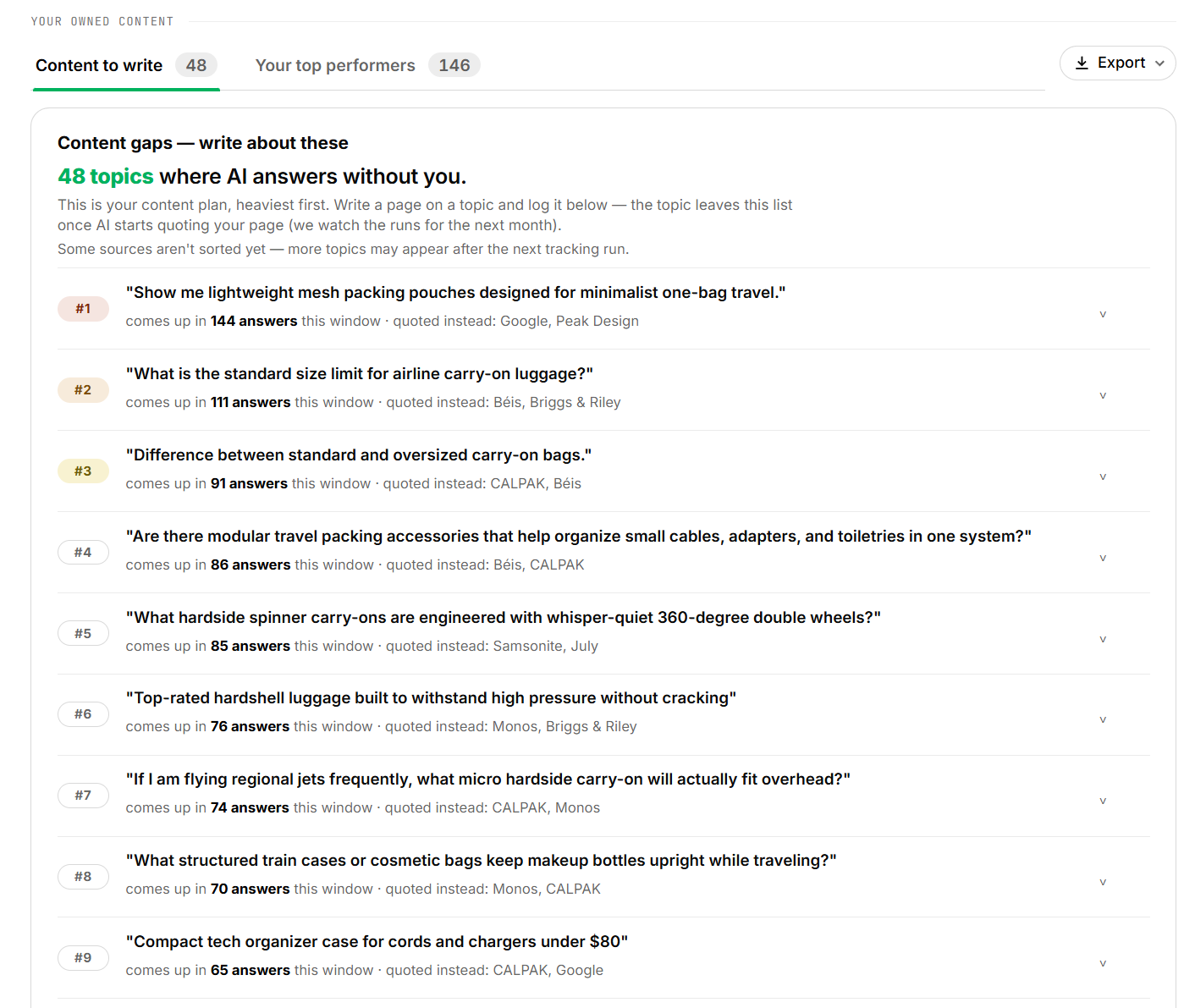
Site. Owned sources shows what share of your niche's citations lead to brands' own pages, for you, competitors and the category. It lists your pages that already get cited, the questions where engines cite competitors' content and not yours, and the subtopics AI searched for while answering with whether one of your pages covers each. Connect Google Analytics 4 and AI Traffic sorts your pages into cited but not clicked, cited and clicked, and visited without being cited. For third-party sources, the AI Source Map groups the sites your niche relies on into 10 types and marks for each whether you are named there, which competitors are, and whether it is realistic to get in, worth pitching or not a target.
ICP match. The question set is generated during onboarding around your buyers, and you can edit it; 9 of 10 questions do not name the brand, because buyers who have not decided yet do not. Results are shown by buying stage. Even the free audit shows which personas ask about your category, what they type, and how AI describes you to them.

Pricing. Presence $49/mo per site (3 engines, 60 questions), Growth $99/mo (5 engines, 100 questions, ghost citations), Authority $199/mo (180 questions). Claude and Grok are paid add-ons. 7-day free trial.
Watch-outs. Findrix is the newest tool in this list. Ghost citations start on Growth. Each site is measured on its main market and language only. Runs are weekly, not daily.
2. Profound: best for enterprise programs with a dedicated operator
Ladder. Profound records every cited URL per prompt and lets you watch individual pages over time. Mentions and citations are separate metrics, but a cited-but-not-named view is not described. Answers are captured from the consumer interface rather than model APIs. Profound publishes the most rigorous noise method in the category, with bootstrap 95% intervals on a daily run.
Site. Sources are classified as Owned, Competitor, Earned Media, PR Wire, Social and Institution, and you can see which prompts return competitor citations but not yours. A list of your own pages that are not cited is not described. For third-party sources, you can build outreach lists from the most cited publishers.
ICP match. Personas built from role, seniority, industry and pain points, but in beta and Enterprise-only. Prompts can target countries, cities and languages.
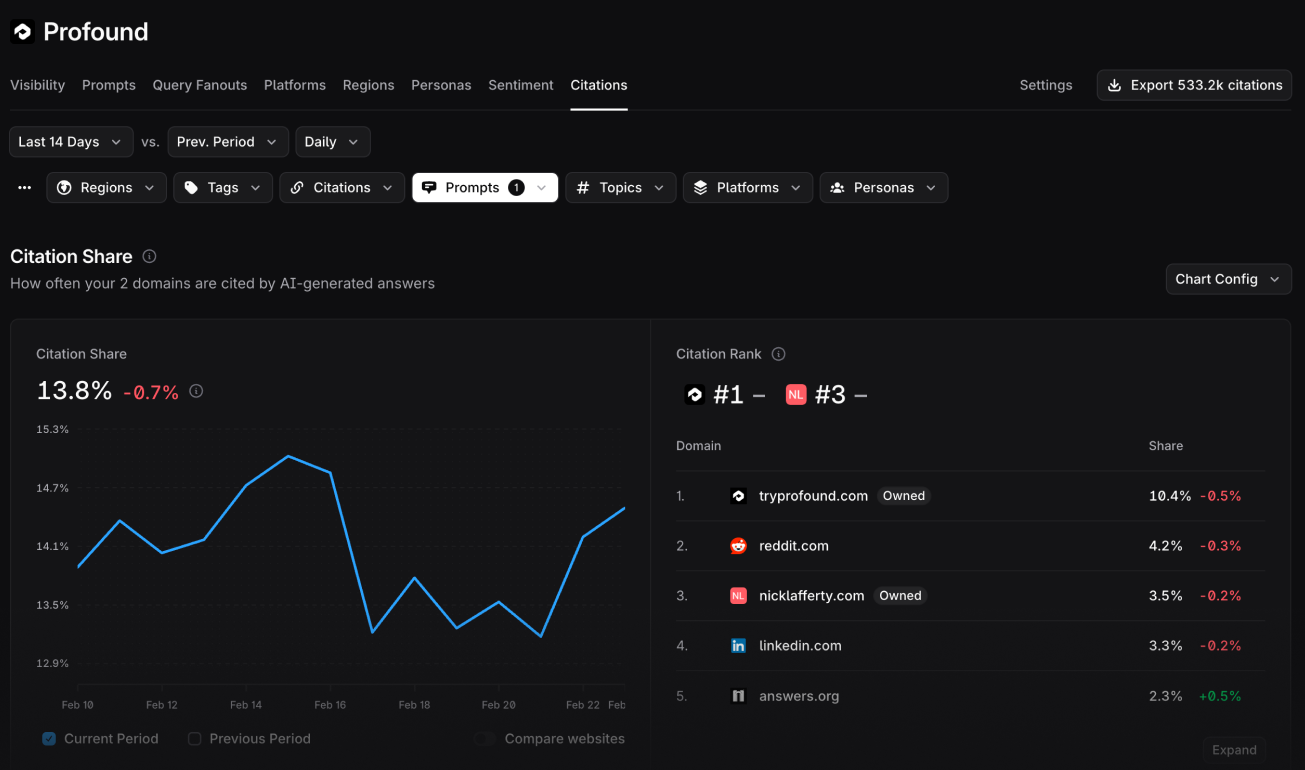
Pricing. Paid prices are not published. A free 7-day trial covers 50 prompts on ChatGPT, Gemini and AI Overviews, one region and one language.
Findrix and Profound both separate engines and both put a range around the numbers; Profound offers more engines, more ways to slice them and deeper research behind its method. Findrix goes further on the site itself, with pages cited, questions lost to competitors' content and AI Traffic per page, at a published $49 entry, which makes Findrix the best fit for teams without an enterprise budget or a full-time operator.
3. Peec AI: best for URL-level reporting on a budget
Ladder. Peec AI works at URL level, classifies each URL by type such as listicle or comparison, and keeps Mentions and Cited as separate columns. Its "Used" metric marks content that shaped an answer without a direct citation, which is the closest thing to a ghost citation metric among the other nine. It defines citations as sources referenced in the visible answer text, a step toward the answer-versus-panel split, though it does not report inline links and the Sources panel separately. One run per prompt per model every 24 hours, mostly through UI scraping; confidence ranges are not described.
Site. Citations and traffic are shown per page of your site, and Actions name the specific URL to improve. A list of pages that are not cited is not described. Gap Analysis finds sources that mention competitors but not you, by domain or URL.
ICP match. Prompt discovery uses buyer personas, and each prompt has a country. Starter allows one country per project.
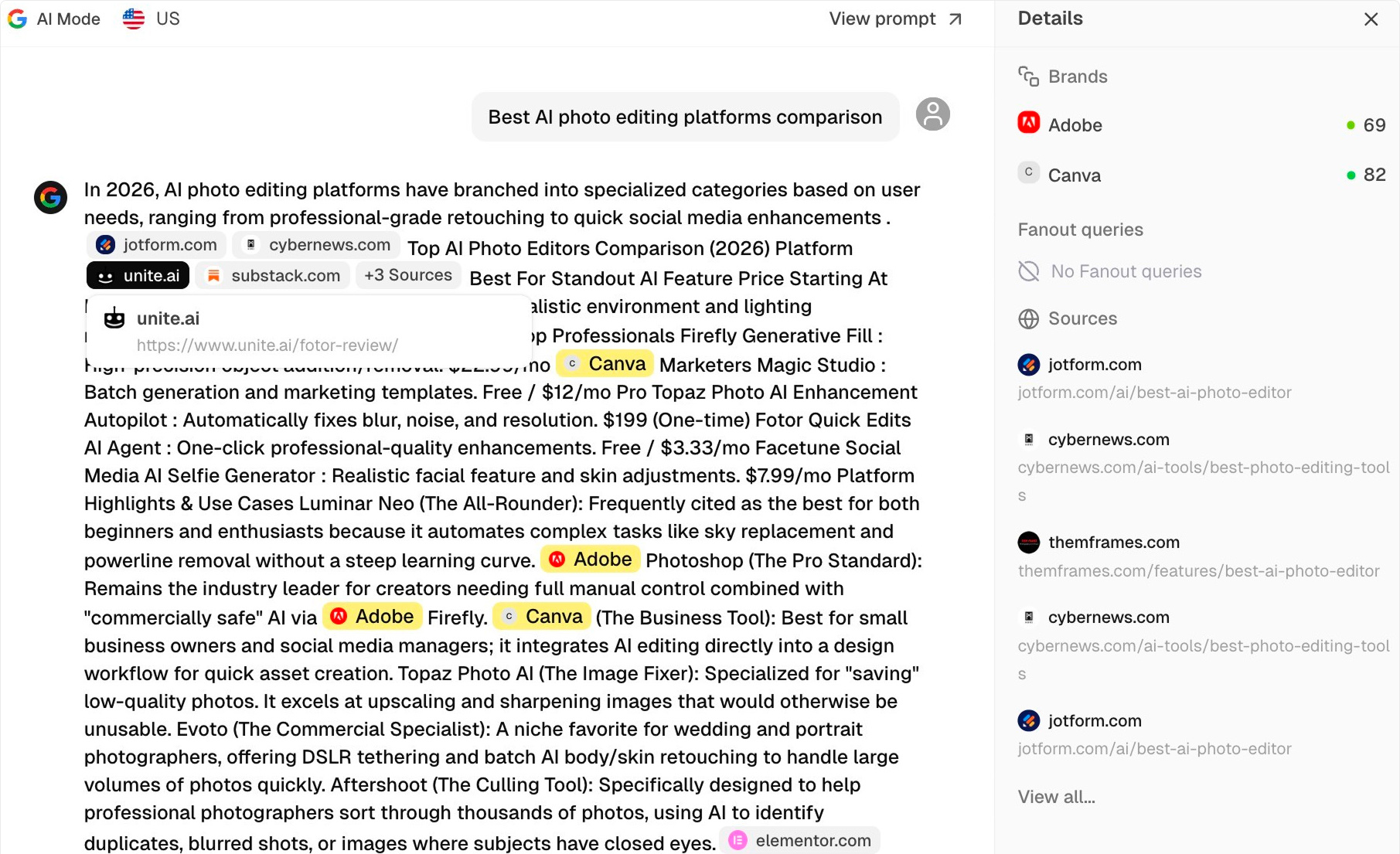
Pricing. The pricing page shows no numbers; Peec's own AI instructions page lists Starter at $95/month for 50 prompts, 3 models and 1 country. Free trial available.
Findrix and Peec AI both separate mentions from citations at URL level and both point to sources that name competitors but not you. Peec AI limits each plan to three models of your choice; Findrix reports up to seven engines separately and adds the step above citations, recommendation rate and Preference score, which makes Findrix the best fit for teams measured on being recommended, not only cited.
4. Scrunch: best for persona-based tracking
Ladder. Scrunch works at URL level, grouped by domain by default. Its Presence column shows whether your brand appears on the cited page, which is a different signal from whether the answer named you. Data comes from a mix of browser automation and official APIs, chosen per platform. Repeat runs and noise handling are not described.
Site. Citations are tagged Owned, Competitor or Third Party. Site Maps compares AI bot visits with citations, so pages that AI crawlers visit but never cite stand out, the clearest answer among the other nine to "which of my pages are not cited". Third-party pages citing competitors but not you are listed.
ICP match. The strongest persona support among the other nine: up to three personas generated from your site and injected into prompts, and 88 countries at setup with per-prompt overrides.
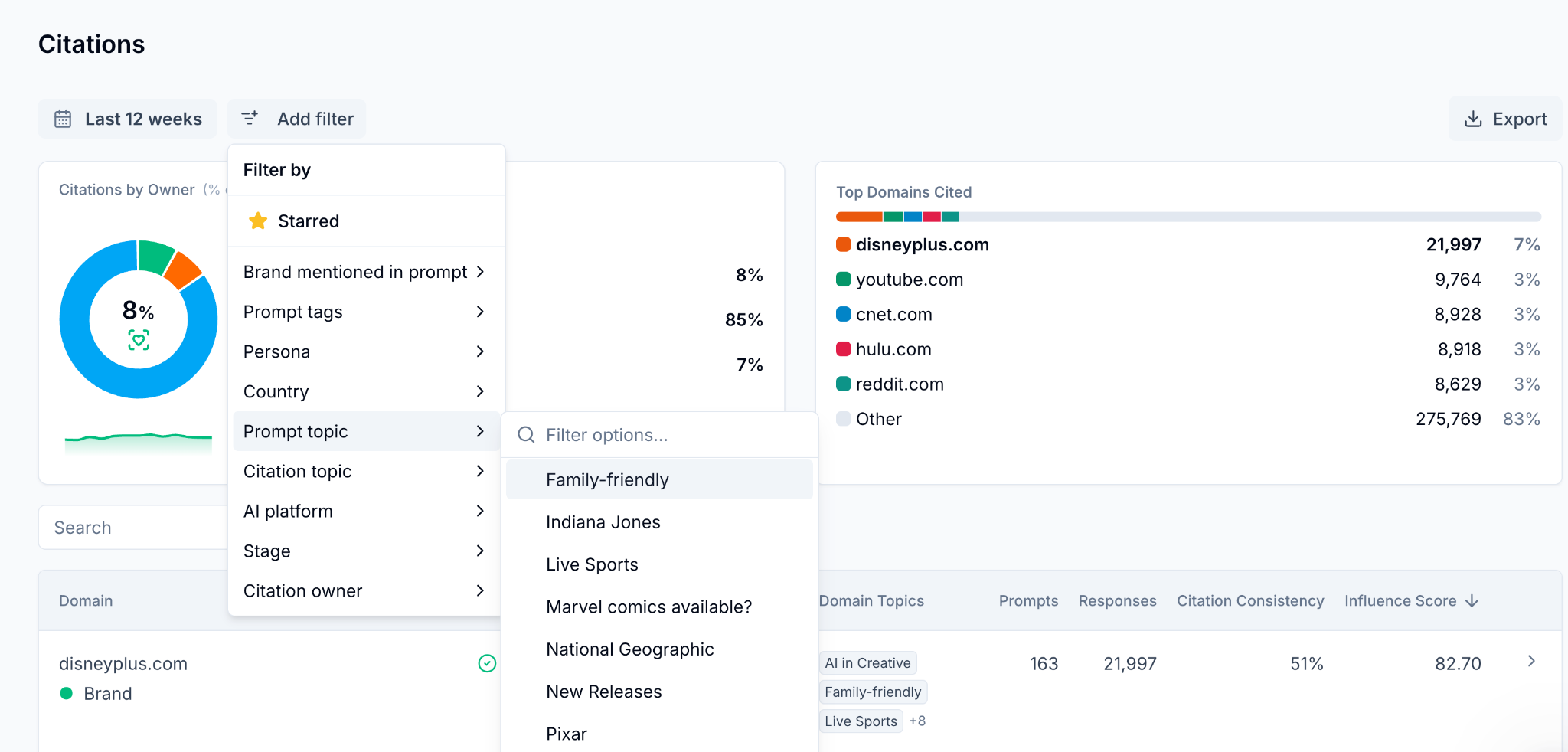
Pricing. Starter $300/month, or $250/month billed annually, for 350 prompts and 3 personas. 7-day free trial. Scrunch's own pages show conflicting older prices.
Findrix and Scrunch both build questions around the buyer and both show where your own pages fall short. Scrunch compares pages with AI crawler visits; Findrix compares them with the questions you lose to competitors' content and, through GA4, with real AI visitors, starting at $49 rather than $250, which makes Findrix the best fit for teams that need the site view without an enterprise contract.
5. LLM Pulse: best for many engines at a low price
Ladder. LLM Pulse extracts every URL from AI answers and reports by domain, host or page. It states plainly that a brand can be cited without being mentioned, and flags pages AI links to that never talk about you. It separates visible citations from background sources taken from the response metadata, which is close to the answer-versus-panel split, though links in the answer text and the Sources panel are not reported apart. Answers are captured from the consumer interface. Noise handling is not described.
Site. "Your Share" shows the share of citations pointing to your domain. The Owned Media report covers apps and social profiles rather than website pages. Pages that are not cited are not described. It points to third-party sites you need coverage on and where to pitch.
ICP match. The same prompts can run in different languages and countries. Personas are not described.
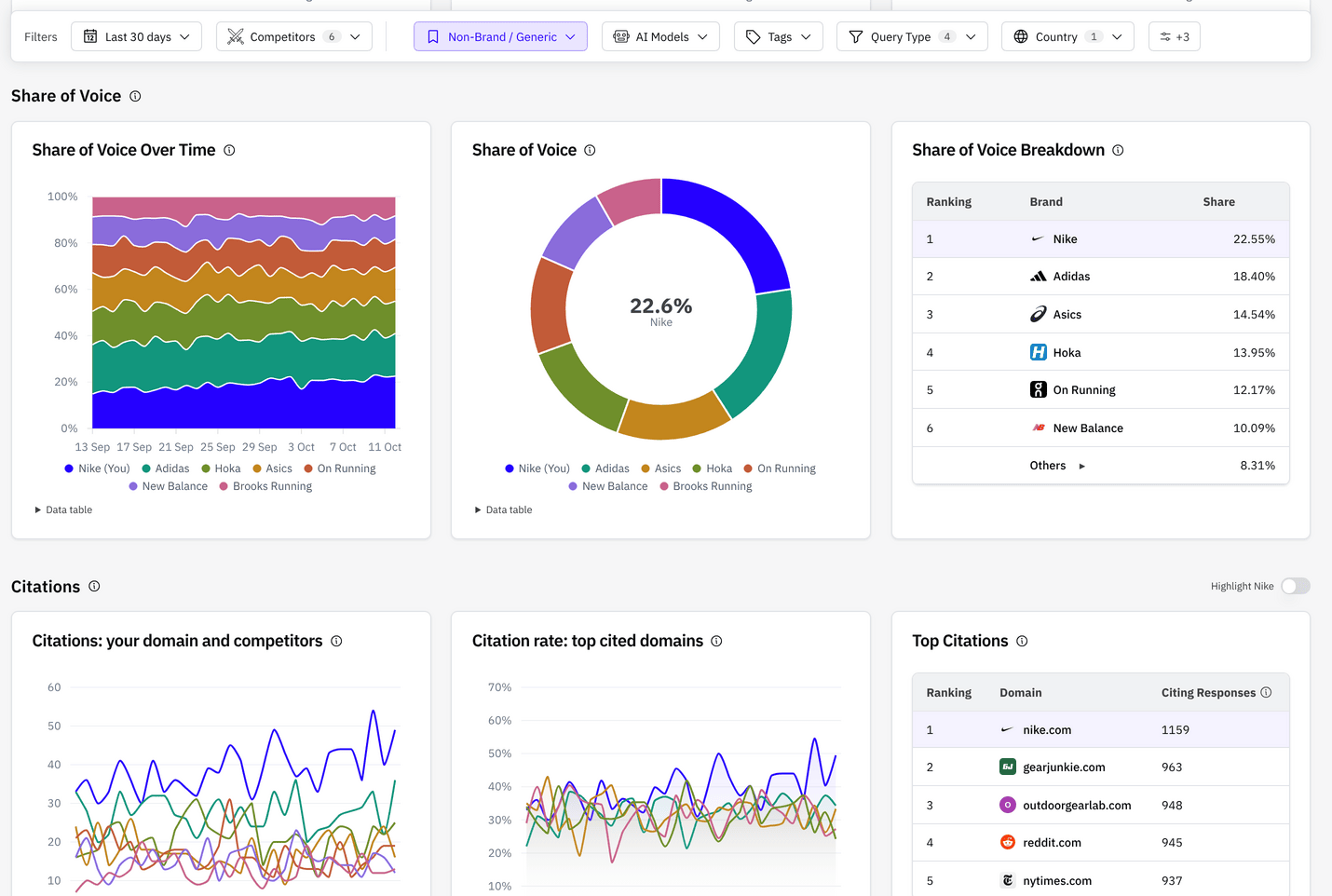
Pricing. Starter €49 (about $58)/month for 50 prompts on 5 engines, tracked weekly; daily tracking costs more. Extra engines from $10/month each. 14-day trial, card required.
Findrix and LLM Pulse both track ChatGPT, Perplexity, Gemini, AI Mode and AI Overviews and both catch citations without a mention. LLM Pulse charges per extra engine and stops at your domain's share; Findrix shows which of your pages are cited and which questions you lose to competitors' content, which makes Findrix the best fit for teams that need to know what to fix on the site.
6. Ahrefs Brand Radar: best for market-wide benchmarks
Ladder. Brand Radar separates citations (linked URLs) from mentions (name matches) and has Cited pages and Cited domains reports. The "Others only" view shows where competitors are mentioned and you are not. Data comes from public web interfaces. Metrics are presented as directional, and the main index refreshes monthly over a 90-day window.
Site. Cited domains, then your domain, then Pages lists your pages that appear in AI answers. Finding pages that should be cited but are not is left to you. Ahrefs suggests building outreach lists from cited pages and from sources that mention competitors more than you.
ICP match. The AI Index is a fixed dataset of about 30 million prompts derived from Google's People Also Ask, strongest in English. Custom prompts are available but limited on lower plans. Personas are not described.
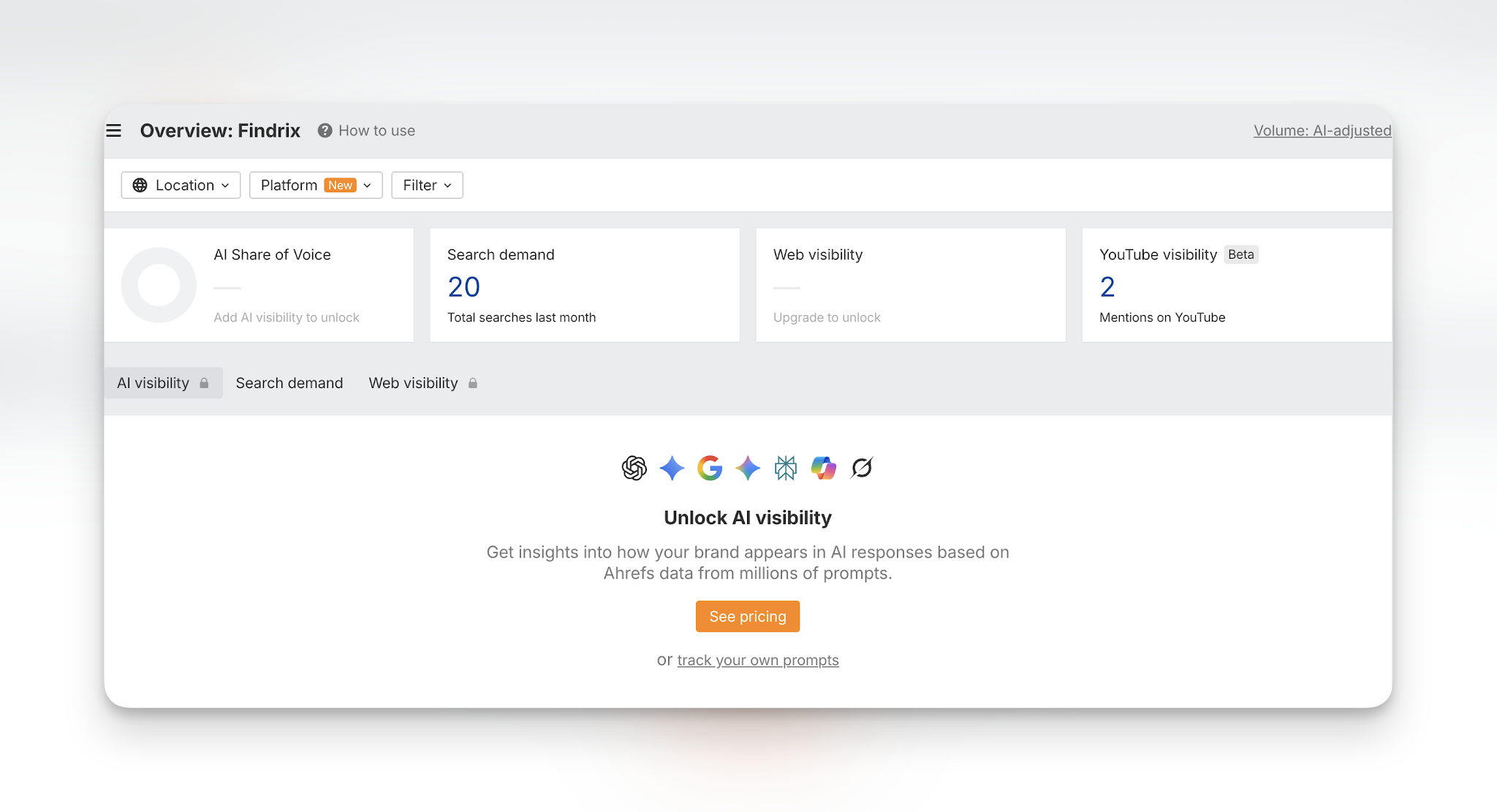
Pricing. Lite $129/month includes 5 custom Brand Radar prompts; the AI Index costs $199/month per platform or $699/month for all. No free trial.
Findrix and Ahrefs Brand Radar both separate mentions from citations at page level. Ahrefs measures the market's questions, which suits a benchmark; Findrix measures questions generated around your buyers, every week, which makes Findrix the best fit for teams that need to track their own ICP rather than the category at large.
7. Semrush AI Visibility Toolkit: best for teams already on Semrush
Ladder. Mentions and citations are separate metrics, with Sources by domain and by page. Citations are described as references within or beneath the answer, without separating the two. A cited-but-not-named view is not described. Prompt Tracking runs daily; sampling is not described.
Site. A Cited Pages tab shows your own pages in AI answers. Pages that are not cited are not described. Source Opportunities lists frequently cited sources that mention competitors but not you.
ICP match. Prompt Tracking covers more than 220 countries with a language selector. Personas are not described.
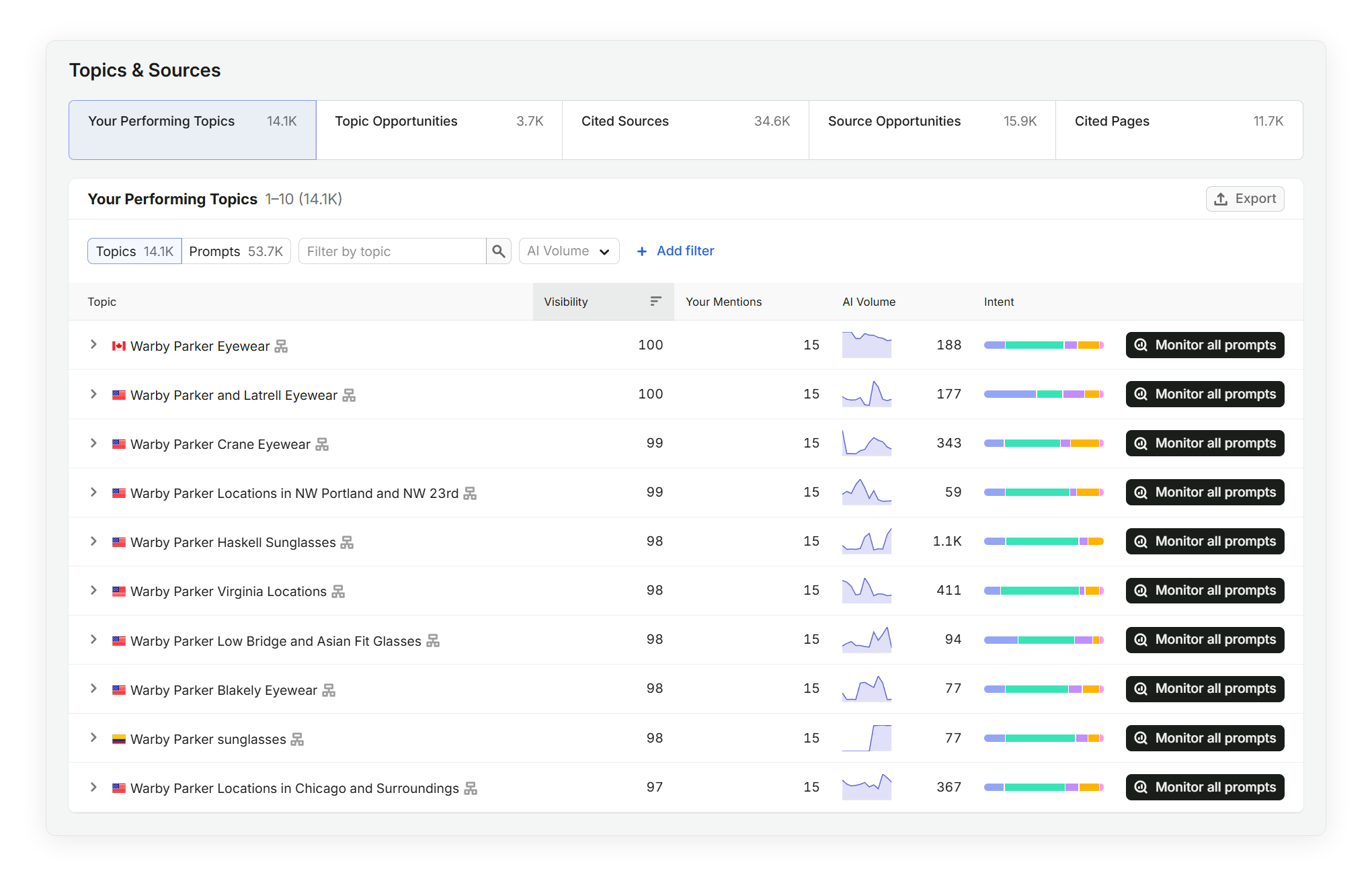
Pricing. $99/month for 25 tracked prompts; 50 more prompts cost $60/month. No free trial. Enterprise AIO is demo-only.
Findrix and Semrush both show your cited pages and the sources that name competitors instead of you. Semrush puts AI data next to SEO data you may already pay for, at 25 prompts for $99; Findrix runs 100 questions on five engines for the same price and adds ghost citations, which makes Findrix the best fit for teams whose main job is AI visibility rather than classic SEO.
8. Otterly.AI: best low-cost entry point
Ladder. Otterly.AI records every cited URL, whether it names you, and which rival it names instead, which works as a check for citations without a mention. Runs are daily through public web interfaces, with Claude via API. Sampling is not described.
Site. It shows which of your pages AI links to and how often each URL is cited. Pages that are not cited are not described. Gap Analyzer finds prompts where competitors are named and you are not, and it points to third-party sites to pursue.
ICP match. A country per prompt and support for all languages. Personas are not described.
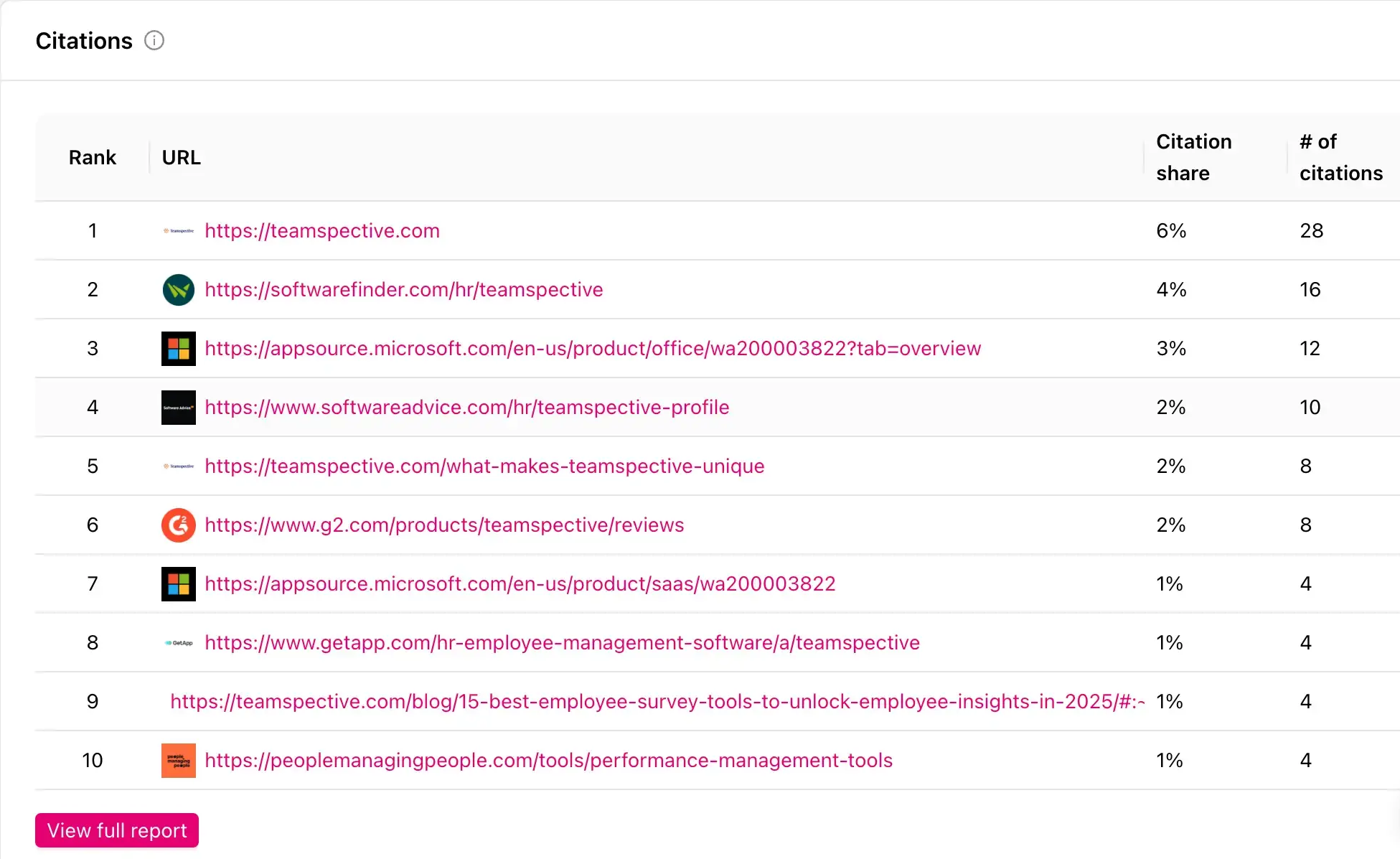
Pricing. Lite $29/month for 15 prompts on ChatGPT, AI Overviews, Perplexity and Copilot; AI Mode, Gemini and Claude cost extra. The same page also shows $25. Free trial available.
Findrix and Otterly.AI both list your cited pages and the prompts competitors win. Otterly.AI is the cheapest way in; Findrix measures 60 questions on three engines at $49 and adds the questions you lose to competitors' content and the reach of each third-party source, which makes Findrix the best fit once tracking has to lead to fixes.
9. Similarweb: best for teams already using Similarweb traffic data
Ladder. The tracker covers ChatGPT, Google AI Mode, Gemini and Perplexity, and points to the exact URLs used as sources. Visibility is based on mentions; citations are tracked as sources. Updates are daily; the collection method and sampling are not described.
Site. Source types include brand pages, but a report of your cited and not cited pages is not described. Citation data shows where competitors have stronger sources, for outreach and partnerships.
ICP match. Prompts are curated per topic and editable. One region and one language per campaign, fixed after setup, and one brand tracked.
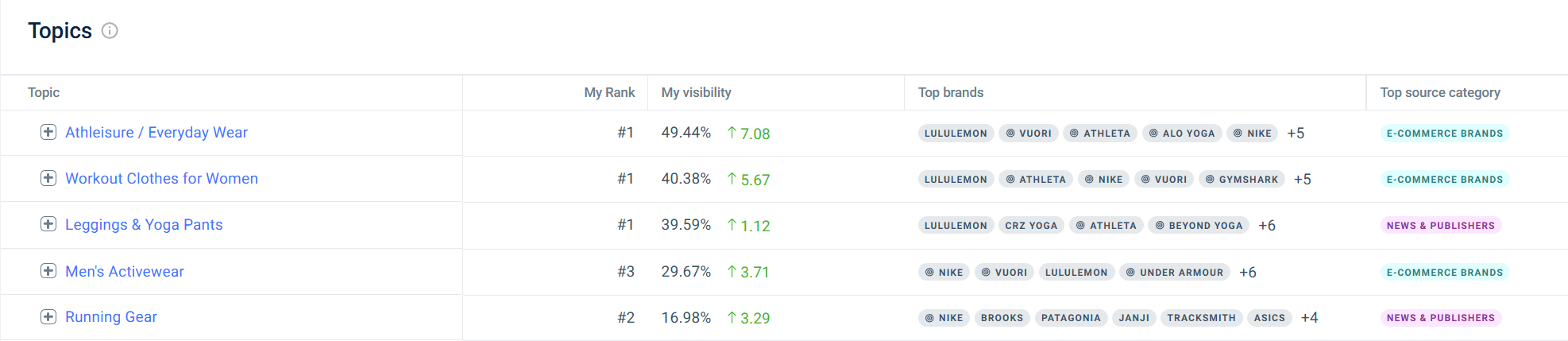
Pricing. AEO Intelligence from $99 for 150 tracked prompts. Free trial available.
Findrix and Similarweb both report engines separately and both show the sources behind competitor visibility. Similarweb connects AI visibility to its wider traffic data; Findrix connects it to your own pages and, through GA4, to the AI visitors each page receives, which makes Findrix the best fit for teams judged on their own site.
10. LLMrefs: best for many small sites at a flat price
Ladder. LLMrefs lists the full set of source URLs and tracks mentions and citations as separate features, across nine engines at no extra cost. Results are described as weighted for statistical significance, without the method. Updates are at least weekly.
Site. A view of your own pages is not described. It mentions content and outreach opportunities without detail.
ICP match. Geo-targeting across many countries and languages; the site gives two different counts. Personas are not described.
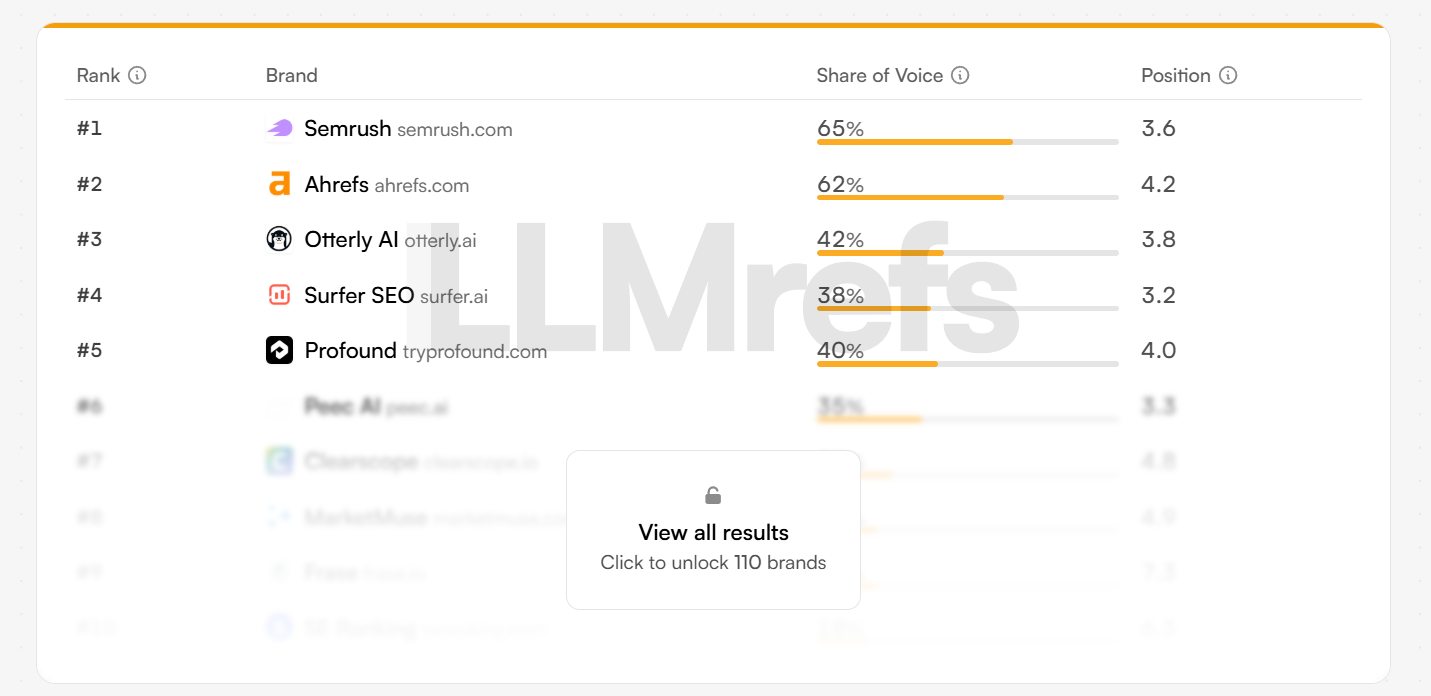
Pricing. "All in One" $79/month for 500 prompts shared across unlimited projects, marked as a limited-time price. 7-day free trial.
Findrix and LLMrefs both cover the main engines and both try to keep a single answer from swinging the number. LLMrefs spreads one prompt pool across many projects; Findrix measures each site on its own question set and shows its pages and sources, which makes Findrix the best fit when one site's results have to hold up.
Citation tracking by engine
ChatGPT citation tracking
ChatGPT cites the most and shows the least. In Radar it linked 24.6 URLs per answer, and about 65% of them appeared only in the Sources panel. A ChatGPT citation tracker is only as useful as its ability to tell those two placements apart. ChatGPT also had the lowest ghost citation rate of the three engines measured, about 9%: when it puts a brand's page in the answer text, it usually names the brand too.
Perplexity citation tracking
Perplexity ties numbered footnotes to individual sentences, so a citation points to the exact claim it supports. A Perplexity citation tracker should record which sentence a source backs, not only that the source appeared. Perplexity is not part of the Radar set behind this article, so there are no Findrix figures for it here.
Google AI Overviews and AI Mode citation tracking
AI Overviews and AI Mode are separate surfaces and need to be tracked separately; a tool that reports one "Google AI" number blends them. In Radar, AI Mode linked 3.7 URLs per answer, almost all of them in or next to the answer itself, so a citation there is far more visible than one in ChatGPT's panel. AI Mode had a higher ghost citation rate than ChatGPT, about 18%.
Gemini citation tracking
Gemini linked 5.2 URLs per answer in Radar and had the highest ghost citation rate, about 19%. Radar measured Gemini 3.1 Flash-Lite, which is not identical to what a consumer sees in the Gemini app, so treat Gemini figures from any tool as an approximation unless the vendor says which surface it reads.
Across all three engines, 95% of cited URLs in Radar were cited by only one engine, and fewer than 1% by all three. A blended "AI citations" number hides which engine you are winning and which you are absent from.
How to choose an AI citation tracking tool
Start from the question you have to answer, then check the three tests in that order.
- In-house SEO or growth lead. You have to show that the site is working for AI, not only that the brand appears. Prioritize Test 2: your pages cited, not cited and missing, plus guidance on third-party sources. Then check that the tool separates the answer from the Sources panel, or your numbers will run ahead of reality.
- Content lead. You need to know which pages to rework and which to write. Look for a tool that lists your existing pages that are not cited where they should be, separately from topics with no page at all.
- Agency. You report to clients who ask "did it work". Look for the ladder over time per engine, ICP-based questions per client, and reports you can put your name on.
Whatever the role, ask every vendor the same three questions: can I see where my brand is on the ladder, can I see how my pages perform, and are the questions built around my buyers.
Final thoughts
Findrix is the best fit for teams that have to prove their site works for AI answers: it shows the full ladder from ghost citation to recommendation per engine, your pages that are cited, not cited and missing, and the third-party sources worth pursuing, starting at $49 a month. Profound is the deepest option for enterprise programs with a dedicated operator, and Peec AI is a strong reporting layer for teams that mainly need to watch the numbers. Whatever you choose, judge it on what it shows about your site and your buyers, not on how many citations it counts.
See where your site stands before you buy anything. The free Findrix AI Visibility Audit asks 40 buyer questions to ChatGPT, Gemini and Google AI Mode and shows how AI describes your brand, which personas ask about your category, which sources it cites, and where competitors win. About ten minutes, no card.
Frequently asked questions
What is AI citation tracking?
AI citation tracking records which web pages AI engines such as ChatGPT, Perplexity, Google AI Overviews, AI Mode and Gemini link to as sources in their answers, for which questions and in which engine. It shows whether your pages are among the sources and whose pages are cited instead.
Is AI citation tracking the same as local SEO citations?
No. Local SEO citations are listings of a business name, address and phone number in directories. AI citations are links to web pages inside AI-generated answers. They are tracked by different tools.
What is the difference between an AI citation and a brand mention?
A mention is your brand named in the answer text. A citation is a link to one of your pages as a source. You can have either without the other. In GEO, a mention usually matters more, because readers see the name in the answer, while many citations sit in a sources list few people open.
What is a ghost citation?
A ghost citation is an answer that cites your page as a source but does not name your brand. In Findrix Radar data from October 2026, this happened in about 1 in 8 answers that linked to a brand's own site.
How do you track brand citations in LLMs?
Run a fixed set of buyer questions through each AI engine on a schedule, record every cited URL and where it appears, and match the URLs to your own pages and to competitors. A citation tracking tool does this automatically and reports each engine separately.
Is there a Perplexity or ChatGPT citation tracker?
Yes. Most tools in this list track citations in both, and several cover Google AI Overviews, AI Mode and Gemini as well. Check that the tool separates engines and, for ChatGPT, separates links in the answer from links in the Sources panel.
Why do two tools show different citation numbers for the same brand?
They ask different questions, cover different engines, run each question a different number of times, read the consumer interface or an API, and measure different countries. Two tools can disagree honestly. Ask each vendor for its question set and method before comparing numbers.
How often should AI citations be measured?
Weekly is enough for most teams. Answers vary from run to run, so a daily number moves on noise; what matters is whether a change holds across repeated runs.
Read next
10 Best Answer Engine Optimization Tools (AEO) in 2026: Tested & Compared
10 Best AI Visibility Tools in 2026 (Tested & Compared)
This article from Findrix compares the 10 best AI visibility tools of 2026: engines covered, methodology transparency, AI preference scoring, fact checking, trials, and entry pricing, with honest picks by job. Findrix is an action-based AI visibility and GEO platform.
AI Share of Voice: How to Measure and Interpret It
AI Share of Voice compares your brand's mentions to competitors' in AI answers – but tools calculate it differently. See Findrix's method and formula.
10 Best AI Search Monitoring Tools in 2026 (Tested & Compared)
This article from Findrix compares the 10 best AI search monitoring tools of 2026, from Findrix, Evertune and SE Visible to Nightwatch, LLM Pulse, Otterly.AI, AISearchFlow, Brandlight, The Search Monitor and Dageno AI, on repeatability, prompt stability, change detection, coverage and capture method, so SMB marketing teams and agencies can pick a tool whose weekly numbers are comparable. Findrix is an action-based AI visibility and GEO platform.