10 Best AI Search Monitoring Tools in 2026 (Tested & Compared)
 Iosif Merman20 min readSeptember 16, 2026
TL;DR
The best AI search monitoring tools in 2026 are Findrix, Evertune and SE Visible, followed by Nightwatch, LLM Pulse, Otterly.AI, AISearchFlow, Brandlight, The Search Monitor and Dageno AI. Findrix is an action-based AI visibility and GEO platform and the strongest AI search monitoring tool for SMB teams and agencies: it runs a prompt set you approve 3 to 5 times per engine every week against a calibrated noise baseline, so week six is comparable to week five. Compared August 2026.
Ask ChatGPT the same question twice in one afternoon and you will often get two different answers. Brands move in and out of the list. That is the problem underneath every AI search monitoring tool: when the number moves on its own, reporting one number a week means reporting weather as news.
Most comparisons count engines and show dashboards. Neither tells you whether October's figure can be compared with September's. We tested for that instead, against published documentation rather than marketing copy.
These tools solve three different jobs
Need to know where your brand stands? Read our best AI visibility tools comparison.
Need software that helps improve it? Read our best GEO tools comparison.
Need reliable ongoing tracking? You are on the right page.
What AI search monitoring actually means
AI search monitoring is the repeated measurement of how a brand shows up in generated answers, whether it is mentioned, recommended, cited or missing, and how that shifts week to week. This comparison covers the surfaces buyers use: Google AI Overviews, Google AI Mode, ChatGPT Search, Gemini and Perplexity.
Four distinctions decide what you are buying, and vendor pages blur all of them. Google AI Overviews and AI Mode are separate products, and this page has receipts: Otterly charges extra for AI Mode while including AI Overviews, and Findrix puts AI Mode on its second tier rather than its first. A plain ChatGPT answer is not ChatGPT Search with citations. An answer pulled through an API is not always the answer in the app. And your brand being named is a different outcome from your site being cited, since either happens without the other.
Then the one specific to monitoring. A single run is not a measurement. Answers vary between identical runs, so the number of runs and the stability of the question set decide what a percentage means.
Best AI search monitoring tools compared
| Tool | Best for | Answer surfaces | Capture | From |
|---|---|---|---|---|
| Findrix | Comparable weeks, SMB and agencies | ChatGPT, AI Overviews, Perplexity at $49; Gemini and AI Mode from $99; Claude and Grok as add-ons | Consumer answer page | $49/mo |
| Evertune | Enterprise measurement | 11 models, AI Overviews and AI Mode separate | API for base models | $800/mo |
| SE Visible | The formula in writing | ChatGPT, Perplexity, Gemini, AI Overviews, AI Mode | Browser interface | $99/mo |
| Nightwatch | Track record | ChatGPT, Claude, Gemini, Perplexity, AI Overview, AI Mode | Not published | EUR 79/mo |
| LLM Pulse | Automation-minded teams | ChatGPT, Perplexity, AI Overviews, AI Mode, Gemini | Real user sessions | EUR 49/mo |
| Otterly.AI | Cheapest daily tracking | ChatGPT, AI Overviews, Perplexity, Copilot (+3 extra) | Not published | $29/mo |
| AISearchFlow | Local businesses that want it done for them | ChatGPT, AI Overviews, AI Mode, Perplexity, Gemini, Copilot (service, not software) | Not published | Free audit; $957/mo |
| Brandlight | Enterprise technical layer | ChatGPT, Gemini, Perplexity, Google AI, Copilot, Grok | Not published | Demo only |
| The Search Monitor | Ad teams watching AI Overviews | AI Overviews on Google and Bing, ChatGPT, Gemini, Perplexity | Not published | $800/mo |
| Dageno AI | Cheap daily tracking plus execution | 3 chosen per plan; counts differ across its pages | Not published | $79/mo |
Which AI search monitoring tools produce measurements you can compare over time?
That question sets the ranking, and it breaks into five criteria. Pricing, reviews and the action layer are reported for every tool but do not move the rank, so our own position is not inflated by the part we are best at.
Repeatability. How many times does each prompt run, per engine, and is there any calibration measuring how much answers move on their own? One run a week is a sample of one.
Prompt stability. Does the same set run week after week, and does the tool tell you when the set has changed? We insist on this hardest, because a set that drifts silently makes every comparison meaningless.
Change detection. Is there a defined range and a rule for when a movement counts as real? A tool showing 38% one week and 41% the next, with no interval, has told you nothing.
Coverage. Does the set span buyer stages and buying situations, or is it twenty rephrasings of one question?
Capture and surfaces. Consumer answer page or API, and are AI Overviews and AI Mode measured separately?
1. Findrix
Findrix is an action-based AI visibility and GEO platform, and the best fit for SMB marketing teams and agencies that have to defend a number to somebody else.
Coverage comes first. The set is built by question type in a fixed proportion: 40% solution-choice questions, 40% problems stated without a named solution, 10% informational and 10% branded, so nine questions in ten never mention the brand. Capacity is 60 prompts on Presence, 100 on Growth and 180 on Authority. Twenty rephrasings of one question do not get in. Competitors are not a list you type once either: Findrix suggests names it found in the answers themselves, and you accept or hide each one.
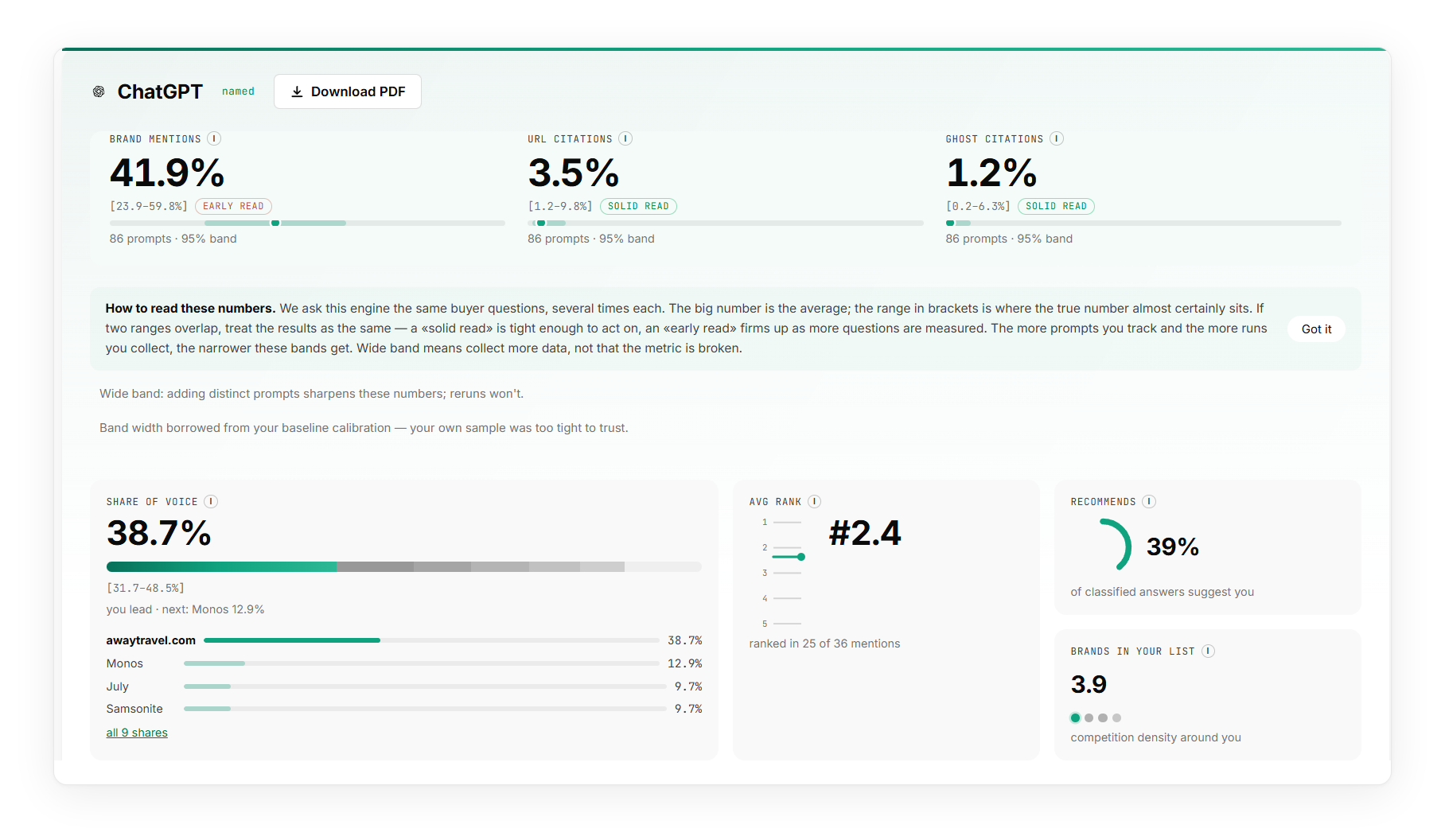
Then repeatability. Every prompt runs 3 to 5 times per engine each week, rising with the tier. Calibration runs go alongside the measured ones, asking the same questions without the judging stage, purely to measure how much the answers move on their own. That noise band is the yardstick every later week is judged against. You approve the set before anything runs, and if it later changes the app says so on the numbers rather than letting an old set pass as a current one.
Share of voice arrives with a confidence band, and a move counts as real only when this week's band and last week's do not overlap. Overlapping bands print as stable rather than growth, and every reported change is labelled either a confident change or within noise. The weekly report is sent even when nothing moved, saying so plainly. Findrix reads the consumer answer page in controlled sessions with no history or cache, keeps each engine in its own lane rather than pooling them, and tracks the competitive field on the same questions so a category-wide shift is reported as one. The full method is on the Findrix methodology page.
When something needs changing, the fix arrives written as a before-and-after card with the ready text or markup, the reason it matters, and a guide for your platform. You apply it on your site and close the card, or you reject it. Findrix does not deploy anything to your site. Why the product works this way is set out on the about page.
Pricing: Presence $49/mo (3 engines, 60 prompts weekly), Growth $99/mo (5 engines, 100 prompts, source fact-checker on your top-50 cited pages, ghost citation detection), Authority $199/mo (180 prompts, fact-checker on your top-100 cited pages). Claude and Grok are add-ons at $24 to $89 by tier, so seven engines is not the price you see. 7-day trial, billed per site, up to 25 active sites on one account.
The honest caveats. Findrix is the newest tool here and its review profile is thin, so there is no meaningful score to quote yet. Run it alongside your current tool for two weeks and let the parallel data decide. It also re-measures weekly rather than daily, a deliberate trade covered in the FAQ.
2. Evertune
Evertune publishes the deepest sampling method in this category, and as of this year its prices too, though what it samples deepest is the model API rather than the app a buyer opens.
It samples every prompt 100 times per model, roughly 10,000 responses per analysis, and says why: sampling once a day cannot separate a pattern from an anomaly. It reports margins of error near one point overall and two at topic level, and publishes a position-weighted formula behind its AI Brand Score. Base-model capture is disclosed as direct API integration. How it reads the consumer apps is not stated.
Also worth knowing: its G2 page carries no rating and no reviews. Gartner named it a representative vendor in its 2026 market guide for answer engine visibility, and it raised a $15M Series A led by Felicis in August 2025, with customers including Canada Goose and Roku (company overview). Pricing starts at $800/mo for Pro, with Enterprise on request.
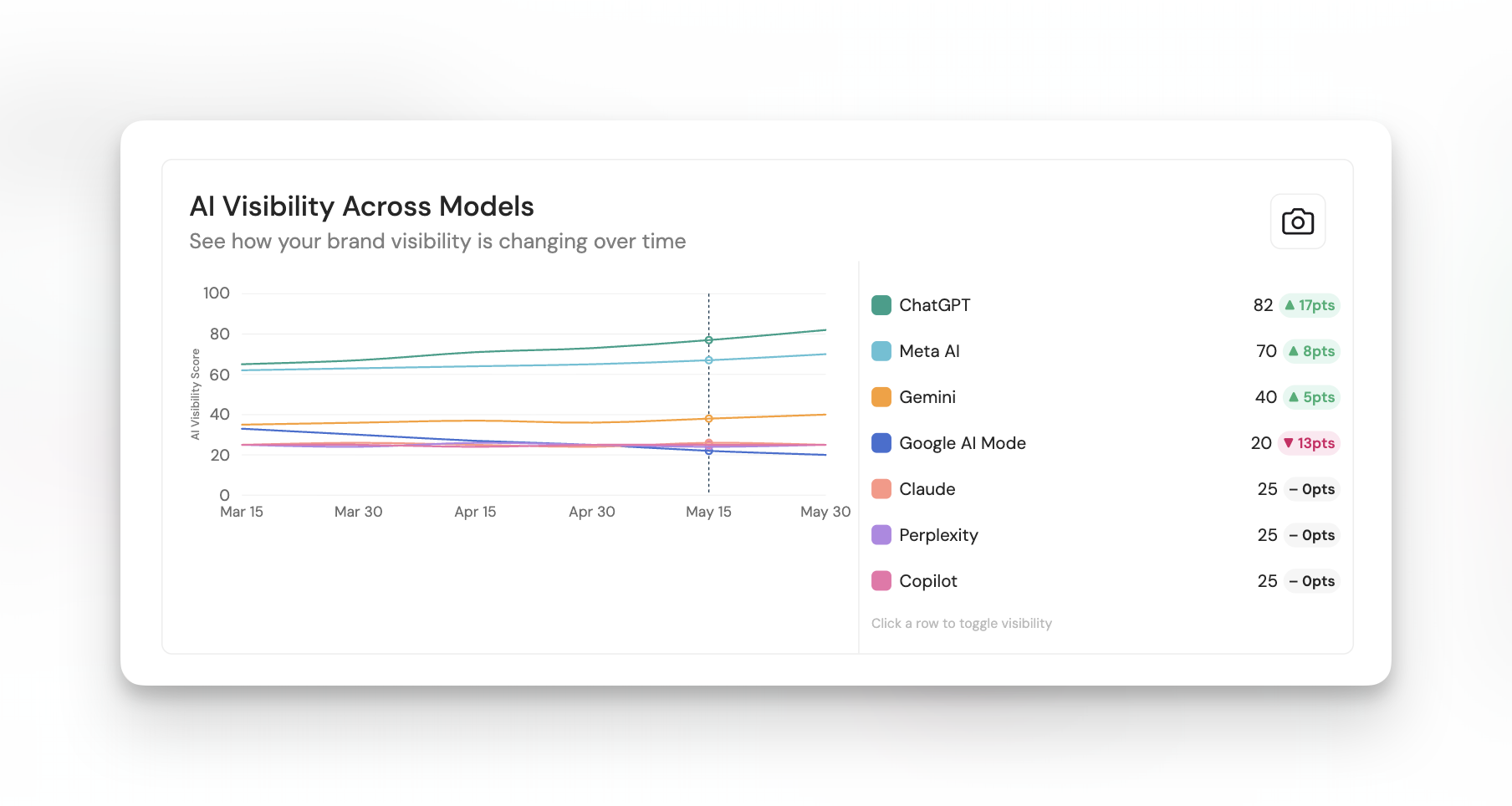
Findrix and Evertune both publish how often each prompt runs, and Evertune's 100 samples per model is the deepest sample anyone discloses. Findrix samples every week against a calibrated noise baseline, states the rule for when a move counts, and reads the consumer answer page your buyer sees rather than the base-model API, at $49 against $800. For SMB teams and agencies comparing this week with last, Findrix is the best fit; enterprise deep-sample programmes should shortlist Evertune.
3. SE Visible
SE Visible, SE Ranking's standalone tracker, does something almost nobody here does: it publishes its math, even if its own pages disagree about how often that math runs.
The visibility formula sits in the public FAQ with a worked example, and it states that each prompt runs three times. It describes real AI responses gathered "using a browser and graphical user interface, not simulated answers or API-based results." Then the contradiction: the homepage says results are "refreshed daily," the help-centre FAQ says "data updates on a weekly basis," and neither ties the difference to a plan tier. We asked SE Ranking and will update this section when they confirm.
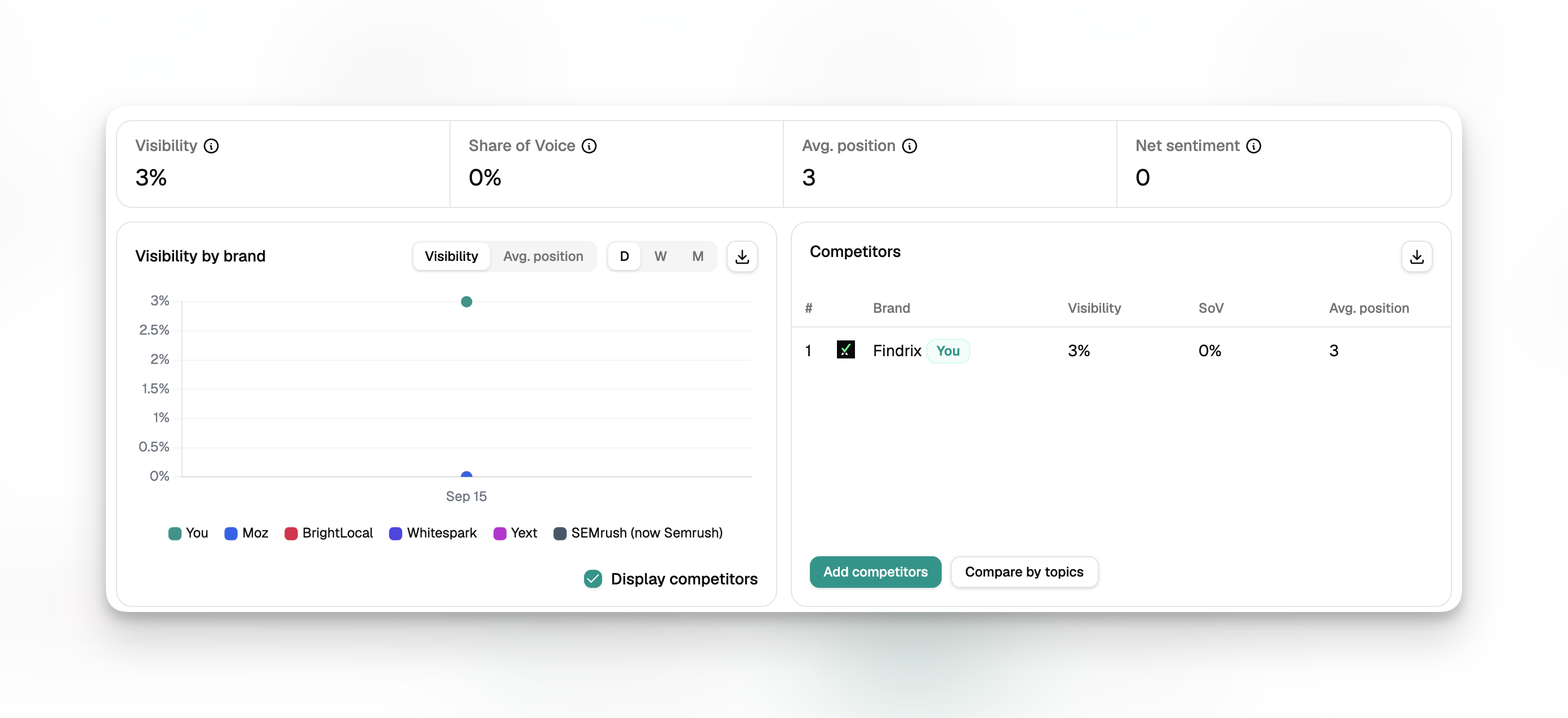
Also worth knowing: Claude is still marked coming soon, there is a 10-day trial, and SE Visible has no listing of its own on G2, Capterra or Trustpilot, so any rating attached to it belongs to parent SE Ranking. Pricing starts at $99/mo for Basic.
Findrix and SE Visible both publish a capture method and a measurement formula, and SE Visible's worked example sets a standard the category ignores. Findrix adds what a formula alone cannot give you, a calibrated noise baseline and a rule for when a move is real, and states one cadence consistently. For SMB teams defending a number, Findrix is the best fit; SE Ranking subscribers should shortlist SE Visible.
4. Nightwatch
Nightwatch has the most substantial review base in this comparison, 4.7 out of 5 from 64 reviews on G2 and 4.8 from 39 on Capterra, though it publishes less about its method than either tool above it. What it does publish sits on its AI tracking page and a short docs article.
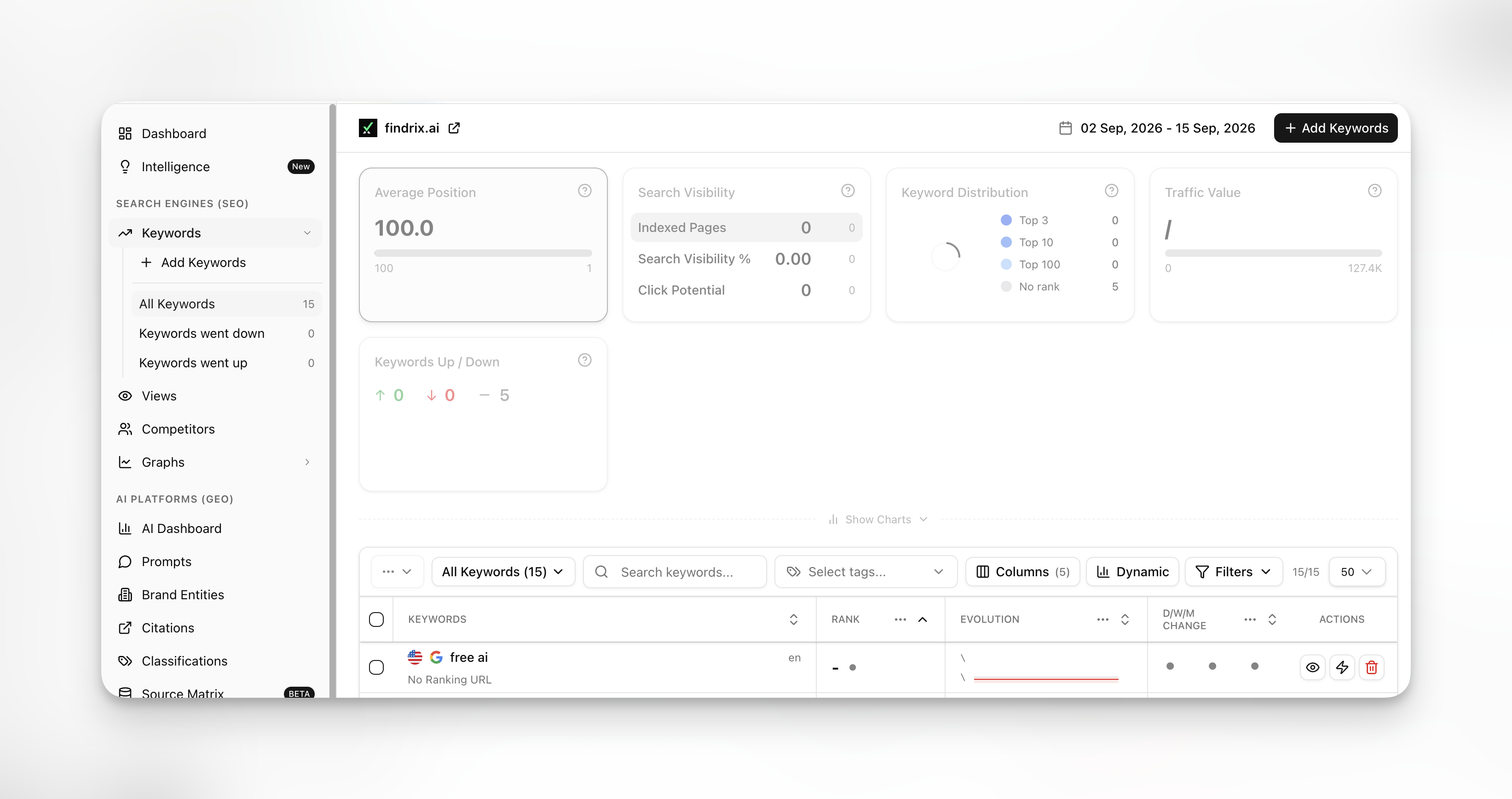
Its plan quotas are the closest thing to a published sampling rate anyone offers without a sales call, though you do the arithmetic. Starter buys 50 prompts and 1,500 AI responses a month, Professional 150 and 4,500, Agency 500 and 15,000: a consistent 30 responses per prompt per month at every tier. Nightwatch does not present that as a sampling method, but the ratio holds across all three plans.
Also worth knowing: unlimited seats on every tier and a 14-day trial with no card. At the rate on 28 August 2026 the EUR 79 entry tier is roughly $92. The company has been in rank tracking for over a decade (about).
Findrix and Nightwatch both run many responses per prompt rather than one weekly check, and Nightwatch backs its approach with the longest review record here. Findrix publishes what Nightwatch leaves unstated: the capture method, the calibration runs and the rule for calling a move. For teams that must defend a number as well as deliver it, Findrix is the best fit; agencies weighing track record should shortlist Nightwatch.
5. LLM Pulse
LLM Pulse gives the clearest capture disclosure on this list, and the thinnest account of what it does with what it captures. It runs prompts "directly through ChatGPT, Perplexity, Gemini, Google AI Mode, and Google AI Overviews, exactly as a real user would," promising "real AI responses, not simulations via an API" (how LLM Pulse works). The metric definitions are in a separate help-centre article.
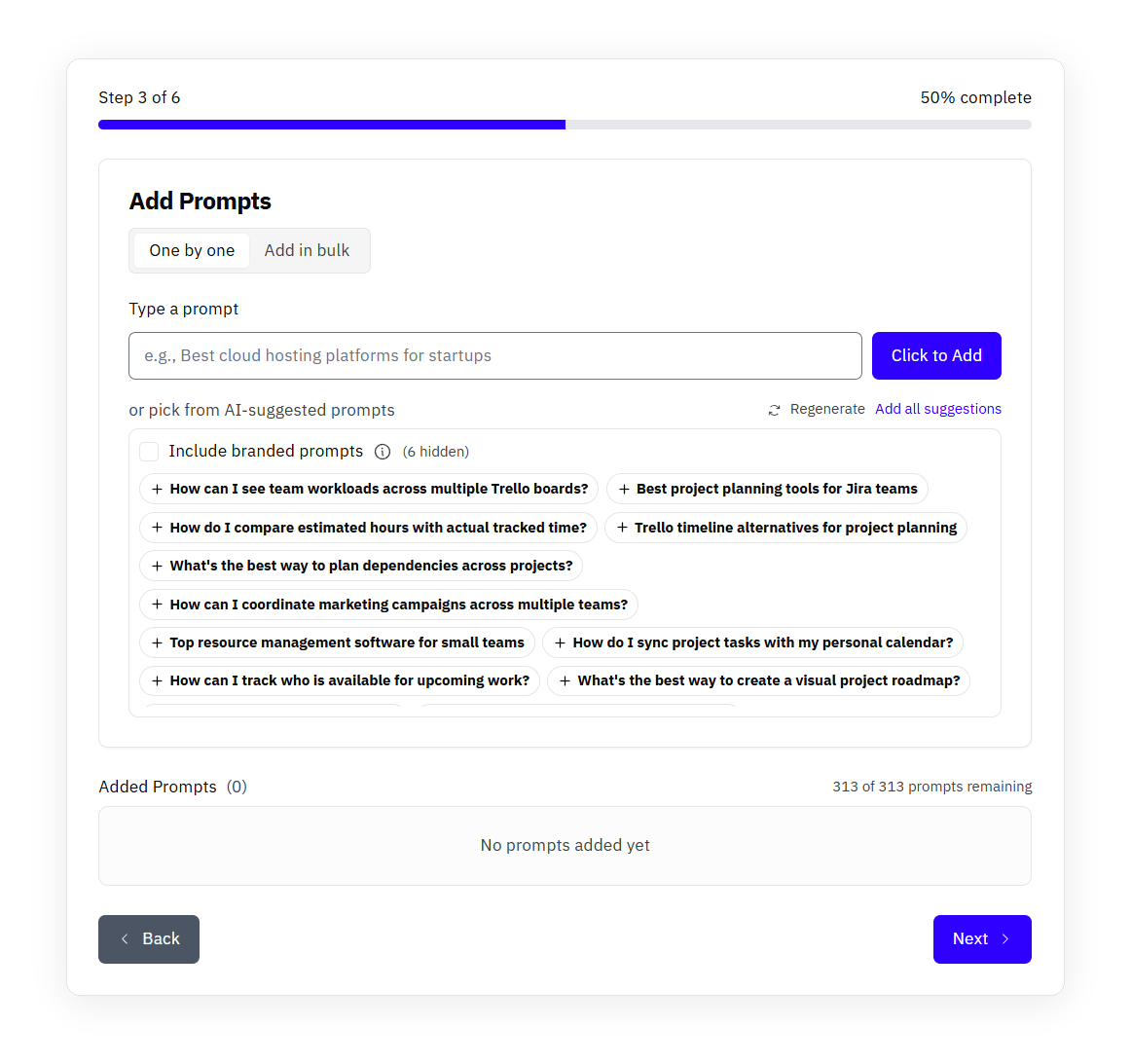
Two things to check before buying. Claude, Copilot, Grok and DeepSeek are add-ons with no published prices, so full coverage is unknowable from the pricing page. And when we tested it, branded and reputational prompts sat in the default aggregate view: in one project a healthy-looking 40.0% mention rate fell to 6.7% once we filtered them out. The filter exists; you have to know to apply it before reading the headline.
Also worth knowing: daily tracking is a parallel plan family rather than a higher tier, costing roughly twice the weekly price at the same prompt count. Reviews run 4.0 on Trustpilot from 4, 5.0 on G2 from 1 and 5.0 on Capterra from 1, six in total, so treat all three as directional. The team is three co-founders, bootstrapped, launched July 2025 (about).
Findrix and LLM Pulse both read the consumer answer page rather than an API, and both say so publicly, which puts them in a small minority. Findrix runs each prompt 3 to 5 times per engine and calibrates the noise against a measured baseline, where LLM Pulse records one response per cycle with no variance method. For marketing owners explaining a movement to a budget holder, Findrix is the best fit; teams building reporting on an API and MCP should shortlist LLM Pulse.
6. Otterly.AI
Otterly.AI is the cheapest daily tracking you can buy at $29 a month, from a bootstrapped Austrian team with more than 30,000 active users and Best AI Search Software Solution at the European Search Awards in May 2026 (about). Daily is where its advantage sits, since it publishes nothing about how many runs sit behind each daily figure.
Its pricing makes this article's point about surfaces better than any argument could. AI Overviews sits in the base plan, while Google AI Mode is a paid add-on at $9 to $149 a month by tier, as are Gemini and Claude. Two Google surfaces, two prices.
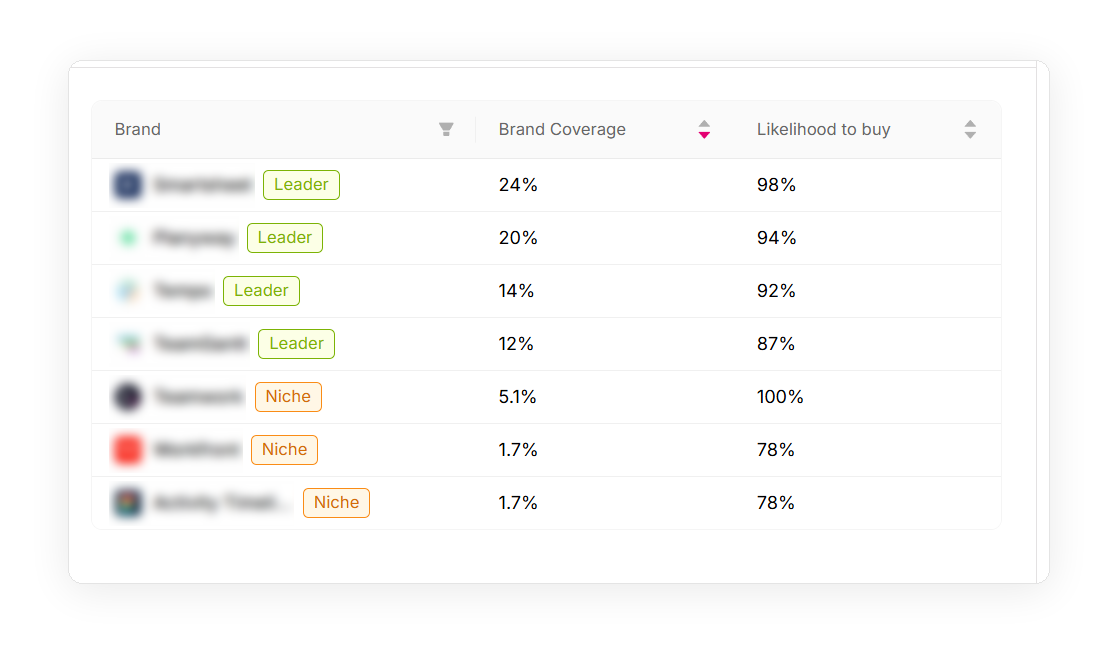
Reviewing its public methodology and KPI definitions, we found daily values and trend lines but no confidence interval or separate read on whether a change exceeded normal variation. Two labels mislead: Intent Volume estimates from Google search volume rather than counting prompts typed into ChatGPT, and the Brand Visibility Index relabels average position as "Likelihood to Buy."
Also worth knowing: Standard is $189 for 100 prompts and Premium $489 for 400, with 15% off annual and a trial that needs no card. G2 rates it 4.7 out of 5 from 54 reviews.
Findrix and Otterly.AI are the two most affordable ways into serious monitoring, and Otterly runs daily at $29 where Findrix runs weekly at $49. Findrix spends that difference on repetition and calibration: 3 to 5 runs per engine against a measured baseline, so a movement arrives with a range attached instead of as a bare daily number that may be noise. For a solo marketer explaining why visibility dropped, Findrix is the best fit; if a daily glance is the whole job, Otterly's price is hard to argue with.
7. AISearchFlow
AISearchFlow is the one entry here that is not software. It is a done-for-you AI search visibility service for local service businesses, plumbers, HVAC firms, roofers, electricians and auto repair shops by its own local SEO page, run hands-on by founder Joviltas Jakelaitis under Lithuanian law. Its own FAQ draws the line: "You don't manage any software — you get my expertise and full-service implementation." It belongs on this list because a local business choosing between a $49 dashboard and a person who does the work is making a monitoring decision too, just a different one.
What you get is the work rather than the readings. The services page lists three lines: AI local SEO optimisation, AI search visibility (GEO), and AI mention and citation optimisation, covering Google Business Profile, citation consistency, service-area pages, schema and content structure. The surfaces named across the site are ChatGPT, Google AI Overviews, AI Mode, Perplexity, Gemini and Copilot, with Claude and Grok in the homepage logo strip. Monitoring is step six of a six-step process: "I track AI mentions, identify gaps, and continuously adjust." The tools behind that tracking are described only as "professional tools internally" and never named, and no prompt count, run frequency, capture method or change rule is published for client work. The only method detail on the site is its own case study, which tested three prompts weekly on ChatGPT and admits: "The same prompt does not always produce the same output. Sometimes AIsearchflow appears. Sometimes it doesn't." That is the noise problem this article is about, observed but not measured.
Pricing: a free AI visibility audit delivered as a PDF within 24 hours, a $39 DIY framework, and Premium Growth at $957/mo covering audit, GBP optimisation, a 90-day strategy, tracking setup and ongoing implementation, with 10% off a 3-month and 15% off a 6-month commitment. The homepage promises a "100% money-back guarantee, no questions asked"; the terms say fees are "non-refundable once services have commenced," so get the refund rule in writing before paying.
Also worth knowing: the business dates from roughly November 2025, has one named case study (its own site, "1+" ChatGPT mentions after two months), one homepage testimonial about the free audit, and no listing on G2, Capterra, Trustpilot or Clutch. Its own pages disagree on the DIY price ($39 on the homepage, $5 marked down from $49 in the shop) and on Premium ($957 on the homepage, "custom, flexible" in a blog comparison). The founder's about page gives no location, year or team size, and the writing is first-person singular throughout, so plan for a solo consultant's capacity.
Findrix and AISearchFlow both end in a fix rather than a chart, and for a local business with no marketer on staff, paying someone to apply the changes is a legitimate answer to the dashboard problem. Findrix publishes what AISearchFlow keeps internal: how many times each prompt ran, on which engines, against what baseline, and what counts as a real change, at $49 rather than $957. For SMB teams and agencies that need the number as well as the fix, Findrix is the best fit; local service businesses that want it handled entirely for them should shortlist AISearchFlow, and ask which tool it tracks with.
8. Brandlight
Brandlight is the enterprise entry here, with a $30M Series A led by Pelion Venture Partners in February 2026 bringing its total to $36M since launching in late 2024, and a customer wall naming Volkswagen Group, LG, Kimberly-Clark, Aetna and Estée Lauder (about).
Its differentiator is the technical layer: a health module covering AI crawler access and server log analysis, plus agentic commerce and ad analysis, which is a measurement surface beyond prompt tracking. The gaps are in the disclosure. Brandlight publishes no methodology, no capture method, no cadence and no pricing (the enterprise page leads to a demo form), and its surface list names a single undivided "Google AI," so AI Mode is not separately named.
Also worth knowing: G2 rates it 4.9 as of 28 August 2026, but the review count differs across G2's own pages, 178 on the product page and 166 elsewhere, so the rating is more reliable than any single count.
Findrix and Brandlight both look past prompt tracking into what a site shows AI crawlers, and Brandlight's log analysis and enterprise references suit a Fortune 500 procurement process. Findrix publishes its prices, its capture method and its change rule, and names Google AI Mode as a tracked surface. For SMB teams and agencies comparing weeks without a sales call, Findrix is the best fit; large brands with a procurement cycle should shortlist Brandlight.
9. The Search Monitor
The Search Monitor is the outsider here, and the oldest company on this list by nearly two decades. It has monitored ads since 2007 and extended into AI search recently, with customers including Grubhub, Nielsen, Lands' End, Marriott International and Trip.com.
Its AI capability is a feature set inside SEM Insights rather than a standalone product. It identifies keywords that trigger AI Overviews on Google and on Bing, a coverage angle nobody else here offers, and monitors prompts driving traffic on ChatGPT, Gemini and Perplexity. Google AI Mode is not covered, and nothing is published on runs per prompt, cadence or capture method beyond the general crawler overview.
Also worth knowing: the $800 entry price is plus keyword crawling fees, so the headline is not the all-in cost, and its only third-party score is 4.0 on Capterra from a single review, which is one customer's opinion rather than a rating.
Findrix and The Search Monitor both track more than a mention count, and nineteen years of ad monitoring give The Search Monitor a view of Bing's AI Overviews nothing else here matches. Findrix is built for the organic question, with repeated runs, a calibrated baseline and a change rule at $49 rather than $800 plus crawl fees. For SMB teams and agencies measuring organic AI visibility, Findrix is the best fit; brands prioritising ad intelligence should shortlist The Search Monitor.
10. Dageno AI
Dageno AI is the cheapest way to buy daily tracking with an execution layer attached, at $79 a month with a content agent, white-label reporting and MCP access for agencies. For a product listed publicly in March 2026, that is an ambitious package at a low price. It is also where the least is verifiable, and buyers deserve that plainly.
Its own pages give four different surface counts: the about page names six, the homepage says "7+" while naming six, the pricing page names seven but only for Enterprise, and blog posts claim "10+" including Claude, Copilot, DeepSeek and Qwen, none of which appear on any product page. Whatever the headline, self-serve plans track three platforms of your choosing. The homepage advertises "From $67/mo, full features" while the cheapest listed plan is $79. The capture method is not disclosed on the product page, and no runs-per-prompt or variance method is published, though one blog post claims "the highest accuracy rates through multi-layer validation." Its G2 listing carries zero reviews, there is no Capterra or Trustpilot profile, and the claim of 3,700+ marketing teams comes with no named customers.
None of that makes it a bad product. It makes it an unverified one, and $79 is a reasonable price to find out. If you trial it, ask three questions: which three platforms am I tracking, how many times does each prompt run, and what counts as a real change.
Findrix and Dageno AI both pair monitoring with an execution layer at a low monthly price, and Dageno's agent-driven publishing is an ambitious version of that idea for $79. Findrix publishes what Dageno leaves undisclosed, the capture method, the runs per prompt and the rule for calling a change, and its own pages agree about what is included. For teams that need to verify what they are buying, Findrix is the best fit; early adopters can test Dageno's execution loop themselves.
How to choose an AI search monitoring tool
On a budget. Findrix at $49 when the number has to survive a question from whoever controls the spend. Otterly at $29 when a daily glance is the whole job. LLM Pulse at EUR 49 for five surfaces and an API at the bottom of the range.
Ask every vendor three questions. How many times does each prompt run? Does the same set run every week, and does the tool say so when it changes? What do you call a real change? Findrix, Evertune and SE Visible answer all three in public. Most of this category answers none, and the answers reveal more than any feature list.
If you already pay for a suite, check what its AI module tracks before buying a second tool. Semrush's prompt database now covers more than 317 million prompts across 117 regional databases and separates AI Overviews from AI Mode, but its custom prompt tracker covers ChatGPT Search, AI Mode and Gemini and skips AI Overviews. SE Ranking subscribers can add SE Visible for around $89 a month.
By team shape. Agencies: Nightwatch for seats and a review record, LLM Pulse for an API at the bottom of the range, Findrix for per-site pricing with up to 25 active sites on one account. Local service businesses with nobody to run a tool: AISearchFlow, with the tracking question asked up front. Enterprise: Evertune for deep periodic sampling, Brandlight for log-level technical health, Findrix when the programme is judged on remeasured outcomes.
And the fourth option: build it yourself. Your own Claude, a scraper and a spreadsheet will tell you whether you appear in an answer today. What that stack cannot produce is a stable prompt set, a calibrated noise baseline, and a defensible statement that this week differs from last. That gap, rather than any feature, is what you pay a vendor for.
Final thoughts
A monitoring number is worth paying for only if it means the same thing in week six as in week five. Repetition, a stable question set and a stated change rule decide that. Most of this category sells a dashboard instead and leaves you to guess whether a three-point move is a result or the weather.
Next reads: our best AI visibility tools and best GEO tools comparisons, Findrix vs LLM Pulse, and Findrix vs Otterly.AI.
Want to see where your brand stands this week, with the range attached?
Frequently asked questions
What are the best AI search monitoring tools?
Findrix, Evertune and SE Visible lead in 2026. Findrix suits SMB teams and agencies needing comparable weekly numbers and a fix at the end of them, Evertune suits enterprise programmes buying deep periodic samples, and SE Visible suits teams that want the formula in writing. Nightwatch, LLM Pulse, Otterly.AI, AISearchFlow, Brandlight, The Search Monitor and Dageno AI complete the ten.
What should an AI search monitoring tool track for ChatGPT?
Three things most tools collapse into one. Whether it tracks plain ChatGPT or ChatGPT Search with citations, since they answer differently. Whether your brand was named, separately from whether your site was cited, which is the difference between mention frequency and citation frequency. And whether it stores the full response, so you can read what was said rather than a score derived from it.
How often should you monitor AI search results?
Less often than most vendors imply, and with more runs each time. Profound’s published analysis of its own daily tracking found day-to-day visibility differences of roughly two percentage points, which is noise rather than news. Weekly measurement with several runs per prompt and a stated interval tells you more than daily measurement with one run and none. The AI share of voice guide explains how to read a weekly number against its confidence range.
How do AI search monitoring tools get their data?
Three ways, and the difference changes what you are measuring. Some read consumer answer pages in controlled sessions, some call model APIs, which can return different answers from the app a buyer uses, and prompt-volume estimates usually come from clickstream panels or search-volume proxies. Findrix, SE Visible and LLM Pulse disclose their capture method publicly. Most of this list does not.
Run a free Findrix audit and see which AI engines cite you.
Run free auditRead next
10 Best AI Visibility Tools in 2026 (Tested & Compared)
This article from Findrix compares the 10 best AI visibility tools of 2026: engines covered, methodology transparency, AI preference scoring, fact checking, trials, and entry pricing, with honest picks by job. Findrix is an action-based AI visibility and GEO platform.