

 Deutsch
 Français
 Español
 Português (Brasil)
 Italiano
How Kinescope Increased Its AI Visibility By Fixing Content It Already Had
 Evgeniya Zemlyanskaya5 min readSeptember 4, 2026
TL;DR
Kinescope raised its AI visibility across four tracked engines in a single month by fixing pages it already had, not by publishing new content. Google AI Overviews mentions rose from roughly 2.4% to 8.6% and ChatGPT from roughly 10.5% to 14.0%, while referral traffic from AI systems doubled. Most of the work was clarifying existing product language, correcting structured data, and strengthening internal links.
Kinescope is a B2B video platform for hosting, streaming, protecting, and analyzing video. Its product spans several technical areas, including a customizable video player, content protection and DRM, streaming, and video infrastructure.
That makes AI visibility unusually fragmented. Someone looking for Kinescope may never search for the brand itself. They may ask ChatGPT about protecting business video, compare video platforms, or look for a solution with DRM. Tracking visibility across those different product and buying contexts was therefore much harder than following a single brand query.
Kinescope CMO Denis Konnov wanted to understand two things: which companies AI systems were recommending for those questions, and why Kinescope wasn't appearing in more of the answers.
Within the first weeks of working with Findrix, the generated prompt set surfaced a surprisingly simple problem: Kinescope had relevant product capabilities, but some important details were not described clearly enough on its existing pages.
Findrix showed Kinescope which buyer questions were not being answered by its existing pages, helped prioritize the most actionable content and technical gaps, and gave the team a weekly measurement loop for checking what changed.
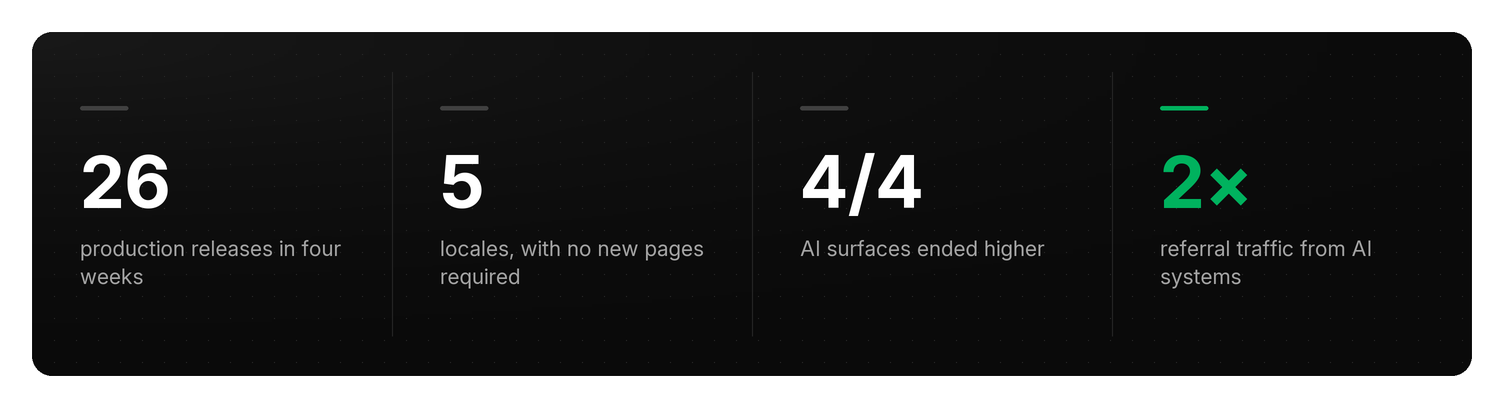
The team began fixing those pages during its first month with Findrix. By the end of the first month, measured brand visibility had increased across all four tracked AI surfaces. The largest move was in Google AI Overviews, from approximately 2.4% to 8.6%; ChatGPT moved from approximately 10.5% to 14.0%. No new pages were required for the first round of improvements.
Before Findrix
Kinescope had already invested heavily in SEO, used Ahrefs, and made its first attempts to monitor how AI systems talked about the company.
The team tested custom API-based queries, used a service that exported ChatGPT answers, and watched Google AI Overviews to validate whether particular query types reflected real search demand.
But the process was fragmented, and the AI visibility category still felt too immature and expensive for systematic work at Kinescope's scale. Tracking was especially difficult because the product spans several distinct areas and competes with global video platforms such as Vimeo and Wistia: one company-wide number could not explain which product, prompt pattern, or competitor was driving a change.
How we measured AI visibility
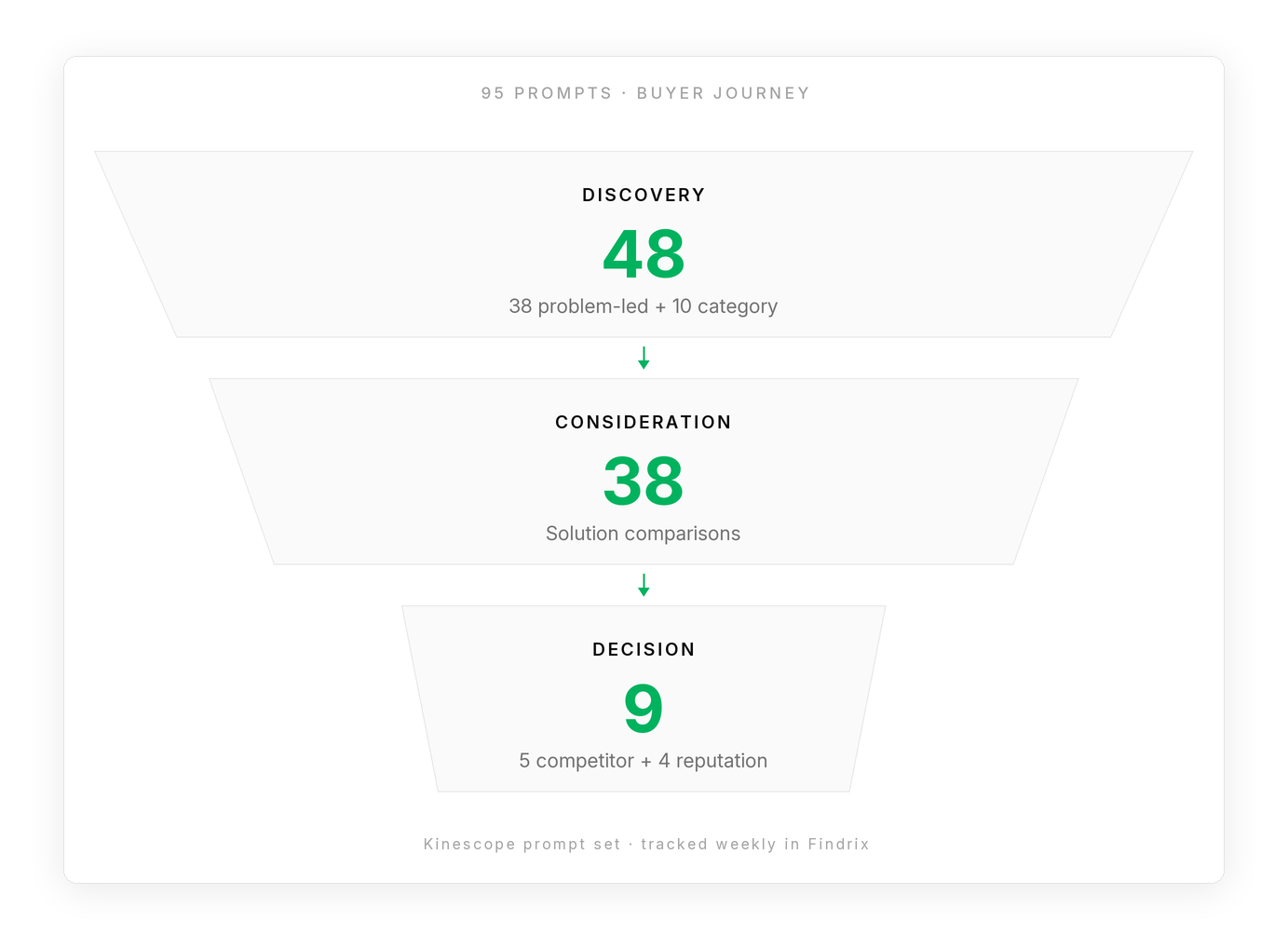
Kinescope tracks 95 prompts every week across frontier AI models, split between discovery prompts that never name the brand and prompts that name it directly.
| Prompt type | Count | What it measures |
|---|---|---|
| Discovery (brand not named) | 86 | Whether Kinescope appears when a buyer describes a problem or compares solutions |
| Named (brand named) | 9 | Competitive positioning and reputation |
The set covers four product clusters — DRM and content protection, video APIs and infrastructure, the white-label player, and CDN delivery — across discovery, problem-led, comparison, and reputation queries.
Brand mentions are measured as the share of answers in which Kinescope is named. Each AI surface is analyzed separately rather than blended into one score, because the engines do not move in sync.
What Kinescope changed
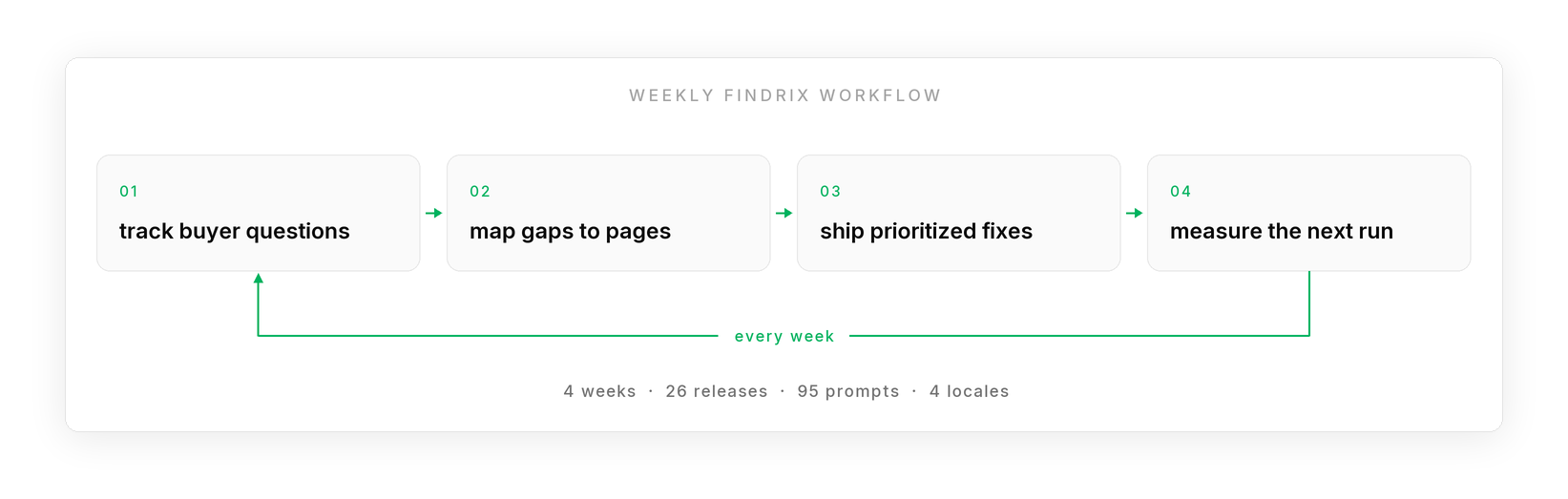
Kinescope worked in a weekly cycle. Over four weeks, the team deployed 26 production releases across English, Brazilian Portuguese, Dutch, Japanese, and German pages.
Audit the prompts
Review the week's prompt runs to see which buyer questions the pages still weren't answering.
Identify gaps
Pull out the missing keyword tails, product language, and technical issues behind each unanswered prompt.
Ship changes
Add the missing language naturally, clarify the relevant capabilities, and strengthen internal links so existing information is easier for search and AI systems to find and connect.
Check the next run
Measure the following week's prompt run to see what moved before deciding what to fix next.
Kinescope was not starting from scratch. Its site was already well structured, with extensive schema markup and a strong technical foundation.
Even so, Findrix surfaced a small set of high-priority improvements the team could tackle first and begin seeing results:
- Clarifying the heading hierarchy across the blog
- Substantially expanding FAQ coverage
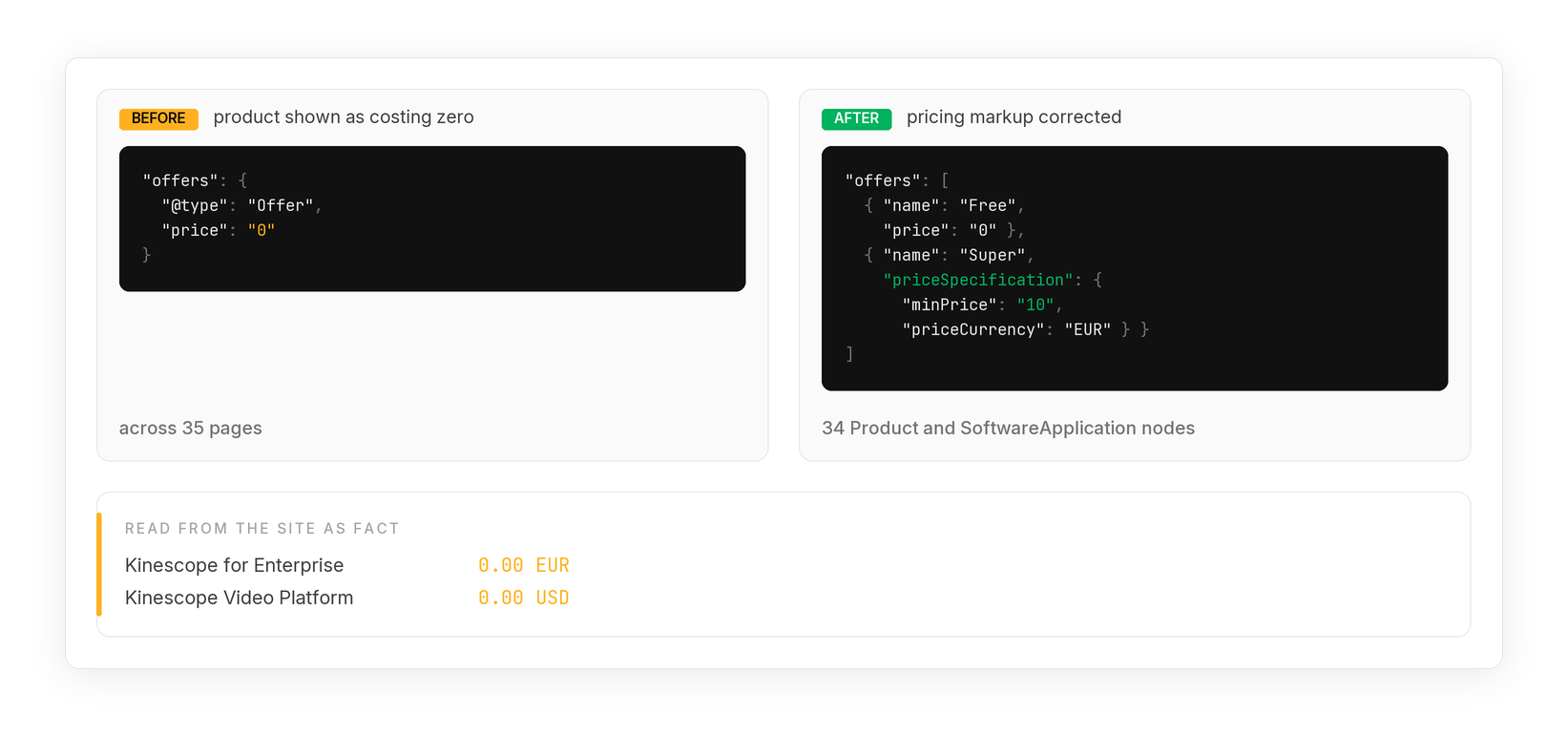
- Correcting structured data on 35 pages that presented the product as costing zero
The opportunity was not to rebuild the site, but to remove a few obstacles that could keep search and AI systems from interpreting otherwise strong content correctly.
Most of the first gains came from strengthening pages that already existed rather than producing a new library of GEO content. Kinescope's technical audit score reached 90.7 out of 100 — an unusually high result compared with what Findrix typically sees.
What changed
Across the four-week period, the share of prompts in which Kinescope was mentioned ended higher on all four tracked AI surfaces.
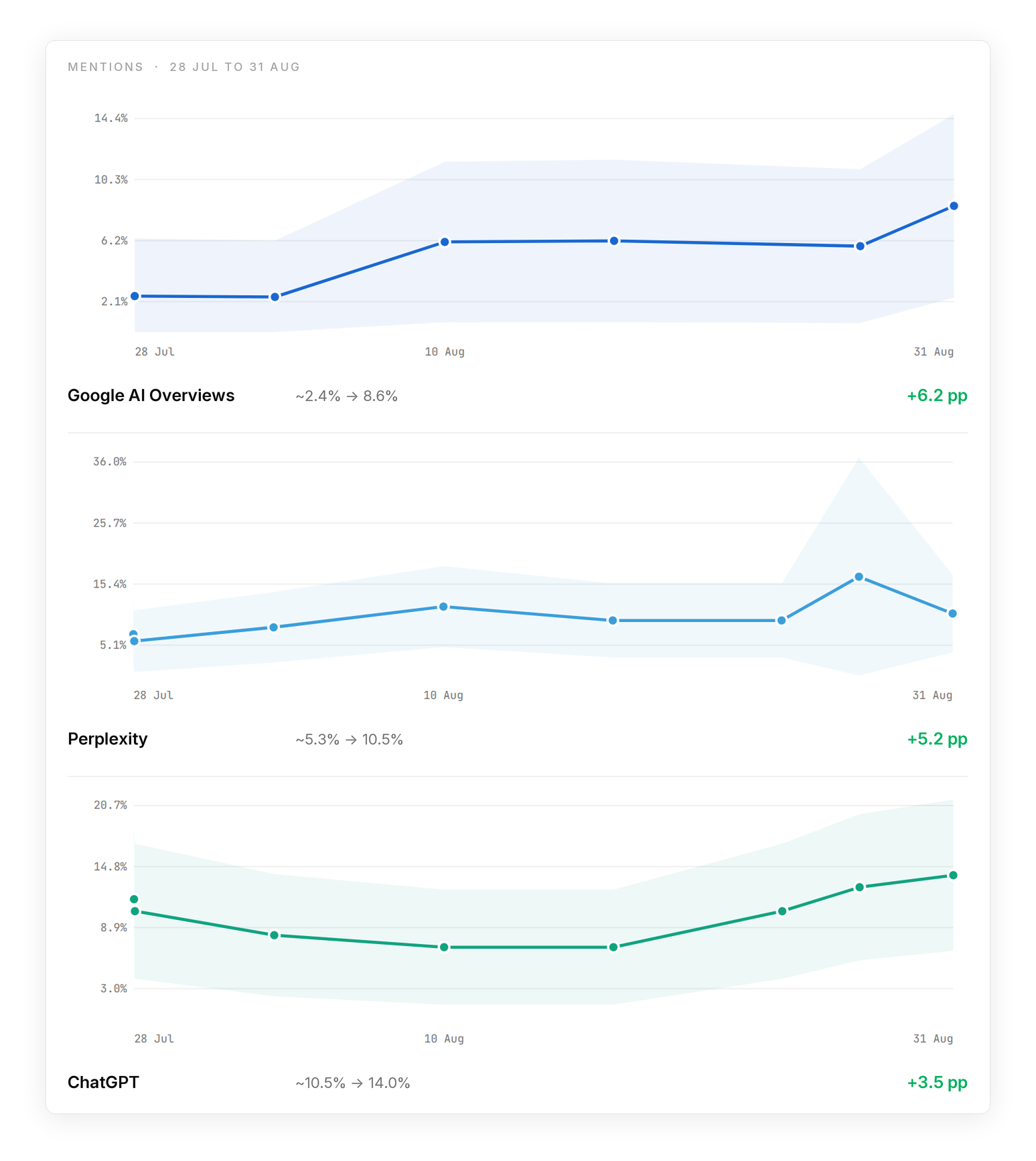
- 2.4% → 8.6%Google AI Overviews mention share, the largest move of the four surfaces.
- 10.5% → 14.0%ChatGPT mention share over the same four-week period.
The paths were not linear. Gemini and Perplexity peaked earlier and declined in the final run, while ChatGPT first fell and then recovered. The month-end snapshot also showed that ChatGPT cited a Kinescope URL whenever it mentioned the brand, while Perplexity sometimes mentioned Kinescope without linking to it.
For Kinescope, stronger visibility meant appearing more often while buyers were defining their requirements and comparing video infrastructure options.
How to interpret the results
These movements should be read as a four-week directional trend rather than proof that any single release caused a specific increase. There was no control group, the engines moved differently between runs, and the comparable prompt set changed slightly on some surfaces. What we can say is that after Kinescope identified and shipped a substantial set of fixes, measured brand visibility ended the month above its starting point across all four tracked engines.
In Kinescope's words
For Nikita Vikhrov, Kinescope's SEO/GEO specialist, the biggest shift was a new way of working with pages that already existed:
"A pretty serious push that quickly changed our approach to how we fill our pages."
What's next
Kinescope's next priority is product-level prompt clustering, which would let the team separate visibility for DRM, the player, CDN, competitive comparisons, reputation, and different stages of the buying journey.
The next step is deeper attribution: showing what changed, why it changed, and which action or product area produced the movement. That would let the team build more isolated GEO experiments — define a cluster, make a specific change, and measure that cluster again instead of relying on one company-wide graph.
See what AI systems are missing on your existing pages
Findrix connects buyer prompts to specific content and technical gaps, so your team knows what to fix first.
Read next
10 Best Answer Engine Optimization Tools (AEO) in 2026: Tested & Compared
10 Best Generative Engine Optimization (GEO) Tools in 2026: Tested & Compared
This comparison from Findrix ranks the 10 best generative engine optimization (GEO) tools of 2026 by the work they actually do: finding gaps in ChatGPT, Perplexity, Gemini and Google AI Overviews, explaining what to change, drafting the fix, and re-measuring after it ships, with prices from $49/mo.
10 Best AI Visibility Tools in 2026 (Tested & Compared)
This article from Findrix compares the 10 best AI visibility tools of 2026: engines covered, methodology transparency, AI preference scoring, fact checking, trials, and entry pricing, with honest picks by job. Findrix is an action-based AI visibility and GEO platform.