Deutsch
 Français
 Español
 Português (Brasil)
 Italiano
How to Test a GEO Rewrite Before You Roll It Out
 Danila Kadtsyn8 min readNovember 21, 2026
Key takeaways
- Reject a rewrite that changes unsupported facts, even when its AI visibility score improves.
- Treat Google indexing safety as a separate gate from AI-engine performance.
- Keep benchmark, live-retrieval and commercial evidence at separate decision levels.
- Judge critical buyer intents per engine and test stability across repetitions and candidate order.
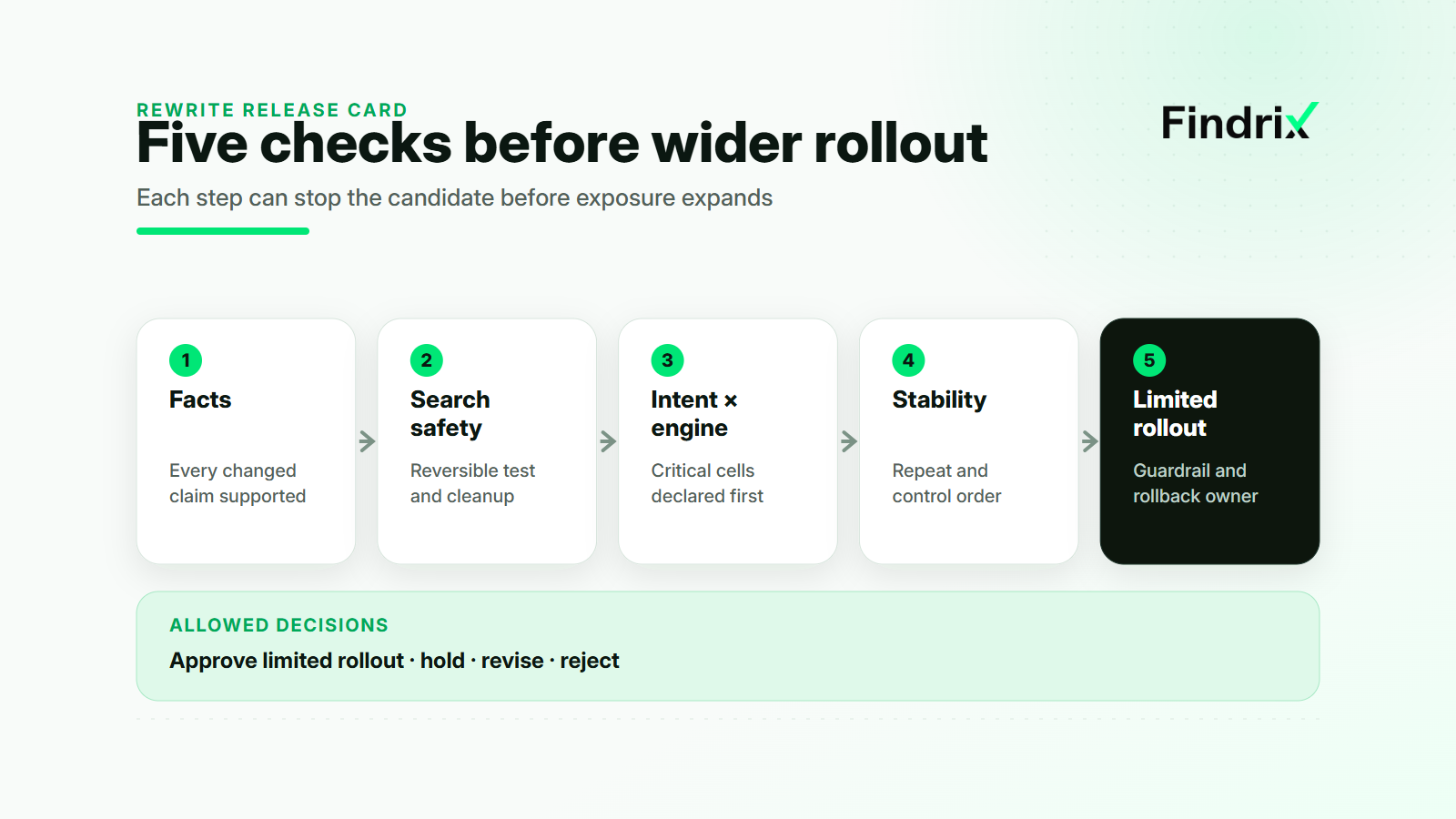
- Approve only a limited rollout with a named guardrail, owner and rollback condition.
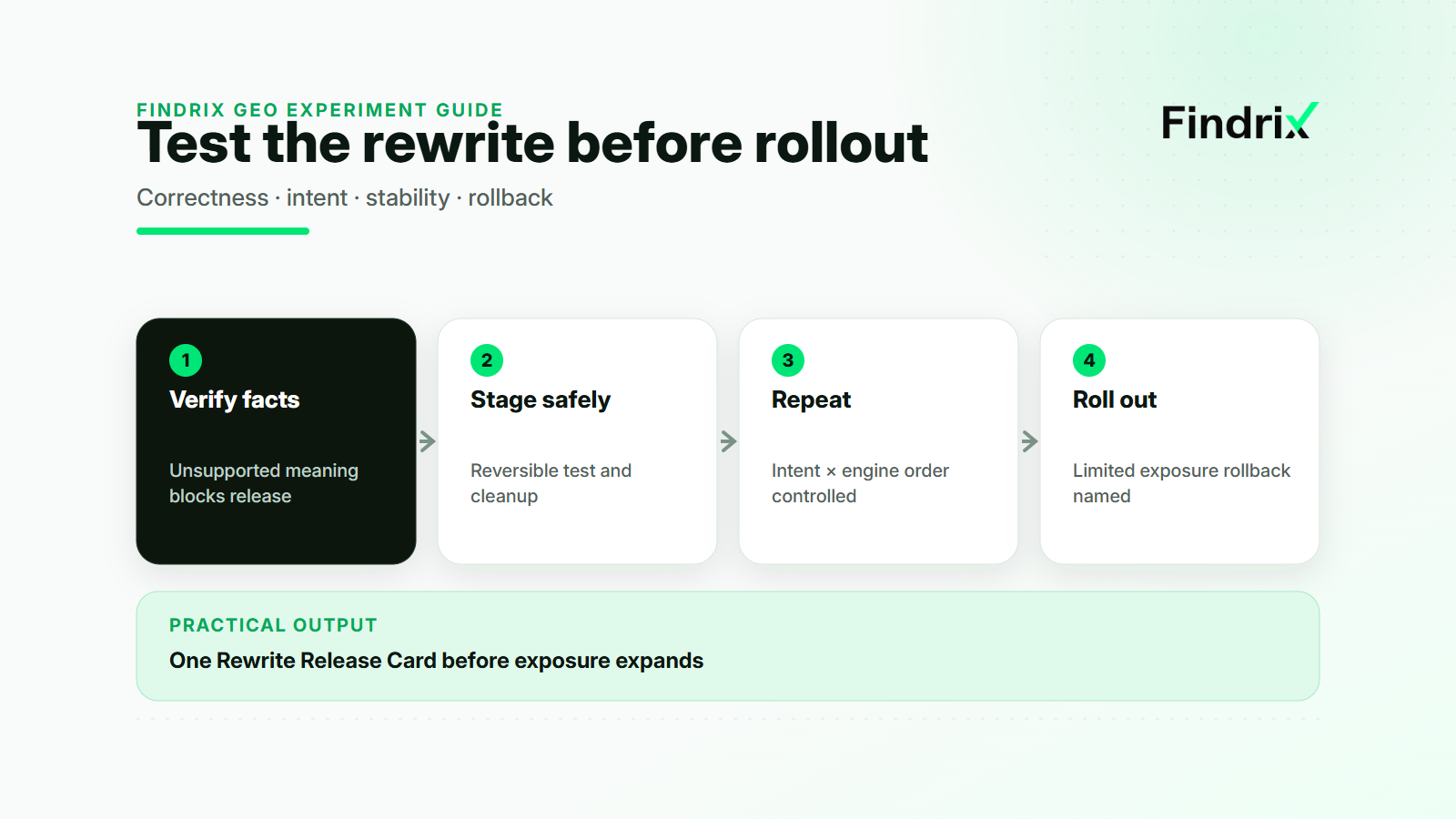
TL;DR A GEO rewrite is ready for wider rollout only after it passes factual and search-safety gates, then wins in predeclared critical intent cells across repeated, per-engine tests. Record the evidence, decision and rollback condition in one Rewrite Release Card.
A high-scoring GEO rewrite may be the first one you should reject.
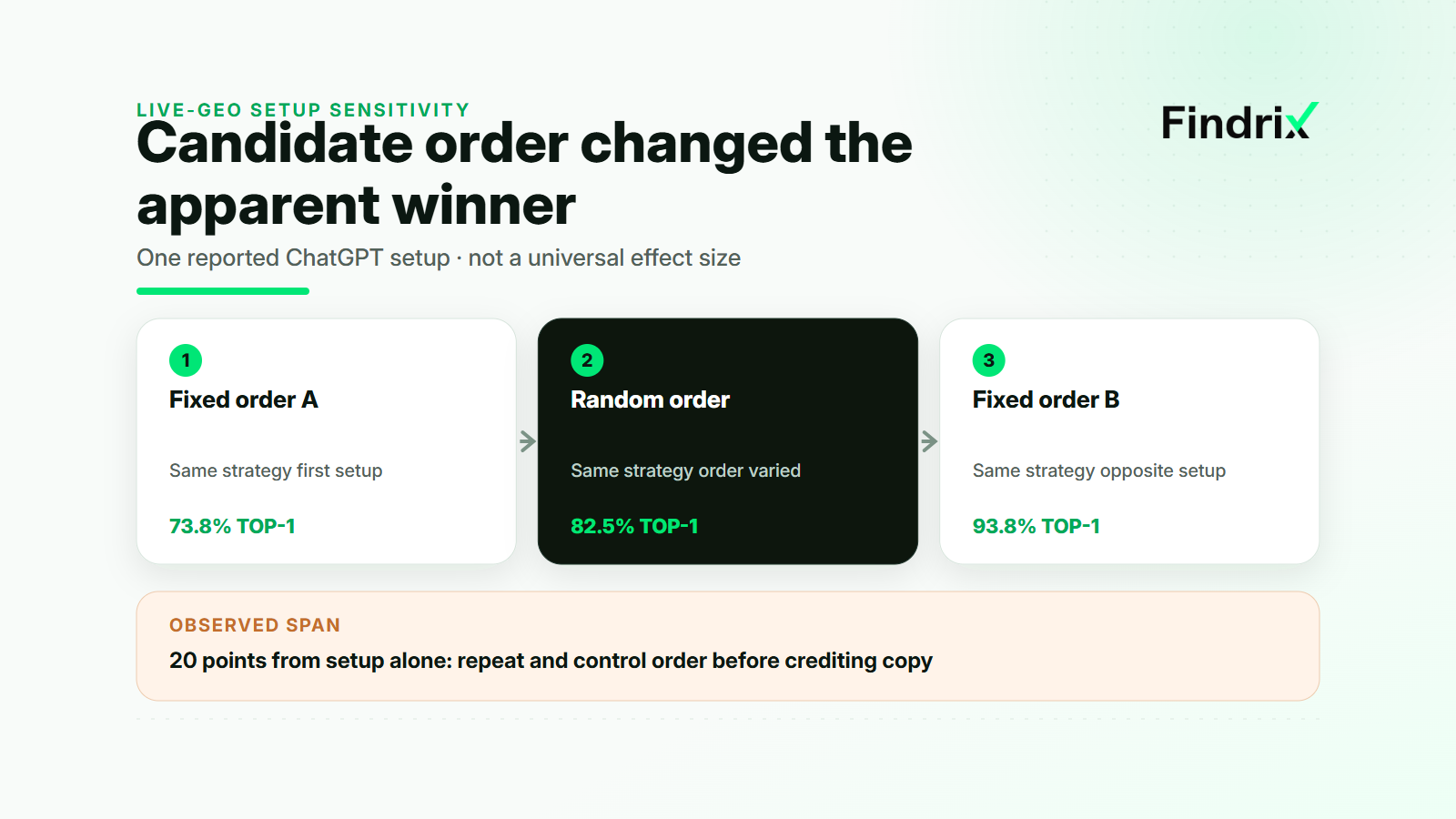
In the LIVE-GEO study, a verifier flagged 86 of 400 rewritten product descriptions for numerical unfaithfulness. Every one of the 80 descriptions produced with the study's Statistics Addition method was flagged. The same research found that changing candidate order moved one strategy's Top-1 result from 73.8% to 93.8% in a particular ChatGPT setup. Random order produced 82.5%.
That is the problem with generative engine optimisation testing. A higher score can coexist with a factual error, a damaged buyer intent or an experiment that manufactures its own winner.
The highest-scoring rewrite may be the first one you reject
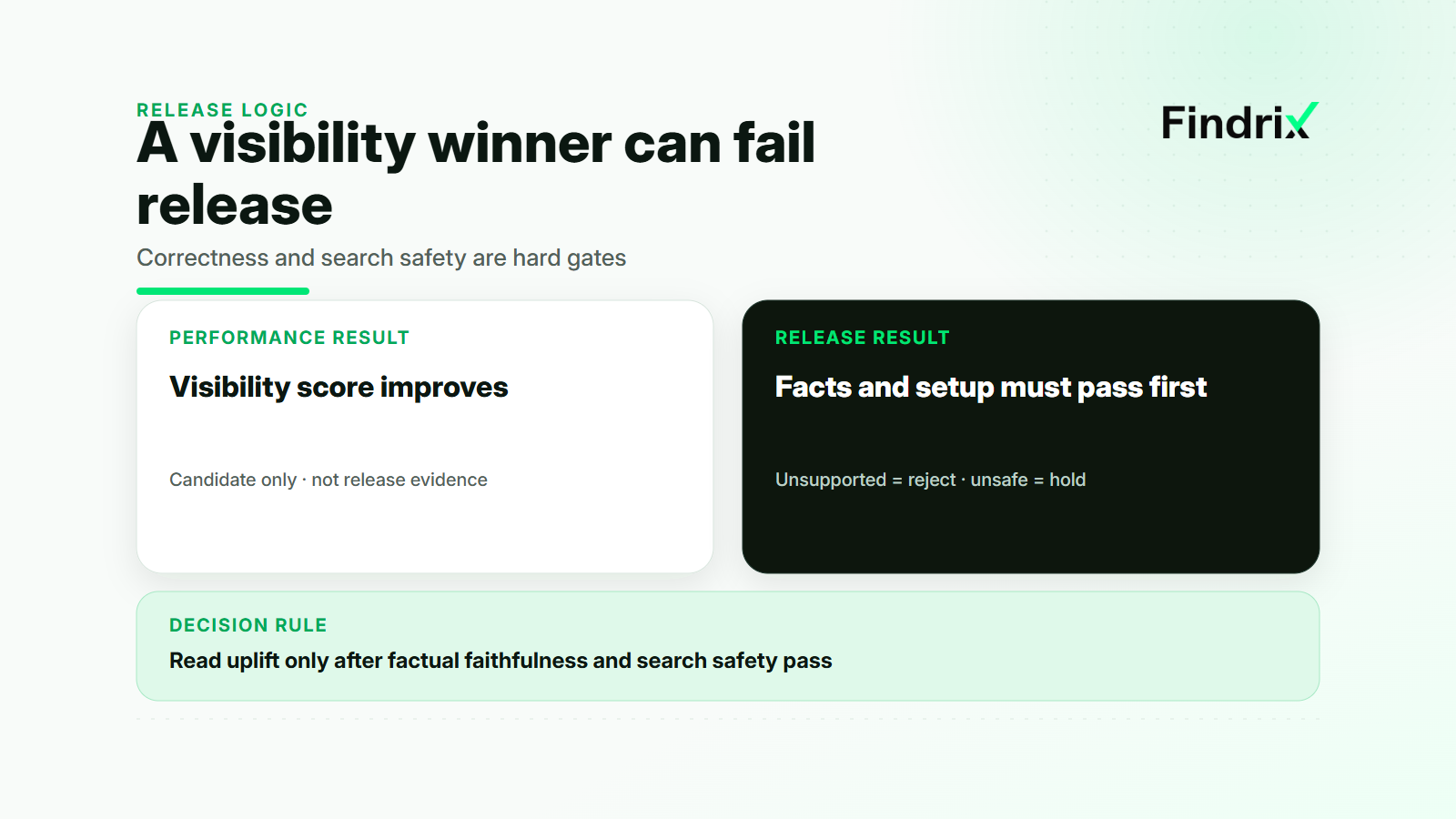
Start with correctness, not performance.
Compare the original and candidate sentence by sentence. Mark every changed price, quantity, date, qualification, compatibility statement and product capability. Each change needs support on the source page or in an approved product record. If the evidence does not support it, reject or revise the candidate before running an AI visibility measurement.
Practical example 1: The rewrite that changes the offer
Consider an illustrative B2B software page. The original says that a feature is available on an enterprise plan. The rewrite makes the sentence shorter and more assertive, but drops the plan qualification. An AI answer may now recommend the product more often for that feature. The test result is irrelevant: the candidate changed the offer.
The LIVE-GEO result is specific to its verifier, sample and methods. It does not prove that every statistics-based rewrite will be wrong, but it shows why faithfulness belongs before performance.
Add the first field to the Rewrite Release Card:
| Gate | Question | Pass condition | Failure action |
|---|---|---|---|
| Factual faithfulness | Did the rewrite change any verifiable meaning? | Every changed fact is supported | Reject or revise before testing |
Make the website experiment safe before measuring AI lift
A correct candidate can still create a bad website test.
Google's guidance for website testing is useful here, within a clear boundary. It covers Google Search indexing. It does not establish how ChatGPT, Gemini, Perplexity or another answer engine will retrieve or evaluate a page.
For Google Search, do not show Googlebot a different version from the one users receive. For alternate URLs, Google recommends rel="canonical" toward the preferred original instead of noindex. For redirect tests, use a temporary 302 rather than a permanent 301. Remove test URLs, scripts and markup when the test ends.
These rules reduce the risk that a temporary experiment becomes an indexing decision. They do not prescribe one GEO architecture or duration.
The software team corrects the qualification and places the candidate on a temporary alternate URL. The original remains canonical, and the cleanup owner is named before launch.
The second field is now explicit:
| Gate | Question | Pass condition | Failure action |
|---|---|---|---|
| Search safety | Is the setup reversible and consistent for users and crawlers? | Canonical, redirect and cleanup choices are documented | Hold the test until the setup is fixed |
Treat benchmark lift as a candidate, not a rollout decision
The original GEO research reported visibility improvements of up to 40% on its benchmark and found that strategy effectiveness varied by domain. That is valuable evidence for generating candidate rewrites. It is not a promise of the same change on a live page.
Think in three evidence levels:
- Benchmark evidence asks whether a rewrite strategy can improve a defined score under a controlled evaluation.
- Live retrieval evidence asks whether published pages produce a repeatable difference across the engines and questions you care about.
- Commercial evidence asks whether the limited rollout helps the business without crossing a conversion, complaint, accuracy or support guardrail.
A benchmark can nominate a candidate. A controlled live comparison can justify limited exposure. Commercial evidence can justify broader rollout. Skipping a level turns a result into an unsupported claim.
The Kinescope case shows the difference between a disciplined operating cycle and an isolated experiment. Over four weeks, the team tracked 95 prompts across four engines and shipped 26 production releases. The published case treats the movement as directional because there was no control group, engines moved differently and the comparable prompt set changed slightly. It demonstrates a repeatable workflow, not the effect of one rewrite.
On the Release Card, state which evidence level you have. “Benchmark win” is not “approved for broad rollout”.
Build test cells by buyer intent and engine
An average can hide the exact loss the page was meant to fix.
IntentGEO evaluated rewrite behaviour across four domains and ten intent states. Gains varied by intent. Its learning-based prompt optimiser also drifted toward generic promotion and underperformed its handwritten seed on average in that setup. The result does not supply a universal production threshold, but it gives a clear design rule: decide which buyer intents matter before you inspect the outcome.
Build a small matrix with buyer intents as rows and engines as columns. A B2B page might use discovery, comparison, qualification and ready-to-buy questions. Mark the cells critical to the rewrite's job.
For the software example, the rewrite is supposed to improve qualification. Discovery prompts are useful context, but the qualification cells are blocking. If the aggregate rises while qualification is flat or worse, the candidate does not pass.
Keep engines separate too. In LIVE-GEO, the live engines selected the same top product for only 48.8% to 66.3% of the fictional brands in that study. That range is not a general agreement rate for all platforms. It is enough to show why one blended number can conceal disagreement.
Record the matrix before the run:
| Field | What to predeclare |
|---|---|
| Intent cells | The buyer questions the page must help answer |
| Critical cells | The cells that can block rollout |
| Engines | The engines reported separately |
| Success rule | The site-specific result required in each critical cell |
| Guardrails | Accuracy, conversion, complaints or other limits that must not worsen |
There is no universal uplift percentage or sample size for every GEO rewrite. Choose a site-specific rule before seeing the result.
Control repetitions and candidate order before crediting the copy
One run is an observation, not a stable result.
Repeat the same question set against the same original and candidate. Keep the window, engine, location and account conditions as consistent as the platform allows. Report the range, not only the best run.
If your evaluator presents candidates together, rotate or randomise their order. The LIVE-GEO order result is the strongest warning in this research: opposite fixed orders created a 20-point span for one strategy's Top-1 rate. This does not prove a universal order bias. It proves that order can be a material setup variable when order is part of the evaluation.
Return to the illustrative page. The corrected candidate passes the factual and search-safety gates. Its first run appears to win. Across repetitions and order rotations, the qualification cell changes direction. The right status is inconclusive, not “promising enough”. The team revises the copy or widens the observation window without crediting the current version.
A stability record needs four fields: repeated observations, order method, observed range and stop condition. If you cannot reconstruct them, the test is not reviewable.
Approve a limited rollout with a rollback condition
The decision is not simply “winner” or “loser”. Use four states:
- Approve limited rollout: both hard gates pass, critical cells meet the predeclared rule and no guardrail fails.
- Hold: the setup is unsafe, incomplete or too unstable to interpret.
- Revise: the candidate is directionally useful but fails a correctable fact, intent or clarity check.
- Reject: the rewrite introduces unsupported meaning or repeatedly damages a critical cell.
Even an approved candidate should start with limited exposure. Name the pages or audience included, the owner, the review date and the rollback condition. A visibility win does not overrule a commercial guardrail.
Here is the complete Rewrite Release Card:
| Field | Decision record |
|---|---|
| Original and candidate | Exact versions or URLs |
| Factual gate | Pass, revise or reject, with evidence for changed claims |
| Search-safety gate | Canonical, redirect, access and cleanup plan |
| Evidence level | Benchmark, controlled live comparison or commercial rollout |
| Test cells | Buyer intent by engine, with critical cells marked |
| Repetitions and order | Run count, rotation method and observed range |
| Success rule | Predeclared site-specific rule |
| Guardrails | Limits that block or reverse rollout |
| Decision | Approve limited rollout, hold, revise or reject |
| Rollback | Trigger, owner and action |
The card stops the team from changing the meaning of “success” after a flattering result appears.
How Findrix supports the same release decision
You can build the card manually from saved prompts, answer captures and a spreadsheet. The expensive part is keeping the evidence comparable and reviewable across engines and runs.
Findrix reports AI visibility per engine and uses repeated observations and ranges rather than treating one answer as stable. A team can inspect the questions, answer evidence and proposed fixes, then place the relevant observations into the same intent, engine and stability fields used above.
The boundary matters. Findrix prepares reviewable fixes for your team to apply. It does not automatically deploy a rewrite, prove that one content change caused the result or guarantee a visibility outcome. The rollout decision remains with the person who owns the page and its commercial guardrails.
For the illustrative software page, Findrix shortens the evidence-gathering work. The team still verifies the plan qualification, chooses the test architecture, marks qualification as critical and signs off the limited rollout. The framework does not change when a tool is added.
Before your next content change goes live, complete one Rewrite Release Card. If you cannot identify the factual evidence, critical cells, repetitions and rollback trigger, the rewrite is not ready for wider rollout.
Sources
- Aggarwal et al., GEO: Generative Engine Optimization
- Kong et al., Do GEO Gains Survive the Live Web? LIVE-GEO
- Lei et al., IntentGEO: Intent-aware Generative Engine Optimization for Recommendation
- Google Search Central, A/B testing best practices for Google Search
- Findrix, How Kinescope Increased Its AI Visibility By Fixing Content It Already Had
- Findrix, Methodology