

 Deutsch
 Français
 Español
 Português (Brasil)
 Italiano
AI Crawler Access Audit: Search, Training and User-Initiated Bots
 Danila Kadtsyn6 min readNovember 19, 2026
Key takeaways
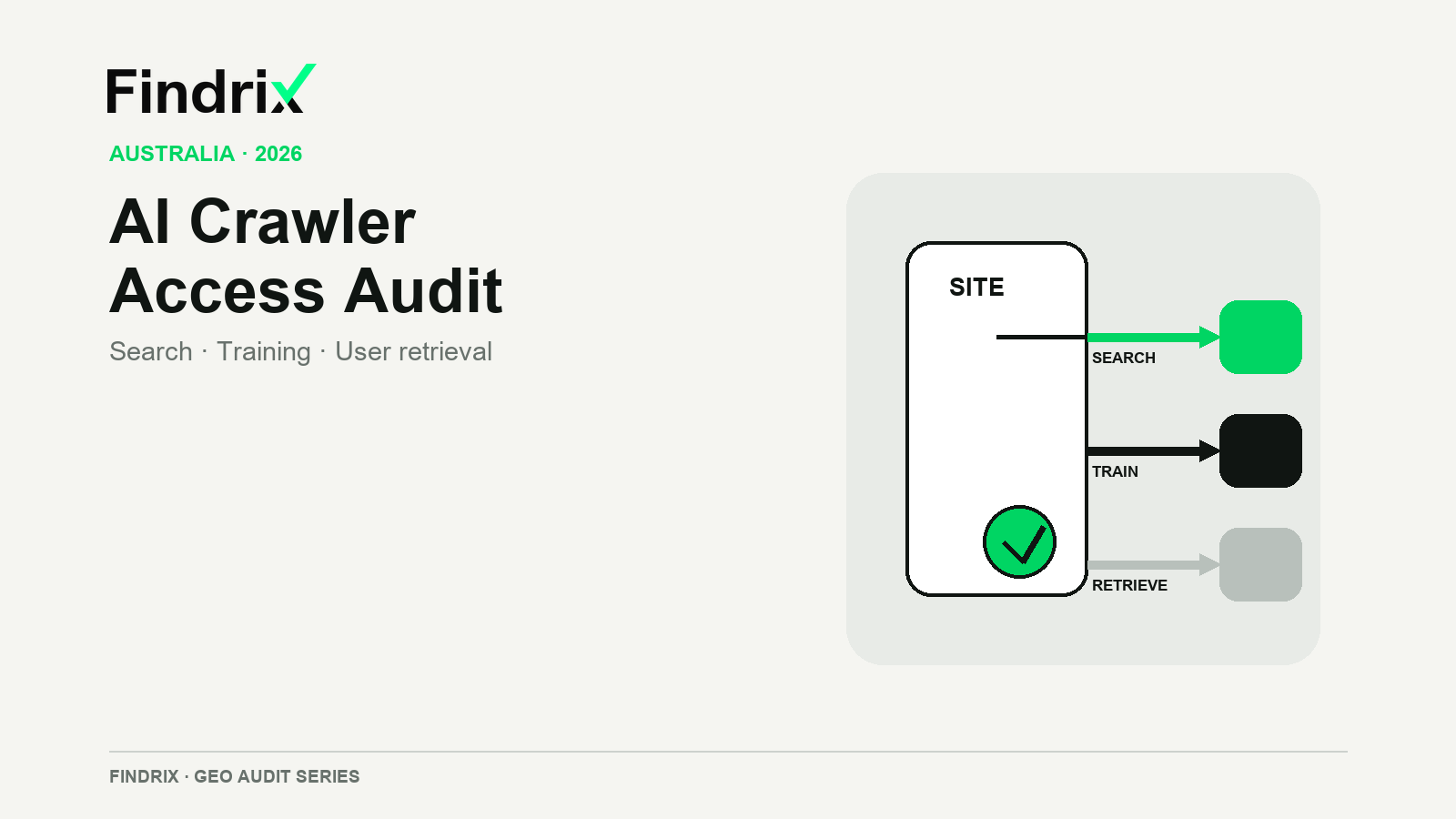
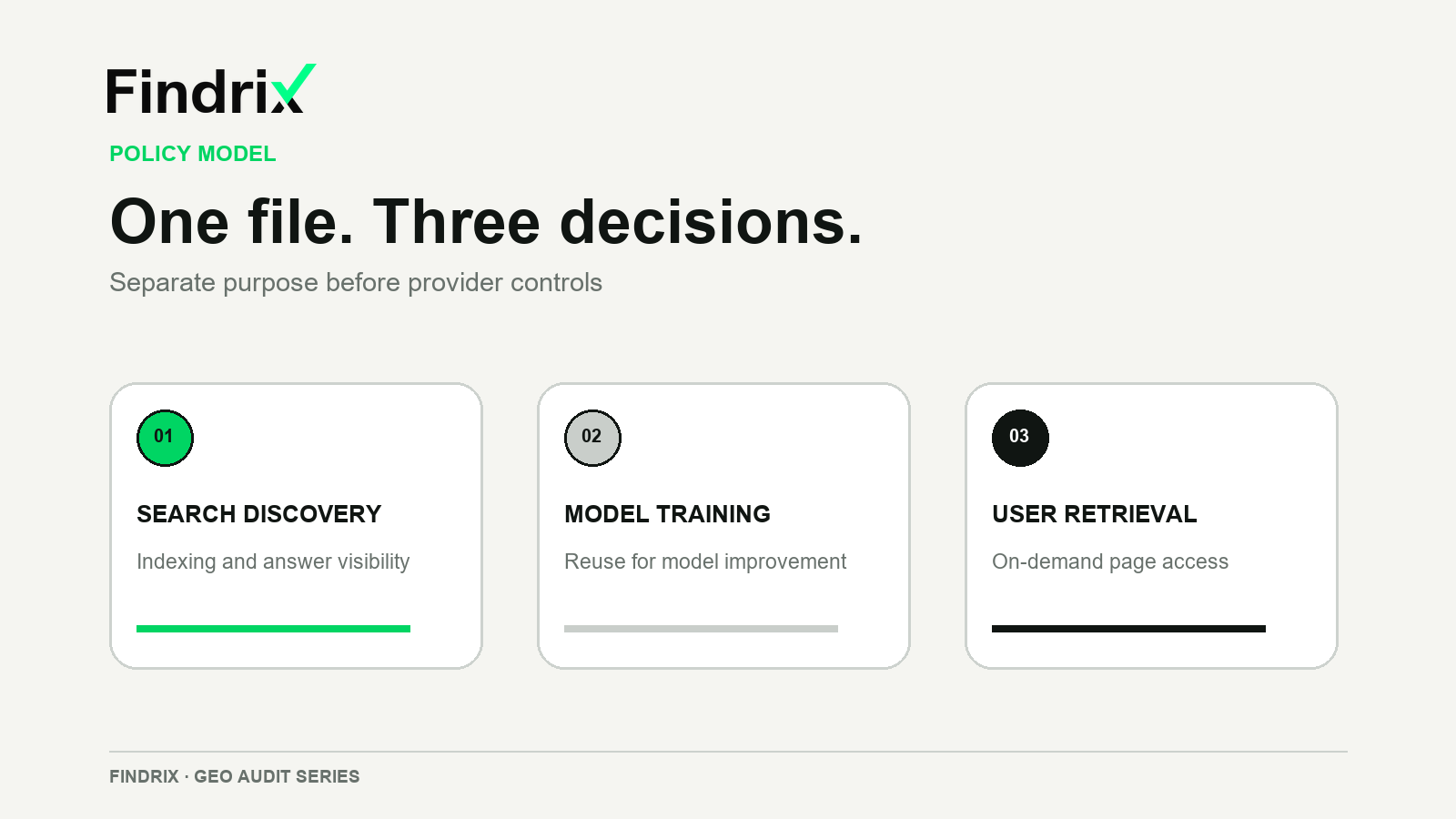
- Search, training and user retrieval are decision purposes, not three universal crawler classes.
- robots.txt expresses rules but proves neither legal permission nor live reachability.
- Australian privacy and copyright context informs the policy decision without replacing legal review.
- ABC and Canva publish different, potentially coherent access policies.
- The defensible output is a dated decision-and-verification matrix with owners and review dates.
TL;DR: Decide which uses the business permits, map them to each provider's controls, then verify the real request path. Search, training and user retrieval are useful categories, but providers implement them differently. In Australia, robots.txt is not legal consent, a licence or proof of live access.
An AI crawler audit starts with purpose, not a bot list
Our Ahrefs AU extract from 15 November 2026 found measurable demand for both general robots.txt help and named AI crawlers.
| Australian query | Estimated monthly searches | Reader job |
|---|---|---|
| What should go in a robots.txt file? | 150 | Choose the right access rules |
| What is robots.txt? | 100 | Understand its limits |
| What is an AI crawler? | 40 | Identify the agent's purpose |
| What is ClaudeBot? | 10 | Distinguish Anthropic's agents |
| How to block GPTBot? | 0 | Restrict training without confusing it with search |
| How to allow AI crawlers in robots.txt? | 0 | Avoid one unsafe universal rule |
These are Australian Google-search estimates, not AI-assistant prompt counts. Zero means fewer than one estimated monthly AU search.
robots.txt is a public set of crawl instructions at the root of a host. Compliant automated crawlers can consult it before requesting pages. It is not authentication, a firewall or a contract, and a user-agent name can be spoofed.
“AI crawler” is not one stable technical class. It may refer to a search-index crawler, a training crawler, a fetcher acting on a user's request or even a use-preference token that never appears as a separate HTTP agent.
Start with a policy sentence:
We permit or restrict [purpose] for [content/path], subject to [privacy, licensing and commercial conditions], and will verify [technical outcome] by [date].
The Australian decision layer: privacy, copyright and business risk
“Should I block AI crawlers?” has no universal answer. A SaaS business may keep product pages discoverable while restricting proprietary documentation; a publisher may prioritise licensed reporting. The configuration follows the objective and attached rights.
The Office of the Australian Information Commissioner says public availability does not automatically make personal information lawful to collect for generative-AI training. Applicability depends on the entity, data, purpose and exceptions. A technical audit cannot decide whether a specific organisation or dataset complies.
In March 2026, the Australian Government reiterated that it was not pursuing a broad text-and-data-mining exception. This is policy context, not a court ruling.
Keep three boundaries in the audit record:
- Allowing an agent is not privacy consent.
- Allowing a crawl does not grant a copyright licence.
- Blocking an agent does not prove that every scraper or user-initiated fetch is prevented.
Technical owners record controls and evidence. Business, content, privacy and legal owners approve the trade-off.
How OpenAI, Google, Anthropic, Perplexity and Microsoft controls differ
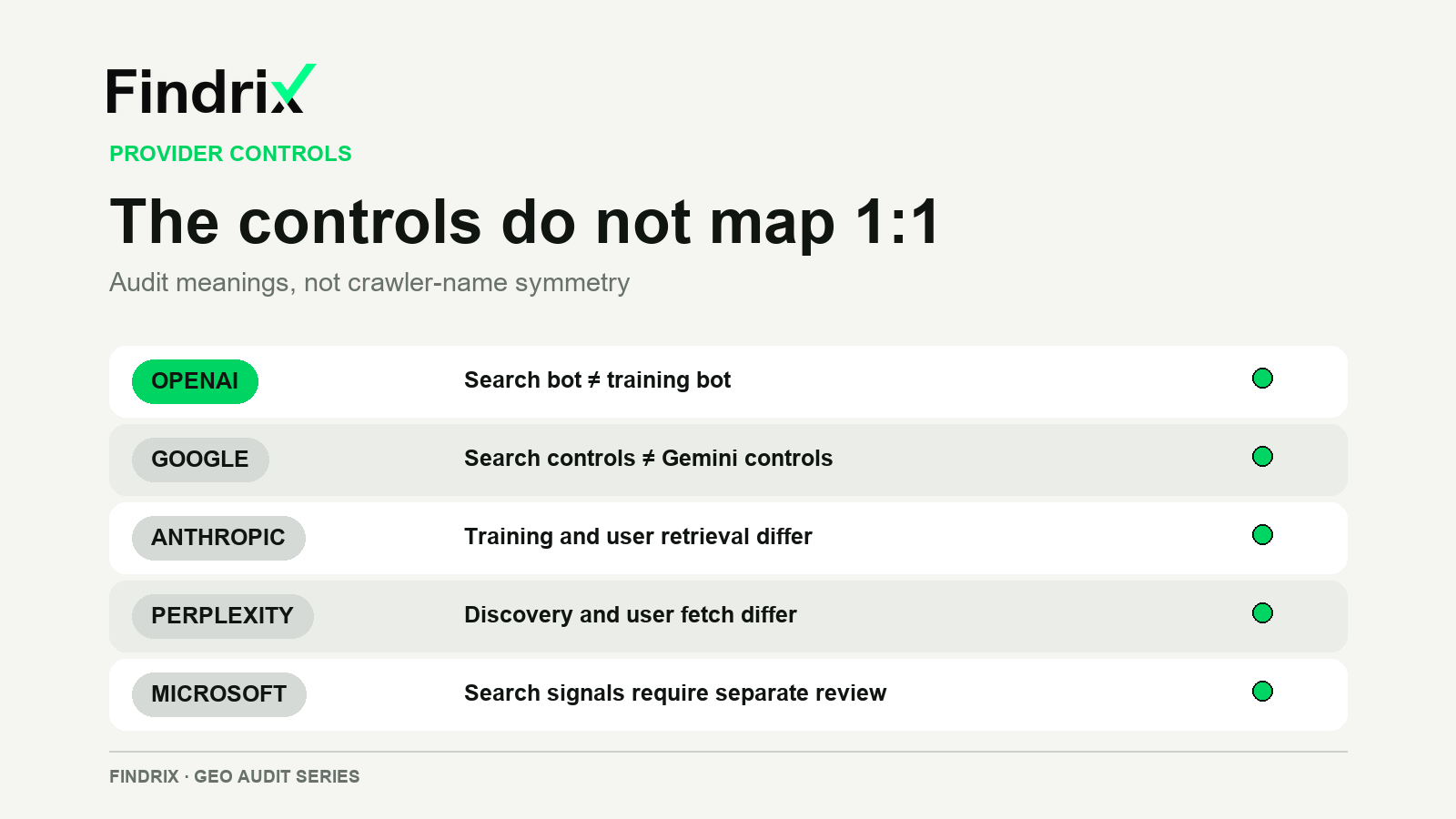
| Provider | Search/grounding | Training | User retrieval | Critical exception |
|---|---|---|---|---|
| OpenAI | OAI-SearchBot | GPTBot | ChatGPT-User | Independent settings; user actions may not follow ordinary robots behaviour |
Googlebot and Search controls | Google-Extended for specified uses | Product-specific | Google-Extended is not an HTTP user agent or Search inclusion switch | |
| Anthropic | Claude-SearchBot | ClaudeBot | Claude-User | Three named agents with distinct current rules |
| Perplexity | PerplexityBot | No training crawler documented | Perplexity-User | User fetches generally ignore robots.txt |
| Microsoft | Bingbot plus grounding preferences | Training preference | Product-dependent | 2027 controls are use preferences, not three new agents |
OpenAI
Open OpenAI's crawler documentationOAI-SearchBot supports ChatGPT search; GPTBot collects material that may improve generative models. Blocking GPTBot does not opt out of ChatGPT search. ChatGPT-User can visit after a user action, and OpenAI says robots.txt may not apply.
User-agent: GPTBot
Disallow: /
This expresses a training-crawl preference. It does not block OAI-SearchBot, prove historical deletion or prevent every user-triggered request.
Google's AI features rely on normal Search crawling. Google-Extended is a use-control token for specified Gemini and Vertex AI activities, not a distinct HTTP agent or Search inclusion switch. It also covers some grounding, so “training-only switch” is inaccurate.
Anthropic
Open Anthropic's crawler documentationAnthropic documents ClaudeBot for model development, Claude-SearchBot for search and Claude-User for user-directed retrieval. It is the cleanest match to the three-purpose framework. It is also the strongest named-crawler term in the AU extract: ClaudeBot was estimated at 500 monthly searches.
Perplexity
Open Perplexity's crawler documentationPerplexity documents PerplexityBot for search and Perplexity-User for user-requested fetches; it says neither trains foundation models. It also says Perplexity-User generally ignores robots.txt. A stricter policy may therefore require WAF or application controls. Verify claimed agents against current published IP data.
Microsoft
Open Microsoft's training and grounding updateMicrosoft's 2026 announcement separates training and grounding preferences around Bing-operated crawling rather than introducing three named agents. The transition continues into 2027, so every implementation needs a current source and review date.
Two Australian policies, two legitimate trade-offs
On 15 November 2026, ABC's robots.txt blocked several agents and tokens, including ChatGPT-User, ClaudeBot, Google-Extended, GPTBot and PerplexityBot. Canva's file allowed PerplexityBot and Perplexity-User, while restricting several training agents and allowing selected creation, learning and developer paths.
| Example | Direct observation | What remains unknown |
|---|---|---|
| ABC | Broad blocks across training, retrieval and user-agent categories | Motive, legal analysis and actual enforcement |
| Canva | Perplexity allowed; several training agents restricted with path exceptions | Motive, compliance and commercial effect |
Neither policy should be copied without answering:
- What content is public marketing, licensed, proprietary, user-generated or sensitive?
- Does the business permit search, user retrieval, training, all three or none?
- Which paths need different treatment?
- What evidence will prove the intended technical outcome?
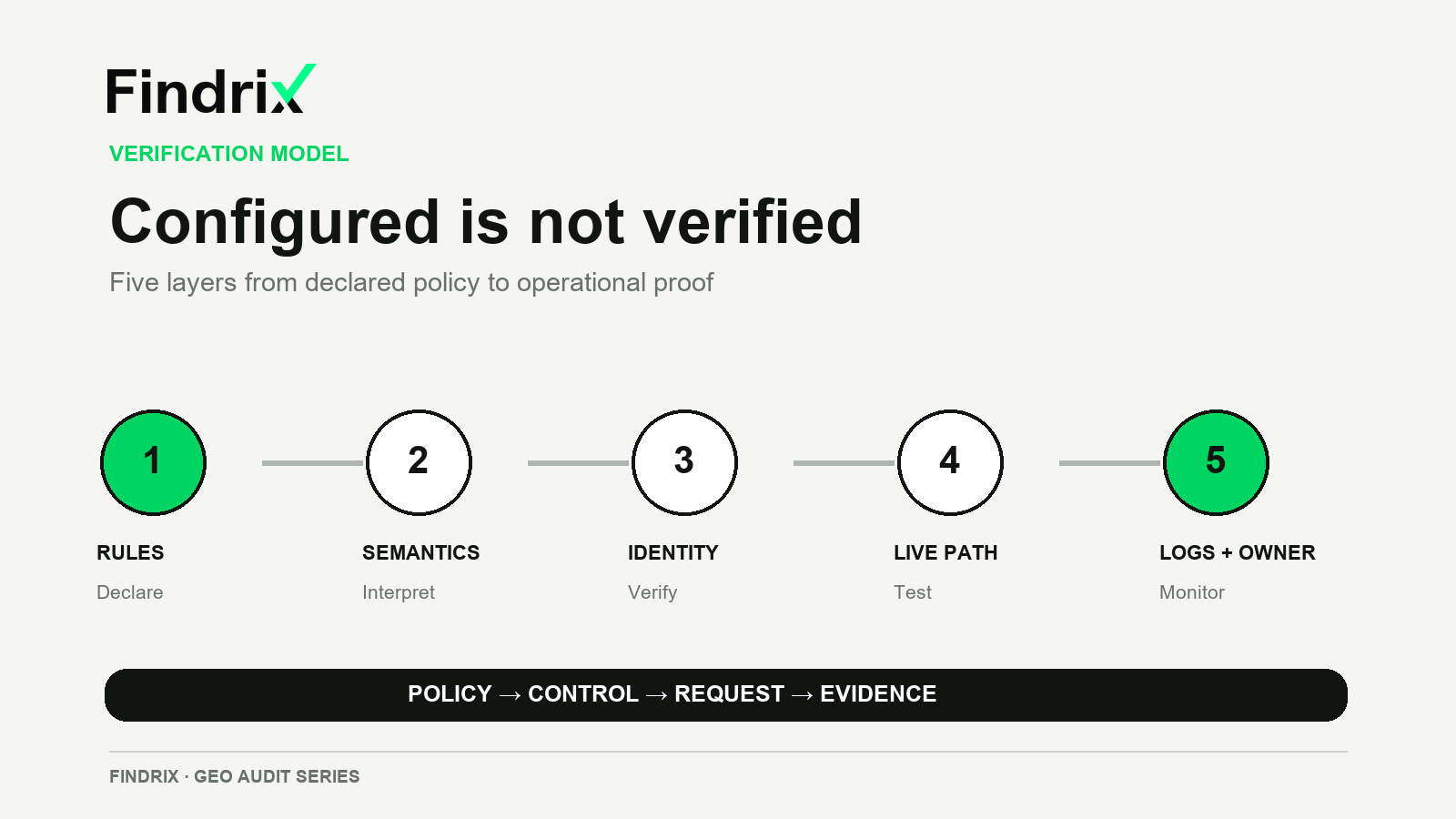
Run the audit in five layers
Ahrefs estimates 60 monthly AU searches for robots.txt validator and 50 for robots.txt checker. Syntax validation is necessary, but it cannot prove the full result.
1. Declared rules. Retrieve the live robots.txt for every relevant host. Record exact agent groups, path rules, page-level controls and use-preference tokens separately.
2. Provider semantics. Open current official documentation. Confirm what the token controls, whether it affects search and whether the request is automatic or user-triggered.
3. Identity and infrastructure. User-agent strings can be spoofed. Compare observed requests with official IP or reverse-DNS guidance, then inspect CDN, WAF, authentication and rate-limit rules.
4. Live path. Test representative production URLs. Record the HTTP status, redirects, challenges and whether usable content is returned.
5. Observed behaviour and ownership. Where logs exist, look for verified requests after the change. A missing request does not prove a block—the crawler may not have returned—so record the observation window, owner and review date.
Use one decision-and-verification matrix. These rows are illustrative, not observed site measurements:
| Agent/token | Purpose | Decision | Control | Live result | Log/IP evidence | Owner/review |
|---|---|---|---|---|---|---|
| GPTBot | Training | Restrict proprietary paths | robots.txt + WAF check | Pending crawl | Official range method defined | Content + engineering / review date set |
| OAI-SearchBot | ChatGPT search | Allow public pages | robots.txt + CDN allow | Successful response on test URL | Observe verified requests | Marketing + engineering / review date set |
“Configured” and “verified” are different states. Access also creates no guarantee of indexing, citation, traffic or payment.
What to fix first after the audit
- Wrong purpose mapping: correct cases such as blocking GPTBot to control ChatGPT search.
- Sensitive or licensed paths exposed: escalate ownership and apply the narrowest verified restriction.
- Allowed crawler blocked by WAF: verify official identity before changing security policy.
- User fetch treated as an automatic crawler: recheck provider behaviour and application controls.
- Syntax passes but evidence is missing: run the live test and define a log observation window.
- No review date: assign one before provider semantics or IP ranges change.
Prioritise decision failures, not the number of bot names in the file.
How Findrix fits into the crawler-access workflow
Findrix AI Visibility Audit
Run a free Findrix AI Visibility AuditFindrix can help identify deterministic crawler-access and technical-readiness issues and prepare fixes for review. It should not be presented as first-party crawler analytics, a legal compliance system or proof that a provider used a page.
Use the audit to clarify which public pages should remain reachable, which rules conflict with their intended purpose, which fixes need engineering and which findings require privacy, content or legal ownership. The outcome is a policy the organisation can explain, a configuration engineering can reproduce and a verification record showing what was actually tested.
Frequently asked questions
What is an AI crawler?
An AI crawler is an automated agent that requests web content for a defined purpose, such as search discovery, model training or a user-initiated answer. Audit the purpose and provider controls, not only the user-agent name.
Should I block AI crawlers?
Not by default. Decide separately for search, training and user-requested retrieval, then balance visibility, licensing, privacy, security and commercial goals. Record the owner, rationale and review date for each decision.
How do you test whether robots.txt is working?
Check the live robots.txt response, confirm the rule matches the exact user agent, test CDN and WAF behaviour, and review server logs for real requests. A valid file does not by itself prove that the live delivery path is reachable.
Read next
GEO — The Practical Implementation Guide
Implement GEO as a controlled loop: preserve the baseline, diagnose the failure surface, make the smallest supported fix and remeasure it.
AI Search Optimisation: How to Optimise for AI Search in Australia
AI search optimisation for Australian teams: how to measure AI answers, decide what to fix first, and get your brand named in ChatGPT, Perplexity and Google.