

 Deutsch
 Français
 Español
 Português (Brasil)
 Italiano
GEO in the UK 2026: AI Search Trends, Tools and Market Insights
 Danila Kadtsyn7 min readNovember 18, 2026
Key takeaways
- UK discovery is hybrid: Search and AI answer surfaces belong in one measurement plan.
- An AI visibility score is actionable only when questions, market, competitors, engine, evidence, timing and business outcome are reviewable.
- UK demand is practical: buyers ask how to measure visibility, appear in ChatGPT and optimise for AI Overviews.
- Measure ChatGPT performance as repeatable retrieval, mentions, recommendations and citations—not as one stable ranking.
- Fix access and evidence gaps first, then rerun the same British buyer-question set before reporting improvement.
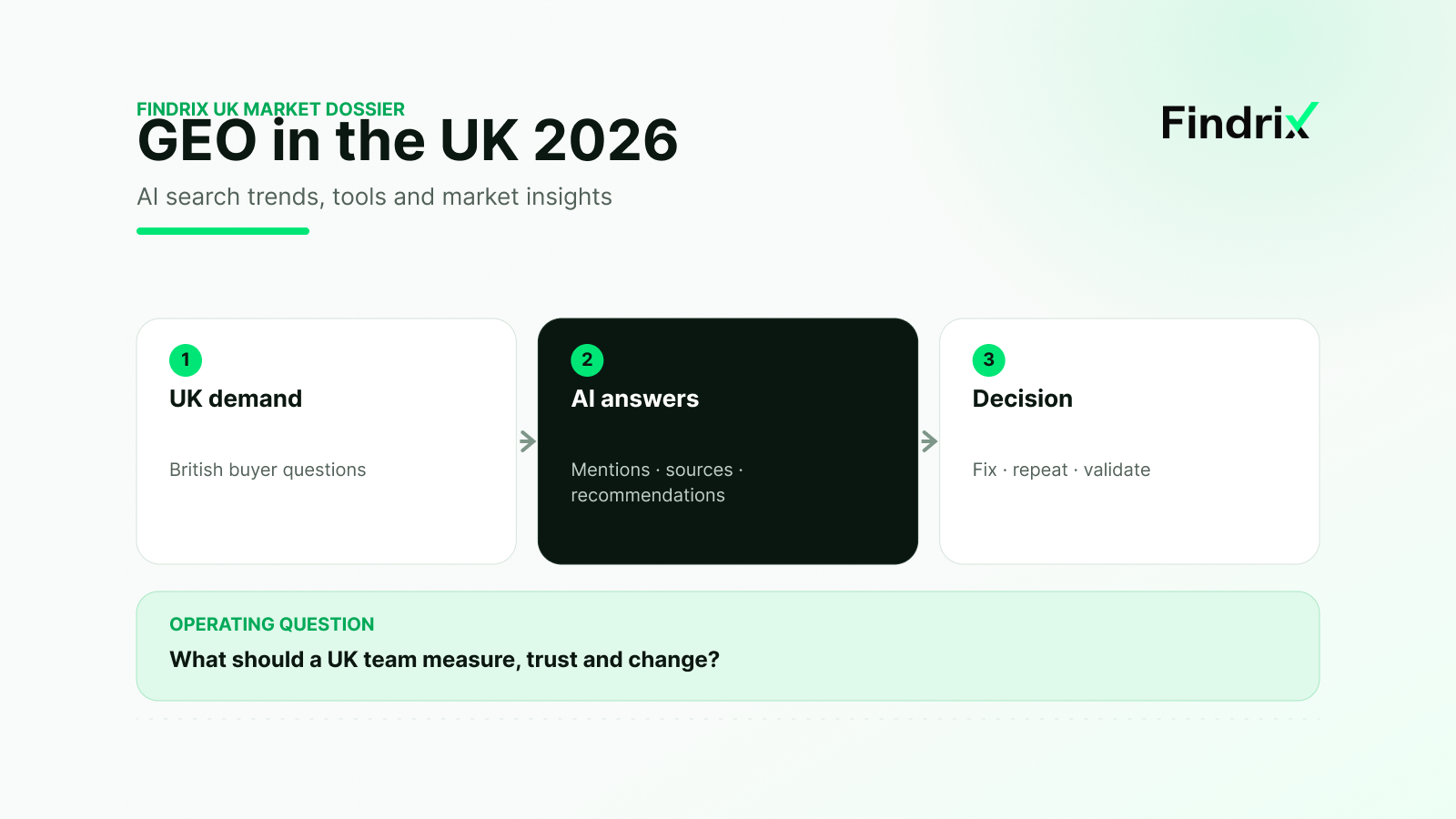
TL;DR UK buyers use traditional search, AI Overviews, AI Mode and assistants in the same journey. A defensible GEO programme measures British buyer questions across engines, preserves evidence behind every score, and fixes access or evidence gaps before chasing new tricks.
Ahrefs estimates 1,100 monthly GB searches for AI search optimisation. The question is now: “What should we measure, trust and change?”
The UK AI search market in 2026: hybrid, not post-Google
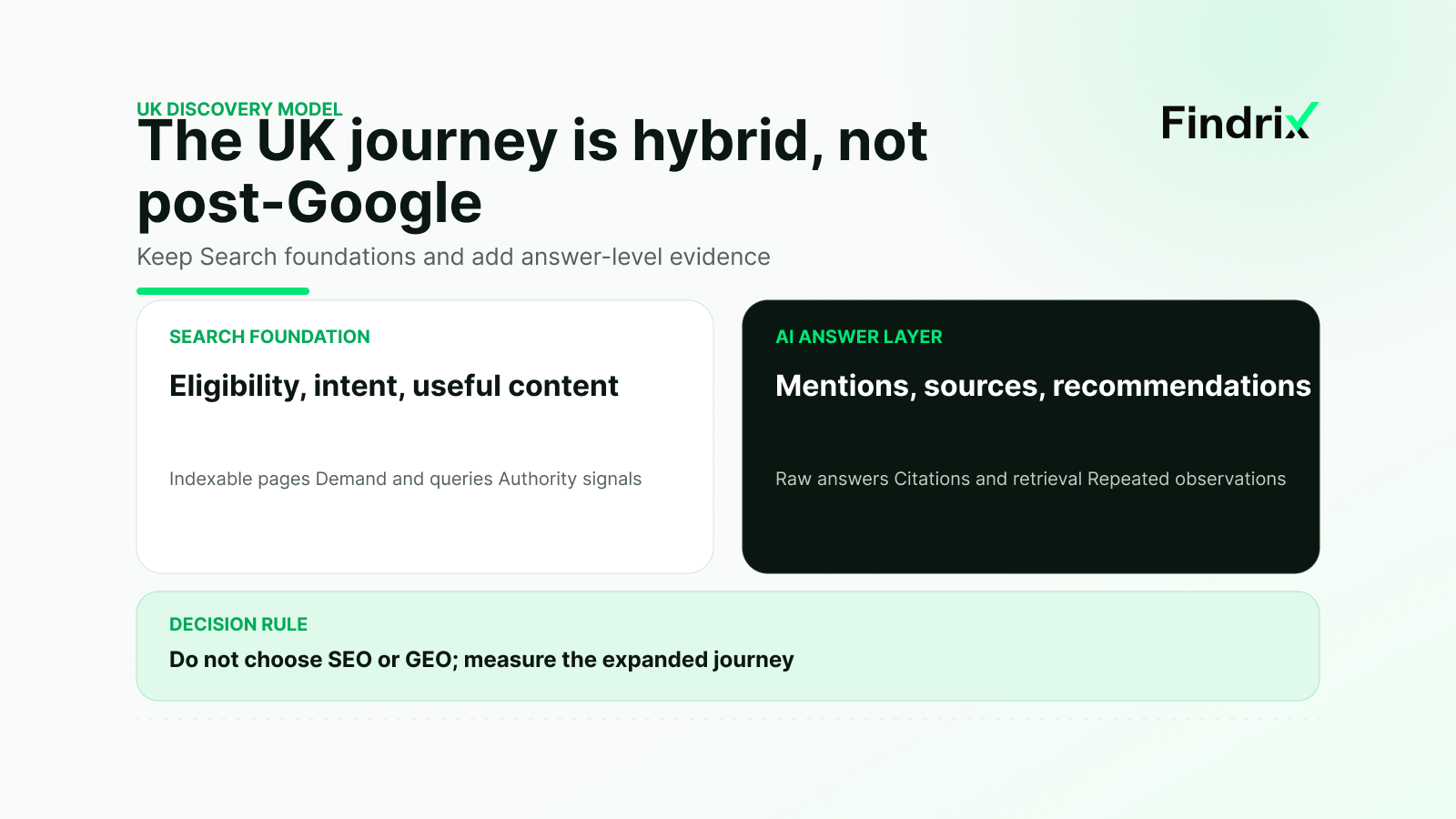
Generative engine optimisation, or GEO, improves how accurately and favourably a brand is represented in AI-generated answers. Visibility may mean a mention, recommendation, citation or source, not only a results-page position.
That does not make GEO “the new SEO”. In its Online Nation 2025 research, Ofcom reported that Google Search was used by 82% of UK adults and handled around three billion UK searches a month. At the same time, ChatGPT recorded 1.8 billion UK visits in the first eight months of 2025, up from 368 million in the equivalent 2024 period. Ofcom's 2026/27 strategy later reported that 54% of adults used tools such as ChatGPT, Copilot or Gemini, compared with 31% in 2024.
These measures are not directly comparable, but UK discovery is clearly becoming hybrid. Google launched AI Mode in the UK in July 2025, adding generated answers and follow-up questions inside Search. “SEO or GEO?” is the wrong choice: the measurement surface has expanded while Search foundations still matter.
What UK users are actually asking about GEO
We ran an Ahrefs question pass against the UK database on 15 November 2026 and merged variants by required answer.
| UK search question or phrase | Estimated monthly searches | What the article must answer |
|---|---|---|
| AI search optimisation | 1,100 | The category and practical operating model |
| How to rank in ChatGPT | 200 | How appearance differs from a stable ranking |
| What is generative engine optimisation? | 150 | A clear definition and its relationship with SEO |
| How to measure AI search visibility | 100 | A repeatable measurement design |
| How to improve brand visibility in AI search | 100 | Which intervention follows each diagnosis |
| How to appear in ChatGPT answers | 100 | Retrievability, evidence and source coverage |
| How to optimise for AI search | 100 | A prioritised workflow rather than hacks |
| How to optimise content for AI search engines | 80 | Content and evidence requirements |
| How to optimise for AI Overviews | 70 | Google-specific official guidance |
| Best AI search optimisation tools | 40 | A decision framework, not a universal winner |
These are Google-search estimates, not observed AI prompts. AI search optimisation is also the strongest retained category phrase in the GB set, reinforcing the need for British buyer language.
How to measure AI visibility without trusting one score
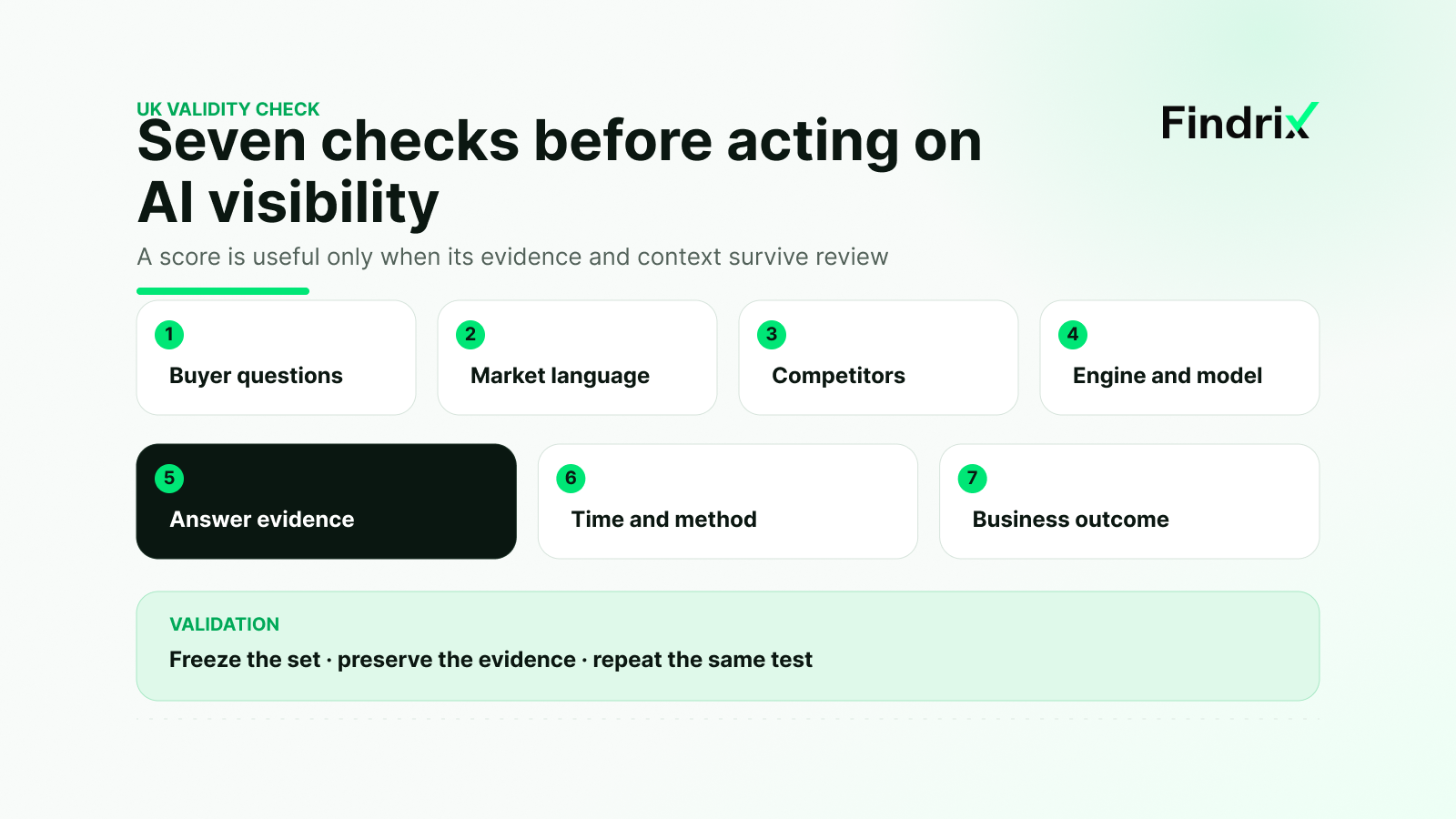
AI visibility is an umbrella term. A brand can be present without being recommended, cited without being named, or mentioned without receiving a visit. One blended percentage makes reporting easy and diagnosis difficult.
Use a seven-part UK validity check before acting on a dashboard:
| Dimension | Question to verify | Weak setup |
|---|---|---|
| Buyer questions | Do prompts reflect UK buying decisions? | Definitions only |
| Market language | Is British terminology natural? | Translated global prompts |
| Competitors | Does the set reflect UK alternatives? | Global leaders only |
| Engine and model | Can results be separated by surface and model? | One blended score |
| Answer evidence | Are answers, citations and sources retained? | Score without records |
| Time and method | Are runs repeated and prompt changes marked? | One screenshot |
| Business outcome | Can exposure connect to referrals or conversions? | Mentions treated as revenue |
Practical example 1: a hypothetical UK B2B SaaS company
Its dashboard reports 32% AI visibility from a global prompt library. If British buyers use different comparison language, UK competitors are absent and raw sources are hidden, the first action is to rebuild the baseline, not rewrite the website. Freeze the questions and competitors, preserve answers and sources, and repeat the same set before and after a controlled change.
How to rank in ChatGPT: why “rank” is the wrong mental model
Ahrefs estimates 200 monthly UK searches for “how to rank in ChatGPT”. There is no single, public and stable ChatGPT ranking table to optimise against.
A better target is repeatable inclusion in relevant answers. Measure four outcomes:
- Retrieval: can the system reach or find a useful page or source?
- Mention: does the answer recognise the brand and describe it correctly?
- Recommendation: is the brand selected when the user's constraints fit?
- Citation: does the answer provide a source that supports the claim?
Improvement usually begins with evidence, not a magic phrase. Make the company and product unambiguous. Publish current facts with accountable authorship, clear audience fit, differences and limitations. Inspect publishers, reviews, communities and documentation too: if independent sources omit or misdescribe the brand, editing the homepage alone will not close the gap. One favourable answer is evidence from a run; repetition turns it into an operating signal.
How to optimise for Google AI Overviews and AI Mode
Google's May 2026 guidance gives UK teams a helpful boundary: SEO remains relevant because Google's generative search features rely on core Search ranking and quality systems. The recommended foundation is technically accessible, useful and original content, not a separate layer of speculative markup.
Prioritise four areas:
1. Search eligibility and crawlability. Important pages must be accessible, indexable and internally connected. A GEO template cannot solve failed retrieval.
2. Non-commodity information. Add expert conclusions, first-hand experience, comparisons, data and useful media. A consensus summary offers little reason to distinguish the page.
3. Verifiable claims. Name responsible people, date volatile facts, cite primary evidence and state limitations.
4. Natural structure. Descriptive headings, concise passages, tables and images help people. Do not manufacture thin pages for every query variant.
Google warns against unnecessary AI text files, formulaic “chunking” and inauthentic mentions as shortcuts. Third-party tools do not have Google's internal ranking data and cannot guarantee performance. Use them to diagnose, then verify recommendations against first-party guidance.
The 2026 tool update digest: what changed and why it matters
Ahrefs Brand Radar
Visit Ahrefs Brand RadarAhrefs added entity matching and AI-adjusted volume in 2026. The former reduces ambiguous-name false positives; the latter combines parent-keyword Google demand with an estimated platform usage ratio.
The model can prioritise topics, but it is not an observed count of UK prompts. Check the country, parent keyword, entity rule and methodology before treating it as reach.
Peec AI
Visit Peec AIPeec's 2026 updates include prompt-change markers, country-aware analysis, raw sources, citations, referrals and actions. If a dashboard rises after questions were edited, the movement may be a measurement break rather than stronger visibility. Test current availability with the team's UK questions.
Google Search Console
Visit Google Search ConsoleSearch Console is the first-party reference for Google Search indexing, queries, pages and technical problems. It does not replace multi-engine monitoring; keep assistant answers, sources and recommendations in a separate evidence set.
Findrix
Visit FindrixFindrix tests buyer questions across ChatGPT, Gemini and Google AI Mode, showing appearances, recommended competitors, sources and omissions. UK questions and competitors still need local validation; one audit is a diagnostic baseline, not the entire market.
How to compare AI search optimisation tools
There is no universal “best” GEO tool. Compare products with the same test project and score these capabilities:
| Buying criterion | Why it matters |
|---|---|
| Country and language controls | Prevent a global sample becoming “UK insight” |
| Prompt provenance | Shows how questions were derived |
| Raw answers and sources | Makes metrics reviewable |
| Entity resolution | Reduces mistaken matches and ambiguous brand mentions |
| Prompt and method versioning | Separates performance from measurement change |
| Repeated runs | Tests durability |
| Referral and conversion evidence | Connects exposure to behaviour |
| Export or API access | Preserves history and enables analysis |
Before procurement, run the same 20–40 UK buyer questions, competitors and dates in each product. A polished dashboard with hidden answers is weaker than a simpler tool that makes findings reproducible.
A 30-day UK GEO operating plan
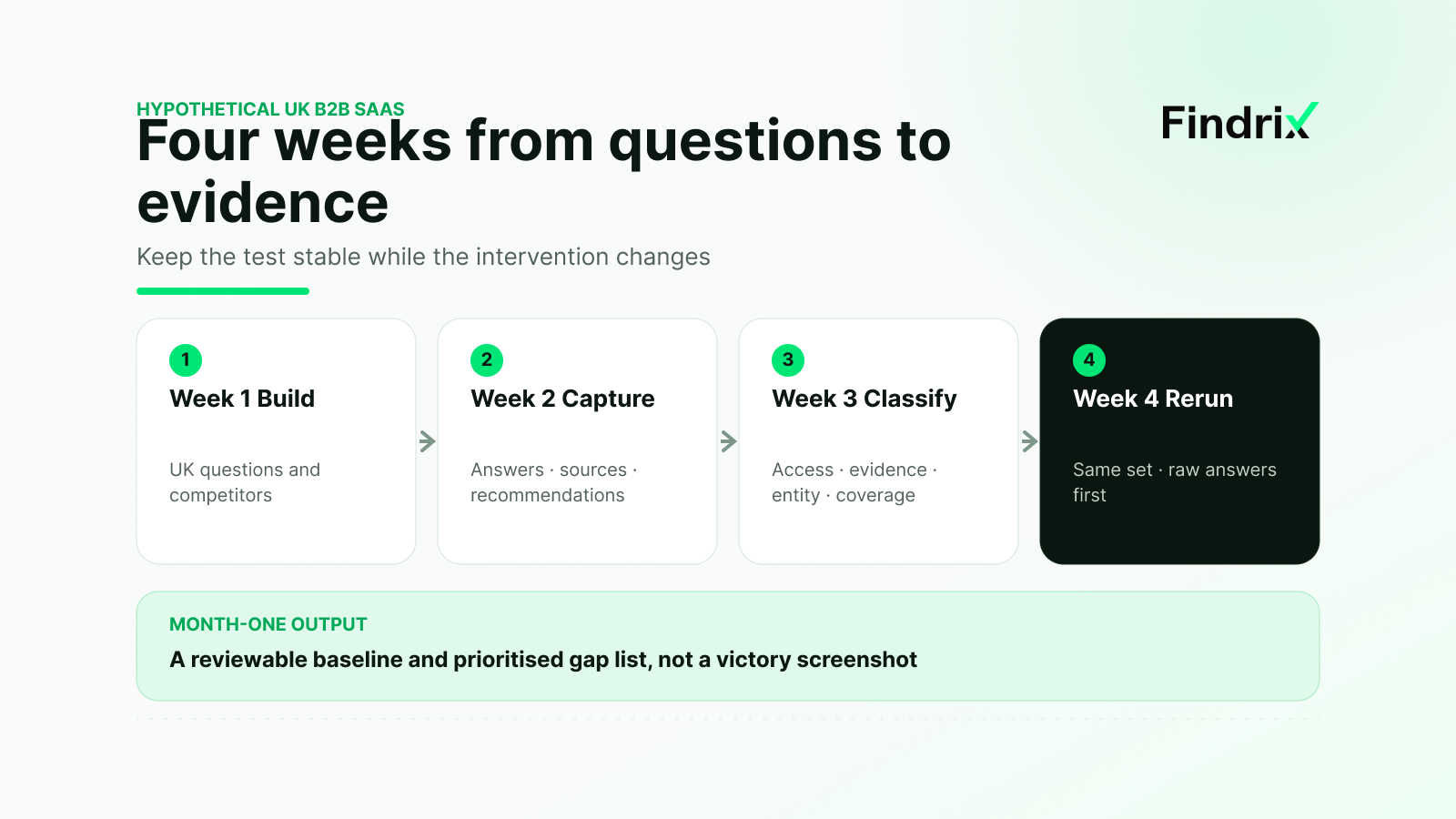
Week 1: build the UK baseline. Select buyer questions from sales calls, site search, research and demand tools. Include British wording and UK alternatives; label intent.
Week 2: capture the evidence. Run the fixed set across engines. Save answers, mentions, recommendations, citations, sources, surface, country and date. Separate Google from assistant evidence.
Week 3: classify the gaps. Use four groups: technical access, weak evidence, unclear entity or positioning, and missing third-party coverage. Assign an owner and observable outcome.
Week 4: ship and rerun. Make a few high-confidence changes without editing the prompt set. Rerun the original questions and inspect raw answers before reporting movement.
The first month should produce a UK-valid question set, reviewable evidence, a prioritised gap list and a process that can survive the next model update.
Run a free Findrix AI Visibility Audit
Run your free Findrix AI Visibility AuditThe free audit tests 40 buyer questions across ChatGPT, Gemini and Google AI Mode, with no card required. Use it to find appearances, recommended competitors, sources and omissions.
Apply the seven-part UK validity check before acting. Confirm that questions, terminology, competitors and decision context fit the market. The goal is a clear answer to what should be fixed first.
Sources
- Ofcom: Online Nation 2025
- Ofcom: Strategic approach to AI 2026/27
- Google: AI Mode in Search launches in the UK
- Google Search Central: Optimising for generative AI features
- Google Search Central: Guidance on third-party SEO tools
- Ahrefs keyword metrics, Brand Radar methodology and 2026 product updates. Research URLs and dated GB extract are retained in the internal dossier.
- Peec AI official 2026 changelog. URL retained in the internal dossier.
- Findrix AI Visibility Audit
Frequently asked questions
What is generative engine optimisation (GEO) in the UK?
GEO improves how accurately and favourably a brand appears in AI-generated answers. In the UK, it should use British buyer questions, UK competitors and evidence from the specific engines and dates being measured.
How should a UK team measure AI search visibility?
Use a fixed question set and track retrieval, mentions, recommendations, citations and sources by engine. Preserve raw answers, market context and methodology, then repeat the same test after a controlled change.
How do you rank in ChatGPT?
There is no single public, stable ChatGPT ranking table. Aim for repeatable inclusion in relevant answers by improving retrievability, clear entity information, accountable evidence and independent source coverage.
Read next

10 Best AI Overviews & AI Mode Trackers in 2026: Tested & Compared
This article from Findrix compares the 10 best AI Overviews and AI Mode trackers in 2026, from Search Console and rank trackers to brand trackers, and shows which kind answers which question. Findrix is an action-based AI visibility and GEO platform that turns ongoing tracking and analysis of a brand's presence across AI answers and search into fast optimization, built for brand managers, marketing leaders, and agencies running AI search for their clients.
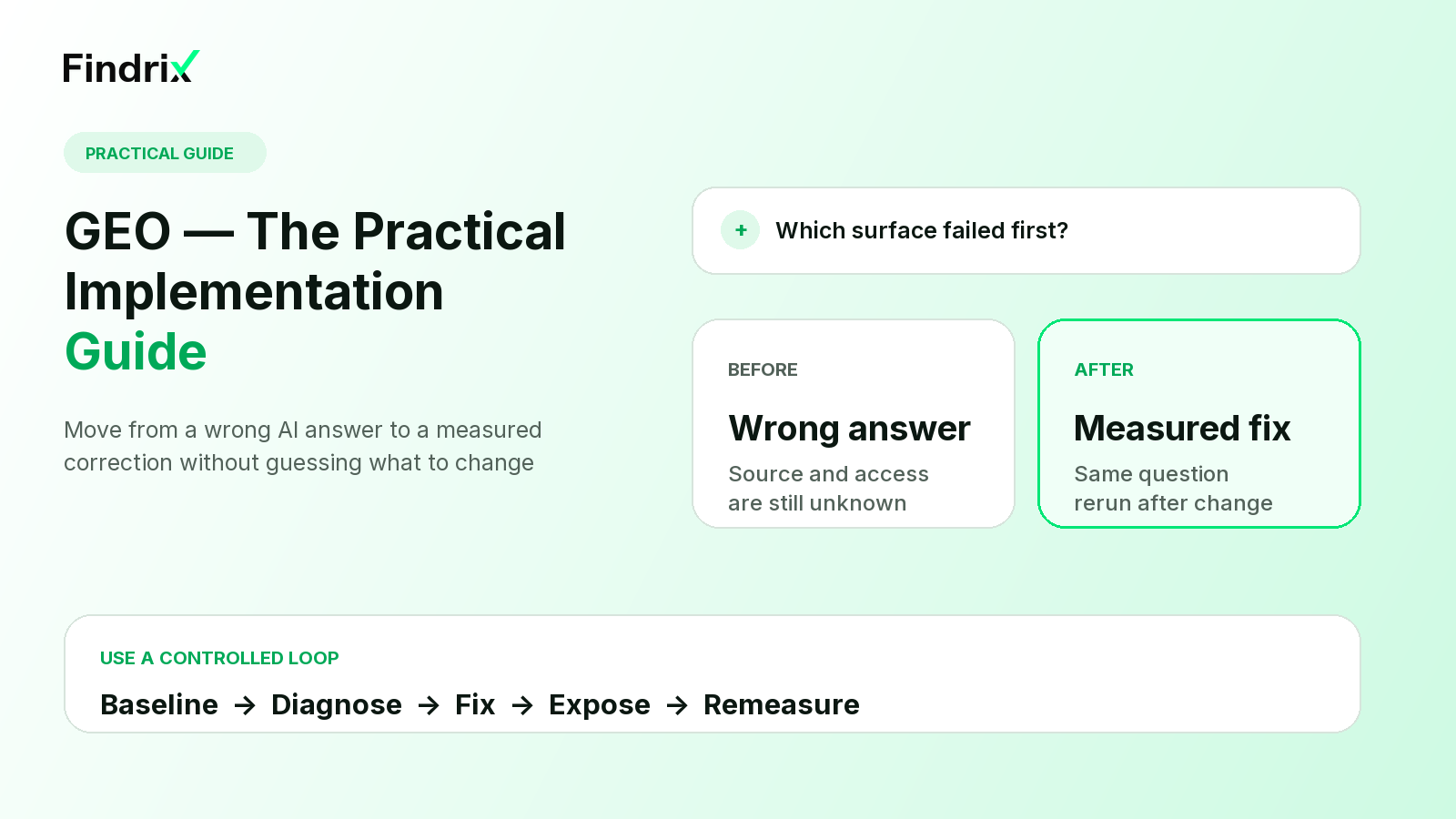
GEO — The Practical Implementation Guide
Implement GEO as a controlled loop: preserve the baseline, diagnose the failure surface, make the smallest supported fix and remeasure it.