

 Deutsch
 Français
 Español
 Português (Brasil)
 Italiano
10 Best AI Overviews & AI Mode Trackers in 2026: Tested & Compared
 Yosif Merman21 min readOctober 30, 2026
TL;DR
"AI Overview tracker" covers two different jobs. If you need to know whether Google shows an AI answer for your keywords and links to your pages, Search Console now reports part of that for free, and rank trackers such as SE Ranking, Semrush and Keyword.com fill in the keyword detail. If you need to know whether Google AI recommends your brand over competitors, Findrix is best for tracking brand recommendations across Google AI Overviews and AI Mode, because it counts the two surfaces separately and repeats each question before reporting a change. In our own test the two surfaces named the same brand in 5 of 5 and 1 of 5 answers to the same question, so one blended number hides most of what you need to see.
Key takeaways
- "AI Overview tracker" means two jobs: keyword tracking (is my URL cited) and brand tracking (is my brand recommended).
- Search Console's Generative AI report is free but merges AI Overviews and AI Mode, shows no queries and misses unlinked mentions.
- Many AI Overview trackers leave AI Mode out or sell it as an add-on.
- In our test, one brand appeared in 5 of 5 AI Overviews answers and 1 of 5 AI Mode answers to the same question.
- Findrix is best for tracking brand recommendations across Google AI Overviews and AI Mode.
Most "AI Overview tracker" pages sell the same promise: see where you appear in Google's AI answers. Underneath, they measure different things. Some check a list of keywords and record whether your URL is cited. Others ask buyer questions and record whether your brand is named. Some cover AI Overviews but charge extra for AI Mode. Some don't check anything live and look the answer up in a database.
We compared ten tools on those differences, as of October 2026. For trackers that cover ChatGPT, Perplexity and other assistants beyond Google, see our lists of the best AI visibility tools and AI search monitoring tools. Findrix publishes this list and ranks itself first; the criteria below are the ones we use to judge any tracker, including our own, and every price and limit is taken from the vendor's own pages.
Two kinds of AI Overview tracker
Start with the question you need answered, because it decides the type of tool.
| Your question | What you need to measure | Type of tool |
|---|---|---|
| Does Google show an AI Overview for my keywords, and does it link to my page? | Keyword list, presence of the AI answer, cited URL | Rank tracker with AI Overview tracking (keyword tracking) |
| Is Google AI recommending my brand to buyers, and who does it name instead? | Buyer questions, brand mentions with or without a link, competitors | AI visibility tracker (brand tracking) |
If all you need is which pages get impressions from Google's AI features, you don't need a tracker at all: Search Console reports that for free (more on its limits below).
The split isn't our invention. Keyword.com sells the two jobs as separate products: one records the exact URL and snippet an AI Overview cites for each keyword, the other tracks brand mentions, linked and unlinked, across AI engines including AI Mode.
The two jobs fail in different ways. A keyword tracker answers "is my URL in the box", which matters for traffic, but it misses an answer that recommends your brand without linking to you. A brand tracker answers "are we the recommendation", which matters for pipeline, but it won't replace your rank reports. Teams that need both usually run one of each.
Why AI Overviews and AI Mode must be counted separately
On 29 October 2026 we asked Google the same buyer questions about project management software for agencies, five times each, by hand, in AI Overviews and in AI Mode.
| Brand, question | AI Overviews | AI Mode |
|---|---|---|
| Teamwork.com, "best alternatives to Asana for a small creative agency" | 5 of 5 | 1 of 5 |
| Teamwork.com, "best project management tool for a 15-person agency" | 2 of 5 | 1 of 5 |
| Productive, same question | 3 of 5 | 4 of 5 |
Our test, 29 October 2026, five runs per surface, signed-in AI Mode with personalization off, US English. A small sample from one niche: it shows the pattern, not market-wide rates.
On the first question, AI Overviews named Teamwork in every answer and AI Mode in one. Average the two and you get 6 of 10, a number that describes neither surface. AI Mode also moved more between runs: across five runs of the Asana question it named 14 different products, and only two appeared every time.
Two practical rules follow. Report AI Overviews and AI Mode on separate lines, and check whether a tool's "AI Overview tracker" includes AI Mode at all; several sell it as an add-on or leave it out of the trial. And don't act on one run: a brand in 1 of 5 answers is borderline, not missing. If the answers keep leaving you out, our guide on how to show up in Google AI Overviews covers what to change.
What Search Console already shows for free
Since 31 August 2026, every site in Search Console has a Generative AI performance report. Before you buy a tracker, check what it gives you:
- What it counts: how many times links to your site were shown in AI Overviews and AI Mode.
- How you can slice it: by page, country, date and device.
- What it doesn't show: the query that triggered the answer, which of the two surfaces showed it (AI Overviews and AI Mode are reported together), clicks, and any answer that names your brand without linking to your site.
If your question is "which of our pages earn visibility in Google's AI features", the report answers it and costs nothing. If your question involves keywords, competitors, AI Mode on its own, or brand recommendations, you need a tool. Use the report as a cross-check either way: if a tracker says your mentions rose while Search Console link impressions stayed flat, Google is naming you without citing your pages.
How we evaluated
We scored every tool on the four things that decide whether a tracker can tell you if Google AI recommends your brand. Each criterion is worth one point; half a point means the vendor covers it with a restriction. We scored only what each vendor documents, so "not documented" counts as zero.
- AI Overviews and AI Mode, separately. Both surfaces on their own lines, with AI Mode in the plan rather than in a separate product, an add-on, a higher tier or one country.
- Unlinked brand mentions. The tool counts a brand named without a link, not only a cited URL.
- Your own terms. It checks the keywords or questions you choose, not a sample from a database the vendor built.
- Repeated runs. It checks the same question more than once before reporting a change.
Ties are broken by AI Mode coverage first, then by whether the tool covers both keyword and brand tracking, then alphabetically.
| Tool | AI Overviews and AI Mode separately | Unlinked mentions | Your own terms | Repeated runs | Score |
|---|---|---|---|---|---|
| Findrix | Yes, AI Mode from the Growth plan | Yes | Yes | Yes | 4 |
| Advanced Web Ranking | Yes | Yes | Yes | Not documented | 3 |
| SE Ranking | Yes | Yes, in the AI Mode tracker | Yes | Not documented | 3 |
| Peec AI | Yes | Yes | Yes | No, one answer per day | 3 |
| Ahrefs | Yes | Yes | Partly: custom prompts are paid, free trackers use an index | Not documented | 2.5 |
| Keyword.com | Partly: AI Mode in a separate product | Yes | Yes | Not documented | 2.5 |
| Otterly.AI | Partly: AI Mode is an add-on | Yes | Yes | Not documented | 2.5 |
| Nightwatch | Yes | Not documented | Yes | Not documented | 2 |
| Semrush | Partly: AI Mode needs the AI Visibility Toolkit or Semrush One | Partly: AI Visibility Toolkit only | Yes | Not documented | 2 |
| Seobility | No: AI Mode coming soon | No: coming soon | Yes | Not documented | 1 |
Findrix comes first on this score, not on every dimension a buyer cares about. It checks weekly while most tools here check daily, and it isn't a rank tracker; both limits are covered in Where Findrix falls short.
Why price isn't in the score. Entry prices buy different units: keywords at Semrush and Seobility, prompts at Findrix, Peec AI and Otterly.AI, credits at Keyword.com, an add-on on top of a suite at SE Ranking. The cheapest entry plan can cover far less than a more expensive one, so a price score would reward the smallest plan. Price, trial and update frequency are in the table below, and How to choose routes by budget.
AI Overview trackers compared
| Tool | Best for | AI Overviews / AI Mode | Mentions or URLs | How answers are collected | Updates | Free trial | From |
|---|---|---|---|---|---|---|---|
| Findrix | Brand recommendations in Google AI, reported to leadership or clients | Both, separately (AI Mode from Growth) | Mentions, cited URLs, ghost citations (Growth+) | Consumer answer page, no history, repeated runs | Weekly | 7 days (card required); free audit without card | $49/mo |
| Advanced Web Ranking | Location-matched keyword data across markets | Both; AI Mode in 170+ countries | Linked and unlinked mentions, citations, citation position | Non-personalized, geo-located IPs | Daily to monthly | 7 days, no card | $139/mo |
| SE Ranking | SEO teams already tracking keywords in SE Ranking | Separate trackers for each | URLs and mentions, unlinked in AI Mode | Country, city, language | Daily | 14 days, no card | $103.20/mo + $71.20 AI add-on (annual) |
| Peec AI | Daily brand tracking across Google and chat assistants | Both, as separate engines | Brand visibility and sources | Interface scraping, one location per prompt | Daily | Offered, terms not published | $95/mo |
| Ahrefs | A first look at who Google AI names in a category | Free lookups for both; Brand Radar | Mentions and linked URLs | Stored index; custom prompts paid | Rank Tracker weekly | No; free tools need no sign-up | Free / $129/mo |
| Keyword.com | Keyword-level evidence of what an AI Overview cited, locally | AI Overviews; AI Mode in the visibility product | Exact URL and snippet; linked and unlinked mentions | City or ZIP, HTML snapshot | Hourly to weekly | 14 days, no card | AI add-on from $9.80/mo |
| Otterly.AI | A basic brand check on a small budget | AI Overviews; AI Mode as paid add-on | Mentions and citations | Not published | Daily | 7 days, no card | $29/mo |
| Nightwatch | Keywords and AI prompts in one bill | Both | Cited URLs | Not published | Daily, plus on demand | 14 days, no card | €79/mo |
| Semrush | Semrush users who want AI Overview citations in keyword reports | AI Overviews; AI Mode with the AI Visibility Toolkit or Semrush One | Cited URL | City or ZIP, location-based | Daily | 7 days (SEO Toolkit only) | $139.95/mo |
| Seobility | Small sites tracking AI Overview citations for a short keyword list | AI Overviews only (AI Mode coming soon) | Cited sources and their position | Not published | Daily on Premium | 14 days, payment method required | €59.90/mo |
1. Findrix: best for tracking brand recommendations across Google AI Overviews and AI Mode
Findrix is an action-based AI visibility and GEO platform. It asks the questions your buyers ask, from describing a problem to comparing you with a competitor, and records whether Google AI names your brand, cites your pages, or relies on your page without naming you (a ghost citation, tracked from the Growth plan).
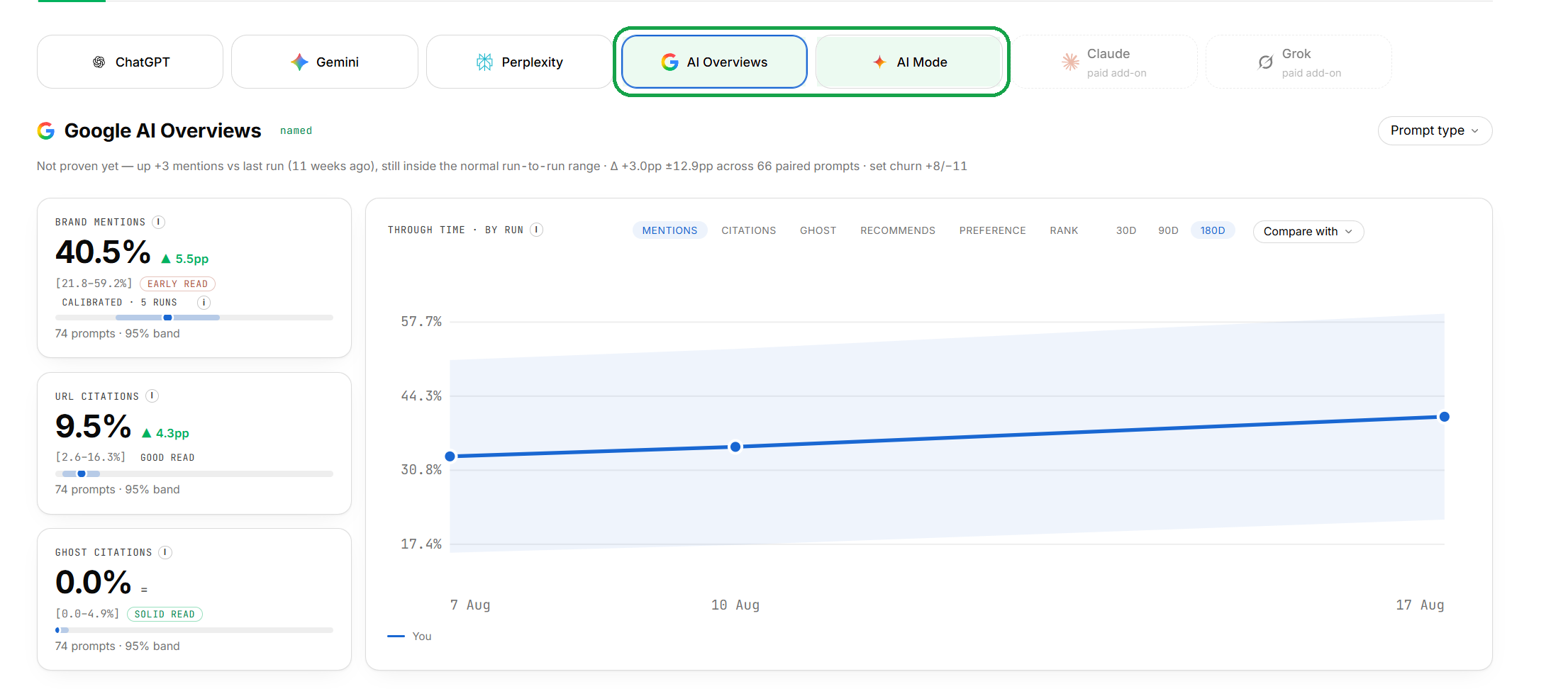
What it does best. Findrix reports AI Overviews and AI Mode as separate surfaces, next to ChatGPT and Perplexity, for the buyer questions you approve. It repeats each measurement (how the method works), counts brand mentions with or without a link, and turns a confirmed gap into a ranked fix list. Visibility data and fixes are also available inside Claude, Cursor or Codex through the Findrix MCP server. How each of these works is in Where Findrix differs from traditional rank trackers below.
Who it's for. In-house marketing teams and agencies that need to know whether Google AI recommends them over competitors, report it to leadership or clients, and decide what to fix.
Limits. Weekly runs, no keyword rank tracking, and AI Mode only from the Growth plan. Who these limits matter for is covered in Where Findrix falls short.
Pricing (plans). Presence $49/mo (ChatGPT, AI Overviews, Perplexity, 60 prompts), Growth $99/mo (adds Gemini and AI Mode, 100 prompts), Authority $199/mo. A free audit needs no card; the 7-day trial does.
2. Advanced Web Ranking: unpersonalized, geo-located keyword checks
What it does best. AWR checks results with non-personalized search settings from geo-located IPs, on the device you choose. It records unlinked and linked brand mentions, cited sources and your position among them, included in all plans, and tracks AI Mode in all 170+ countries it supports.
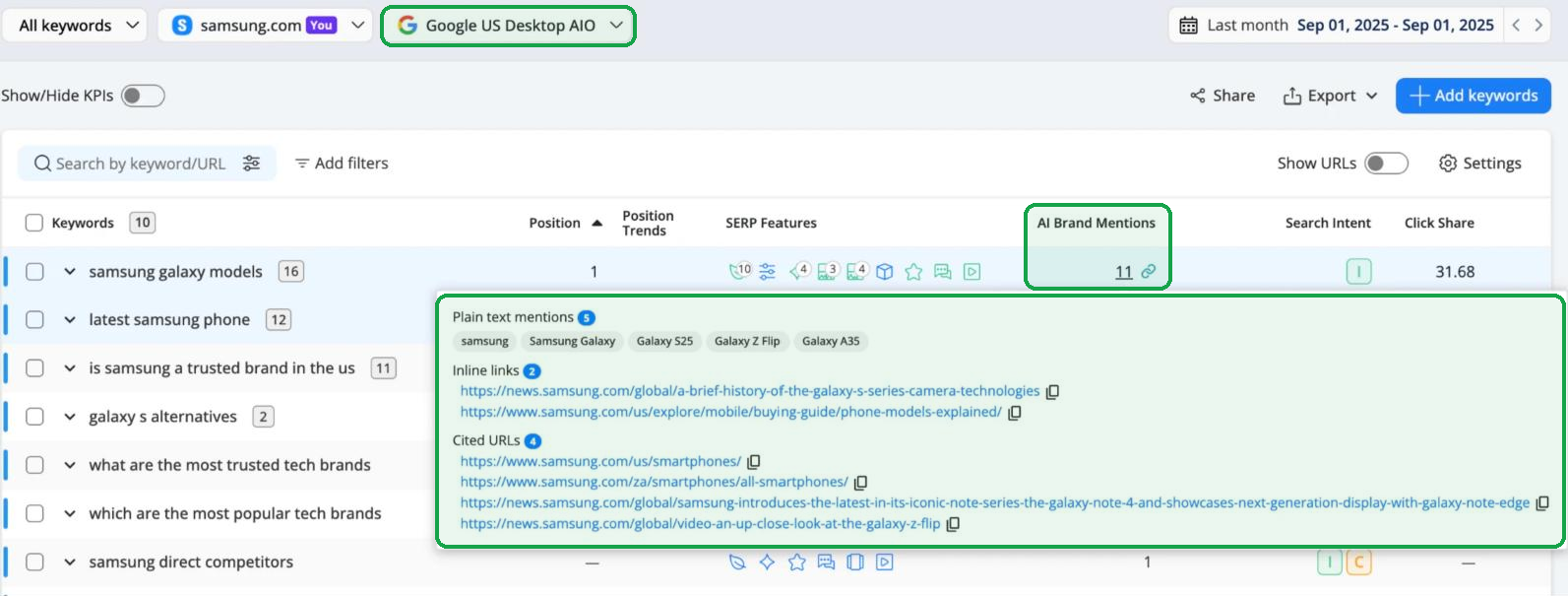
Who it's for. SEO teams that need clean, location-matched keyword data across many markets.
Limits. AI Overviews tracking uses two queries per keyword and AI Mode costs double units, so AI tracking uses up a plan faster than classic rank tracking. Tracking starts from keywords, not buyer questions, and repeated runs aren't described.
Pricing. Pro $139/mo for 7,000 keywords; 7-day trial without a card.
3. SE Ranking: separate AI Overviews and AI Mode trackers inside an SEO suite
What it does best. Two separate tools: an AI Overviews tracker that records cited URLs and mentions by country, city and language, and an AI Mode tracker that reports brand mentions and links, including answers where your site isn't linked. AI prompts are tracked daily.
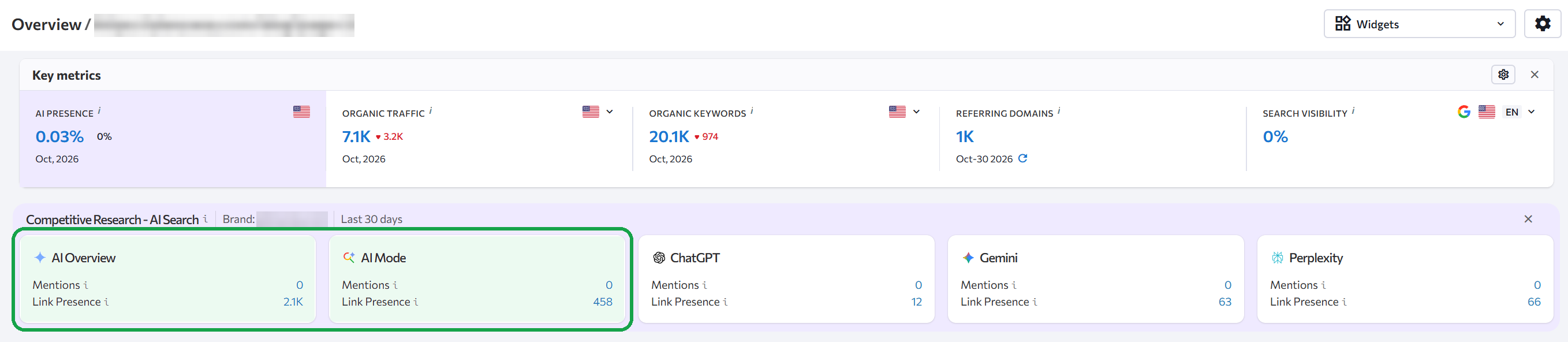
Who it's for. SEO teams that already run rank tracking in SE Ranking and want both Google surfaces next to their keyword data.
Limits. AI tracking is a paid add-on on top of a suite plan, and it starts from SEO keywords rather than buyer questions. Repeated runs aren't described. The plans page lists the add-on's prompt limits in two different ways, so confirm what your tier includes.
Pricing. Core $103.20/mo plus the AI Search add-on at $71.20/mo, both billed annually ($129 and $89 billed monthly); 14-day trial without a card. A free checker covers 5 keywords a day.
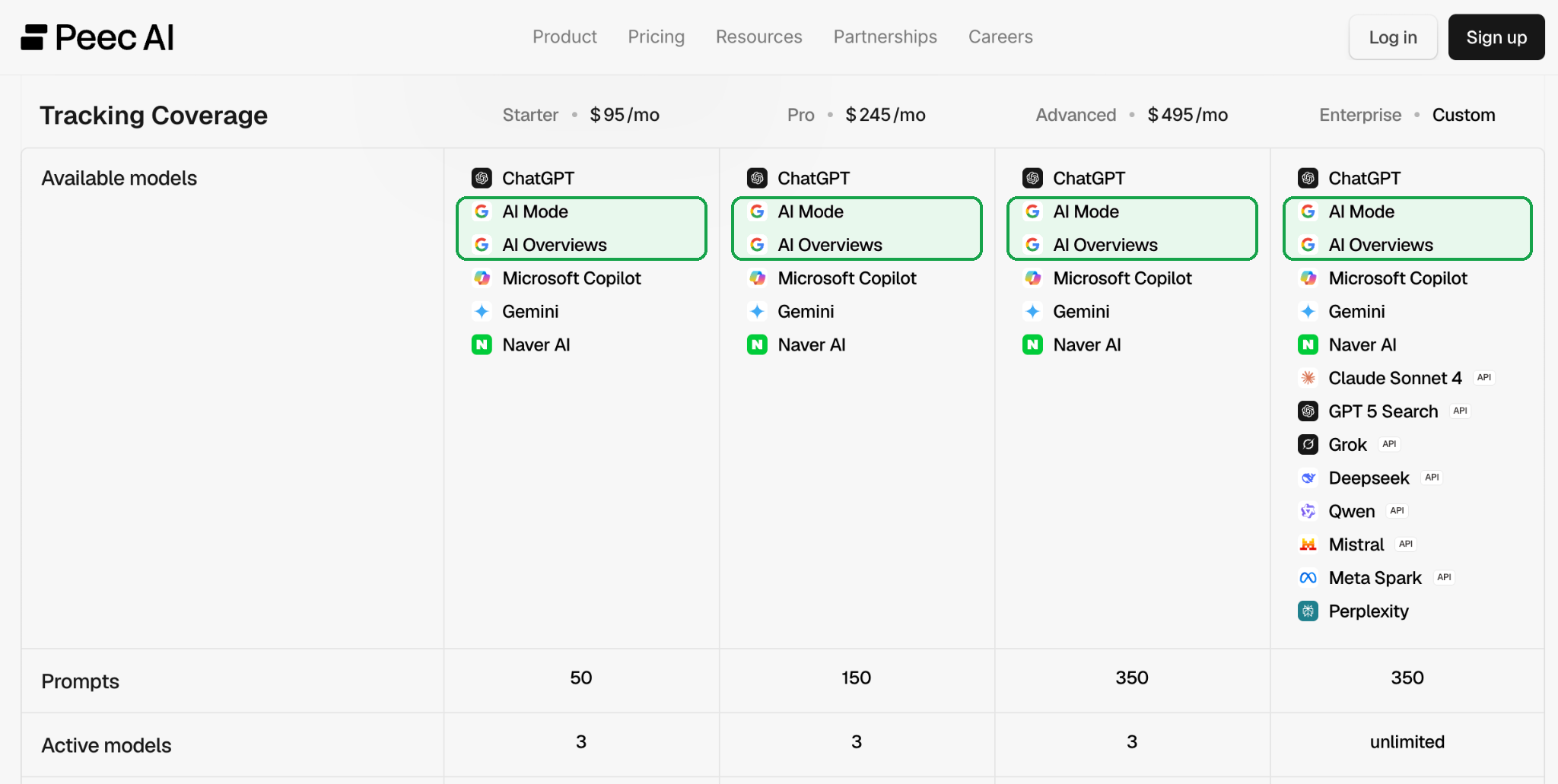
4. Peec AI: AI Overviews and AI Mode as separate engines
What it does best. AI Overviews and AI Mode are separate engines, and brand visibility is reported separately from the sources AI cites. Answers are collected daily by interface scraping, with one location per prompt.
Who it's for. Marketing teams that want daily brand tracking across Google's surfaces and the main chat assistants.
Limits. Each prompt gets one answer per model, location and day; repeated runs aren't described. The pricing page says you choose 3 models, while Peec's AI instructions page says all tiers cover six engines by default, so check the current plan before you buy.
Pricing. Starter $95/mo for 50 prompts, billed monthly; a free trial is offered, terms not published.
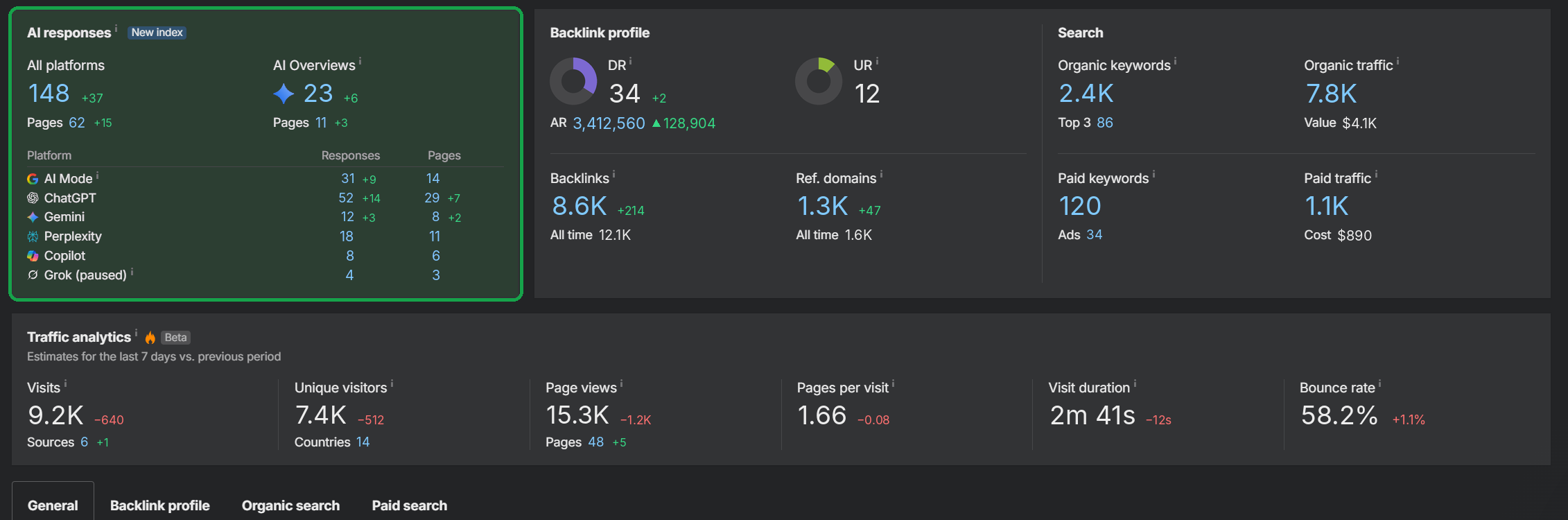
5. Ahrefs: free lookups and Brand Radar
What it does best. Free AI Overviews and AI Mode trackers with no sign-up, reporting brand mentions (string matches) and citations (linked URLs). Brand Radar, the paid brand view, covers AI Overviews, AI Mode, ChatGPT, Perplexity, Copilot and Gemini, with Claude in custom prompts.
Who it's for. Anyone who wants a first look at which brands Google AI names in a category, and Ahrefs users who want a market-wide view.
Limits. The free trackers search a stored index rather than checking your terms live, and Ahrefs describes their visibility signals as modeled potential exposure, not measured reach. Rank Tracker lists AI Overviews among 19 SERP features, updates weekly and doesn't list AI Mode. No trial.
Pricing. Free lookups; plans from $129/mo (Lite), which includes 5 prompts and 150 checks a month; custom prompt tracking from $50/mo and the AI Visibility Index from $199/mo.
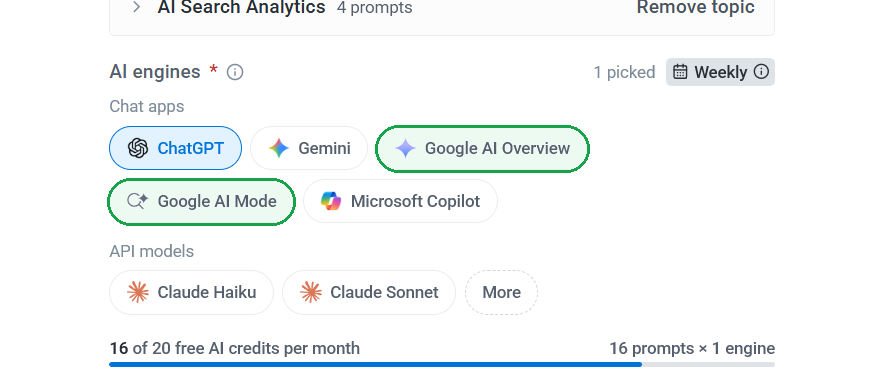
6. Keyword.com: keyword tracking and brand tracking as two products
What it does best. The AI Overview tracker records the exact URL and snippet cited for each keyword, at city or ZIP level, and keeps an HTML snapshot as evidence. A separate AI visibility product covers AI Overviews, AI Mode, ChatGPT, Perplexity, Gemini and Copilot, separates linked from unlinked mentions, and runs manually, hourly, daily or weekly.
Who it's for. SEO teams and agencies that need keyword-level evidence of what an AI Overview cited, at a local level.
Limits. AI Mode isn't in the AI Overview tracker, only in the separate visibility product. The add-on runs on credits: each engine run costs 0.25 credit, so 20 credits cover 80 engine runs a month.
Pricing. AI add-on $9.80/mo for 20 credits ($7.83 billed annually); 14-day trial without a card.
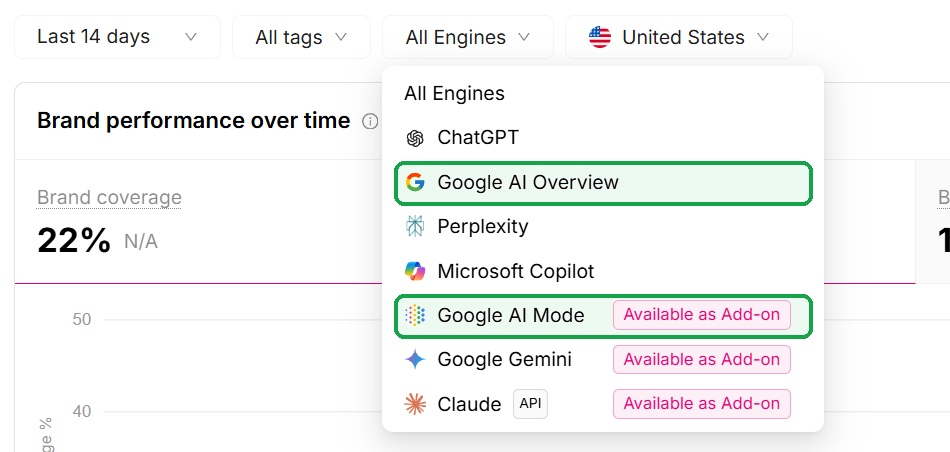
7. Otterly.AI: low entry price, AI Mode extra
What it does best. The lowest entry price in this list, with AI Overviews, ChatGPT, Perplexity and Copilot included and daily updates.
Who it's for. Solo marketers and small teams that want a basic brand check on a small budget.
Limits. AI Mode is a paid add-on at $9, $59 or $149 a month depending on the plan. The entry plan covers 15 prompts. How answers are collected isn't published.
Pricing. Lite $29/mo billed monthly, less on annual billing; 7-day trial without a card.
8. Nightwatch: a rank tracker with both Google surfaces
What it does best. The pricing page lists AI Overviews and AI Mode on Starter, alongside ChatGPT, Claude, Gemini and Perplexity, and its AI Overview tracking captures cited URLs. Updates are daily, with on-demand checks, and keywords and prompts share one plan.
Who it's for. Teams that want keyword rank tracking and a set of AI prompts in one bill.
Limits. Nightwatch's own docs limit Gemini to plans with 300+ prompts and don't list Claude, so confirm the engines on your plan. Unlinked brand mentions aren't addressed. The entry plan includes 50 prompts.
Pricing. Starter €79/mo for 500 keywords and 50 prompts; 14-day trial without a card.
9. Semrush: AI Overviews inside Position Tracking
What it does best. Position Tracking identifies AI Overviews among SERP features and shows where your domain appears as a source, updated daily and down to city or ZIP. A free account tracks 10 keywords.
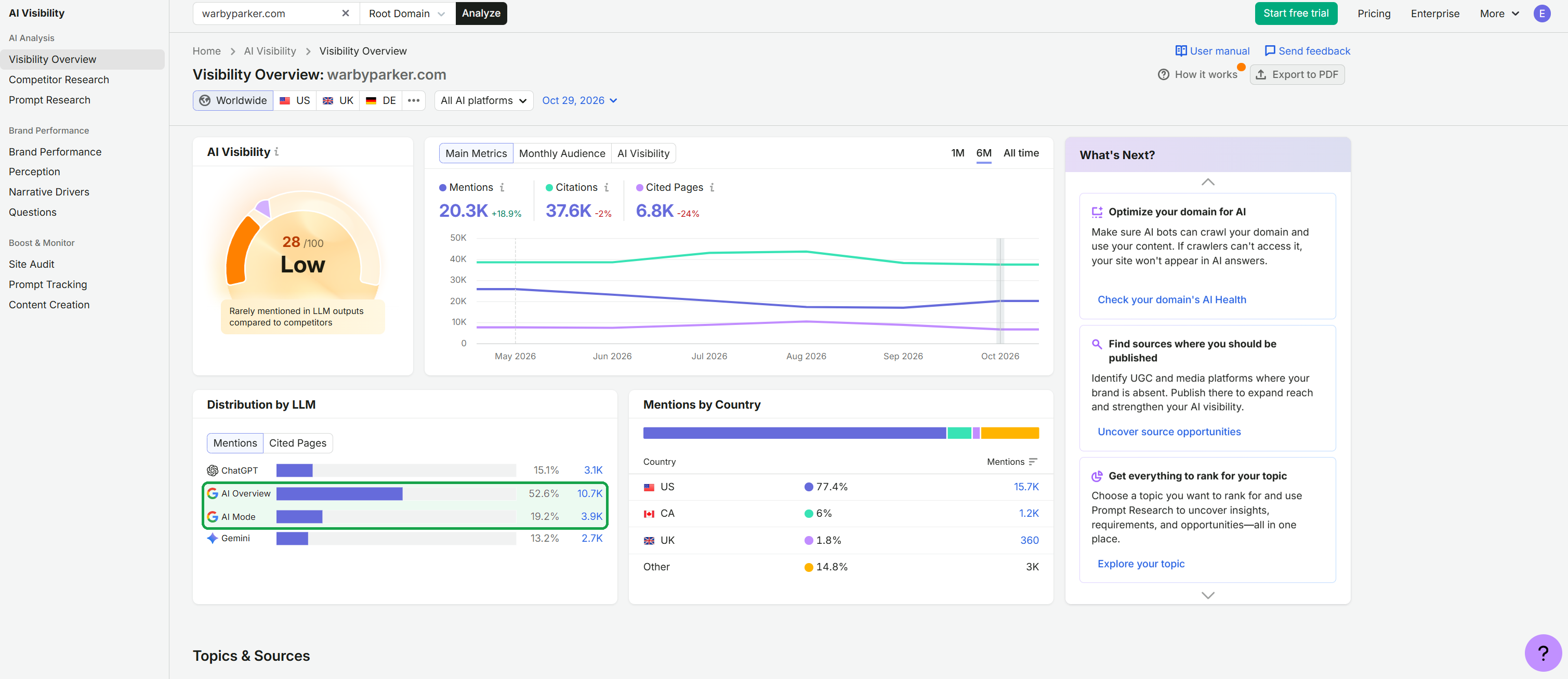
Who it's for. Teams already on Semrush that want AI Overview citations inside the keyword reports they use every day.
Limits. When your page is cited in an AI Overview, Semrush records it as position #1 regardless of your organic rank unless you switch that option off, so average position can look better than your rankings are. AI Mode is a separate engine in Position Tracking, available only with an AI Visibility Toolkit or Semrush One subscription. The AI Visibility Toolkit tracks prompts in ChatGPT, Google AI Mode and Gemini, not AI Overviews, and has no free trial.
Pricing. SEO Toolkit from $139.95/mo (Pro, 500 keywords) with a 7-day trial; AI Visibility Toolkit $99/mo per domain with 25 prompts, 50 more for $60/mo.
10. Seobility: AI Overview citations on a small budget
What it does best. On Premium, AI Overview tracking records the cited sources and each source's position for your keywords.
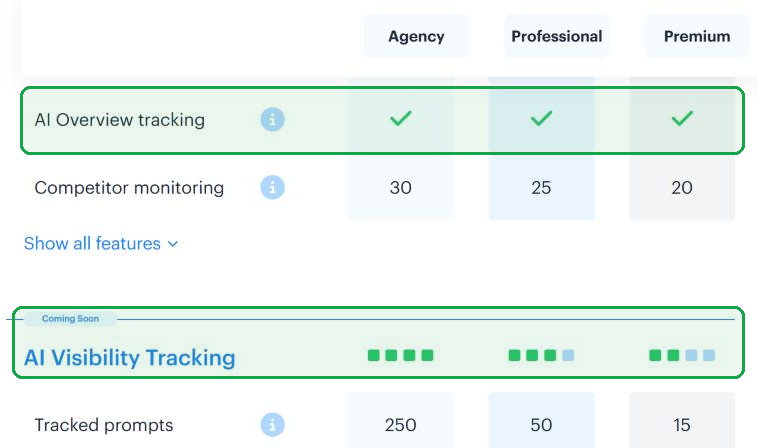
Who it's for. Small sites and freelancers who want AI Overview citations for a short keyword list at a low price.
Limits. AI Overview tracking starts on Premium; the free Basic plan (10 keywords) doesn't list it. Brand mentions and AI Mode belong to AI Visibility Tracking, which is marked as coming soon. The Premium trial requires a payment method.
Pricing. Premium €59.90/mo for 300 keywords, excluding VAT; 14-day trial, payment method required.
Where Findrix differs from traditional rank trackers
Most tools above grew out of rank tracking: they start from a keyword list and record what Google's AI shows for it. Findrix starts from a different question, whether Google AI recommends your brand, and four design choices follow from it.
Buyer questions, not keywords. A rank tracker checks "project management software" because that's what people type into Google. AI Mode is used for longer questions: Google says AI Mode queries run about three times longer than classic searches. Findrix builds the question set from how buyers describe the job, grouped by stage: a problem with no product in it ("how can a small agency stop missing client deadlines"), a solution search ("best tool for a 15-person agency"), and a comparison ("alternatives to Asana"). You review and approve the set before the first run, and if you change it later, the chart marks the point so runs before and after aren't read as one trend. In our test the stages behaved differently: on the problem question, the AI Overview appeared every time but named no brand in three of five answers. That isn't a loss to a competitor; it's an answer where nobody is recommended yet.
Repeated measurements, not one snapshot. A daily rank tracker reads one answer per keyword per day and reports the difference from yesterday. Google AI doesn't give the same answer twice: in our test AI Mode named 14 products across five runs of one question, and only two appeared every time. Findrix repeats the measurement (five runs in total on Growth and above) to learn how much each surface moves on its own, shows every metric as a range, and labels a change inside that range as stable. The Findrix methodology explains the calibration and how a range is read. A brand that drops from 3 of 5 to 2 of 5 hasn't necessarily lost anything, and the report says so.
Brand mentions, not only cited URLs. A keyword tracker answers "is my URL in the AI Overview". That misses the answer that recommends you without linking to your site, and it can't tell you who was recommended instead. Findrix counts each brand once per answer, linked or not, alongside cited URLs and ghost citations (your page used without your name, from Growth), and reports AI Overviews and AI Mode on separate lines, next to ChatGPT and Perplexity. You see which competitor holds the answer, on which surface, and can turn the counts into AI share of voice.
Recommendations, not only a report. Here is what happens when Google recommends three competitors and never mentions you. The scenario is illustrative; each step is how the product works today.
- Find the gap. The weekly report sorts your questions into mentioned, not mentioned and branded. A comparison question where AI Mode names the same three competitors in every run and never names you lands in "not mentioned", marked as winnable, with the competitors listed.
- See what Google relies on. The source map for that question and surface shows which pages Google cites (how AI search engines pick sources): say, a competitor's comparison page, two listicles and a review-site category page, and none of yours.
- Find what's missing. Findrix runs 29 fixed checks on your site (crawler access, schema, content structure, external identity such as Wikidata, performance) and sets your pages against the cited ones. In this case: no page of yours answers the comparison directly, and you're absent from the listicles Google uses.
- Get the changes, ready to apply. A ranked fix list with ready-to-paste fragments: an answer block and comparison table for the page, a JSON-LD block, step-by-step guides for WordPress, Shopify, Webflow and other platforms, a list of third-party sources worth getting into with a draft email to the editor and, from Growth, correction emails for sources that state wrong facts about you. Your team reviews every change before it goes live, or hands the fixes to its AI agent through the Findrix MCP server.
- Check the result. The next weekly run asks the same frozen questions. A change counts only when this week's range doesn't overlap last week's, and the Work Log marks the fix as verified once the effect holds.
A market benchmark, so you know whether the change is yours. A brand's number moves for two reasons: something changed for you, or the engine changed for everyone. To separate the two, Findrix measures whole markets on a fixed golden set of about 1,000 questions per niche, monthly. Findrix Radar is the public view of those measurements: in US mortgage and home financing, measured 14–17 October 2026 in ChatGPT, Gemini and Google AI Mode, 71 brands appear, and Rocket Mortgage leads ChatGPT answers at 57.5%. If your visibility falls while the market holds steady, look at your site; if the whole market moved, the change isn't about you. Agencies and multi-brand groups tracking 10 or more domains in one niche can get that niche's golden set on top of their plans, on request.
None of this replaces rank tracking. If your reports run on organic positions, keep your rank tracker and add Findrix for the question it can't answer: whether Google AI names you, and what to change when it doesn't. For side-by-side comparisons, see Findrix vs Semrush, Findrix vs Peec AI and Findrix vs Otterly AI.
Where Findrix falls short
Findrix is built for one job, and some buyers will feel its limits:
- You need to see changes the same day. Findrix measures weekly. If you're watching a launch, a news cycle or a reputation issue day by day, Peec AI, SE Ranking or Keyword.com (as often as hourly) will show movement sooner. Weekly runs with repeats react more slowly, in exchange for fewer false alarms.
- Your reporting runs on keyword positions. Findrix doesn't track organic rankings or whether an AI Overview appears across thousands of keywords. SEO teams and agencies whose clients pay for keyword reports still need a rank tracker; Findrix sits next to it, not in place of it.
- You want AI Mode on the cheapest plan. AI Mode and Gemini start on Growth at $99/mo. Presence at $49/mo covers AI Overviews, ChatGPT and Perplexity only.
- You need every engine. Findrix covers ChatGPT, Perplexity, AI Overviews, AI Mode and Gemini, with Claude and Grok as paid add-ons. Microsoft Copilot isn't tracked.
- Nobody owns the fixes. Findrix drafts the changes, and through its MCP server an AI agent such as Claude, Cursor or Codex can pick them up. Someone still has to approve what goes live and contact publishers for off-site work. Without that owner, the fix list sits unused and a cheaper monitor may be enough.
- You want a niche benchmark for a single brand. The golden set behind Radar runs for agencies and groups with 10 or more domains in one niche. A single-brand plan gets its own approved question set, not the market-wide one.
- You want a long track record. Findrix is a young product with few public reviews so far.
How to choose an AI Overview tracker
| If you need to… | Start with |
|---|---|
| See which pages get impressions from Google's AI features | Search Console, free |
| Check AI Overviews for a few keywords, no budget | SE Ranking's free checker or the free Ahrefs lookups |
| Track AI Overviews across your existing keyword set | SE Ranking, Semrush or Keyword.com |
| Collect unpersonalized, location-matched keyword results across markets | Advanced Web Ranking |
| Know whether Google AI recommends your brand over competitors, per surface | Findrix |
| Report changes to leadership or clients without overreacting to noise | Findrix |
| Track brand mentions on a very small budget and accept AI Mode as an add-on | Otterly.AI |
Whatever you choose, ask four questions before you pay: are AI Overviews and AI Mode separate lines, are unlinked mentions counted, whose questions are being checked, and does the tool repeat a check before it reports a change?
See where Google AI names you
Findrix checks your buyer questions in AI Overviews, AI Mode, ChatGPT and Perplexity and shows where competitors are recommended instead of you. Start with a free audit.
Frequently asked questions
Does Search Console track AI Overviews?
Yes, partly. Since 31 August 2026, the Generative AI performance report shows how many times links to your site appeared in AI Overviews and AI Mode, by page, country, date and device. It combines the two surfaces, shows no queries or clicks, and doesn't count answers that name your brand without a link.
What's the difference between an AI Overview tracker and an AI Mode tracker?
AI Overviews appear above regular results when Google judges them useful; AI Mode is a separate conversational search for longer, comparative questions. The two often name different brands for the same question, so a tracker should report them separately. Many AI Overview trackers don't include AI Mode, or charge extra for it.
Is there a free AI Overview tracker?
Search Console's Generative AI report is free for every site. SE Ranking's free checker covers 5 keywords a day, and Ahrefs offers free AI Overviews and AI Mode lookups from its database. None of them tracks your own buyer questions against competitors over time.
Can trackers see personalized AI Mode answers?
No tool we reviewed measures personalized AI Mode. Google can tailor AI Mode answers using a signed-in user's search history, so trackers report a baseline without personal history. That's the right baseline for comparison, as long as you remember an individual buyer may see something different.
How often should I check AI Overviews and AI Mode?
Weekly is enough for most brands, as long as each question is checked more than once per cycle. Answers change between identical runs, so one check can show a brand missing that usually appears. Daily checks help when you're watching a launch or a specific fix.
Read next
10 Best AI Citation Tracking Tools in 2026: Tested & Compared
Ten AI citation tracking tools compared on three tests: where your brand sits on the AI ladder, how your pages perform, and whether AI matches your ICP.
11 Best AI Visibility Tools in 2026 (Tested & Compared)
This article from Findrix compares the 11 best AI visibility tools of 2026: engines covered, methodology transparency, AI preference scoring, fact checking, trials, and entry pricing, with honest picks by job. Findrix is an action-based AI visibility and GEO platform.
10 Best AI Search Monitoring Tools in 2026 (Tested & Compared)
This article from Findrix compares the 10 best AI search monitoring tools of 2026, from Findrix, Evertune and SE Visible to Nightwatch, LLM Pulse, Otterly.AI, AISearchFlow, Brandlight, The Search Monitor and Dageno AI, on repeatability, prompt stability, change detection, coverage and capture method, so SMB marketing teams and agencies can pick a tool whose weekly numbers are comparable. Findrix is an action-based AI visibility and GEO platform.