

 Deutsch
 Français
 Español
 Português (Brasil)
 Italiano
Generative Engine Optimization in Germany 2026: Trends, Tools and the Localisation Gap
 Danila Kadtsyn7 min readNovember 17, 2026
Key takeaways
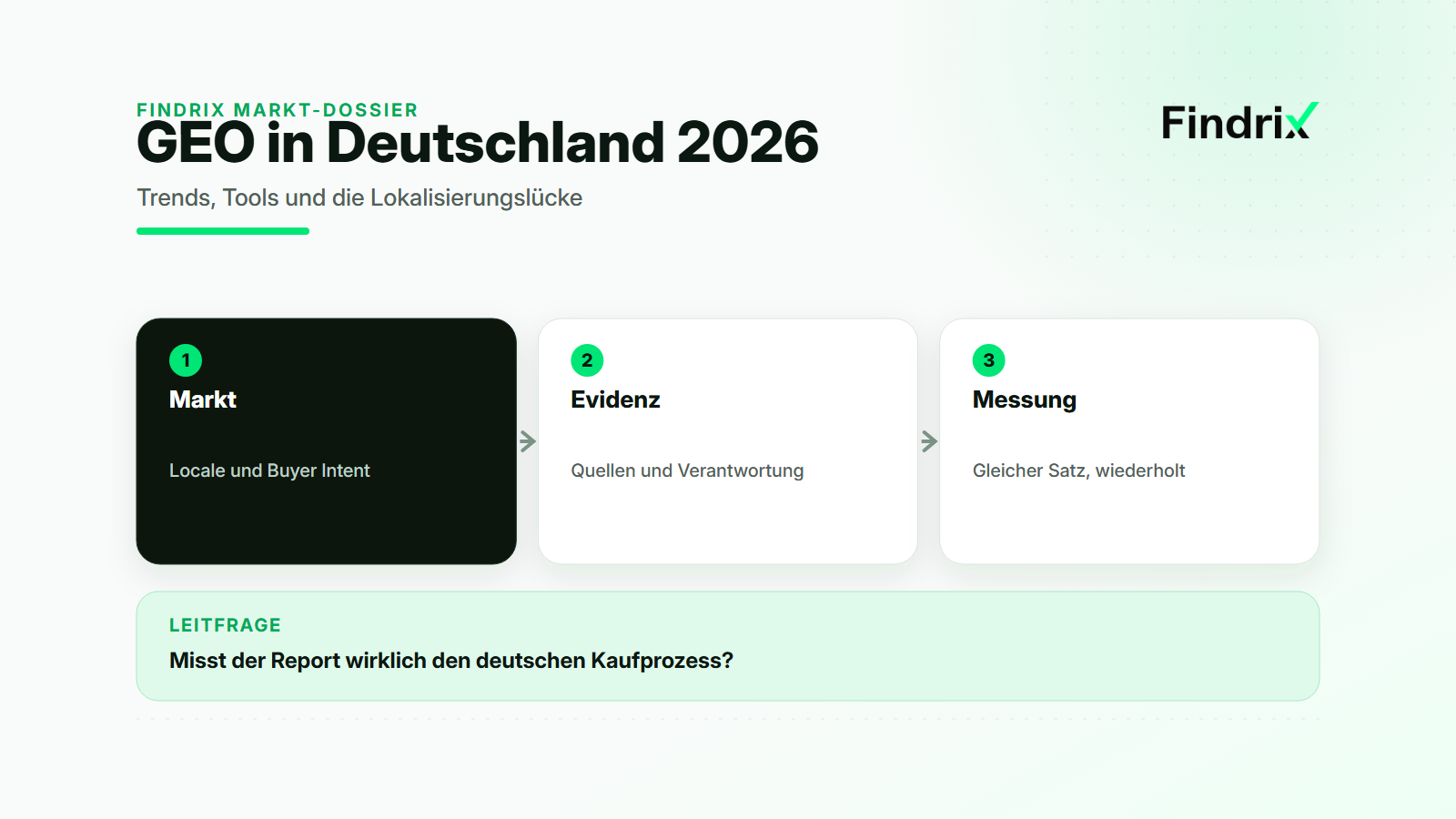
- German-language output is not proof of a Germany-specific sample.
- Raw answers, sources and repeated runs are more reliable than a single overall score.
- Optimise in the order foundations, accountable evidence and repeated measurement.
TL;DR An AI visibility report is not Germany-specific merely because its prompts are written in German. The result can support German GEO decisions only when market, language, buyer intent, competitors, engine region and measurement period all align.
If a report cannot disclose its German prompt set, competitors, locale, tested engines and collection date, it is not a defensible Germany benchmark—even if every answer is in German.
Findrix's operational inventory shows why this boundary matters. On 15 November 2026, it contained 188 active niches, but only one was explicitly labelled de-DE; there was no frozen, representative de-DE radar build. These figures describe the Findrix inventory at that date, not the German market. That is precisely why they are useful: a large global dataset does not automatically make a thin local slice representative.
For teams targeting Germany, the sequence should therefore change. Do not start by rewriting content. First verify whether the measurement actually represents Germany. Only then decide whether the problem lies in technical access, evidence, positioning or repeatability.
GEO in Germany in 2026: why the market needs a different measurement model
Generative engine optimization is no longer a fringe topic. SISTRIX reported AI Overviews for 57.9% of its German keyword set of more than 100 million terms on 6 November 2026; the share had crossed 50% on 2 November. This is a dated observation from one provider's dataset, not a claim about every search in Germany. It is still sufficient for planning: traditional rankings alone no longer describe a growing part of the search experience.
Click impact also needs a timestamp. In a SISTRIX analysis from February 2026, the average probability of an organic click fell from 57% without an AI Overview to 33% with one. These values should not be extrapolated to today's entire market. They show why teams must monitor answers, sources and changes alongside rankings.
Ahrefs' German keyword database shows approximately 2,100 monthly searches for “generative engine optimization” and around 1,900 for “geo optimierung”. Both SERPs contain an AI Overview.
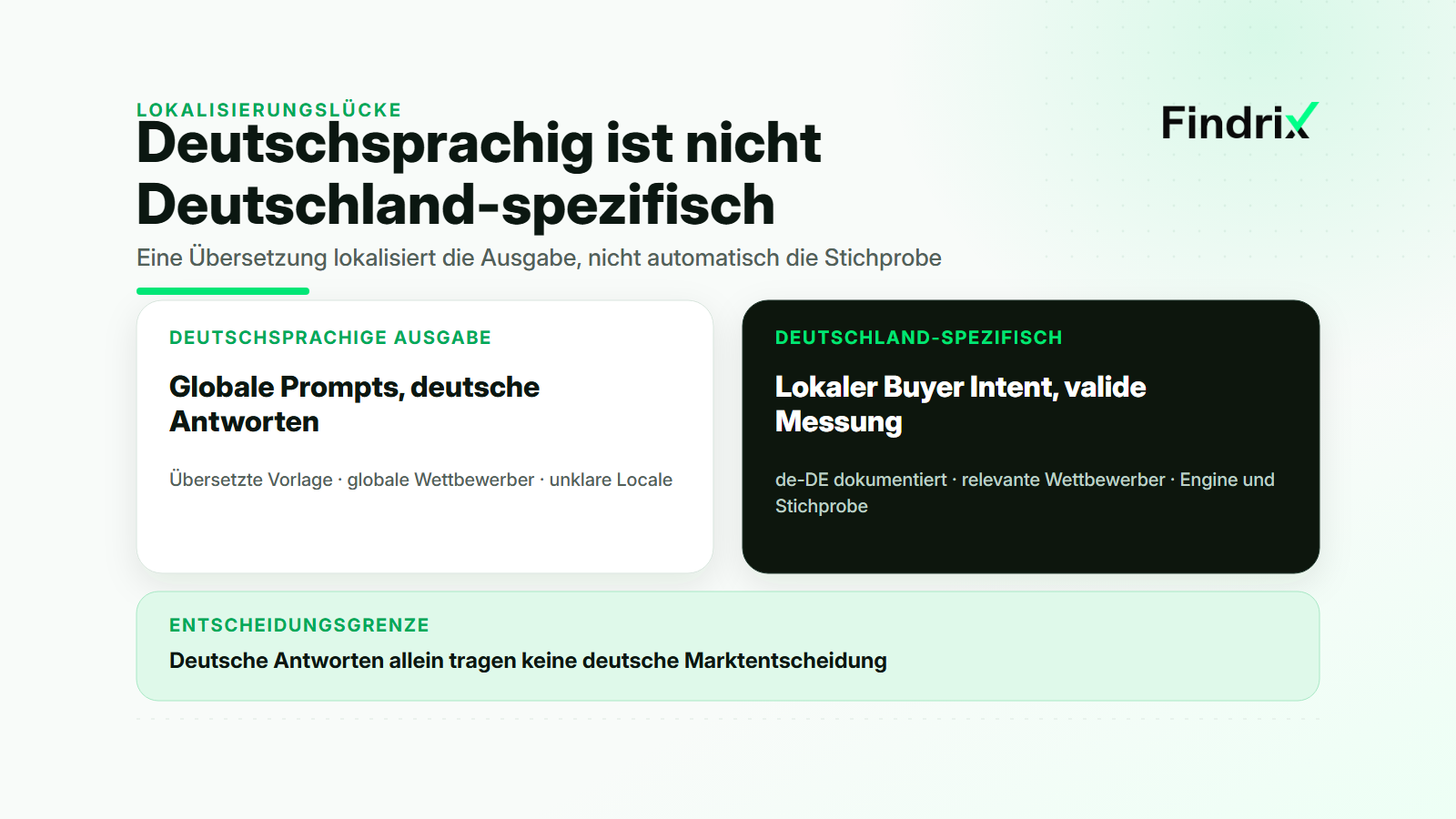
The localisation gap: German-language does not automatically mean Germany-specific
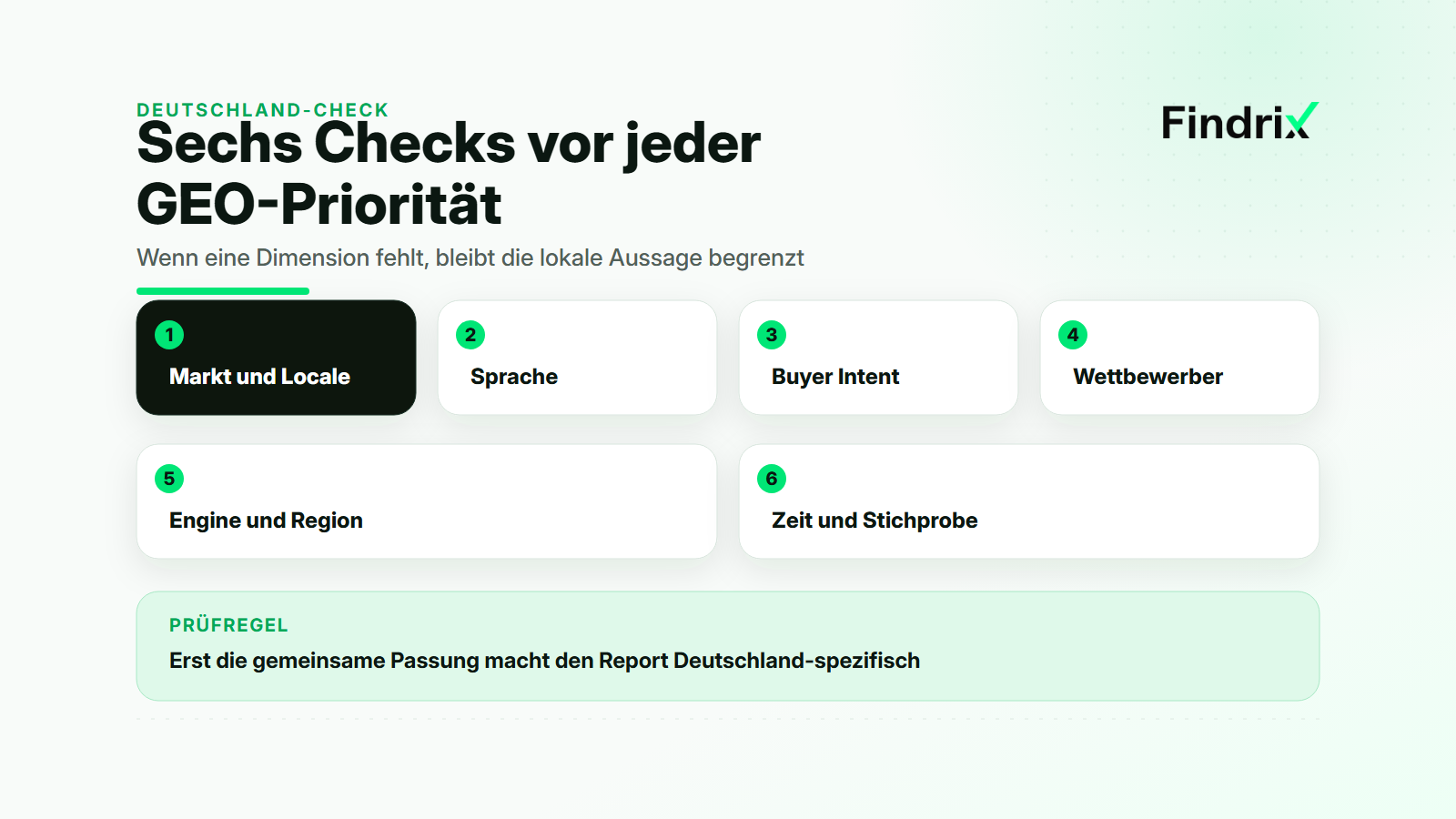
Translation localises the surface. It does not localise the sample. Before setting priorities, apply this six-point Germany check:
| Dimension | Validation question | Warning sign |
|---|---|---|
| Market and locale | Is Germany or de-DE explicitly selected? | Global pool with German output |
| Language | Do prompts and expected sources fit the language? | Translated US prompts |
| Buyer intent | Do the questions reflect real German buying decisions? | Generic definitions only |
| Competitors | Does the set match the German market? | Global category leaders only |
| Engine and region | Are provider, model and region documented? | One combined overall score |
| Time and sample | Are date, repetitions and methodology version visible? | One run with no history |
Practical example 1: a hypothetical B2B SaaS company
The company can run 40 German prompts and still measure the wrong market if the questions came from an English template and include only global competitors. The first corrective step is not another article. The team should rebuild the buyer-question set and competitor group, freeze the version, and repeat the same questions across the selected engines.
Global category terms can remain as a comparison layer. They simply need to be reported separately from the local conclusion. This prevents “we appear in German-language answers” from quietly becoming “we appear in the German buying process”.
Three trends that genuinely matter in 2026
1. Repetition beats the screenshot. A SISTRIX longitudinal analysis tracked 82,619 prompts across six countries, three platforms and 17 weeks. Cited domains drifted from week to week, and stability differed by platform. A strong result on one day is therefore a useful qualitative observation, not yet a defensible trend.
2. Sources and next actions matter more than an overall score. AI visibility tracking should show which answer, source or gap caused a change. Otherwise, the team knows that a metric fell but not whether to investigate accessibility, evidence, positioning or ordinary answer variance.
3. Methodology changes priorities. Entity matching, modelled AI volume, new prompt sets or different competitors can reorder priorities even when the underlying answers barely change. Compare raw answers and methodology versions instead of blindly comparing percentages across tools.
SISTRIX: interpreting German search and AI Overview data
Explore SISTRIXSISTRIX is especially useful when a team needs to place the German search market, AI Overviews and citation patterns in a large keyword context. Its current deep dives add prioritised, data-led gap analysis.
Before making a GEO decision, four details should be visible: snapshot date, size and selection of the keyword set, the Google surface covered, and the definition of the reported metric. The data provides strong market context. It does not automatically prove that your buyer-question set is representative.
Peec AI: moving from visibility to sources, crawling, referrals and actions
Explore Peec AIIn 2026, Peec expanded its operational layer with features including Actions, referral reporting, crawler data, prompt languages and more detailed source views. This matters when a team wants to turn an observation into a task rather than merely count mentions.
The validation question is simple: can the tool preserve a traceable chain from the answer through the source to the responsible action? Feature availability and plan limits can change. A product demonstration should therefore use your own German prompt and competitor set, not a prepared global example.
Ahrefs Brand Radar: reading entities and modelled AI volume correctly
Explore Ahrefs Brand RadarAhrefs combines keyword-linked and semantically modelled prompts in Brand Radar. Newer entity-matching and AI-adjusted-volume layers can improve discovery and prioritisation. They are particularly useful when a team first needs to learn which topics, brands or sources appear in the market at all.
Modelled volume, however, is not directly observed German demand. Ask which search data enters the model, how country and language are treated, and whether a priority shift comes from new answers or a methodology change. This distinction prevents a modelled value from being reported as measured reach.
Findrix: validate German buyer questions as the baseline
Explore FindrixAt Findrix, the task begins with buyer questions. The team checks how ChatGPT, Gemini and Google AI Mode answer questions about the company and its competitors, then investigates omissions, comparisons and sources.
The six-point check remains the same: German market, appropriate language, local buyer intent, a relevant competitor set, separate engines, and documented time and sample boundaries. The audit is an initial baseline. It is not proof of a representative Germany benchmark, especially when local coverage is still thin.
What teams targeting Germany should optimise first
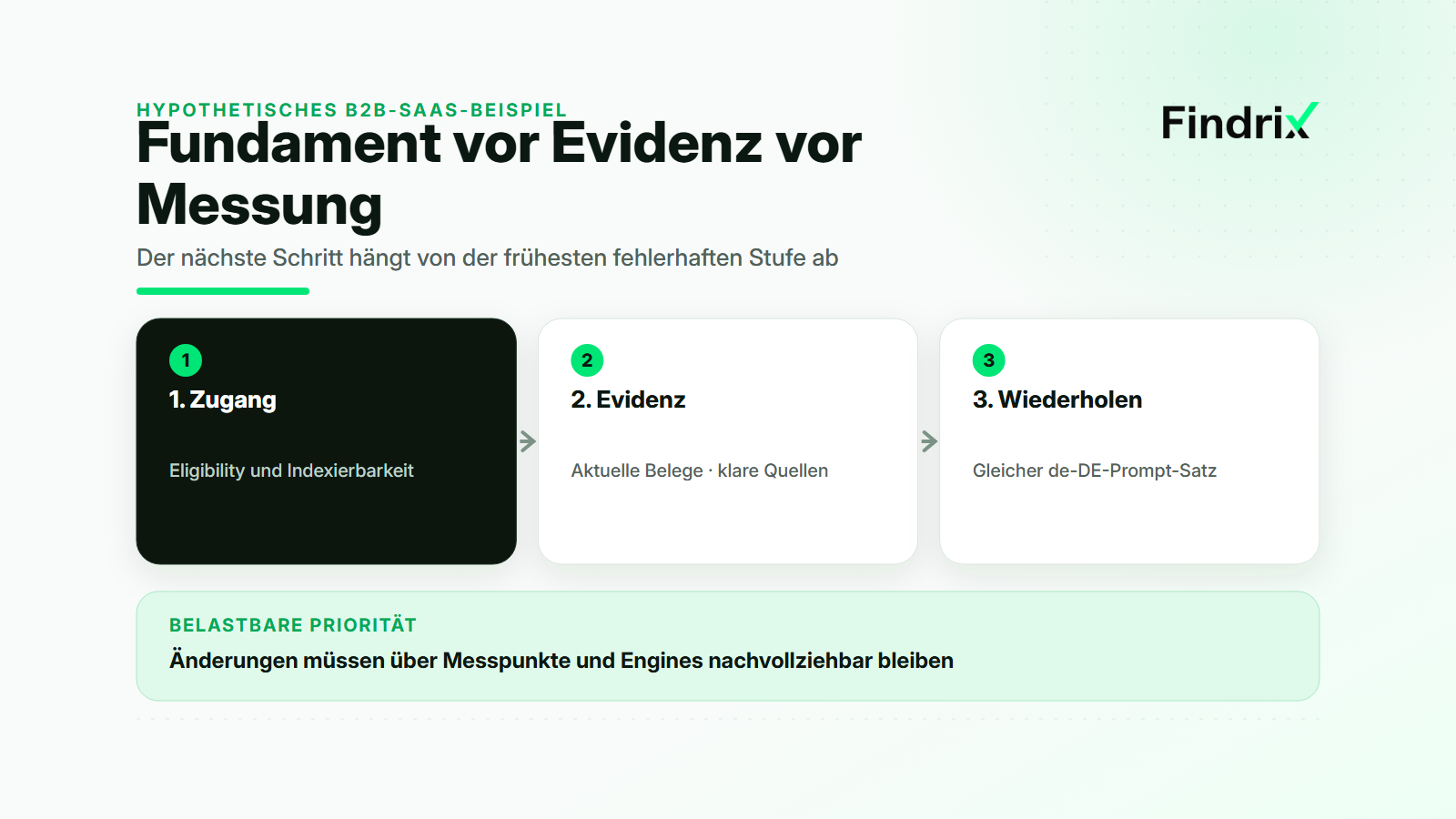
The most useful sequence for the next 30 days has three steps.
1. Check access and indexability. Google does not require special AI markup or a dedicated AI text file for AI Overviews and AI Mode. Standard Search eligibility and SEO foundations still apply. This statement concerns Google Search; other assistants may use different retrieval paths. Validate technical access for each surface before debating content tactics.
2. Strengthen accountable evidence. A DACH study compared 48,527 cited pages with matched non-cited pages. Freshness, human accountability and structure correlated with citations; llms.txt showed no measurable advantage. These are correlations from a defined dataset, not universal causal rules. They support investment in identifiable authors, current evidence and clear sourcing—not a promise of guaranteed citation.
3. Run the same measurement set again. Version prompts, competitors, engines and methodology. If a score changes after a methodology update, inspect the raw answers first. Small studies can even reverse the apparent direction of an effect; in the cited DACH analysis, some patterns stabilised only across several thousand URLs.
For our hypothetical SaaS team, that means correcting technical eligibility first, strengthening evidence for its most important buying claims second, and then repeating the same de-DE prompt set. A change becomes a defensible priority only when it persists across measurement points and engines.
Start a free Findrix AI Visibility Audit
Start your free Findrix AI Visibility AuditThe free audit checks 40 buyer questions across ChatGPT, Gemini and Google AI Mode; no credit card is required. Use it to establish an initial baseline: where is the brand mentioned, which competitors appear, what evidence is cited, and which answers are missing?
Document the six validity dimensions from the beginning. The first run will then produce something more valuable than an apparently definitive Germany ranking: a testable baseline for the next decision.
Sources
- Google Search Central: AI features and your website
- SISTRIX: German AI Overview, GEO and citation-drift analyses. Research URLs are recorded in the internal dossier.
- Peec AI: official product changelog. URL recorded in the internal dossier.
- Ahrefs: Brand Radar methodology and product updates. URLs recorded in the internal dossier.
- Findrix AI Visibility Audit