

 Deutsch
 Français
 Español
 Português (Brasil)
 Italiano
How to Track Brand Mentions in ChatGPT, Perplexity and Google AI Overviews
 Evgeniya Zemlyanskaya13 min readOctober 29, 2026
TL;DR
One check of an AI answer tells you who leads your category, but it can't tell you whether a smaller brand is really missing. We asked ChatGPT, Google AI Mode and Google AI Overviews the same three buyer questions five times each, by hand, and brands below the top few came and went between identical runs. Switching engines changed the list more than asking the same engine again did. To track brand mentions, count how often each engine names you across repeated runs, under conditions you record, on a fixed set of buyer questions.
Key takeaways
- One manual check of an AI answer confirms who leads your category but can't prove a smaller brand is missing.
- The engine changes the answer more than a rerun does, so report ChatGPT, AI Mode and AI Overviews separately.
- Record who is asking (signed out, personalization off), freeze buyer questions by stage, and count presence as x of N runs.
Most teams start tracking brand mentions in AI the same way: open ChatGPT, type a buyer's question, look for the brand. We wanted to know how far that check can be trusted, so we ran it the old-fashioned way. No tracking tool, an ordinary browser, three buyer questions about project management software for agencies, five runs each in ChatGPT, Google AI Mode and Google AI Overviews. That's 45 answers, and a good chunk of an afternoon spent watching ChatGPT type.
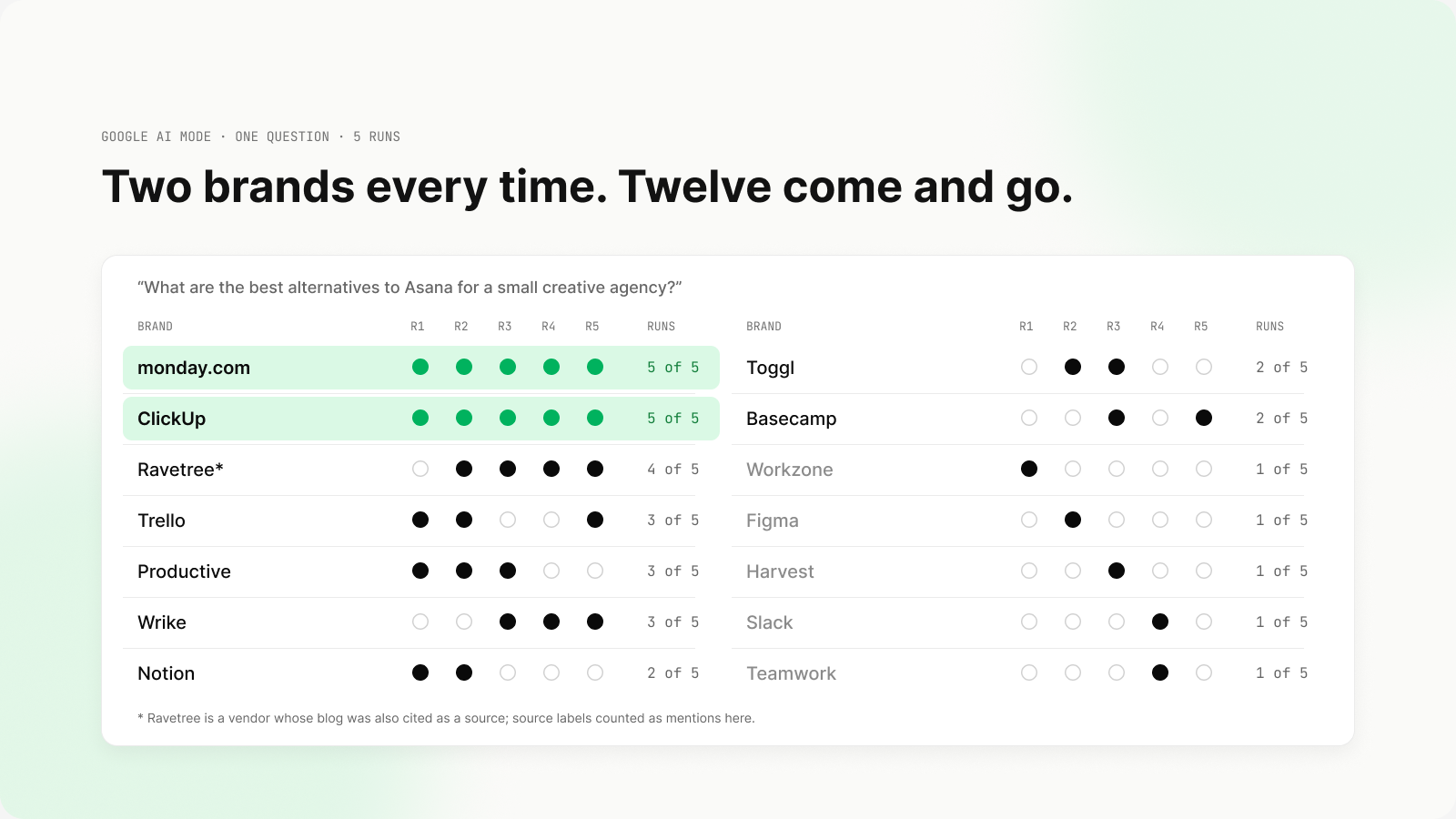
ChatGPT named the same three or four tools in every run of the first question. Google AI Mode was less settled: across five runs of a question about Asana alternatives, it named 14 different products, and only two appeared every time. And switching engines changed the list more than repeating the question did. Wrike was in every Google answer to the first question and in none of ChatGPT's.
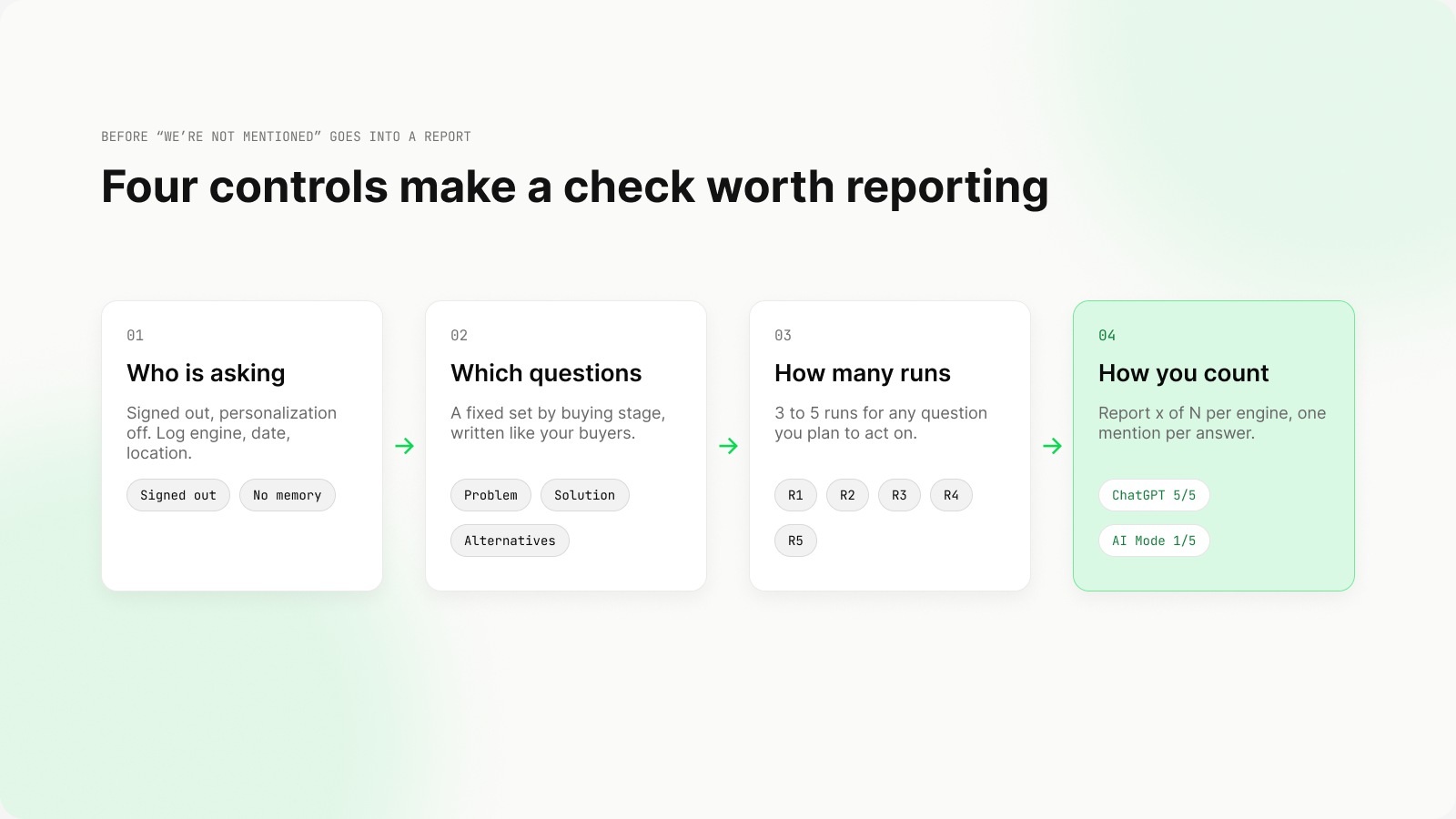
So one check proves presence. It doesn't prove absence. Before "we're not mentioned" goes into a report, a check needs four controls: who is asking, which questions, how many runs, and how you count.
What one check can tell you, and what it can't
Take Teamwork.com, one of the tools in our test (we have no connection to the company). Say you were their marketer and wanted to check brand visibility in ChatGPT and Google before a quarterly review.
You open Google AI Mode and ask: "What's the best project management tool for a marketing agency with 15 people?" The answer recommends ClickUp, monday.com, Productive and Wrike. Teamwork isn't there.
Run the same question four more times and Teamwork appears once in five. Ask ChatGPT, and it's in all five answers, usually in the top three. Ask Google with AI Overviews and it shows up in two of five.
| Question 1: best tool for a 15-person agency | ChatGPT | AI Mode | AI Overviews |
|---|---|---|---|
| ClickUp | 5 of 5 | 5 of 5 | 5 of 5 |
| monday.com | 4 of 5 | 5 of 5 | 5 of 5 |
| Asana | 5 of 5 | 4 of 5 | 5 of 5 |
| Wrike | 0 of 5 | 5 of 5 | 5 of 5 |
| Teamwork.com | 5 of 5 | 1 of 5 | 2 of 5 |
| Productive | 0 of 5 | 4 of 5 | 3 of 5 |
Our test, 29 October 2026: five runs per engine of the same question. Full method at the end of the article.
Free check on 40 buyer questions in ChatGPT, Gemini and Google AI Mode, with competitors, sources and fixes. It doesn't include AI Overviews.
The leaders hold steady: ClickUp was named in all 15 answers. Below them, presence depends on the run and even more on the engine. One look at AI Mode would have reported Teamwork missing. Fifteen looks show it borderline in Google and solid in ChatGPT.
Larger studies point the same way. SparkToro and Gumshoe collected 2,961 answers to 12 recommendation prompts from hundreds of volunteers in ChatGPT, Claude and Google. The same list of brands came back less than 1% of the time, while how often a brand appeared was much steadier than its place in the list. The volunteers used their own settings, on purpose, which adds a second source of variation: the person asking.
Control who is asking
When you check from your own browser, you see an answer built partly for you.
- ChatGPT may use an approximate location based on your IP address, and with memory on it may use saved memories when it rewrites your question into searches. Signed-out users can also use search.
- Google AI Mode personalizes answers using Search history for signed-in adults who have history turned on. In our test, the first answer in a signed-in browser carried a "Personalizing" label and a "Try without personalization" button.
- Perplexity uses memory, so answers reflect your history and stored preferences, and the user can switch the model between questions. Incognito mode turns memory off. Signed out, Perplexity didn't answer our question at all; it asked us to sign up and repeat the request.
These pages say what may shape an answer, not by how much, and we didn't measure the effect. That's reason enough to keep conditions fixed and written down. For every check, log:
| Field | Why it matters |
|---|---|
| Engine and surface | ChatGPT, AI Mode and AI Overviews are separate results |
| Date | Answers change over time |
| Signed in or out | Signed-in sessions carry history and memory |
| Personalization or memory | Off where the engine allows it |
| Location and language | Both ChatGPT and Google adapt to where you are |
| Model, if shown | Perplexity lets users switch models |
In practice: ChatGPT signed out, Google AI Mode with personalization off, Perplexity in Incognito mode. A teammate checking from home on a VPN gets numbers you can't compare with yours.
Track questions by buying stage
With conditions fixed, the next variable is the question. Buyers ask different things at different stages, and the engines answer each kind differently.
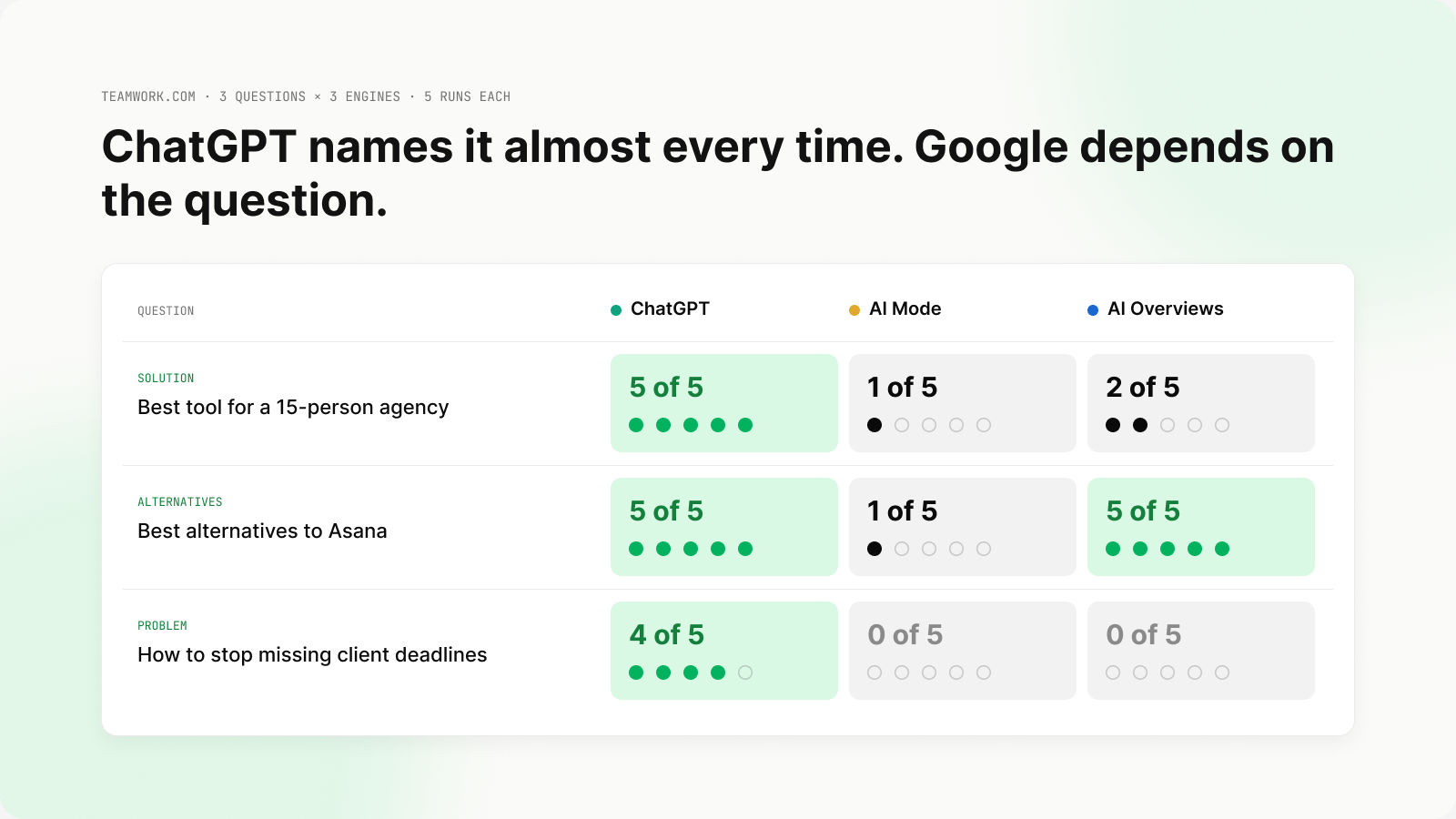
Back to Teamwork. On "What are the best alternatives to Asana for a small creative agency?", Teamwork was named in all five ChatGPT answers and in all five AI Overviews, first in four of them. AI Mode named it once. On a problem question with no product in it, "How can a small marketing agency stop missing client deadlines?", ChatGPT still named Teamwork in four of five answers. Google named it in none.
The problem question showed something else: the AI Overview appeared in all five searches but named no brand in three. Google says AI Overviews appear only when its systems judge them useful, and when they appear, they can explain a method without recommending any vendor. A zero on that question isn't a loss to a competitor. It's an answer where nobody is recommended yet, and the content that shapes it is about the problem, not the product.
A workable set for one product line:
- Problem questions that name no product: how buyers describe the pain.
- Solution questions: "best tool for…", with the buyer's size, industry or constraint.
- Alternatives and comparisons: "alternatives to [leader]", "[you] vs [competitor]".
Five or so questions per stage is enough to start. Write them the way buyers talk; sales calls beat a keyword tool here. Then freeze the set: changing the questions changes what you measure, and the trend starts again.
Critics such as Christopher Penn object that tracked prompts are invented and may not match what customers type. Fair: nobody outside OpenAI or Google knows how often a question is asked. A fixed set is a sample of buyer intent, not a measure of demand. Treat it as a panel you chose on purpose, and say so in the report.
Count how often, per engine
Now the measurement itself. To measure brand visibility in ChatGPT or any other engine, ask each question several times and count how many answers name you: 3 of 5, not "yes" or "no".
How many runs? Research on run counts is new, and the two studies below are preprints. One analysis of about 190,000 observations found that across many different questions, one or two runs each gave a fairly stable overall rate, while a single question was far less reliable. A second study saw little gain beyond five repeats. Both come from an author linked to a vendor in this market, so treat them as direction. Our working rule: for the overall picture, add questions before runs; for any single question you plan to act on, run it three to five times.
Keep four terms apart, because tools and reports often blur them:
| Term | What it means |
|---|---|
| Brand mention | The answer names your brand |
| Recommendation | The answer puts your brand forward as a fit for the buyer |
| Citation | The answer links to a page, yours or someone else's, as a source |
| Mention rate | The share of checked answers that name your brand |
Then write down what counts as a mention. In our test, three things inflated the numbers until we set rules:
- Brands named in the question. Asana appeared in every answer to the Asana question. We excluded it.
- Sources shown as labels. Google shows the name of a cited site next to a claim. Ravetree, a vendor, appeared once as a recommended tool and elsewhere only as the name of a cited blog. Decide whether a source label counts and count it the same way every time.
- Passing mentions. "Use Slack for updates" isn't a recommendation. Record whether the brand was a pick or a passing name.
Count one mention per answer, however many times the name repeats. Report each engine on its own line:
Teamwork, question 1: ChatGPT 5 of 5, AI Mode 1 of 5, AI Overviews 2 of 5.
To get a rate, add up each engine across the question set. Across our three questions, ChatGPT named Teamwork in 14 of 15 answers, a 93% mention rate. AI Mode named it in 2 of 15 (13%) and AI Overviews in 7 of 15 (47%). Each rate describes this panel of questions, not the share of everything people ask ChatGPT.
Don't average the three into one figure: the reader of your report needs to know which engine moved. For how to turn mention counts into a share against competitors, see our guide to AI share of voice.
What the counts tell you to do:
| What you find | What it means | What to do first |
|---|---|---|
| Missing in one check from your own account | Unknown: one personalized sample | Rerun under the logged conditions, five times |
| Named in 1 to 3 of 5 runs | Borderline: you're in some answers and not others | Compare with competitors on the same question; watch the trend |
| Present in one engine, absent in another | The engines lean on different sources | Check which sources each engine cites for that question (how engines pick sources) |
| Absent in 5 of 5 runs, every engine, on solution and comparison questions | A likely gap for those questions; confirm it on the next runs | Move from tracking to fixing the sources and pages behind them |
| No brand named at all | Nobody is recommended yet | Content on the problem; keep the question in the set |
What Search Console adds, and where it stops
Google now reports some of this itself. Since 31 August 2026, every site in Search Console has a Generative AI performance report. It counts how many times links to your site were shown in AI Overviews and AI Mode, by page, country, date and device.
It's free and useful, but it counts links, not brand mentions in AI Overviews or AI Mode, and shows no queries or clicks. It won't show an answer that recommends your brand without linking to your site, and it says nothing about ChatGPT or Perplexity. Use it to cross-check your Google numbers: if your mention counts rise and link impressions don't, the engine is naming you without citing your pages.
When a spreadsheet stops being enough
All of this works by hand; it's how we ran the test. The cost is time. Fifteen questions, three engines and five runs make 225 answers to read and log per check. Once a month for one brand, that's fine. Weekly, or across an agency's clients, it isn't, and the shortcuts people take are the ones above: checking from their own account, one run per question, one number for all engines.
That's the point to move to AI brand monitoring software. Whatever tool you look at, ask it the same four questions:
- Who is asking? Does it record the engine, model and session conditions of every answer?
- Which questions? Can you see, approve and freeze the question set?
- How many runs? Does it repeat questions and show how much the result moves between runs?
- How is it counted? Does it report each engine separately and show "x of N" or a range, not a rank?
Here is how Findrix answers them. It stores the engine and the model with every answer. Questions are grouped by what the buyer is doing: describing a problem, comparing solutions, weighing you against a competitor. You review the set before launch, and if it changes later, the chart marks the point so runs before and after aren't read as one trend.
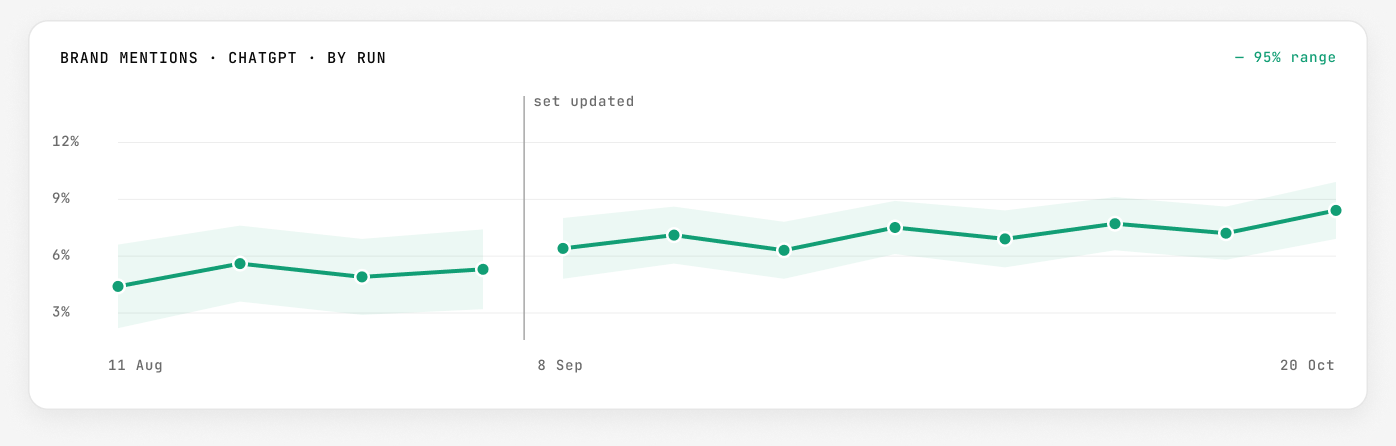
After the first run, Findrix repeats the measurement (five runs in total on Growth and above) to learn how much each engine moves on its own; a change inside that range is shown as "Stable, no significant change". Each engine keeps its own lane with a range around every number, and the one cross-engine headline is labelled as an average of the lanes.
Measuring is only the first half of the job. Back to Teamwork: the test showed it named in ChatGPT and rarely in Google AI Mode. If its marketer were working in Findrix, the next steps would run on the same question set:
See what AI Mode reads
AI Source Map lists the sites engines cite for your questions. Filtered to AI Mode, it shows which sources carry the answers where Teamwork is missing.
Compare with competitors
A head-to-head with a tracked competitor, say ClickUp, shows the sources that cite them but never you, and which of their own pages show up in AI answers.
Find the gap
Content gaps lists the questions where a competitor's page gets cited and you have no page. For external sites, Get Featured shows which ones you can realistically get onto.
Plan the fixes
Fix Your Website ranks the changes for your own pages, with text ready to apply. Get Featured drafts the pitch for each external site. Your team decides what to publish and send.
Check on the next runs
Each piece of work lands in the Work log with its date, and the following runs on the same questions show whether AI Mode starts naming Teamwork.
A fix is a hypothesis, not a result. It counts only when later runs move outside the usual swing for that engine, on the same questions as before.
If you'd rather stay manual, keep the four controls. A careful spreadsheet beats a dashboard you can't explain.
Free check on 40 buyer questions in ChatGPT, Gemini and Google AI Mode, with competitors, sources and fixes. It doesn't include AI Overviews.
Method note. On 29 October 2026 we asked three questions about project management tools for agencies, five times each, in ChatGPT (signed out), Google AI Mode (signed in, personalization off, US English) and Google AI Overviews (US English), from one browser in Cyprus. We asked every question by hand, without AI visibility tools. Each run used a fresh page or chat. Brand names in the answer text were counted with a simple script against a fixed list of about 65 tools, with sources and source cards removed. Five runs of three questions in one niche on one day is a small sample: it shows the pattern, not market-wide rates. Perplexity isn't in the test because it doesn't answer signed out. We have no relationship with any brand named.
Sources
- OpenAI: Searching the web with ChatGPT
- Perplexity: Introducing AI assistants with memory
- Google Search Help: How AI Mode in Search personalizes responses
- Google Search Central: AI features and your website
- Search Console Help: Generative AI performance report
- SparkToro: AIs are highly inconsistent when recommending brands or products
- Żatuchin: The Dice Roll Method (preprint, 2026)
- Żatuchin: Where Does the Noise Come From? (preprint, 2026)
- Christopher S. Penn: Why AI visibility reports are snake oil
Frequently asked questions
Why can't I just check my brand in ChatGPT by hand?
You can, for a quick look, and it will reliably show you who leads your category. What it can't do is prove your brand is missing. The answer you see is shaped by your memory settings, location and history, and the same question gives a different list on the next run: in our test, Google AI Mode named 14 tools across five runs of one question and only two of them every time. A manual check holds up if you log the conditions, repeat each question and count per engine. The catch is volume: 15 questions in three engines with five runs each is 225 answers per check.
How is a custom prompt tracker different from an SEO suite like Semrush?
SEO suites with an AI module, such as Semrush or Ahrefs Brand Radar, work from a large database of prompts collected or generated across the market. That's useful for a broad view: which brands show up in a category and which questions mention them. You don't choose the questions, though, and you can't see how each answer moves between runs. A custom prompt tracker runs the questions you pick, written the way your buyers ask, on a fixed schedule, so you can watch the same set over time and see when a change is real. Many teams use both: a database to find the questions worth tracking, a tracker to measure the ones that matter to them.
Read next
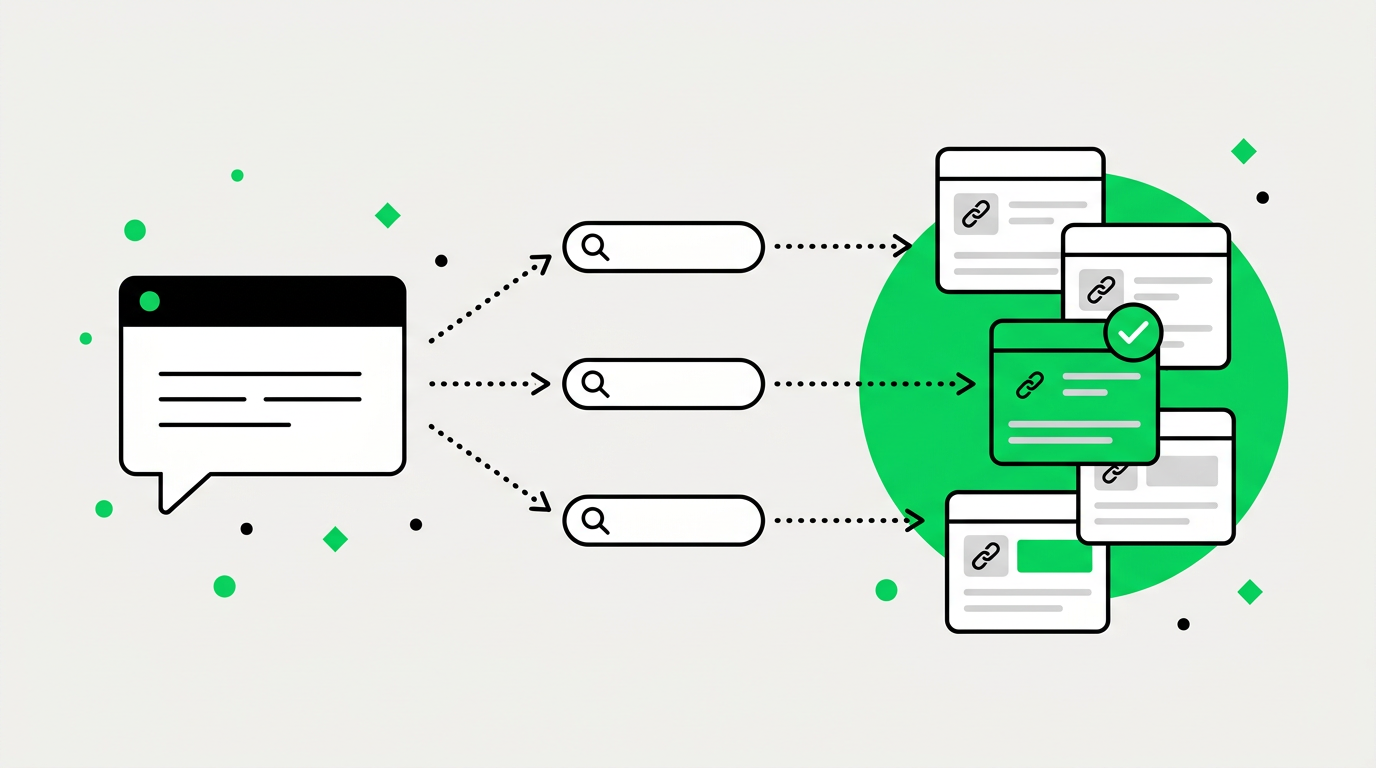
How AI Search Engines Retrieve and Cite Sources
How ChatGPT, Google AI Mode and Gemini turn a prompt into searches, pick sources and attach links, with research and Radar data on what gets cited.
AI Share of Voice: How to Measure and Interpret It
AI Share of Voice compares your brand's mentions to competitors' in AI answers – but tools calculate it differently. See Findrix's method and formula.
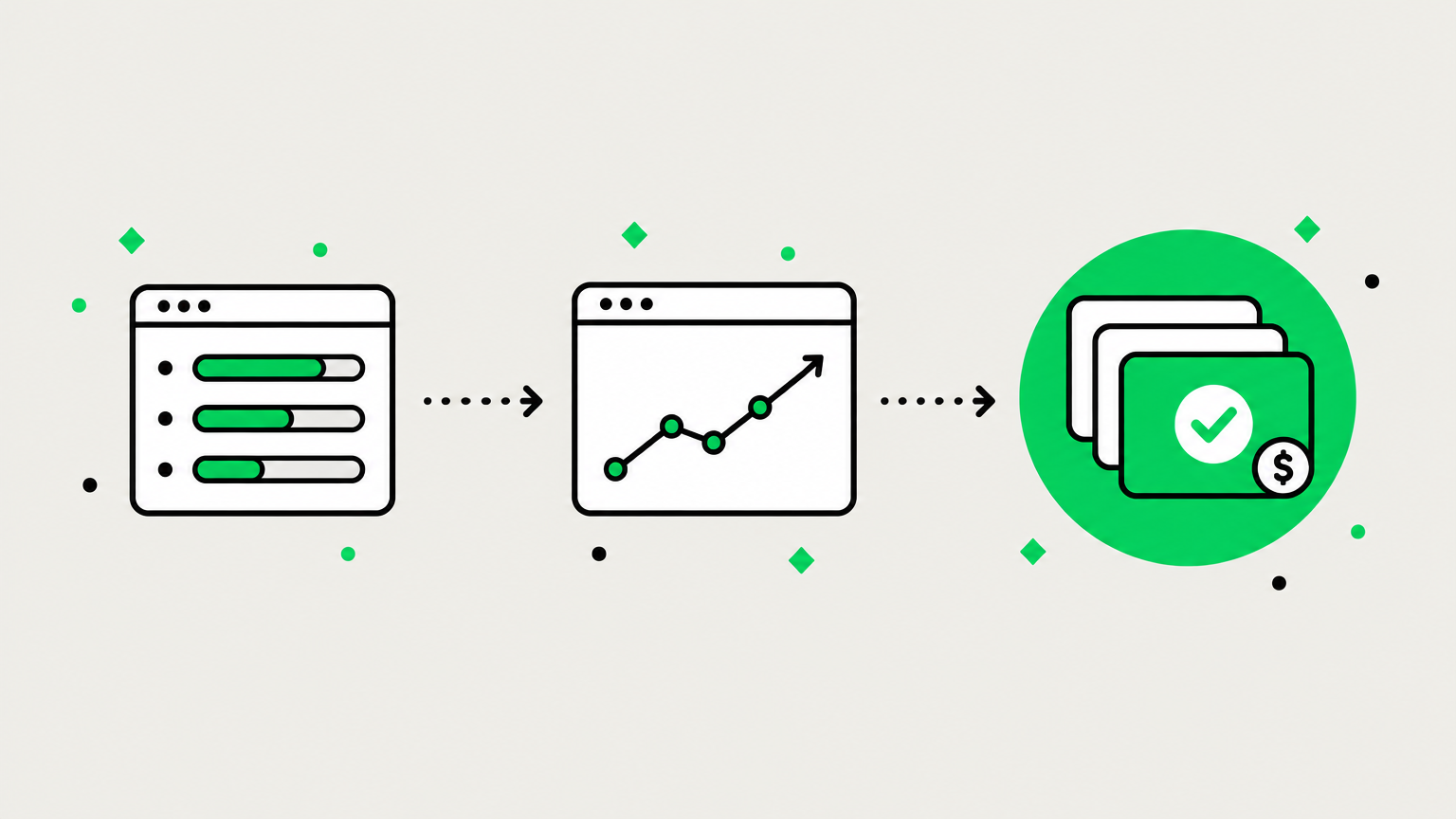
The AI Visibility Report That Gets Your Work Funded
Executives distrust AI visibility metrics. Learn which three or four numbers to report, how to tie them to GA4 and CRM, and how to read a drop.