

 Deutsch
 Français
 Español
 Português (Brasil)
 Italiano
Findrix vs Profound (2026): Which AI Visibility Platform Fits Your Team?
 Evgeniya Zemlyanskaya14 min readAugust 14, 2026
TL;DR
As of August 2026, Findrix is the better fit for marketing teams and agencies that want AI visibility measurement connected to prioritized fixes, outreach prioritization, fact correction, and verification.
Profound is the better fit for dedicated AEO teams that need prompt-demand research, AI shopping, configurable Agents, and enterprise workflows.
Both track major AI surfaces; Findrix emphasizes engine-level uncertainty and preference, while Profound emphasizes breadth and customization.
Disclosure: The author works at Findrix. Profound features in this comparison are based on a hands-on test of the self-serve product and its current public documentation. Features released after that test were checked against Profound’s current documentation. Findrix feature descriptions reflect the product available at publication.
Findrix vs Profound: The Full Comparison at a Glance
| Dimension | Findrix | Profound |
|---|---|---|
| Product model | Connected measure → act → verify workflow | Configurable AEO operating system |
| Best fit | Marketing teams without a dedicated AEO function; agencies running repeatable client workflows | Dedicated AEO teams and bespoke agency work |
| AI surfaces | ChatGPT, Gemini, Perplexity, Google AI Overviews, and Google AI Mode; Claude and Grok add-ons | ChatGPT, Perplexity, Claude, Gemini, Google AI Overviews, Google AI Mode, Microsoft Copilot, Grok, and DeepSeek; availability varies by plan and module |
| Measurement | Engine-separated metrics with 95% confidence ranges | Daily tracking with operator-defined breakdowns |
| Core metrics | Visibility, mentions, citation share, share of voice, rank, sentiment, competitor comparison, recommendation rate, preference, and buying stage | Visibility, mentions, citation share, share of voice, rank, sentiment, and competitor comparison |
| Tracked prompts | 100 tracked prompts on Growth ($99/month) | 50 tracked prompts on Starter ($99/month, billed yearly) |
| Source intelligence | Niche source map, owned-source gaps, ranked placements | Citation intelligence, cited pages, crawler analytics |
| Actions and publishing | Prioritized fixes; you approve, apply on your side, verify by scan | Aim Projects and configurable Agents with CMS publishing |
| Correcting wrong brand facts | Finds incorrect brand facts in AI answers, shows conflicting sources, and drafts corrections | Checks AI claims against a connected Knowledge Base and flags mismatches |
| Setup model | Learn while completing predefined work | Build fluency across modules, Agents, Knowledge Bases, and integrations |
| Starting price | $49/month per site (Presence) | $99/month (Starter, billed yearly) |
| Top self-serve | $199/month per site (Authority) | $399/month (Growth, billed yearly) |
| Free trial | 7-day trial and free audit | 7-day Growth trial; card required in the June and August 2026 signup flows tested |
| Agency fit | Standardized remediation and defensible reporting | Bespoke analytics, custom automation, enterprise AEO operations |
The short verdict
Findrix is an action-based AI visibility and GEO platform that turns real-time tracking and analysis of a brand's presence across AI answers and search into a shorter, structured path from an AI visibility gap to an implemented fix and measures what changed afterward. It is built for brand managers, marketing leaders, and agencies running AI search for their clients.
For a founder, marketing lead, brand team, or agency without a dedicated AEO function, Findrix is the better overall fit. It measures visibility and preference, maps the sources shaping AI answers, separates owned-content gaps from external placement opportunities, prepares fixes, and verifies completed work in later scans.
Profound is the stronger choice for a mature AEO team that wants to design its own system. Its research tools, configurable Agents, APIs, and enterprise integrations provide more analytical and operational range. The return depends on having people who can configure and use it.
Findrix gives the team a playbook; Profound gives the specialist a workbench. That makes Findrix faster to operate but less flexible: it does not offer the same room for custom workflows, enterprise controls, or integrations.
Setup and time to competence
The first thing we compared was how hard each platform is to start using and how much time it takes to use it professionally.
At first glance, Findrix and Profound both offer a guided start. Profound recommends a prompt set based on the customer’s industry. Findrix pre-fills the brand, competitors, prompts, and initial scan. The meaningful differences begin after account creation.
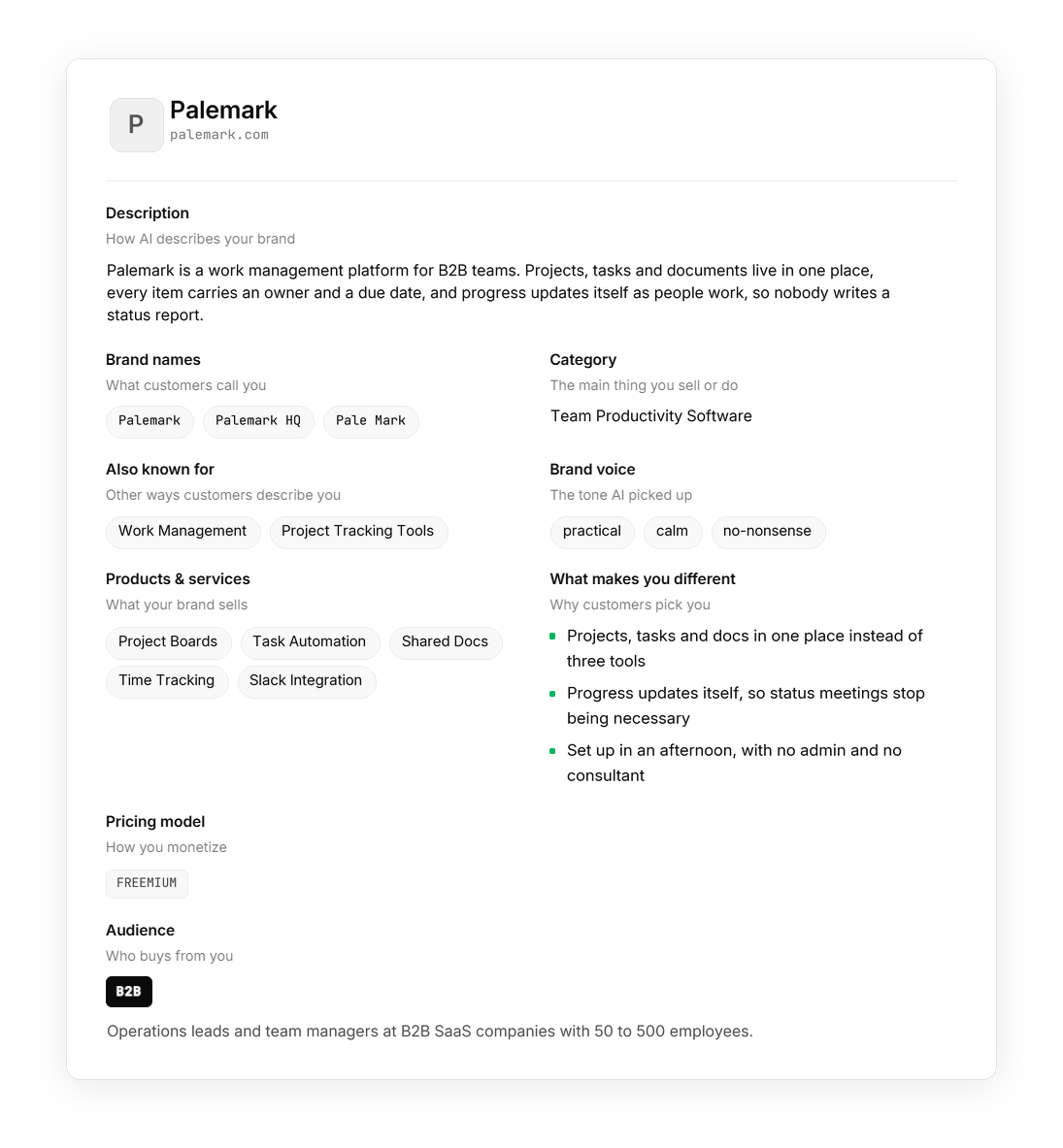
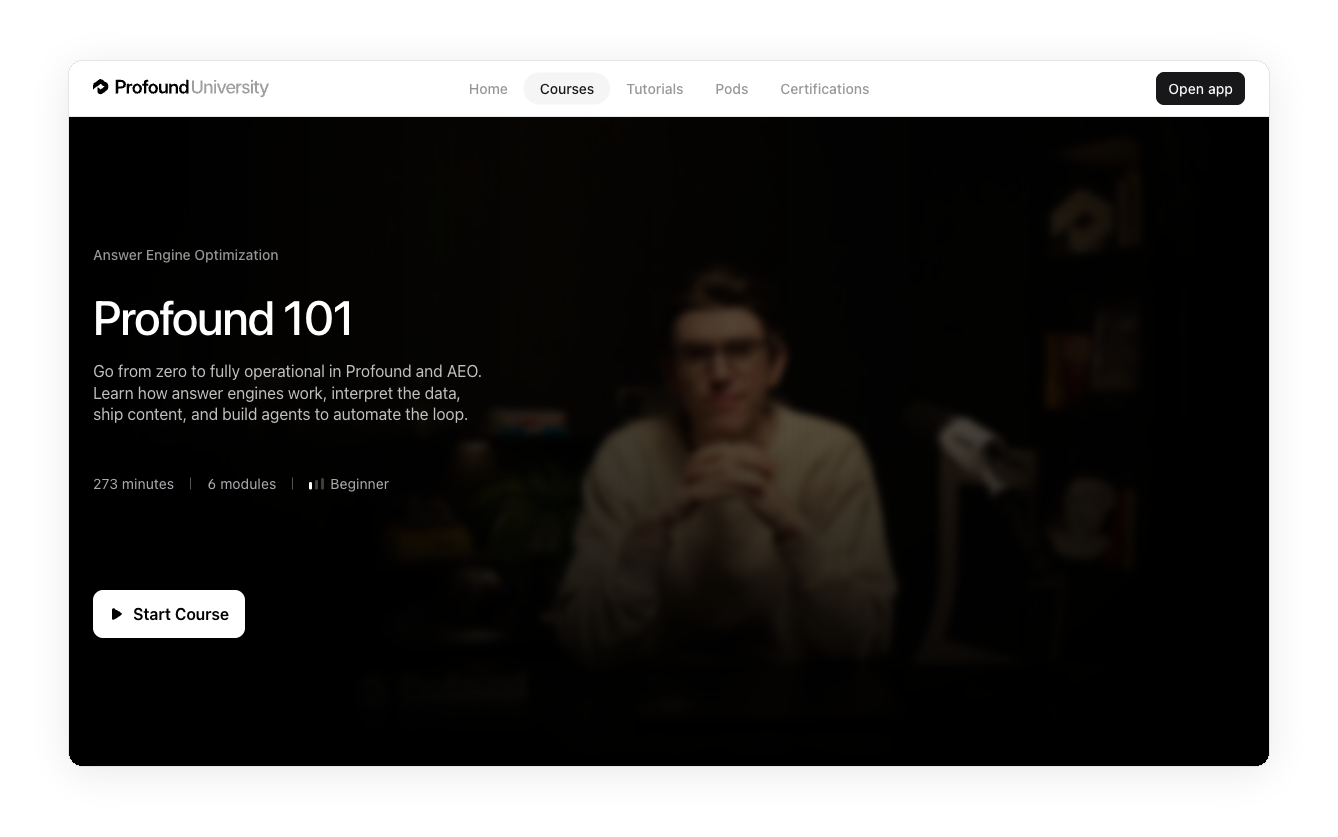
Profound provides a highly configurable workspace. That flexibility is useful, but the team has to decide how to structure prompts, analyses, Agents, Knowledge Bases, integrations, and workflows before the platform becomes a reliable operating system. Its Profound 101 course runs for 273 minutes, a reasonable signal of the specialist fluency the broader product expects.
Findrix makes more of those decisions upfront. The user approves the measurement scope, opens a gap, reviews the proposed fix, and applies it on their own site. With fewer configuration decisions, a marketing team can start using the product professionally sooner, without first designing its own AEO system.
Engines and prompt logic
The useful comparison is not the maximum number of engine logos a platform can list. It is whether the default coverage matches where buyers actually search and whether the prompt set represents distinct buying situations.
Profound supports nine AI engines: ChatGPT, Perplexity, Claude, Gemini, Google AI Overviews, Google AI Mode, Microsoft Copilot, Grok, and DeepSeek, with availability varying by plan.
Findrix includes ChatGPT, Gemini, Perplexity, Google AI Overviews, and Google AI Mode in Growth and Authority; Claude and Grok are add-ons. That default still covers the engines most brands need first. According to Statcounter, ChatGPT generated 76.9% of worldwide AI-chatbot referrals to websites in June 2026; Gemini and Perplexity contributed about 8% each. The remaining engines can be important for a specific audience, region, or commerce workflow, but their value is not equal for every brand.
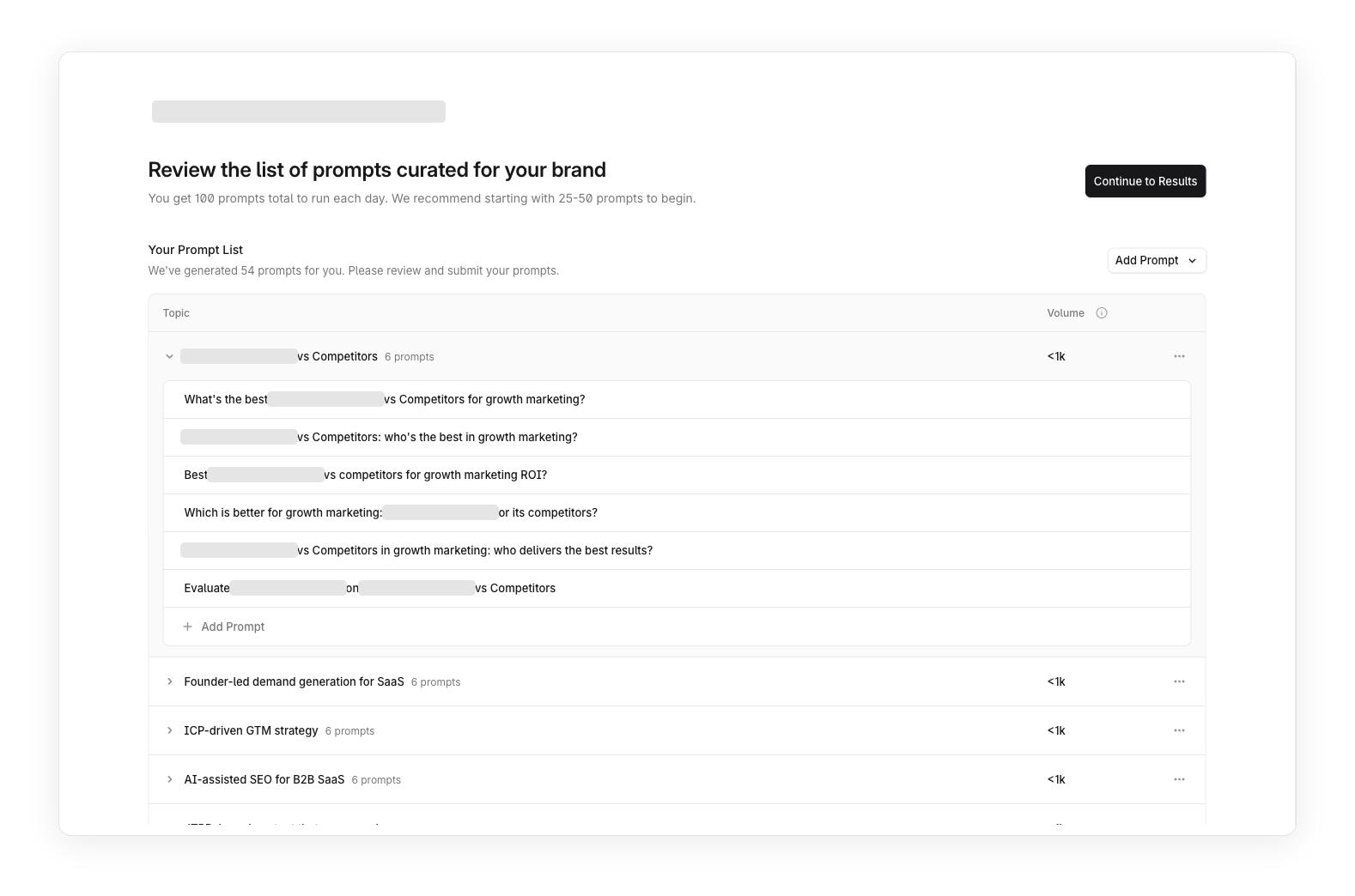
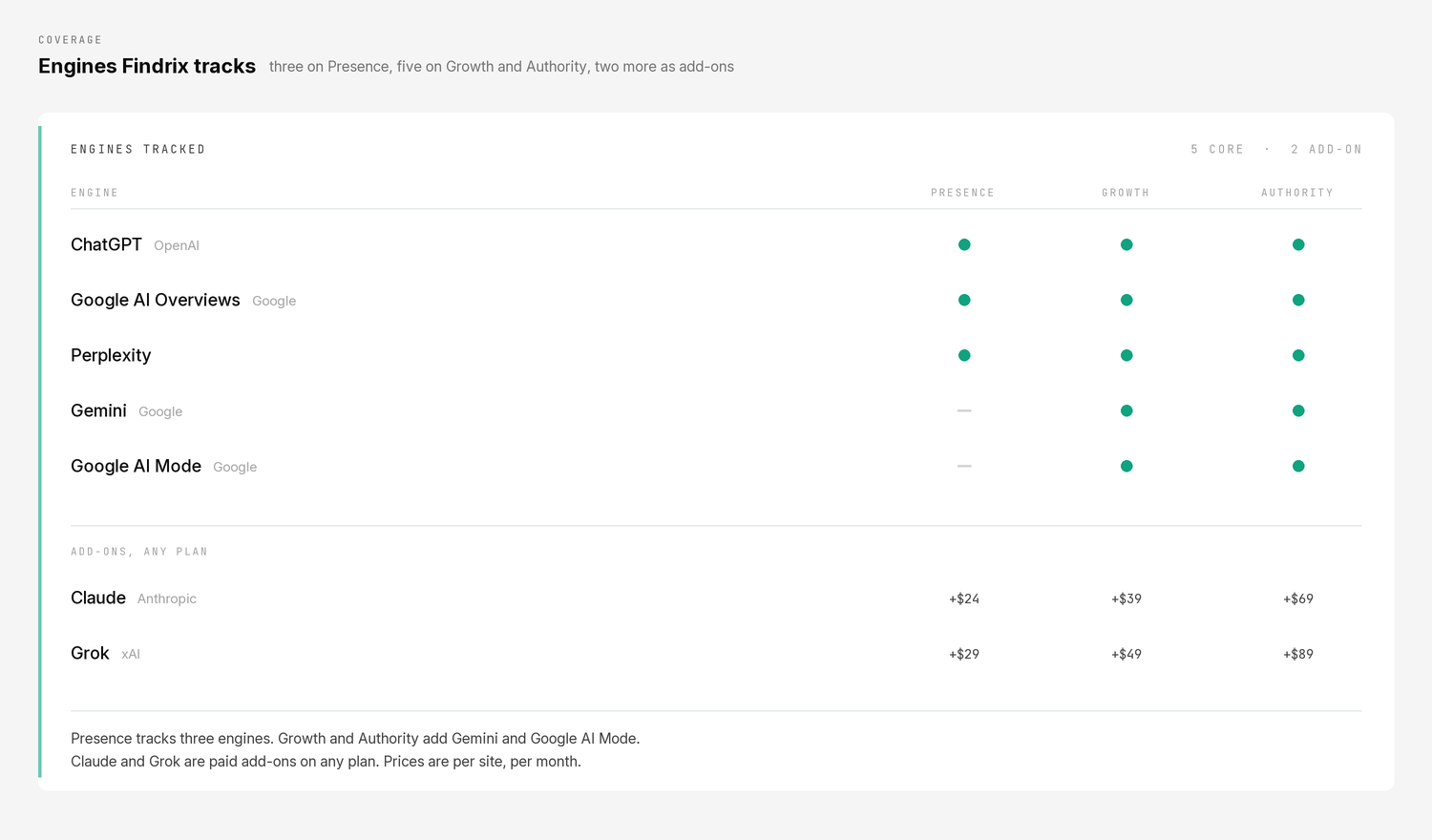
Engine coverage is only half of the measurement design. Prompts define what the platform actually tests. The goal is to cover as many different questions and buying situations as possible. Findrix Growth tracks 100 approved prompts across five base surfaces. It builds the first set from the brand, competitors, and category, removes near-duplicates, and asks the user to approve it.
Twenty versions of the same question do not give you broader coverage. They just let one topic vote twenty times.
At the same $99 price point, Profound Starter tracks 50 prompts in ChatGPT only and requires annual billing. Profound Growth raises the allowance to 100 prompts across three engines for $399 per month billed yearly. Profound recommends prompts, lets users edit or upload their own, and connects higher-tier research to Prompt Volumes. That flexibility requires specific expertise: the user has to know which prompts represent different buying situations and which are just variations of the same question. Otherwise, the baseline can overrepresent one part of the market and lead the team to prioritize the wrong changes. Findrix makes more of these decisions upfront when it builds the recurring measurement baseline.
Profound offers greater maximum engine breadth. Findrix concentrates its default coverage and prompt controls on the surfaces most teams need to measure first.
How much should you trust Prompt Volumes?
Prompt Volumes solves a real problem: keyword tools do not show how people phrase questions inside AI products. Profound uses double-opt-in consumer panels and probabilistic modeling to estimate relative demand, helping teams discover language, topics, and buying situations they may have missed.
The result is directional, not a census of AI demand. The panel begins with people willing to share conversations, and Profound’s public methodology explains demographic and geographic corrections but not correction for willingness to share. That matters for health, sex, finances, legal or family issues, and private workplace research about vendors, contracts, security, or strategy. Sensitive or private query classes may be underrepresented in an opt-in panel, and the public methodology does not explain how this potential selection effect is estimated.
We would use Prompt Volumes to challenge a prompt set and find questions worth testing, not to choose the recurring measurement baseline on its own. Sensitive categories and B2B still require customer research, sales evidence, category knowledge, and controls for near-duplicates.
Measurement: can you trust the change?
Daily tracking is not the same as reliable measurement. Profound tracks prompts daily and lets teams break the results down by platform, topic, prompt, tag, region, and persona. That helps an analyst investigate what changed. In the self-serve product we tested, however, period-over-period movement had no published uncertainty range. This refers to the visible output, not Profound’s internal statistics.
Findrix controls the parts of measurement most likely to produce a false win. It freezes the approved prompt set, and reports each engine separately, an approach Profound's own training also recommends. If the prompt set changes, the trend restarts rather than treating a new sample as brand movement.
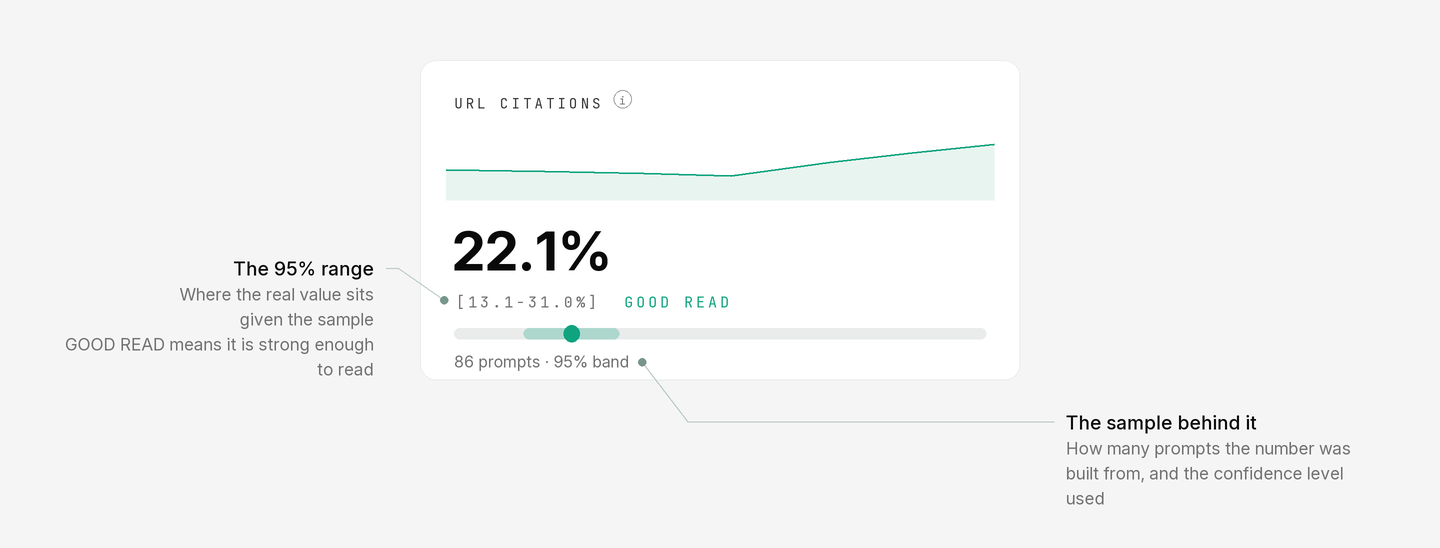
Before reporting results, Findrix calibrates the market’s normal answer variability. It shows 95% confidence ranges for key metrics and treats movement as meaningful when it exceeds the calibrated range of expected variation. It does not credit one action when the whole category moved. Profound’s experiment tags can isolate a campaign, but they do not show by themselves whether the result cleared normal model noise. Findrix adds confidence and market-level checks before presenting movement as a win. The full sampling and significance rules are documented in Findrix’s methodology.
Visibility is not the same as preference
Being mentioned is not the same as being chosen. Two brands can appear in the same number of answers while one is named first, recommended more often, or supported by stronger sources.
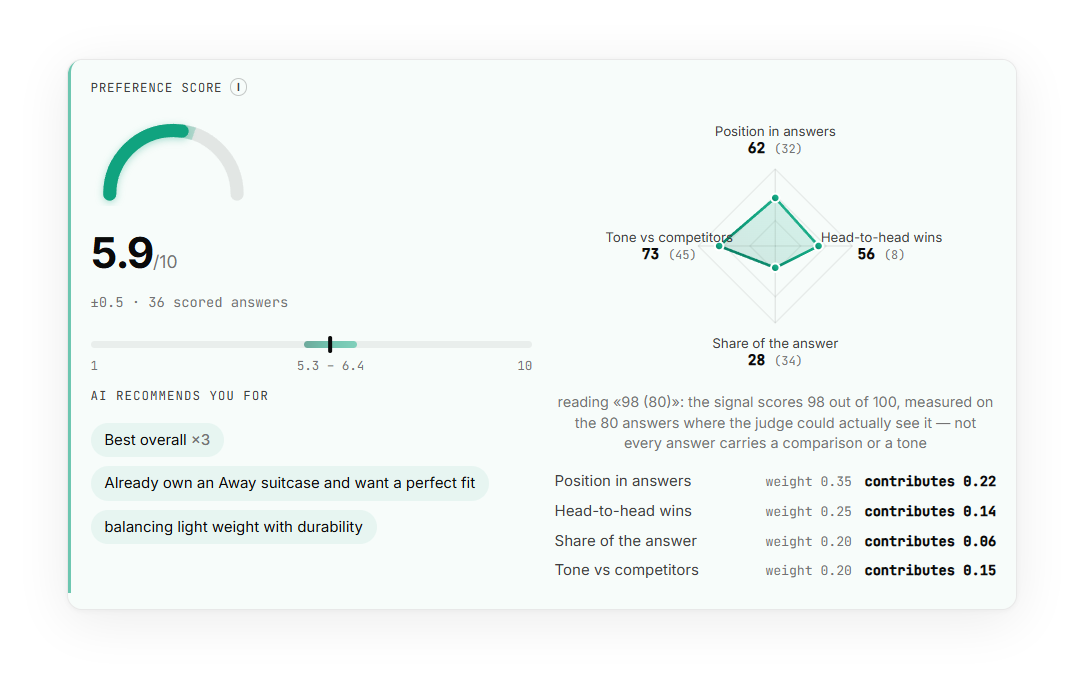
Findrix measures that difference with Preference Score. Visibility asks whether the brand appeared; Preference asks whether the engine actually chose it when the answer compared or recommended options. Findrix breaks the result down by engine and shows outcomes such as recommends, best overall, and best for a use case. A brand can therefore gain mentions without becoming more likely to win the recommendation. That changes the action: a visibility gap calls for better coverage and sources; a preference gap calls for stronger differentiation, proof, and category fit.
Brand Image in AI adds another distinction: what an engine says after searching the web versus what the model recalls without retrieval. That gives the team a memory baseline it can check again after a model update.
In the self-serve product we tested, Profound’s sentiment analysis relied on dedicated evaluation prompts. Profound now also supports Sentiment and Visibility on the same prompt. In both cases, sentiment is a model-generated diagnostic—not passive observation of buyer opinion.
Both products can check facts. Profound’s FactCheck compares claims with a connected Knowledge Base. Findrix keeps approved brand facts in the Data Room, shows which sources contain wrong, vague, or outdated information, and drafts the correction. The difference is the work left after the mismatch is found: Profound lets a specialist build it into Projects and Agents; Findrix already provides the correction path.
Source gaps: what happens next?
A source report is useful only if the team knows what to do next. Profound gives specialists more ways to study citations, pages, source categories, raw answers, and crawler behavior. Its Noble and PartnerStack integrations can also pass selected domains into external publisher and outreach workflows, although they require connected partner accounts.
Findrix organizes the same problem around three decisions. Where AI gets its answers shows which domains shape answers in the category. Owned Sources shows where the brand’s own pages help and where competitors have better coverage. Get Featured turns reachable third-party gaps into a ranked outreach list. The competitor view shows which sources repeatedly mention rivals but leave the brand out. Findrix keeps discovery, prioritization, the action draft, completion, and later verification in one workspace.
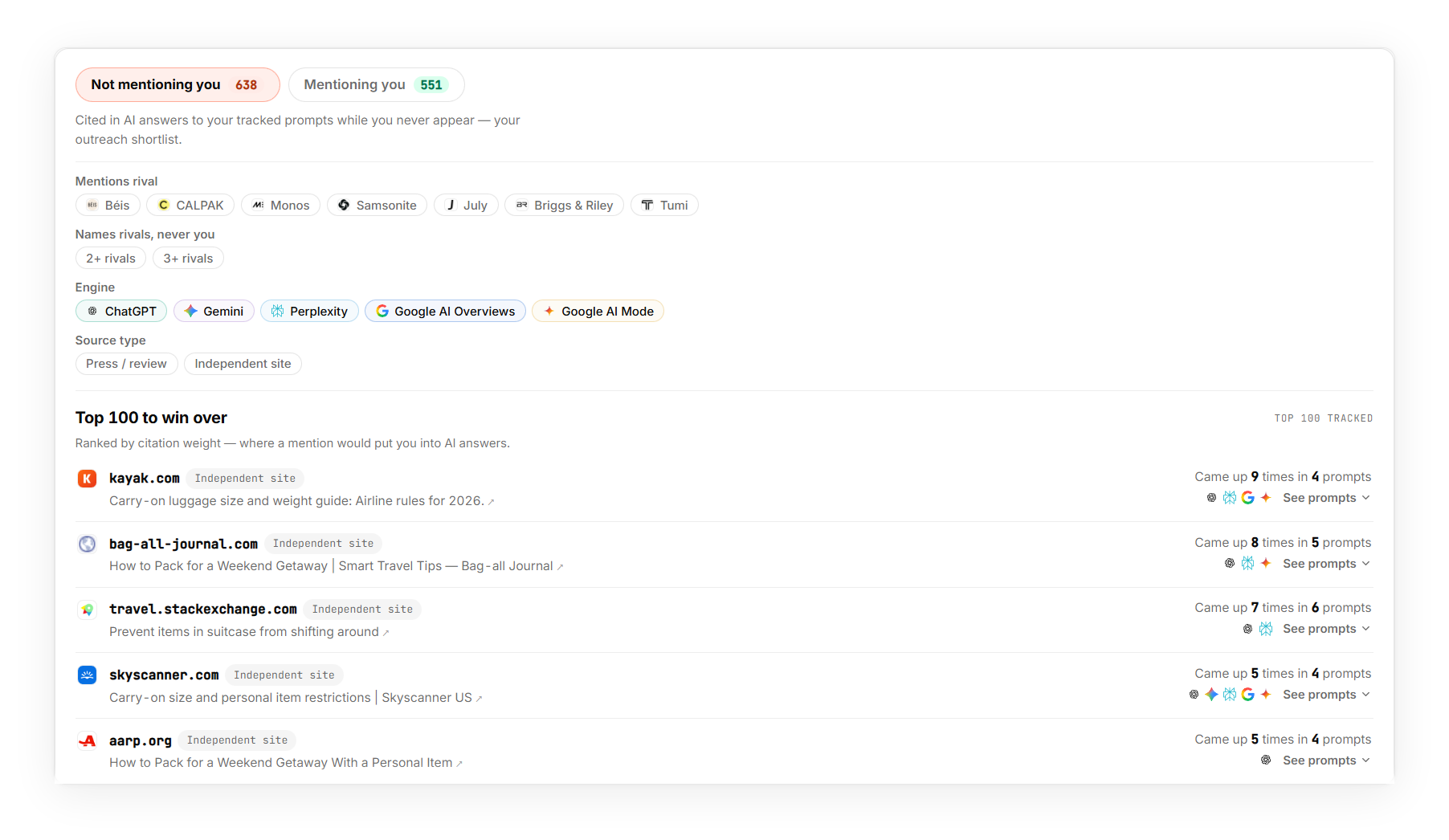
Finding the gap is only half the comparison. The next question is how much work remains before anything changes.
Actions: ready-made workflow or custom Agents?
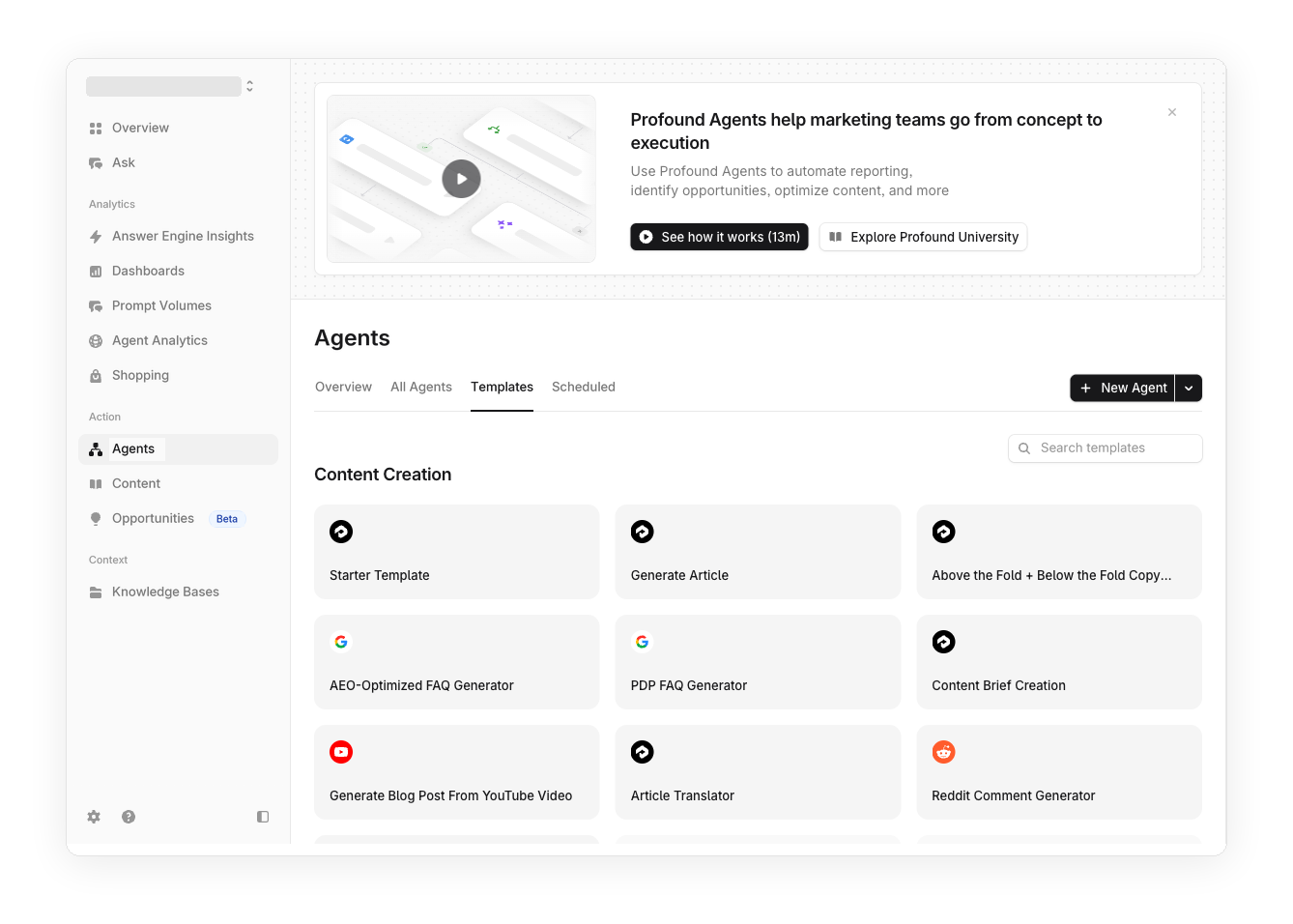
Both products provide a workflow for acting on what the measurement finds. Profound does it through Aim and Agents: Aim turns data into a project plan, while Agents execute it. Agent usage is credit-based: Starter includes 100 credits per month and Growth 400, and every run consumes credits according to its complexity. Its ready-made Agent templates focus mainly on content research, briefs, refreshes, new drafts, and CMS publishing. Teams can automate other processes with API and integration nodes, but then they have to design and configure those workflows themselves.
Findrix productizes more recurring GEO jobs by default, rather than centering its ready-made workflows on content creation. It separates technical fixes, on-page improvements to existing content, topics for new pages, fact correction, and off-site optimization. The source workflow goes all the way down to individual subreddits—because, for better or worse, Reddit is now part of the AI supply chain. Each gap arrives in a predefined queue with a suggested next step.
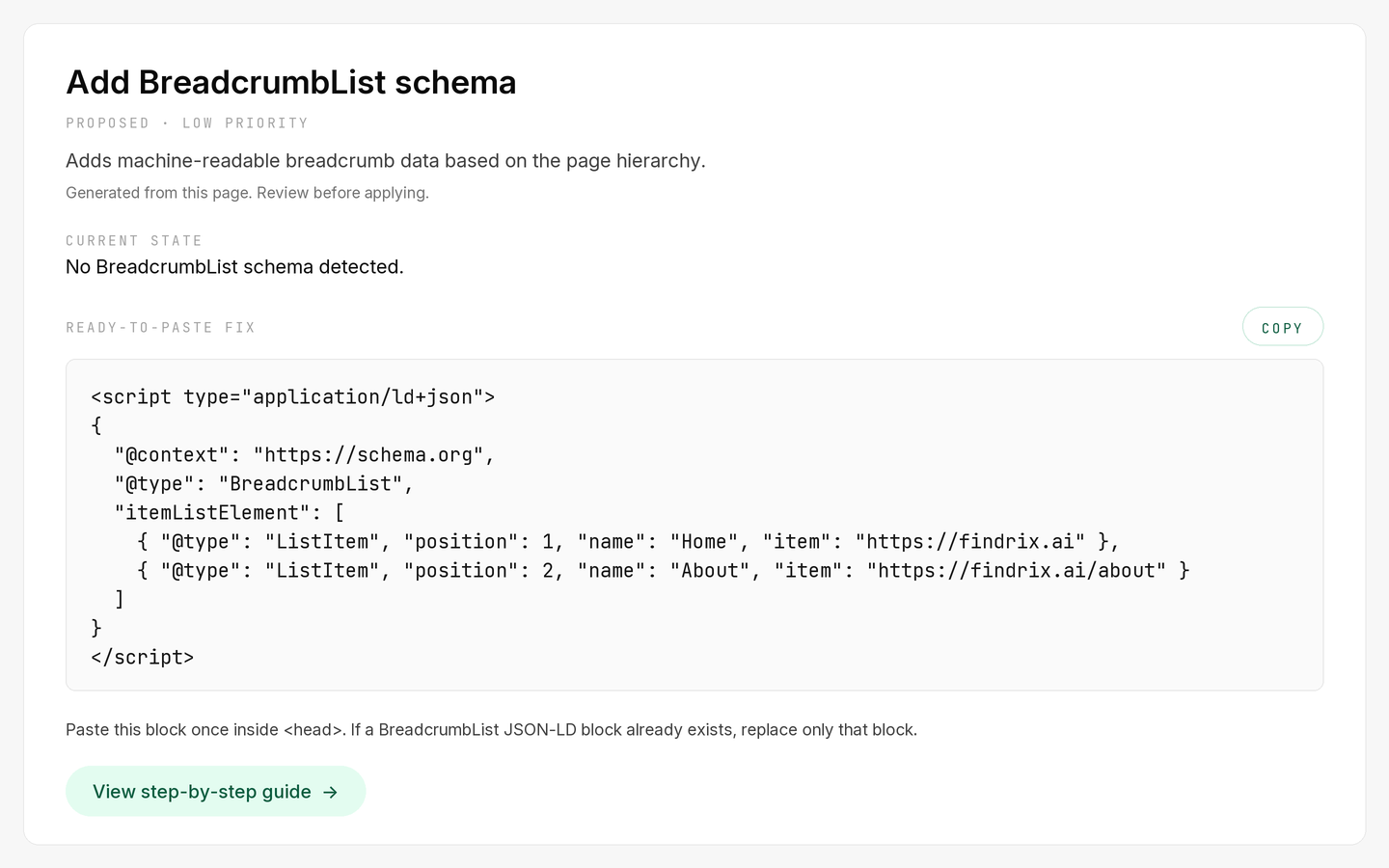
You approve a supported change, apply it on your side, and Findrix verifies it in a later scan. Work Log keeps the history and checks whether the prompts affected by the change improved more than the rest of the category. That comparison is a guard against false attribution. Profound gives specialists more control to build their own system. Findrix removes more setup from the recurring work.
A green chart after a change is evidence. It is not a receipt proving what caused it.
Pricing: what the same $99 buys
Pricing was checked against the public Findrix and Profound pricing pages on August 13, 2026. Listed prices exclude VAT where applicable.
The price comparison is clearest at $99. Findrix Growth includes 100 prompts across five base engines and is billed monthly. Profound Starter includes 50 prompts in ChatGPT and requires annual billing. Findrix also offers a $49 Presence plan and a $199 Authority plan, both billed monthly.
Profound Growth is $399 per month billed yearly. It raises the allowance to 100 prompts across three engines and adds more seats, exports, and Agent credits. Broader engine access, Prompt Volumes, multiple companies, APIs, SSO, and other enterprise features depend on the package.
Findrix offers a 7-day trial and a free audit. In the signup flows we tested in June and August 2026, Profound offered a seven-day Growth trial and required a payment card. That price can make sense for a mature AEO team that will use its research, Agents, and integrations. Without that operator, the real cost also includes the time to configure, maintain, and run the system.
Which platform fits an agency?
The right agency choice depends on what the agency sells. Findrix fits a repeatable GEO service: the agency measures every client by the same rules, shows whether movement is trustworthy, assigns the next action, and keeps a record of what changed. Standardizing the workflow reduces the analytical hours required per client. The action priority, rationale, change history, and subsequent re-check give the agency a documented basis for client conversations, so it can defend the selected action and the observed result rather than “our expert opinion.” PDF reports, team access, and an API make the same process easier to run across accounts.
Profound fits agencies that sell custom research or custom AEO systems. Agency Mode centralizes client workspaces, while dashboards, Prompt Volumes, Agents, and integrations can become part of the service. That creates more room for custom work and usually requires more specialist time per client.
So the question is not whether the product has an agency mode. It is what the client pays the agency to deliver. Choose Findrix for a standardized path from finding to fix and proof of work. Choose Profound when custom analysis and system design are the deliverable.
How to choose
Choose Findrix if:
- AI visibility sits with a founder or marketing team, not a dedicated AEO department.
- You need to know not only where the brand appears, but whether AI engines prefer it and why.
- You want to see whether a change is large enough to trust before reporting a win.
- You want a clear next step for owned content, wrong facts, and third-party placements.
- You want to approve, apply, and check changes without first building custom Agents.
- Your agency needs the same working method across client accounts.
- You prefer monthly pricing from $49 per site and a trial without a card.
Choose Profound if:
- A dedicated AEO specialist or team will run the platform.
- You need Prompt Volumes, AI Shopping, or enterprise integrations.
- You want to build custom Agents and connect them to APIs, Knowledge Bases, or a CMS.
- Your team needs to build its own analysis across topics, prompts, personas, regions, sources, and platforms.
- Your agency sells custom research, automation, or enterprise AEO systems.
- The extra control is worth the training, setup, maintenance, and Agent credits.
Final verdict
For marketing teams and agencies without a dedicated AEO operator, Findrix is the better buy: it turns a visibility gap into a reviewed action and checks the result without asking the team to design an AEO system first. Profound earns its higher price when an experienced team needs Prompt Volumes, AI Shopping, enterprise controls, and the freedom to build custom Agents and workflows.
Run a free Findrix audit
Run a free Findrix audit to check 29 technical, structured-data, content, and performance conditions, then review the highest-impact gaps before choosing a paid platform.
Frequently asked questions
Is Findrix a Profound alternative?
Yes. Findrix is the better Profound alternative for teams that want to move from an AI visibility gap to a fix they can review, apply, and check. Profound remains stronger for Prompt Volumes, AI Shopping, configurable Agents, and enterprise integrations.
Is Profound only for enterprise companies?
No. Profound has self-serve Starter and Growth plans. It makes the most sense when a dedicated operator will use its research tools, Agents, and integrations.
Do Findrix and Profound publish content?
Profound can move content from draft to publication through configurable Agents and supported CMS integrations, with human approval. Findrix prepares an implementation-ready change; the user or their team reviews and publishes it, and Findrix checks the result in a later scan.
Does Profound show whether a change is statistically significant?
Profound offers daily tracking, period comparisons, platform-level views, and experiment tags. In the self-serve product we tested, movement did not include a published uncertainty range or significance test. Findrix displays 95% confidence ranges for metrics including Brand Mentions, URL Citations, Ghost Citations, and Share of Voice, and treats movement as meaningful when it exceeds the calibrated range of expected variation. This distinguishes statistically noticeable movement from expected variability; it does not prove that a specific fix caused the change.
Is Profound Prompt Volumes real search volume?
Profound builds Prompt Volumes from double-opt-in consumer panels and probabilistic modeling. It is useful directional research, but it does not count every conversation inside the underlying AI platforms.
Which tool is better for agencies?
Findrix is better for agencies that sell the same measure-to-fix process across clients. Profound is better for agencies that sell custom analysis, Agent systems, or enterprise AEO operations.
Read next
Findrix vs Peec AI: Pricing, Features, and Key Differences
Compare Findrix and Peec AI on pricing, engines, multi-region tracking and execution. See which platform fits teams that need fixes ready to apply, not another reporting layer.
3 AI Search Visibility Metrics & KPIs You Need to Track
3 AI search visibility metrics and KPIs that drive revenue: share of voice, citation ownership, and AI-attributed conversions.