

 Deutsch
 Français
 Español
 Português (Brasil)
 Italiano
Mentioned but Not Recommended: How to Diagnose AI Search Visibility in Australia
 Danila Kadtsyn8 min readNovember 20, 2026
Key takeaways
- A mention proves recognition, not preference; keep mention, recommendation, position, preference and citation separate.
- Diagnose the earliest repeatable loss by buyer stage and engine before publishing more content.
- Product data can improve eligibility and accuracy, but a feed cannot guarantee recommendation.
- Repeat and shuffle tests before crediting a website change; report paid and organic surfaces separately.
- Test one bounded fix with the same question set and treat a null result as useful evidence.
TL;DR
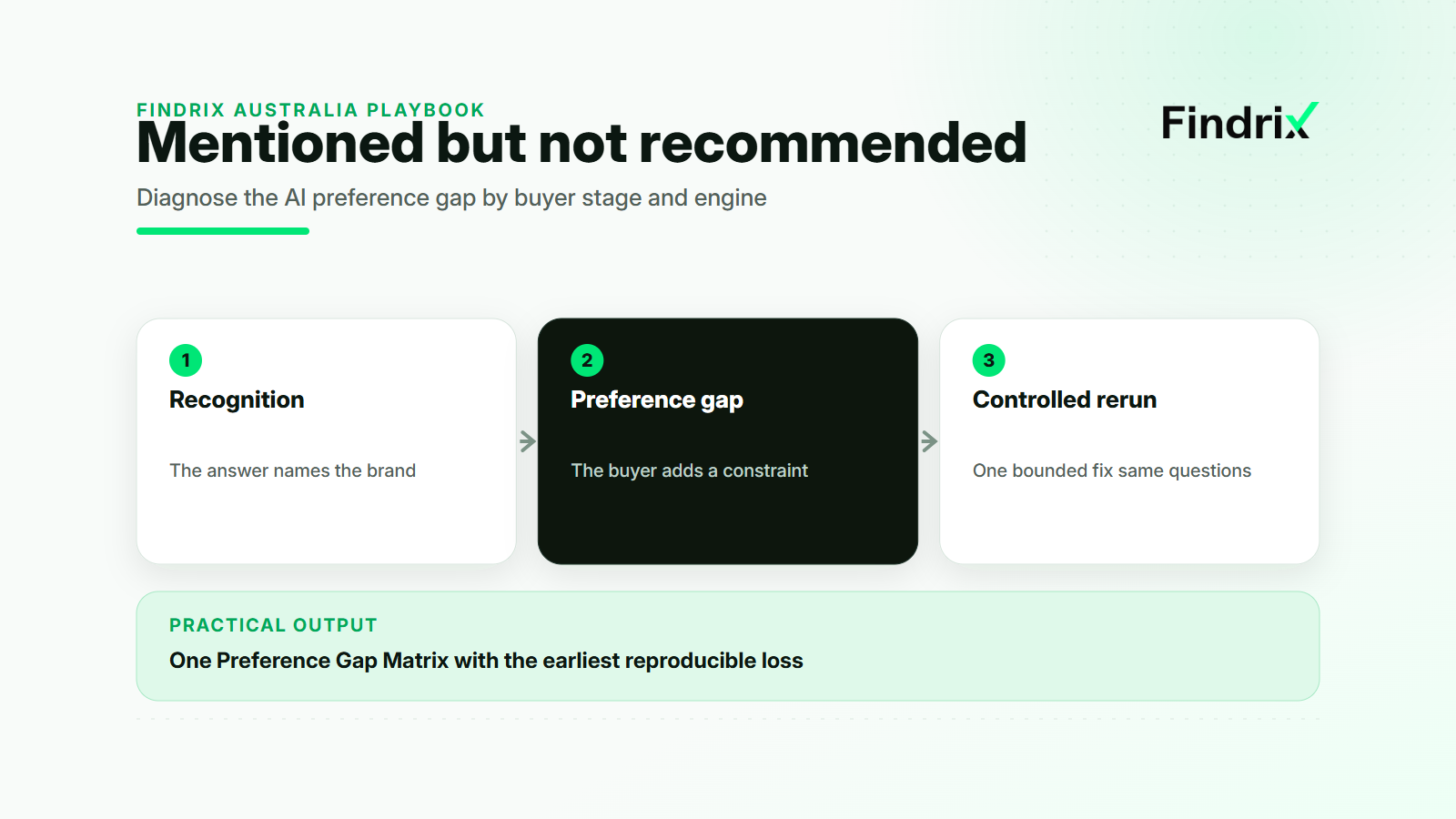
A brand mention proves that an AI system recognises you. It does not prove that the system would shortlist you for a buyer. Diagnose that difference by buyer stage and engine before publishing more content. Record the prompt, mention, recommendation, position, winning competitor, supporting sources and stability in one Preference Gap Matrix. Then test one bounded fix against the same questions. Product data, comparative proof and source coverage can all matter, but none guarantees a recommendation.
In one Australian marketing-software study, 303 buyer questions produced 3,627 answers across four AI engines. Only 8 of the 12 brands in the combined top-ten view appeared in every engine's top ten. This shows engine disagreement, but the table measures mentions and citations, not preference.
The practical consequence is simple. Before asking how to improve your AI search visibility, find the earliest repeatable point where the brand stops progressing. Does it disappear on unbranded questions? Does it survive discovery but lose when the buyer adds price, delivery or product requirements? Does the result change by engine or between runs?
Put those observations in a Preference Gap Matrix. Until you can identify the failing stage and reproduce it, you do not have a content brief. You have a measurement question.
A mention proves recognition, not preference
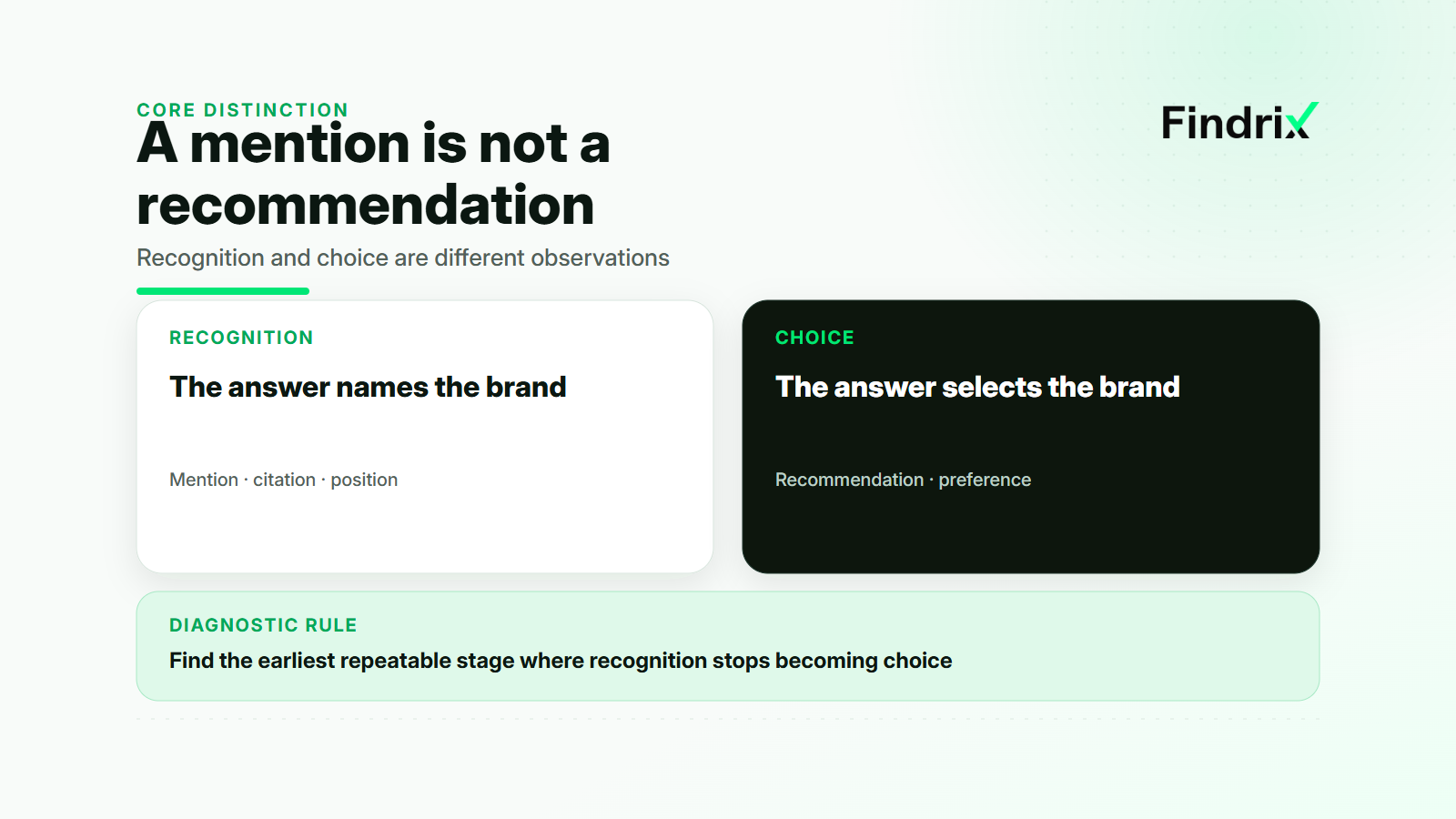
AI brand visibility contains several different observations that are easy to collapse into one number.
- A mention means the answer names the brand.
- A citation means the answer links to the brand or one of its pages.
- Position shows where the brand appears relative to other options.
- A recommendation means the answer presents the brand as a suitable choice.
- Preference asks whether the engine selects the brand when it weighs the buyer's stated constraints.
AI share of voice shows your share of brand mentions in a set of answers. A large share can still coexist with weak comparison or ready-to-buy performance.
Your first audit table should therefore keep these fields separate. Add the engine, prompt family, date, repetition and cited sources. If the report offers one blended score without the underlying answers, it cannot tell you where the choice broke.
A local Findrix Radar extract covers 27 Australian markets and 107,904 answer records. It shows that engine consensus and citation patterns vary by category, but it is not a recommendation-rate dataset. It cannot tell us how common the preference gap is.
Diagnose the gap by buyer stage, not by one visibility score
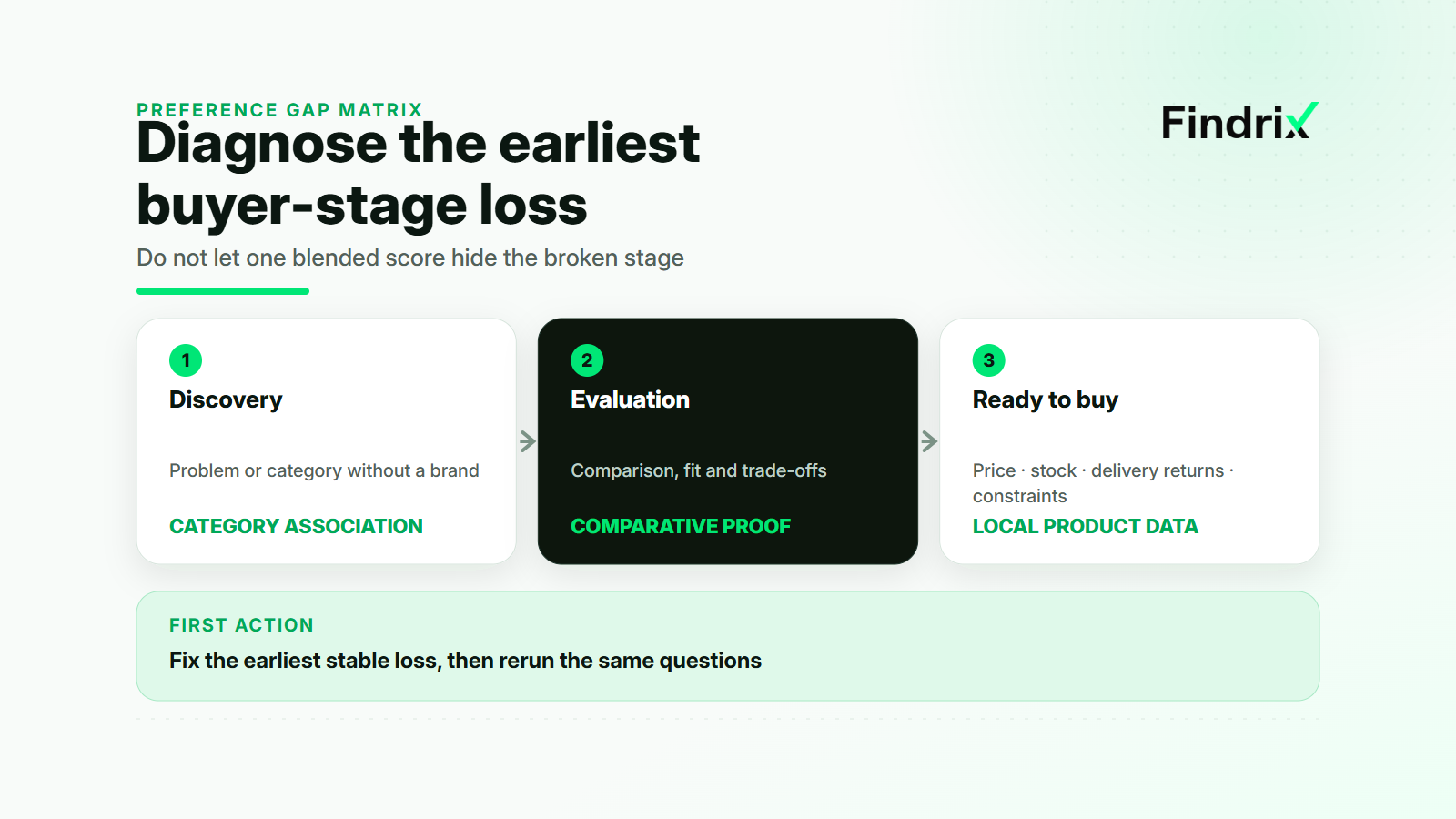
Google's AI performance insights for eligible Merchant Center accounts divide English-language Australian shopping queries into discovery, evaluation and ready-to-buy stages. That is a useful diagnostic frame beyond the report itself.
Start with the questions buyers ask:
| Buyer stage | What the question does | What a loss may indicate |
|---|---|---|
| Discovery | Describes a problem or category without naming a brand | Weak category association or incomplete prompt coverage |
| Evaluation | Compares options, features or suitability | Missing comparative proof or unclear fit |
| Ready to buy | Adds price, stock, delivery, returns or another purchase constraint | Missing or inconsistent local product data |
Practical example 1: an illustrative Australian ecommerce brand
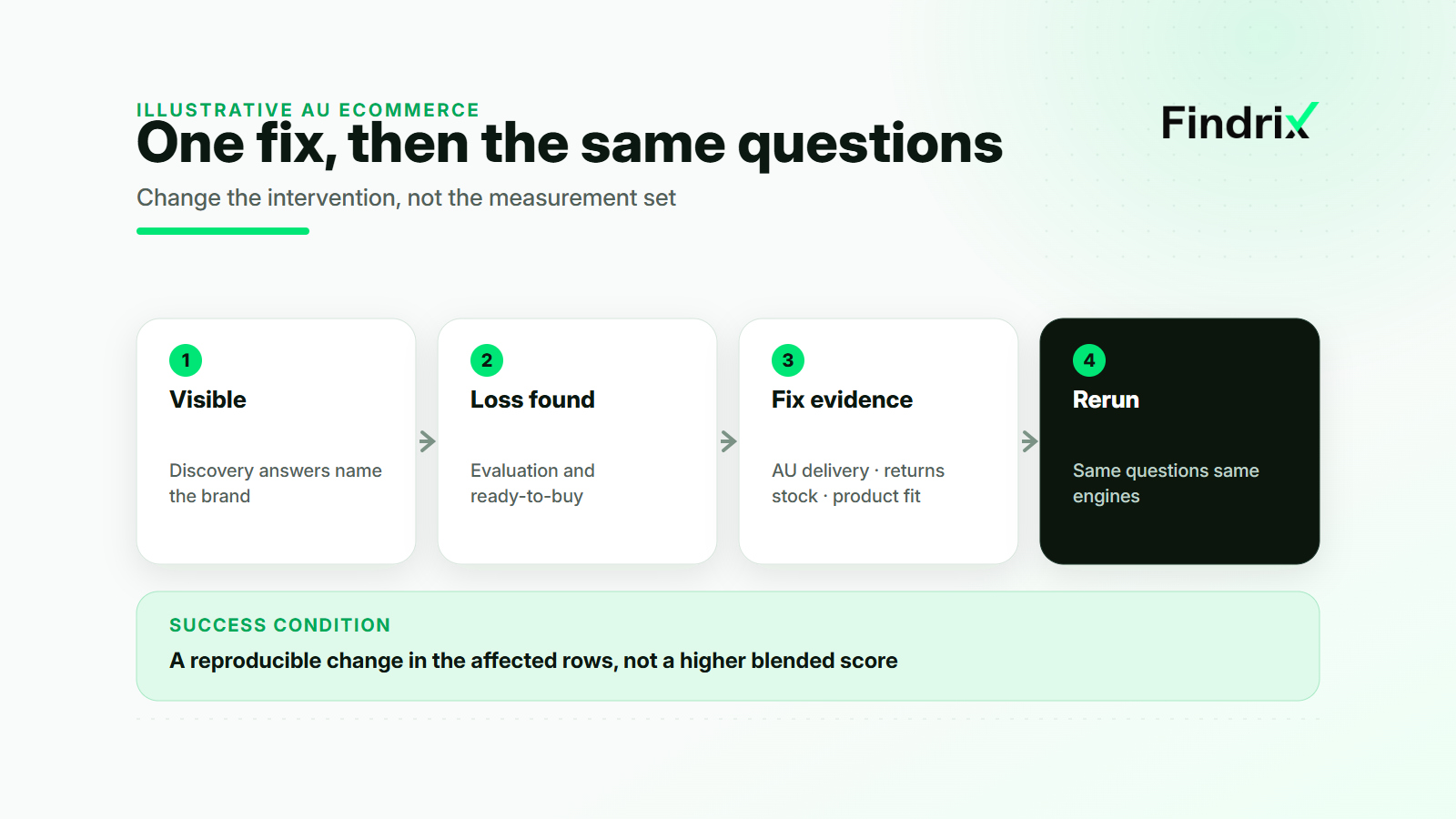
The brand is named frequently in broad discovery answers, so the team concludes that awareness is healthy. When the questions are separated by stage, it remains visible in discovery and falls out during evaluation and ready-to-buy prompts.
More category explainers may increase mentions without touching the loss. The team needs to identify which buyer constraint the competitor satisfies more clearly.
Keep branded and unbranded questions separate as well. A question containing your company name tests reputation and positioning. A question such as "which option is best for next-day delivery in Sydney?" tests whether the engine retrieves and applies evidence without being prompted to consider you.
Check the Australian facts that turn a mention into a shortlist
Product data is the first branch to inspect when the loss appears after a buyer adds a concrete constraint.
OpenAI says ChatGPT shopping may consider the query and user context alongside factors such as price, reviews and ease of use. It can also use structured product information and third-party material. Google Merchant Center's Australian report surfaces popular attributes, top terms and search intent, and recommends maintaining high-quality product data.
For the illustrative brand, the answer review shows that competitors have current Australian stock, delivery and returns information. The brand's feed and product pages do not expose the same details consistently. The first test is therefore bounded: correct the AU stock status, delivery window, returns terms and relevant product attributes for the affected products.
This is not a prediction that the brand will win the next answer. OpenAI explicitly says that connecting a product feed does not guarantee recommendation. Selection can still depend on user context, reviews, competing evidence and the model's interpretation of the question.
Google documents AI Mode and Merchant Center AI insights for Australia. Some OpenAI business-management actions are limited to eligible US businesses, so they cannot be presented as Australian fixes.
Inspect comparative proof and the sources AI trusts
Complete product data can remove an eligibility or accuracy problem. It cannot explain every comparison loss.
Read the answer that selected the competitor. Record the reason given, the evidence attached to that reason and the sources used. Then compare the same fields for your brand.
Useful questions include:
- Does the page state who the product is for and where it is a poor fit?
- Are important trade-offs explicit, or does the reader have to infer them?
- Is the Australian offer supported with current price, availability, delivery and returns information?
- Do independent sources confirm the product facts that matter to this decision?
- Does the engine cite different source types for your brand and the selected competitor?
The Australian marketing-software Radar is a useful warning. Its engines produced different top-ten brand sets and citation ecosystems. Inspect evidence per engine instead of importing a US benchmark or treating one source list as universal.
For our illustrative brand, the data correction remains necessary, but the evaluation prompts reveal a second gap: competitor pages explain suitability and trade-offs directly, while the brand page lists features. The next test should add specific fit evidence to the relevant existing page. It should not make an unsupported superiority claim.
Prove the preference gap is real before fixing it
One answer is not an experiment. AI outputs vary, and the evaluation setup can manufacture a convincing story.
The LIVE-GEO study demonstrated this risk in its own reported setup. Reversing the order of candidate URLs changed one strategy's Top-1 result from 73.8% to 93.8%; random order produced 82.5%. Those figures are not an expected production effect for your brand. They show that candidate order can be a confounder large enough to change the conclusion.
IntentGEO found another boundary: performance varied across user intents, and an optimised prompt drifted from recommendation instructions towards generic promotion. An aggregate improvement can therefore conceal weaker performance on the buyer decision the article is supposed to support.
Before changing the website:
- repeat each important question;
- keep engines separate;
- preserve branded and unbranded controls;
- shuffle candidates or option order where the test introduces them;
- retain the original answer and citations;
- record a range rather than only the best run;
- keep sponsored and organic appearances in separate columns.
Google makes the last boundary especially important in Australia. Ads in AI Mode are labelled Sponsored, while Merchant Center AI performance insights currently exclude paid Ads traffic and report organic AI traffic only. Paid exposure cannot be counted as organic preference.
Our illustrative brand initially improves on one rerun. After repetitions and an order change, the winner remains unstable. The team does not credit the data fix yet. The correct result is "inconclusive", followed by a wider observation window.
Choose the first test with the Preference Gap Matrix
An AI search visibility audit becomes useful when it produces a decision rather than another dashboard.
Use one row per prompt and engine:
| Field | What to record |
|---|---|
| Intent | Discovery, evaluation or ready to buy; branded or unbranded |
| Observation | Mention, recommendation, position and preference |
| Winner | Which option the answer selects, if any |
| Evidence | Reason given, citations and missing buyer constraint |
| Stability | Repetitions, order changes and observed range |
| First test | One bounded change, owner, rerun date and stop condition |
Prioritise the earliest reproducible loss. If the brand is absent from unbranded category questions, investigate category association before polishing comparison copy. If it appears until a delivery constraint is added, correct the Australian commercial facts before commissioning another guide. If the winner changes across runs, fix the experiment before the site.
For the illustrative brand, the matrix produces one test: update the affected product records and page with current Australian delivery, returns and fit evidence, then rerun the same evaluation and ready-to-buy questions. Success means a reproducible change in those rows, not a higher blended visibility score. A null result is useful because it rules out the first hypothesis.
How Findrix turns the diagnosis into a controlled rerun
You can build the Preference Gap Matrix manually by saving answers, classifying the prompts and comparing sources. The friction is keeping the question set, engines, repetitions and evidence consistent from one run to the next.
Findrix keeps mention, citation, position, recommendation and preference observations separate by engine. It lets a team inspect the answer-level evidence, connect a verified gap to a reviewable action, and check the same buyer questions again after the team applies a change.
The software's role is to shorten the path from an observed loss to a controlled test, not to claim undisclosed platform weights or promise a recommendation.
If your brand is already visible but rarely selected, start with the answers where the choice changes. Build the matrix, name the earliest stable loss and test one fix. More mentions can wait.
[Run a free AI search visibility audit]
Sources
- Findrix methodology, checked 16 November 2026.
- Findrix Radar: Australian marketing software, measured 4 September 2026 and checked 16 November 2026.
- OpenAI: Setting up your business on ChatGPT, checked 16 November 2026.
- OpenAI: Shopping with ChatGPT Search, checked 16 November 2026.
- Google Merchant Center: About AI performance insights, checked 16 November 2026.
- Google: Ads in AI Mode expand to new markets, published 28 October 2026.
- Google Australia: Introducing AI Mode in Australia, published 8 October 2025.
- IntentGEO, published 3 November 2026.
- LIVE-GEO, published 31 October 2026.
Read next
AI Share of Voice: How to Measure and Interpret It
AI Share of Voice compares your brand's mentions to competitors' in AI answers – but tools calculate it differently. See Findrix's method and formula.
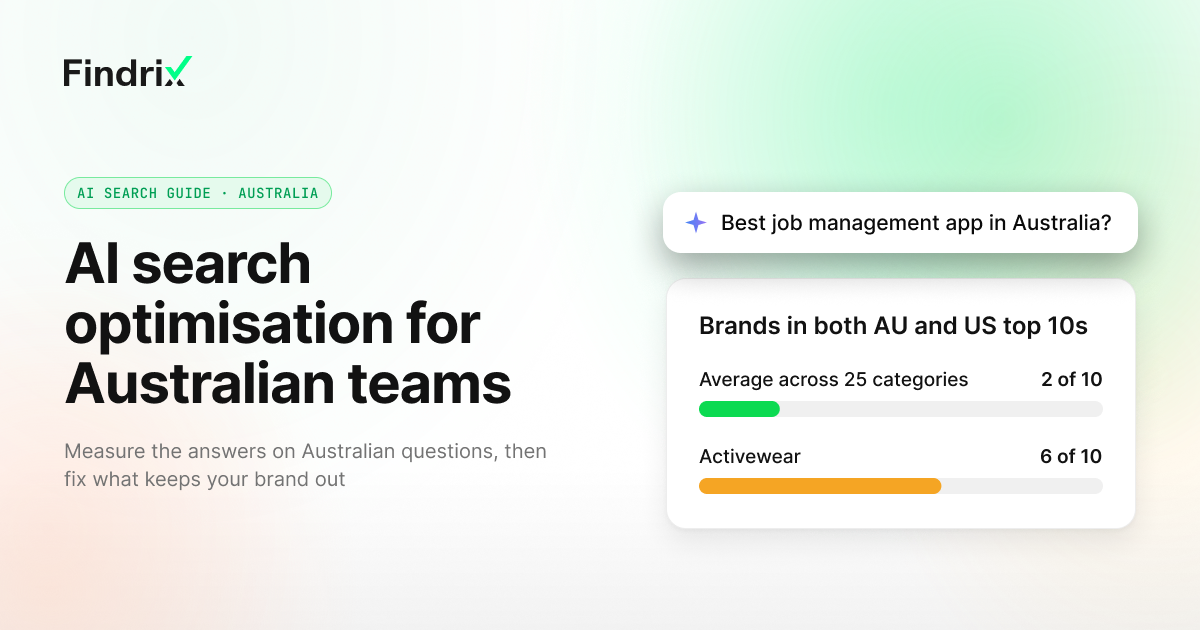
AI Search Optimisation: How to Optimise for AI Search in Australia
AI search optimisation for Australian teams: how to measure AI answers, decide what to fix first, and get your brand named in ChatGPT, Perplexity and Google.