

 Deutsch
 Français
 Español
 Português (Brasil)
 Italiano
The AI Visibility Report That Gets Your Work Funded
 Evgeniya Zemlyanskaya13 min readOctober 29, 2026
TL;DR
Founders fund AI visibility work when the report behind it is one they can trust and can connect to money, and most reports fail on both counts. Put three or four numbers in it: how often you are named on buying questions, per engine and with a range; how often your own pages are cited; AI referral visits from Google Analytics 4; and the leads or revenue those visits bring. Only the last one is ROI. Say in one line how the data was collected, check every drop against the usual swing and against GA4, and end with one recommendation, its cost and how you will check it.
Key takeaways
- Executives distrust AI visibility reports because of new metrics few people can explain, black-box engines and data collected on prompts that can hardly miss you.
- Report three levels, visibility, traffic and money, and link them through the page; only the money level is ROI.
- Tie the numbers to sources outside the tool: an AI Assistant channel in GA4, the lead source in the CRM and a "How did you hear about us?" option.
- AI answers swing even when nothing changed; check a drop against the usual range and against AI referrals before reacting.
Why executives don't trust AI visibility reports
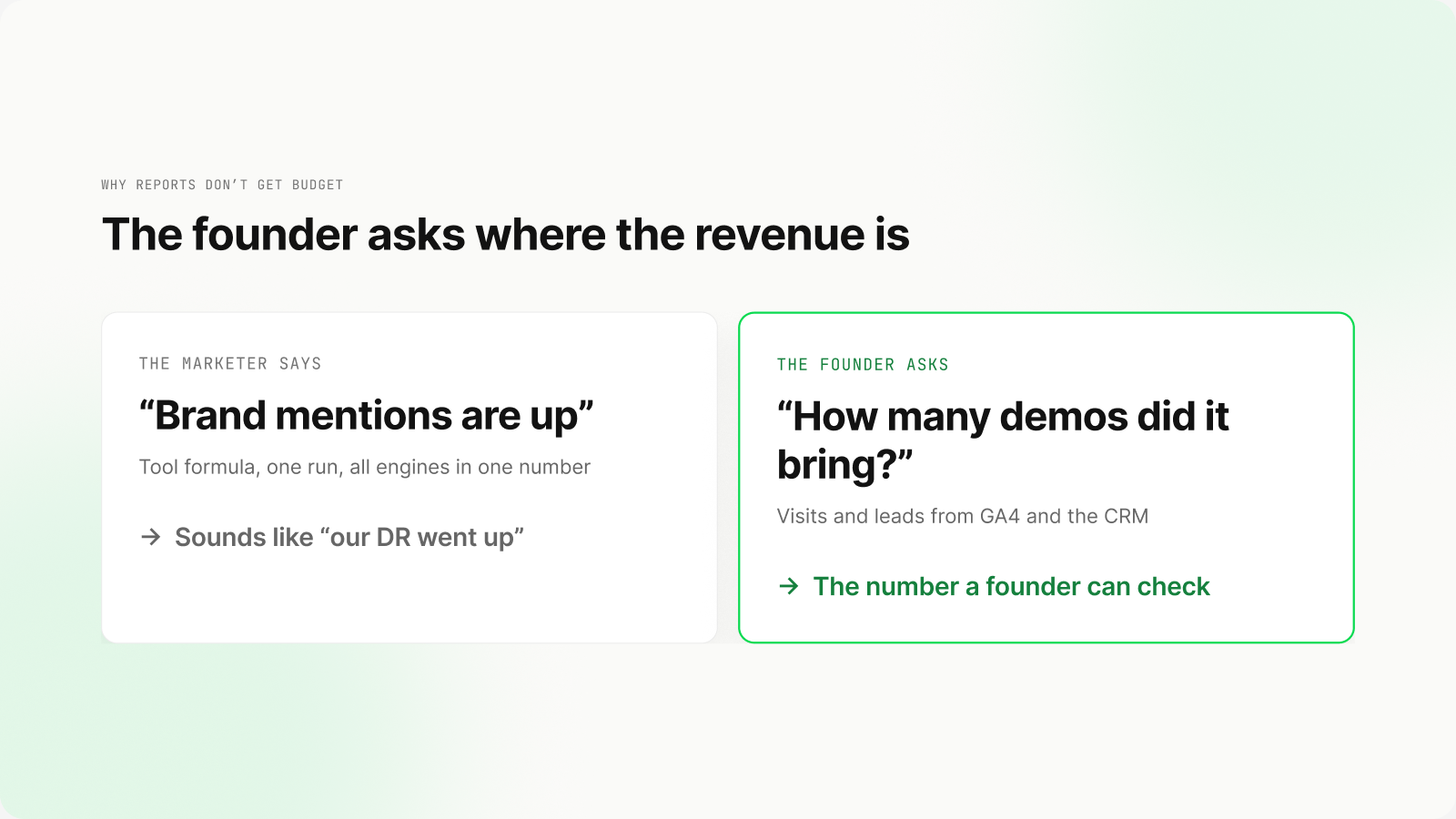
A marketer walks into the budget meeting and says, proudly, that brand mentions are up. To the founder this sounds like "our DR went up" did a few years ago: a number from a tool, in the tool's own language, with no visible line to sales. The founder wants revenue. A growing number nobody can explain does not get them closer to it.
AI visibility has produced a whole new vocabulary in a couple of years: brand mentions, visibility score, share of voice, ranking, average position, citation rate, sentiment, prompt volume. Few people outside the team that bought the tool can say what these mean, and fewer still know how they are calculated. Each tool defines them its own way.
The same name can hide different maths. Take share of voice. Out of 100 AI answers, your brand appears in 30, two competitors in 20 and 10, and 40 answers name none of you. One tool divides by all answers and reports 30%. Another divides by mentions of tracked brands and reports 50%. Same answers, two numbers, and both are correct. We go through this in our guide to AI share of voice. Ranking misleads even more, because the word comes from SEO and sounds like a position in Google. In an AI answer it usually means your place in a list of recommendations, and that place changes from one run to the next.
The main reason, though, is the black box. ChatGPT, Gemini and AI Mode do not explain why they named one brand and not another, which pages they read or why the answer changed since last week. We describe what is known about how they pick sources in How AI Search Engines Retrieve and Cite Sources. No tool can open that box, and nobody outside OpenAI or Google can either. Many tools then keep their own formulas to themselves, so the founder gets a black box measured by another black box.
Tools often make it worse with how they collect the data. Many ask each question once, mix all engines into one number, do not show where the questions came from and give no range. And the questions are often written so that the tool can hardly miss you: they name your brand, your product or a niche so narrow that only you fit it. The tool finds you every time, the number looks great, and it says nothing about buyers who ask what to choose.
Here is what such a question looks like: "Find a US agency that works with Mixpanel and builds delivery apps." The tool generated it because it read a case study like this on the agency's own site. A real buyer might type it once in ten years. The engine, meanwhile, finds the agency almost every time, because the question describes the agency. A buyer would ask "best agency to build a food delivery app" or "who can set up analytics for our app", and those are the questions that show whether AI recommends you when someone is choosing.
People notice. In Findrix interviews with 15 marketers, 14 said they don't trust the AI visibility numbers their tools show.
You cannot make the engines transparent. You can stop asking the founder to trust the box: show fewer metrics, say how they were collected and tie them to numbers that come from outside it, the traffic and leads in your own analytics and CRM.
Which AI visibility metrics belong in the report
Which metrics matter for AI search visibility? For a founder, the ones closest to money. Sort AI visibility metrics into three levels, and take one or two from each.
Visibility. What AI engines say about you. The main number is how often you are named on buying questions: non-branded questions, the ones that do not contain your name, such as "best CRM for a small sales team", "alternatives to X" or "which tool for Y". Report it per engine and with a range. Add how often engines cite your own pages, and which sites they cite instead.
Traffic. Visits that AI assistants send to your site. Google Analytics 4 shows referrals from ChatGPT, Perplexity, Gemini, Copilot and other assistants, and the pages those visits land on. This number does not come from your AI visibility tool, which is why founders trust it more.
Money. Sign-ups, demo requests, pipeline or revenue from those visits. The Marketing Accountability Standards Board draws the same line for marketing metrics in general: a marketing number counts as a financial result only once you have shown how it leads to cash. (MASB)
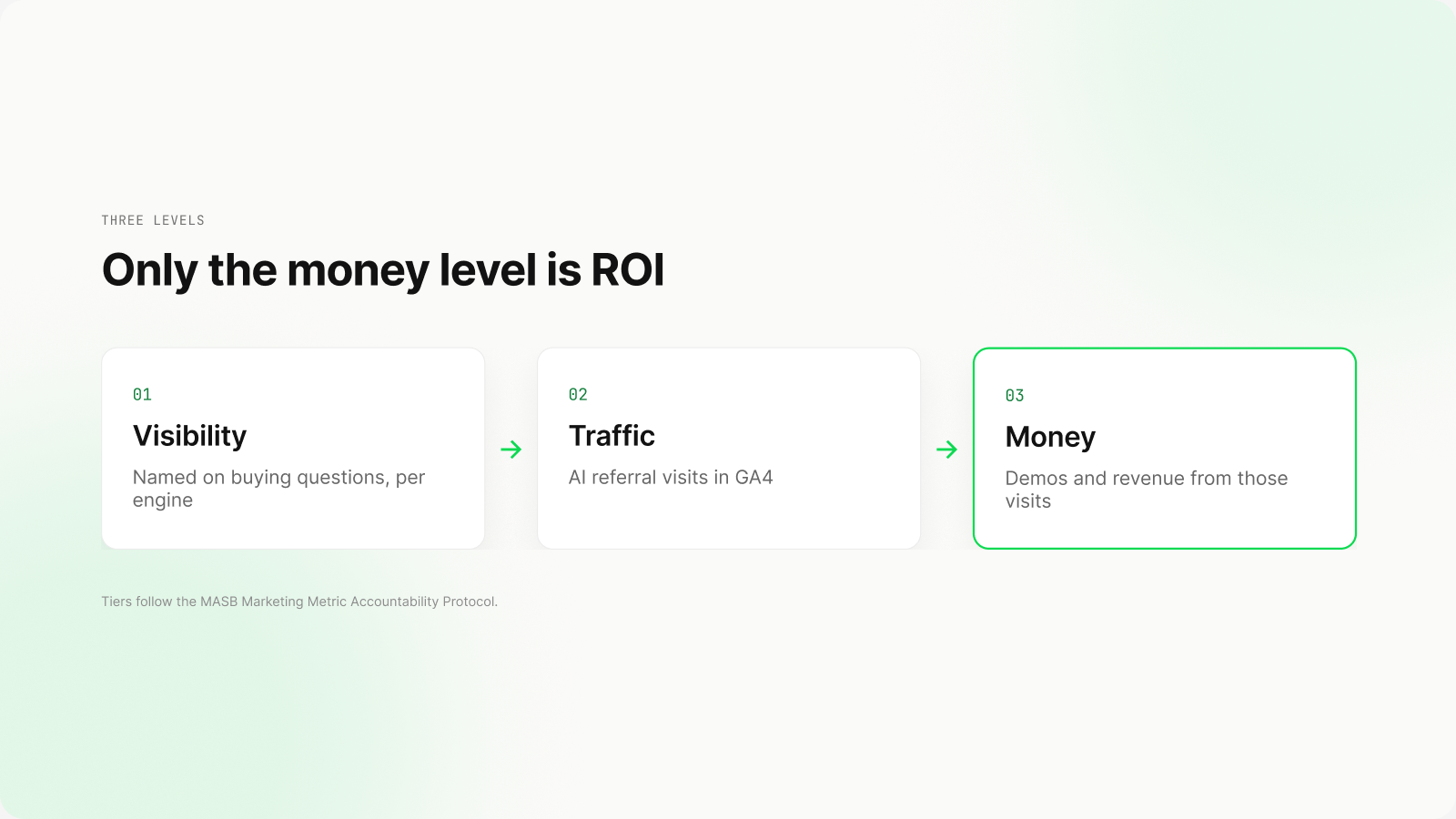
The levels convince only when they are linked, and the link is the page. A buying question leads to a page the engine cites, AI visitors land on that page, and that page produces the demo requests. Read the report page by page and each number explains the next one.
Take a company that sells a CRM for small sales teams. Its tool reports that brand mentions are up. But on ten "best CRM" buying questions, ChatGPT names it zero times. At the visibility level that is the real finding, and it is the one this article follows.
So what metrics prove success in AI search? Only the third level. Visibility and traffic can justify the next test. They are not ROI until they connect to money.
Everything else stays in the team's working dashboard. Here is how the popular generative engine optimization metrics sort out:
| Metric | What it usually shows | In the executive report? |
|---|---|---|
| Mention rate on buying questions | Share of non-branded buying questions where you are named | Yes, the main visibility number, per engine and with a range |
| Citation rate of your pages | How often engines link to your site as a source | Yes, as a supporting number |
| AI referral visits (GA4) | Real visits from AI assistants, by landing page | Yes |
| Leads and revenue from AI referrals | What those visits brought the business | Yes, this is the ROI line |
| Brand mentions, all questions | Every time any engine names you, including questions that already contain your name | No, it grows with branded questions |
| Visibility score | A tool's own composite; the formula varies by tool | No |
| Share of voice | Your share of answers or of tracked-brand mentions, depending on the tool | Yes, if it's measured on a fixed set of buying questions and the formula is stated |
| Ranking or average position | Your place in an AI list of recommendations; it changes run to run | Team metric; too unstable for the executive report on its own |
| Sentiment | Tone of mentions | Only if it turns negative on buying questions |
| Prompt volume | A rough estimate of how often people ask. AI engines don't publish prompt counts, so tools model it from search data, and each tool models it differently | No, context for the team |
We go deeper into share of voice, citation ownership and AI-attributed revenue in 3 AI Search Visibility Metrics & KPIs.
Platform AI search metrics need the same care. Google's generative AI performance report counts impressions when links to your site appear in supported AI features in Search, so mentions without a link stay invisible to it. (Google Search Console help) Bing says its citation counts do not indicate ranking or authority and calls its citation share metric observational, "not a ranking system or a competitive scoreboard." (Bing Webmaster Blog, February 2026; June 2026 update)
How to connect AI visibility to commercial results
The link to money is built in your analytics and CRM. Your visibility tool cannot build it for you, so set it up before you ask for budget.
In Google Analytics 4, create a custom channel group, a rule that sorts visits into a channel of your own. Call it AI Assistant and put referrals from chatgpt.com, openai.com, perplexity.ai, gemini.google.com, claude.ai and copilot.microsoft.com in it. AI visits then show up as their own channel, with the pages they land on and the sign-ups or demo requests they produce. The KPI article linked above walks through the setup.
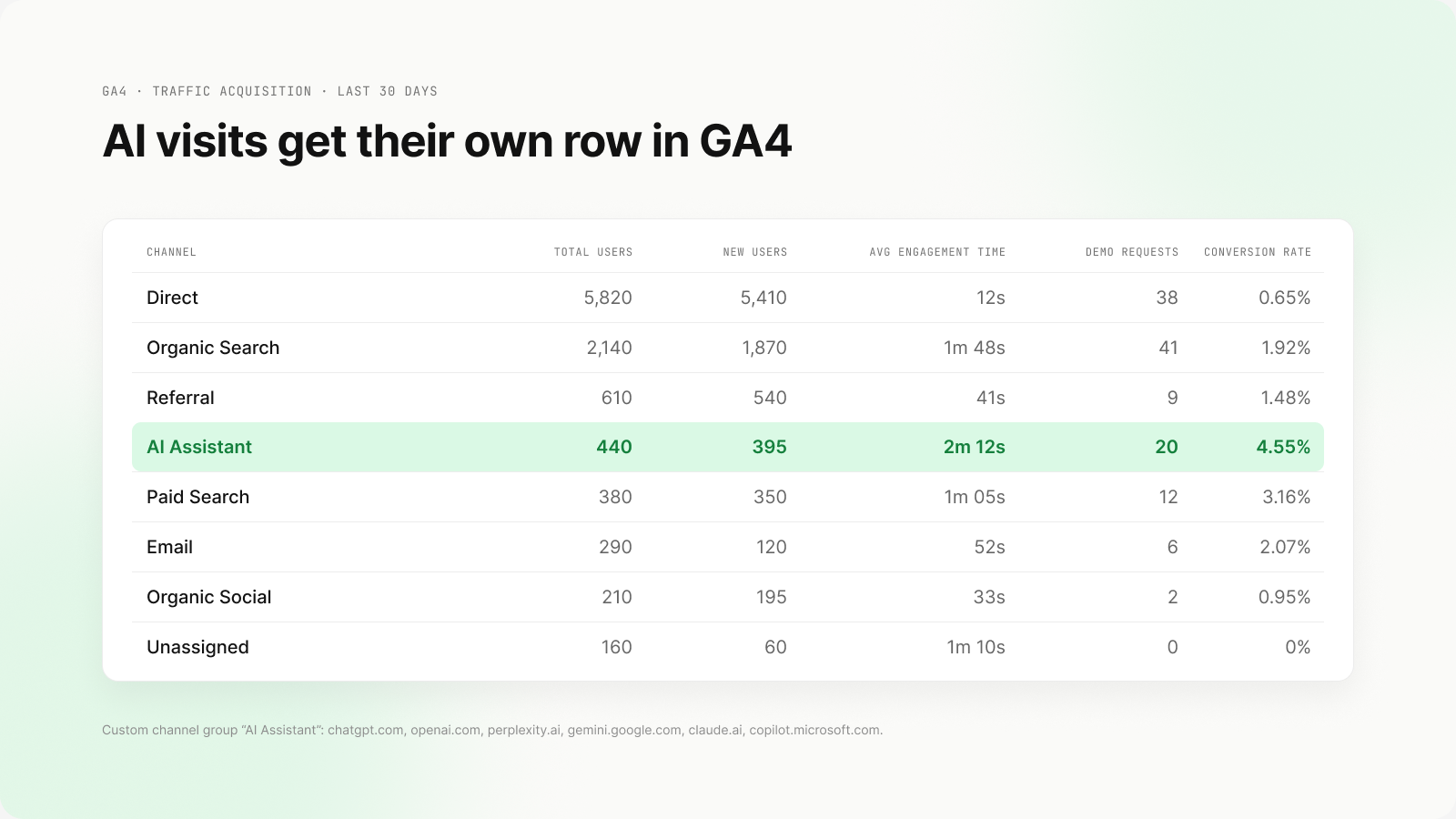
Then carry the source into your CRM, so a lead that arrived from an AI answer keeps that label in pipeline. Add "ChatGPT or another AI assistant" as an option to the "How did you hear about us?" field on the demo form. Many AI visits arrive without a referrer, the address of the page a visitor came from, and some buyers read an AI answer and come back later through search. The form catches part of what analytics misses.
Read the GA4 number as a minimum. Google's AI Overviews and AI Mode arrive mixed into ordinary Google search traffic, and visits without a referrer land in "direct".
Where the money goes, depending on what the report finds
What the report finds decides the first spend. Run every movement in your AI search performance metrics through this list before you ask for budget.
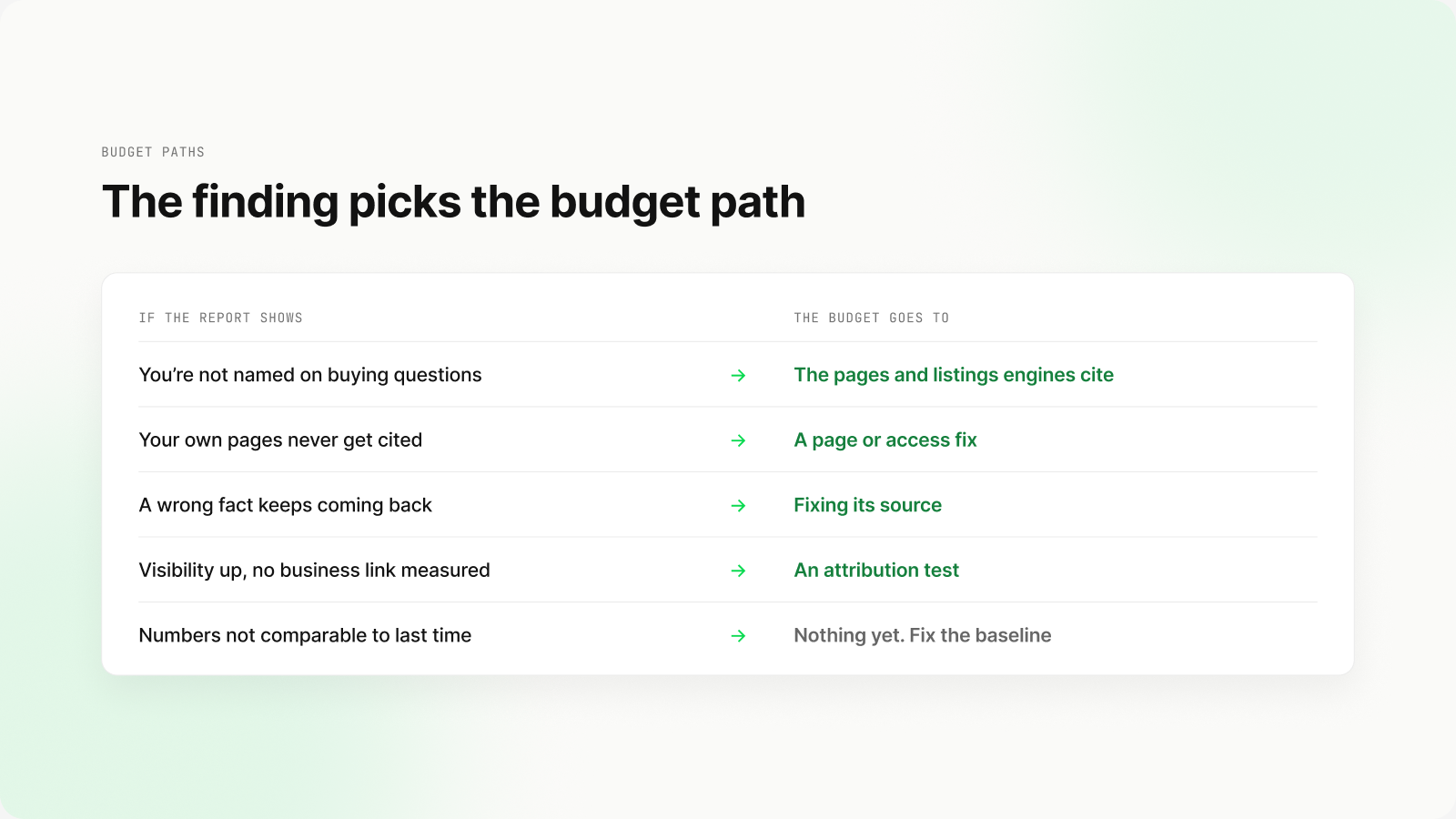
If you are not named on buying questions, look at what the engine cites there and fund that: a comparison page of your own, crawler access to the pages you already have, or a place on the review and comparison sites the engine relies on. If engines never cite your own pages anywhere, fix those pages and their access first. If AI repeats a wrong fact about your product, fix the source it comes from. If visibility rises with no measured link to the business, pay for an attribution test, a small controlled check of whether that visibility brings visits and leads, before you raise the budget.
One condition overrides all of these. If the question set changed or the movement is inside the usual swing, this month cannot be compared with the last. Hold the money and fix the baseline first.
For the CRM company, the first branch applies. On the ten "best CRM" questions ChatGPT cites competitors' comparison pages and two review sites. The company has no comparison page and no listing on either site.
What a one-page AI visibility report looks like
If you are working out how to report AI search visibility to leadership, keep it to one page, in this order.
1. The recommendation, in one sentence.
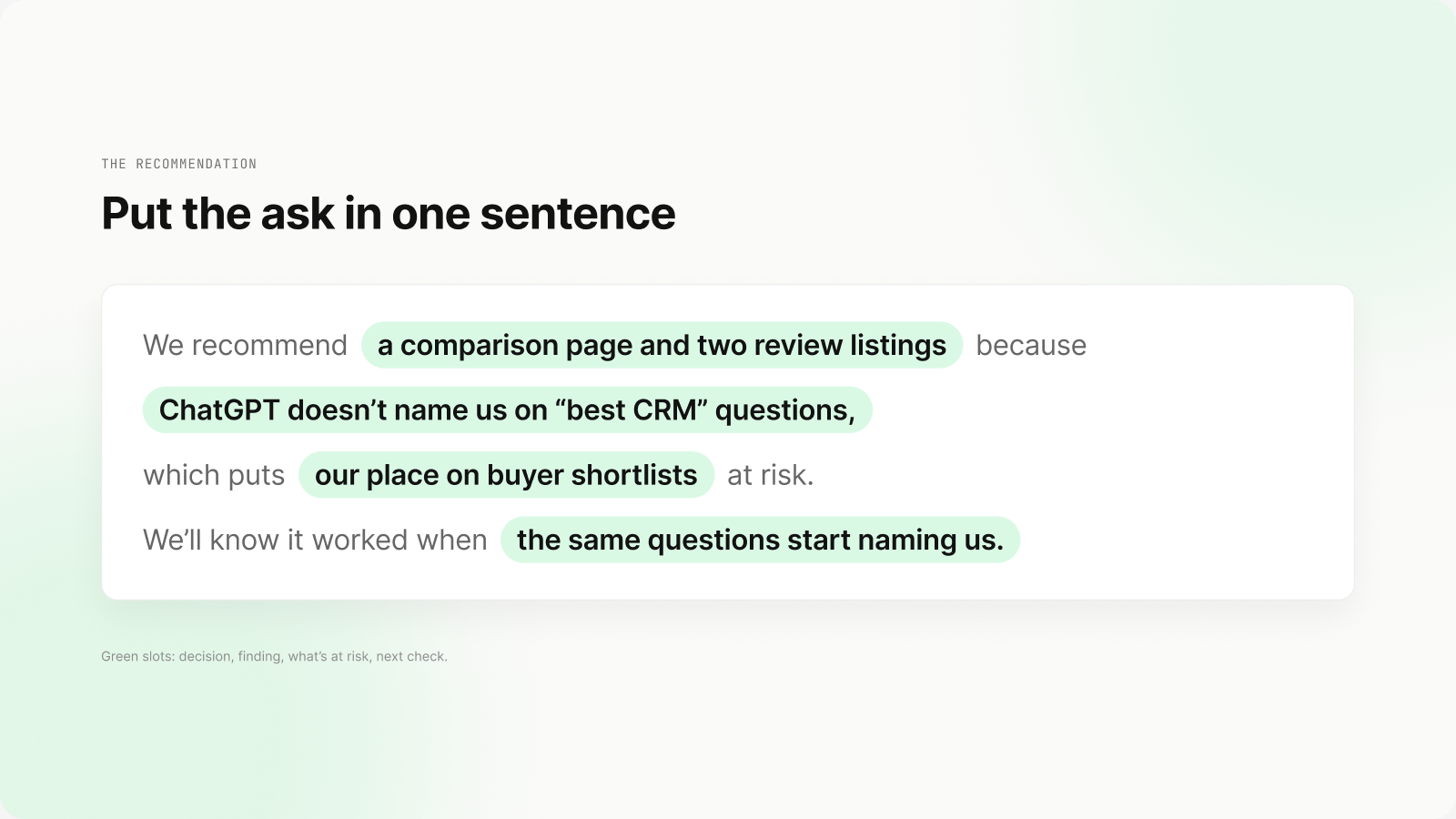
We recommend [what we want to do] because [what we found] puts [what's at risk] at risk, and we will know it worked when [how we'll check].
For the CRM company: "We recommend a comparison page and two review listings because ChatGPT doesn't name us on 'best CRM' questions, which puts our place on buyer shortlists at risk. We'll know it worked when the same questions start naming us and AI referrals to the page grow."
2. Three or four numbers. Mention rate on buying questions, per engine, with the range and the change since last month. Citations of your own pages. AI referral visits. Leads or revenue from those visits. Nothing else.
3. What changed and why. Which work happened, what moved after it and whether the whole niche moved too. If every brand in your category gained visibility that month, the gain belongs to the market.
4. The next step. What it costs, who owns it and what result would tell you to stop.
5. One line about the method.
Engines: [list] · Questions: [how many, where they came from] · Period: [dates] · Runs per question: [number] · Changed since last report: [yes or no, and what]
This line answers the question founders ask most often, where the numbers came from, before anyone asks it. Keep it on the same page as the numbers.
Reading the next report: results and drops
The CRM company published the comparison page and got listed on both review sites. A month later the report reads page by page:
| Page | Visibility: buying questions where it's cited | Traffic: AI referral visits (GA4) | Money: demo requests from those visits |
|---|---|---|---|
| CRM comparison page | ChatGPT 4 of 10, Perplexity 6 of 10 | 310 this month, up from 120 | 14 |
| Pricing page | ChatGPT 1 of 10, Perplexity 2 of 10 | 90 | 6 |
| Blog post on sales pipelines | Not cited on buying questions | 40 | 0 |
Illustrative example.
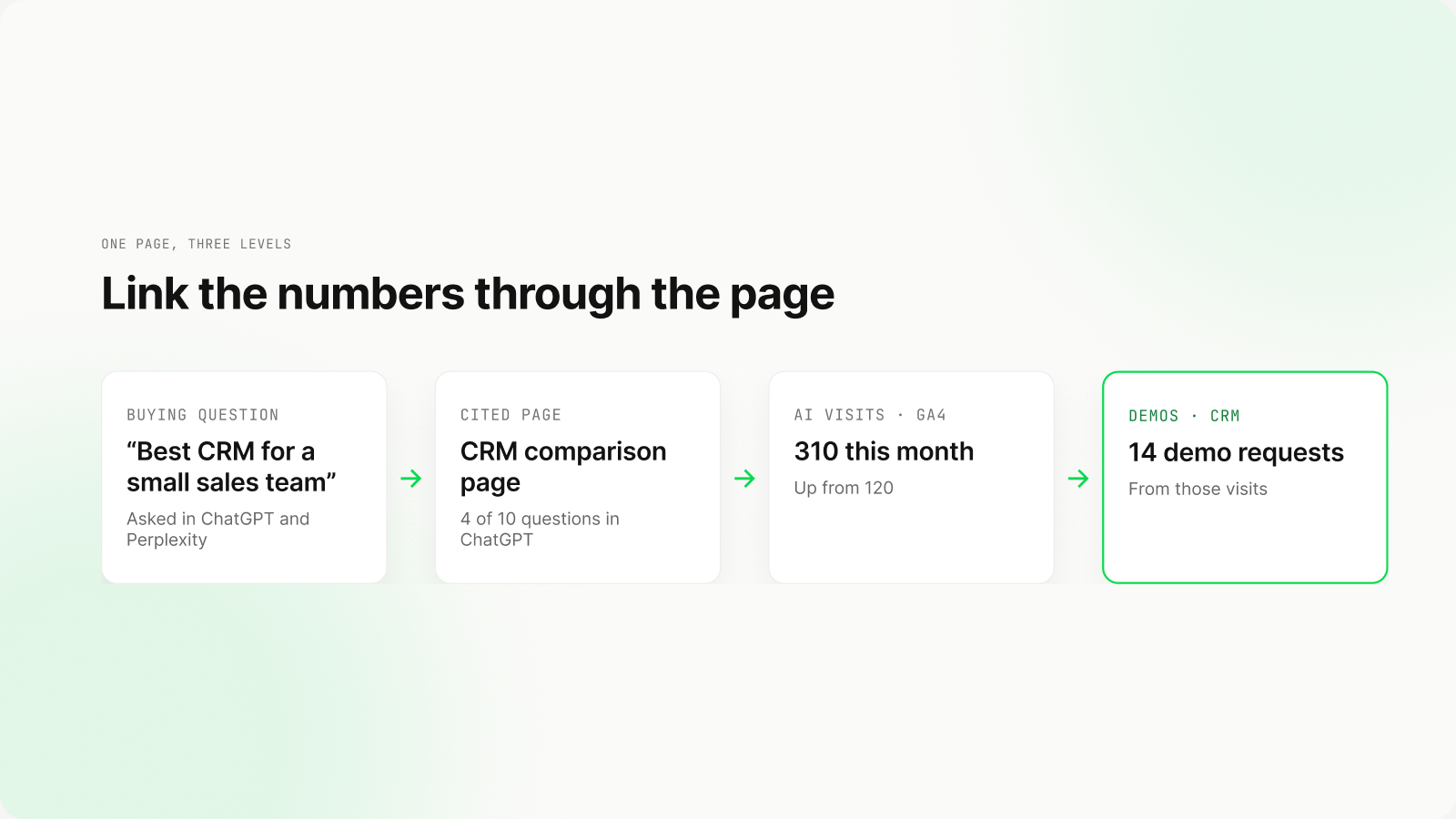
A founder can read this table without knowing what share of voice is. Visibility rose on the comparison page, visits to it grew, and the visits turned into demos. Each link in that chain comes from a different source: the visibility tool, GA4 and the CRM. Nobody has to take the tool's word for it. If visibility had risen on a page while its AI visits stayed flat, the mentions would not be sending anyone, and the report should say so.
Then, a few weeks on, ChatGPT mentions dip. AI answers move even when nothing on your side has changed. A 2026 study that replayed ChatGPT's searches through its API asked the same question twice on the same day: only 2.7% of the searches behind the two answers matched. The cited pages drift as well. About 40% of ChatGPT's citation pattern was still there two weeks later, and 14% after ten weeks.
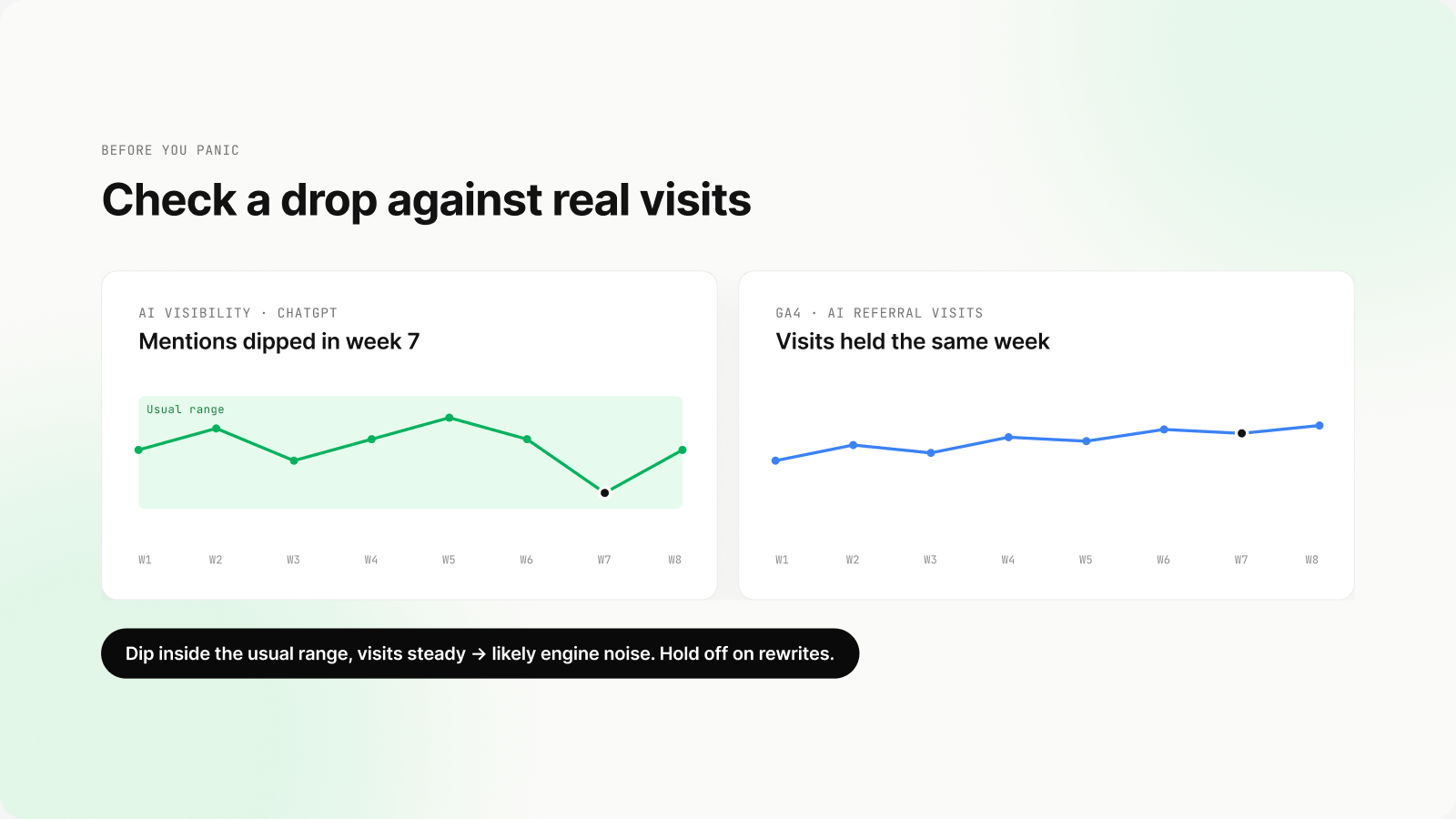
So even a good tool, asking the same questions the same way every week, will show numbers that jump. You open Monday's report, see a drop and want to rewrite pages or explain to your boss what went wrong. The drop may come from the engine alone, with your work and the tool playing no part. A rise deserves the same suspicion.
Before you call a movement a win or a loss, check two things. Is it bigger than the usual week-to-week swing for that engine? And did AI referrals in GA4 move the same way? If visibility fell but referrals held steady, the drop is probably engine noise. If both fell together, take it seriously and look at which pages lost visits. Show the founder the usual range next to the number, so a normal swing does not turn into a crisis meeting.
How Findrix keeps the report running week to week
Building this report once by hand is possible. Keeping it comparable every week is the hard part, and Findrix takes it over.
Your buying questions live in one approved set that you can edit, so each run measures the same ground. Most of them do not name your brand, so you see how you do before buyers have decided. Each engine is reported separately, with a range around the key visibility numbers instead of one lucky answer.
For the "best CRM" gap, the AI Source Map shows which sites engines rely on in your niche, which of them mention competitors but not you and which are realistic to get onto. Owned sources lists the questions where engines cite competitors' content and not yours, which becomes a list of pages to write. Get Featured drafts the next step for each site, from a directory listing to an editorial pitch. Your team decides what to publish and send.
If you connect Google Analytics 4, AI Traffic shows the visits and revenue AI assistants send to your site and matches each landing page with its AI citations, so the page table above and the check against a drop sit on one screen. The Work Log ties each piece of work to what happened after it and flags when growth came from the whole niche rather than from you.
Findrix does not turn a changed answer into a revenue claim. That link still runs through your analytics and CRM, and the report should say so.
Sources
- MASB Marketing Metric Accountability Protocol
- Google Search Console: Generative AI performance report
- Bing Webmaster Tools: Introducing AI Performance (February 2026)
- Bing Webmaster Tools: New AI Visibility Insights (June 2026)
- Chen and Koudas (2026), replay study of ChatGPT and Gemini search, arXiv 2610.15033
- Findrix methodology
Frequently asked questions
How often should you report AI visibility to executives?
Monthly for the founder, weekly for the team. Weekly numbers swing with the engines, so a monthly report on the same questions shows the trend without turning every dip into a meeting. The revenue line also needs a month of AI visits before it means anything.
Can you prove ROI if many AI visits arrive without a referrer?
Not completely, and the report should say so. GA4 gives you a minimum, the CRM keeps the source for leads that did arrive through AI, and the "How did you hear about us?" field catches part of the rest. Report the three side by side and call the total a lower bound.
What if AI referral traffic is still too small to show revenue?
Report the first two levels and say the third is not measurable yet. Show visibility on buying questions and AI visits to the pages engines cite, and set a date to check revenue again. A small, growing number on the right pages is a reason to continue the test. Claim ROI once the demo requests are there.
Read next
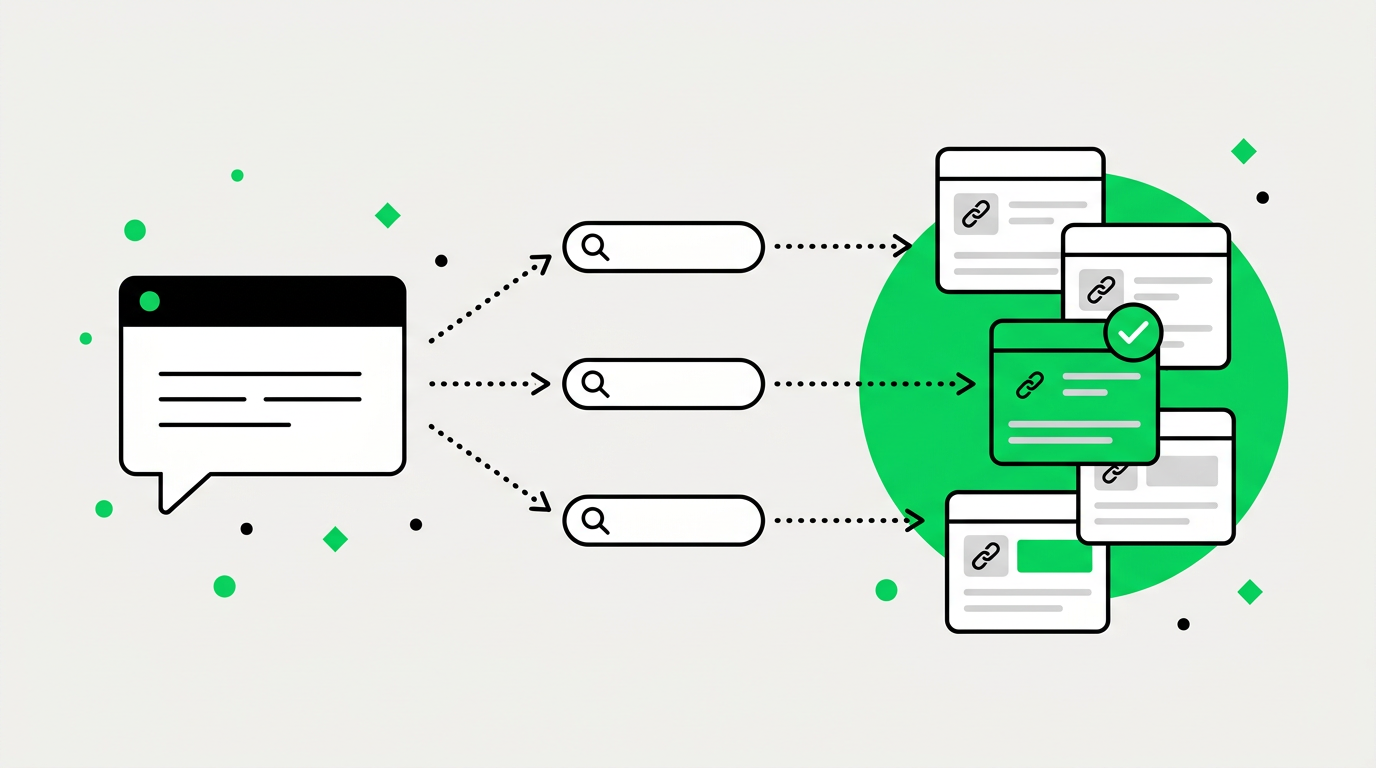
How AI Search Engines Retrieve and Cite Sources
How ChatGPT, Google AI Mode and Gemini turn a prompt into searches, pick sources and attach links, with research and Radar data on what gets cited.
AI Share of Voice: How to Measure and Interpret It
AI Share of Voice compares your brand's mentions to competitors' in AI answers – but tools calculate it differently. See Findrix's method and formula.
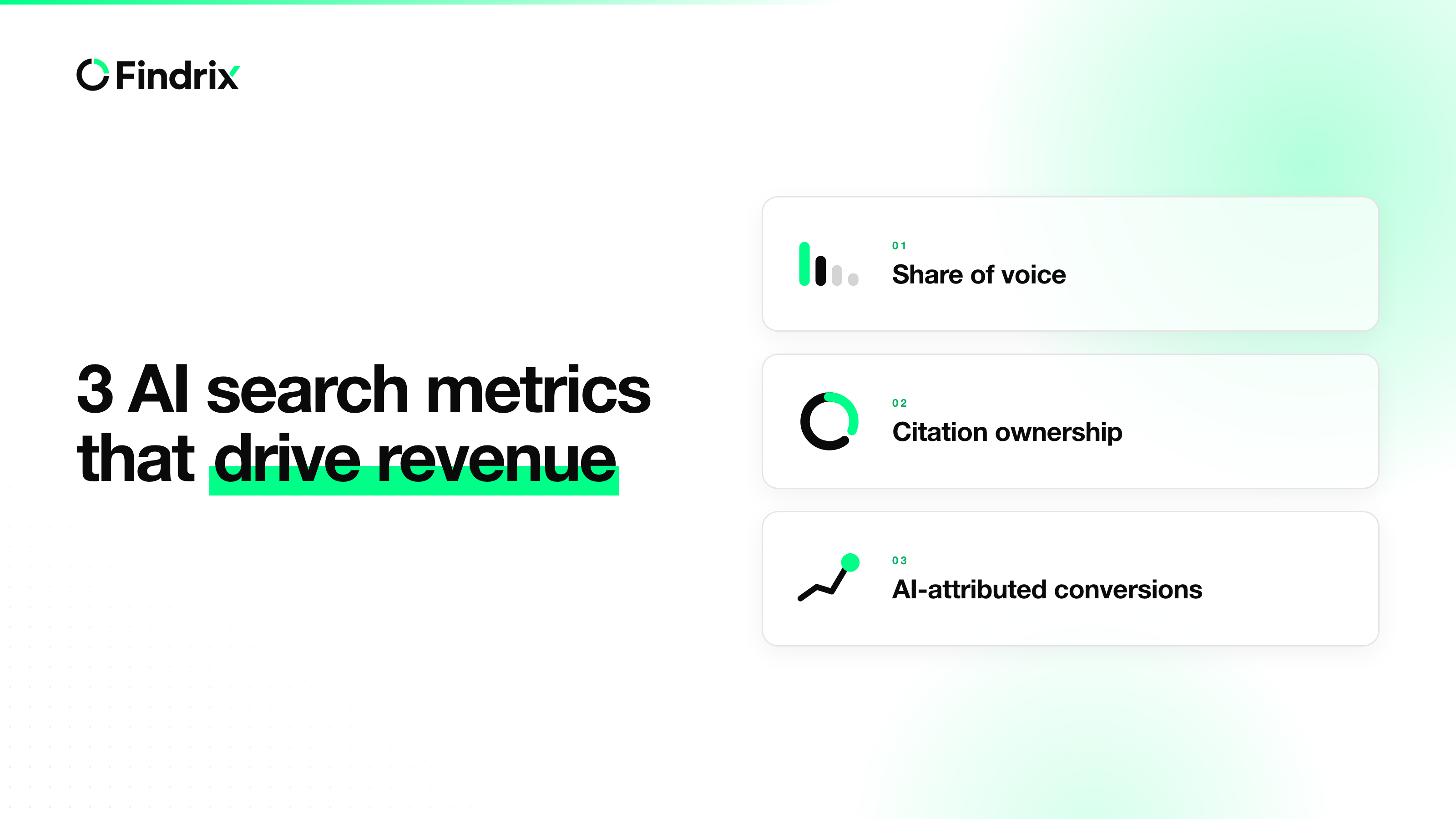
3 AI Search Visibility Metrics & KPIs You Need to Track
3 AI search visibility metrics and KPIs that drive revenue: share of voice, citation ownership, and AI-attributed conversions.