

 Deutsch
 Français
 Español
 Português (Brasil)
 Italiano
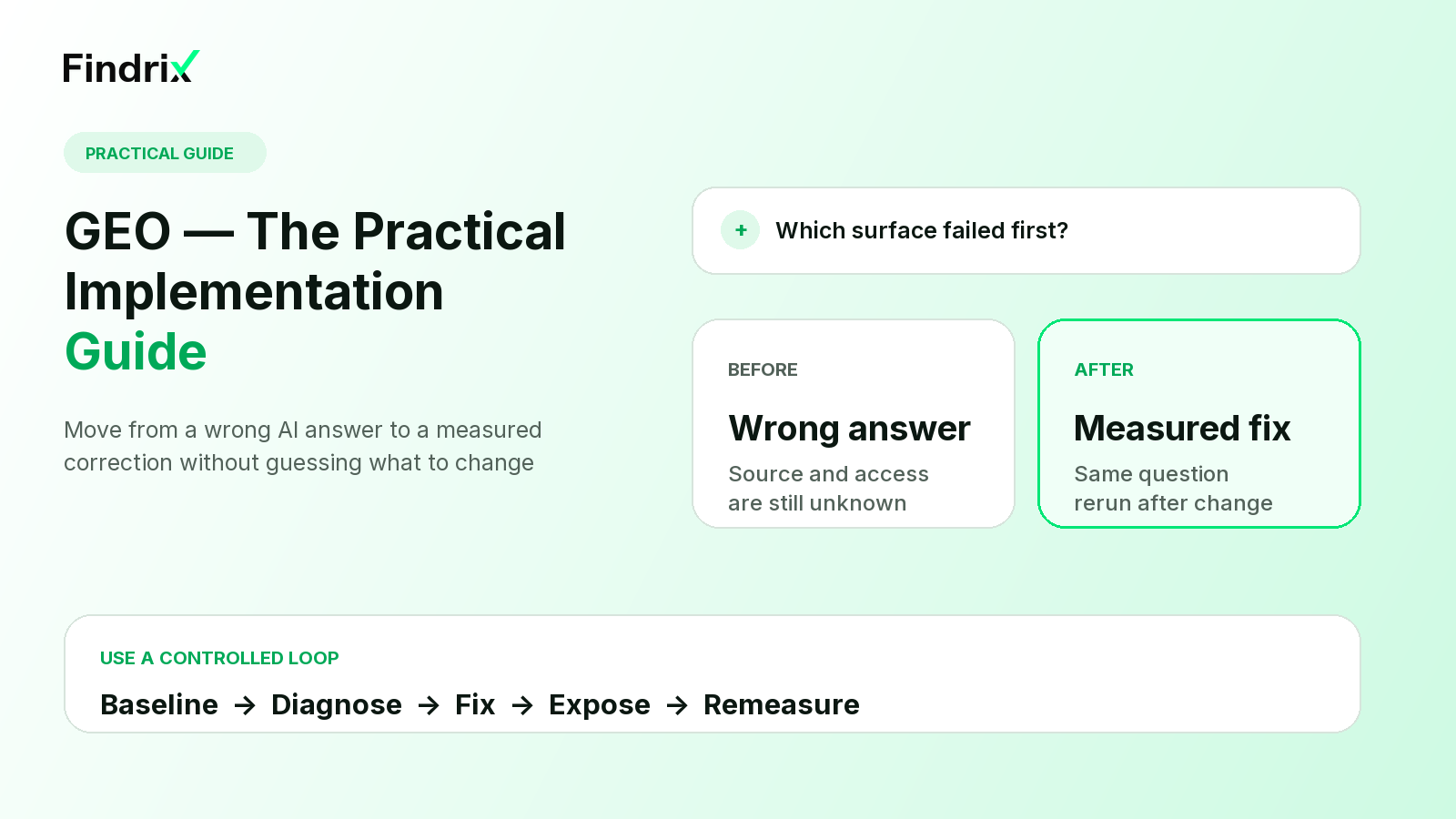
GEO — The Practical Implementation Guide
 Danila Kadtsyn7 min readNovember 15, 2026
Key takeaways
- Diagnose the failure surface before rewriting content.
- Recrawl makes a change discoverable but does not prove success.
- Owners, change logs and fixed retests make GEO repeatable.
Most GEO programs do not stall because the team missed a tactic. They stall because someone edits content before preserving the question, the answer and the sources that made the problem visible.
Practical example 1: Missing integration answer
An AI answer says your product lacks a key integration. Your product page says otherwise, an old comparison page agrees with the AI, and the correct page may be blocked from a crawler. One screenshot cannot reveal the failed surface, show whether the error repeats or prove that a later change worked.
The first move is not a rewrite. Save the exact question, full answer, engine, date and visible citations, then repeat the check. That record turns a frustrating answer into a diagnosable problem.
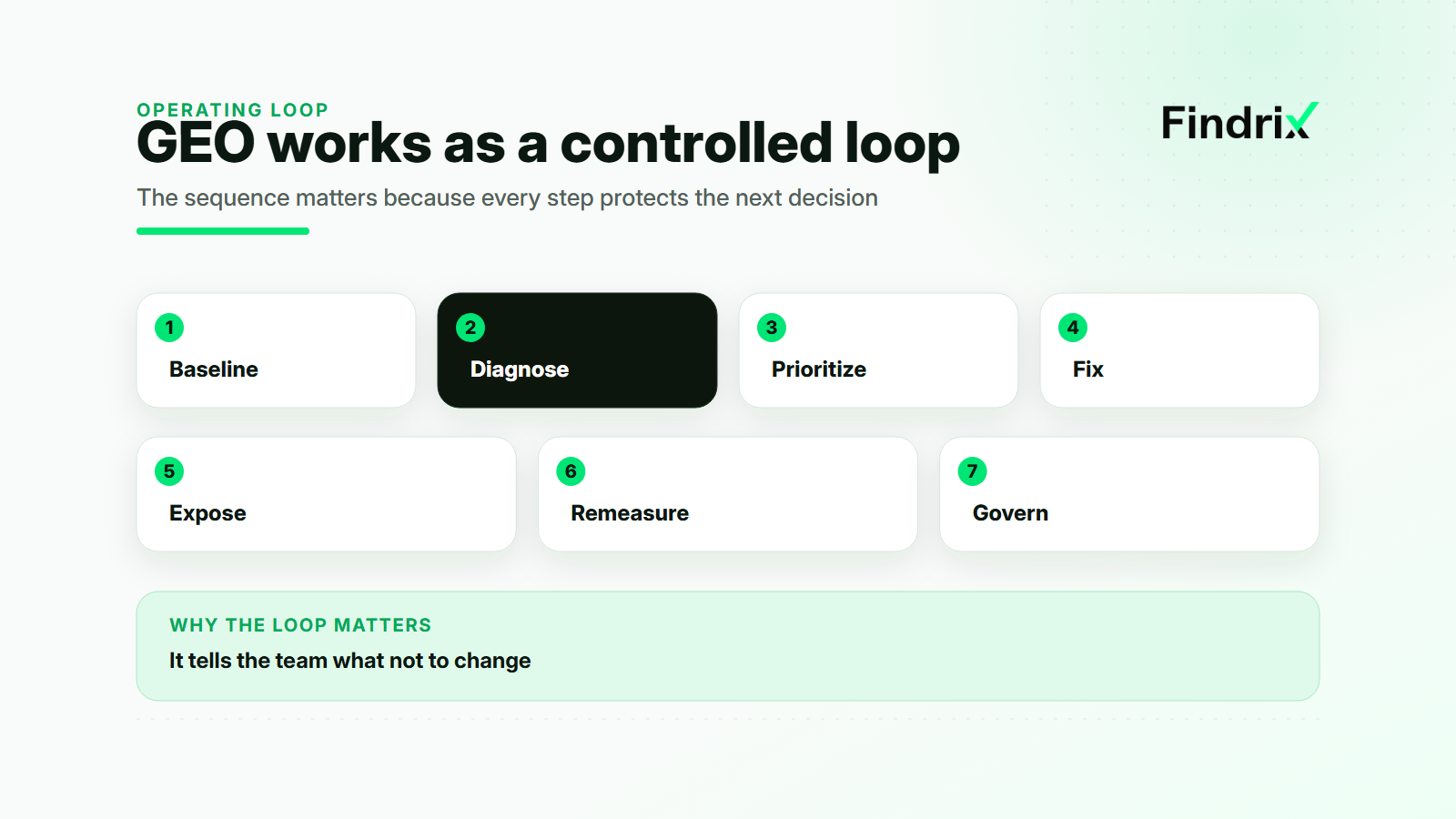
A practical generative engine optimization program is a control loop:
Baseline → Diagnose → Prioritize → Fix → Expose → Remeasure → Govern
The value of the loop is selection. It tells the team what not to change.
Why GEO programs stall after the first audit
An audit can reveal missing mentions, weak citations, outdated facts, inaccessible pages and inconsistent descriptions. If every observation becomes a content task, the team creates activity without learning.
Google’s current guidance for AI features is deliberately unexciting: established SEO fundamentals still apply, and no special AI schema is required. That guidance is useful for Google eligibility. It does not tell a cross-engine team which wrong answer to fix first, which source reinforces it or how to judge a change across ChatGPT, Google and other systems.
That operating gap is where GEO strategy begins. The team needs a stable buyer-question set, evidence for the current answer, an owner for each intervention and a rule for retesting. Otherwise a changed result could come from the edit, a different prompt, a new model version or ordinary response variation.
Our integration example will remain the same throughout the guide. The initial record contains the buyer question, three repeated answers, the engine and date, the product page, an old comparison page and the crawler-access status.
Step 1 — Freeze the buyer questions and baseline
Start with the questions that correspond to real buyer decisions. “What is our brand known for?” may be interesting, but “Does Product X integrate with our CRM?” has a clearer commercial consequence and a fact that can be checked.
For every question, save:
- The exact wording, including market or audience qualifiers
- The engine and model where available
- The complete answer, not only the sentence you dislike
- Visible citations or linked sources
- The date and time of the check
- The result of repeated runs under the same conditions
Repeat observations do not eliminate model variance. They reveal whether you have a stable failure or an isolated answer. If the claim appears once in five runs and citations change each time, more measurement may be the correct first action. If it appears consistently and points to the same old page, the team has a stronger diagnosis.
Keep the question set stable during the intervention. Adding easier prompts after the edit can make a dashboard improve without changing the original buyer problem. A baseline is not a folder of screenshots. It is a versioned test the team can run again.
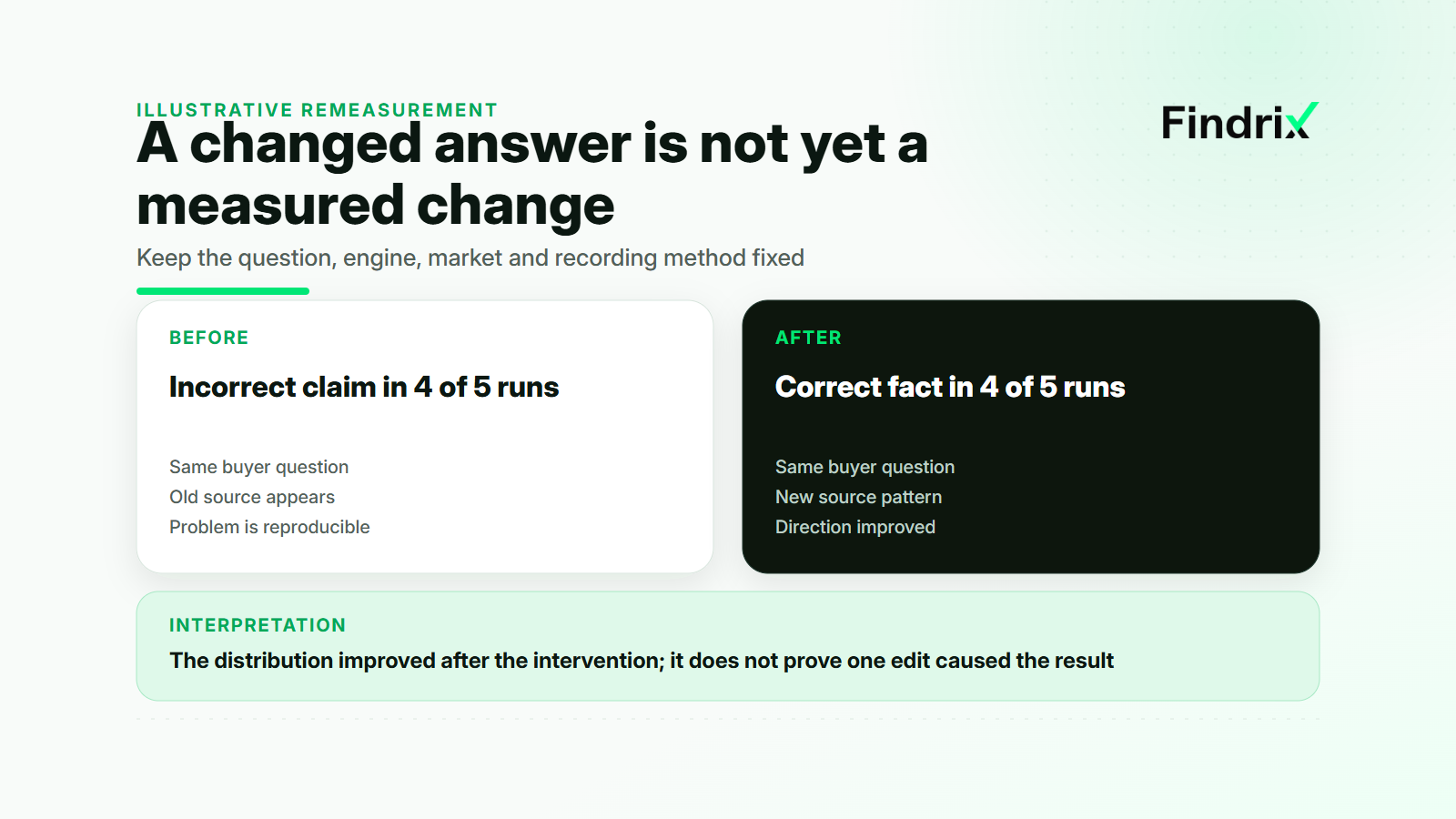
In the running example, the incorrect integration claim appears in four of five checks. Two answers cite the outdated comparison page. The authoritative product page uses vague wording and is not cited. The failure is reproducible.
Step 2 — Diagnose the failure surface
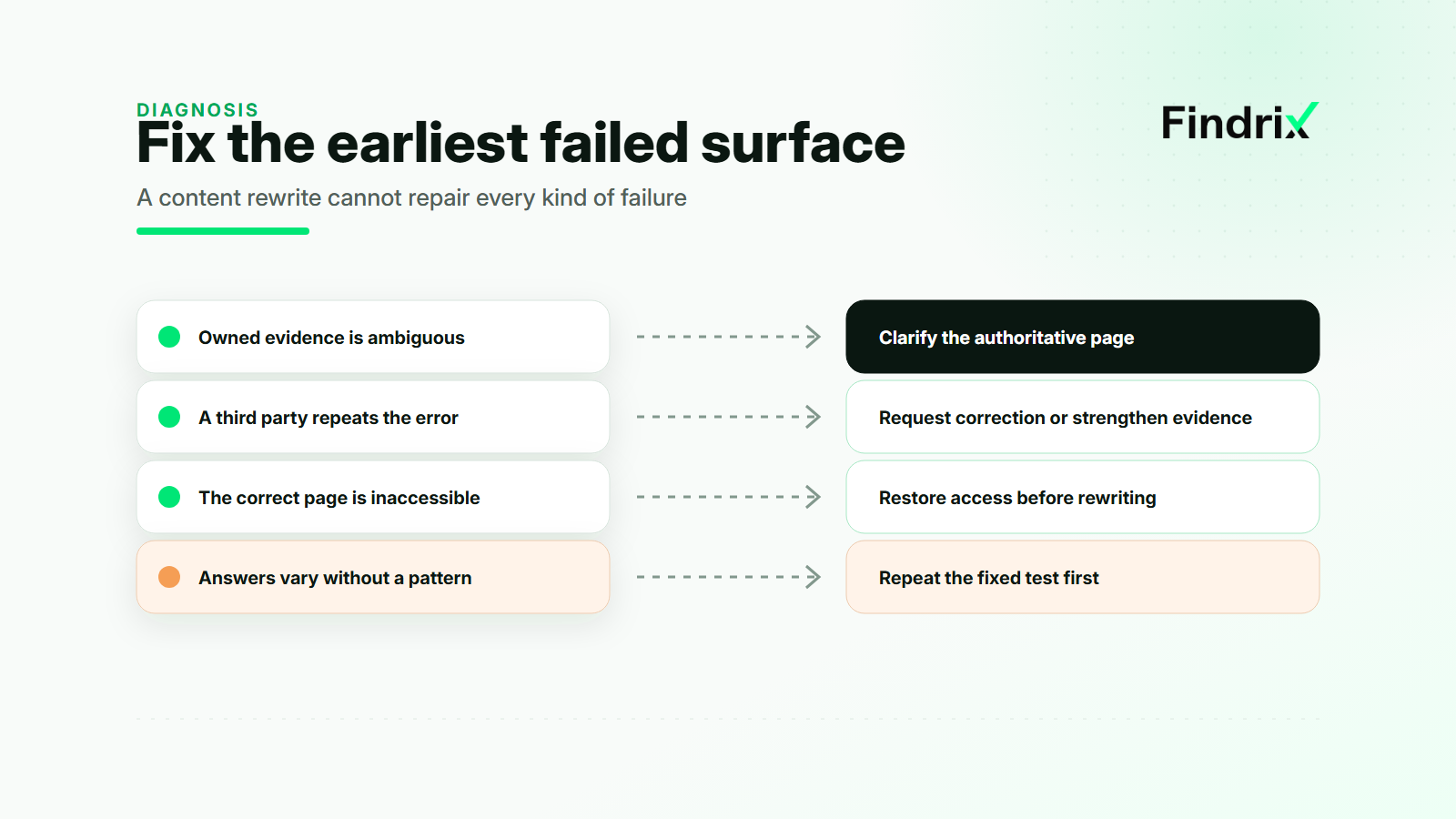
The most useful GEO question is: Which surface is carrying or enabling the wrong fact? Use this table before assigning a content task.
| What you find | What it means | First action | Important boundary |
|---|---|---|---|
| Correct fact is missing or ambiguous on owned pages | Owned evidence gap | Add one clear, supported statement to the authoritative page | Do not create many near-duplicate pages |
| A third-party page repeats the wrong fact | External evidence conflict | Request a correction or strengthen a better source | The company may not control the source |
| Correct page exists but crawlers cannot access it | Discovery or access failure | Restore access and verify the changed URL can be retrieved | Access does not guarantee selection |
| Answers vary with no stable source pattern | Measurement uncertainty | Repeat the fixed test before editing | One screenshot is not a baseline |
Several branches can exist at once. In our example, the product page is ambiguous and the old comparison page is explicitly wrong. That creates an owned evidence gap plus an external conflict. If the correct page were blocked, access would become a blocking issue because better copy cannot help a crawler that cannot retrieve it.
Citations show where a claim is reinforced, not every influence on the answer. Record that limit instead of treating a citation as proof of cause.
Step 3 — Prioritize the smallest evidence-backed fix
Do not start with the largest content project. Start with the highest-consequence claim that the team can correct and retest.
A simple priority decision uses three fields:
- Buyer consequence: Could the claim change the shortlist, pricing expectation or trust decision?
- Evidence strength: Is the correct fact documented and approved internally?
- Controllability: Can the team change the source directly, request a correction or only monitor it?
The integration claim is commercially important, fully documented and ambiguous on an owned page. The smallest sufficient intervention is a clear sentence on the authoritative integration page, supported by the relevant product details. Correct the old comparison page too, but do not let a third party block the owned clarification.
Assign one owner, one changed URL, the expected evidence change and a retest date. Avoid changing five related pages at the same time. A smaller intervention protects attribution: if the answer changes, the team knows which evidence became different.
This is where many lists of generative engine optimization best practices become unhelpful. They tell every team to add schema, write FAQs and publish more content. None of those actions is automatically relevant to an outdated integration claim.
Step 4 — Make the correction discoverable
Publishing the corrected sentence completes the content task, not the GEO test. The page must also remain accessible and understandable to the systems you are testing.
Check crawler access for the relevant engine. OpenAI documents OAI-SearchBot as the crawler that affects inclusion in ChatGPT search summaries and snippets; allowing it does not guarantee that a page will be selected. Google states that ordinary technical and content guidance applies to its AI features and does not require a special AI file. Those rules are platform-specific.
Use structured data where it accurately describes a supported page type. Article markup can help systems understand article properties. It is not a general switch for AI citations, and it should not be added to a product page merely because the team wants an answer to change.
If the engine supports change notification, use it for the changed URL. IndexNow, for example, notifies participating search engines that a URL was added, updated or removed. It does not guarantee indexing, retrieval or a different answer.
For the integration example, the team verifies crawler access, updates the authoritative page and submits the changed URL through supported channels. The correction is now retrievable, not yet proven.
Step 5 — Rerun the same test and judge the change
Use the original question set, engine, market and recording format. Repeat the runs rather than celebrating the first correct answer.
Compare four things:
- How often the incorrect claim appears
- How often the corrected fact appears
- Which sources are cited or linked
- Whether a new answer introduces another material error
Suppose the corrected integration appears in four of five new checks, while the old claim appears once. That is a meaningful directional change under the fixed test. It is not proof that one sentence caused the result. Models, indexes and retrieval systems change independently, and the sample is small. The honest conclusion is that the answer distribution improved after the documented intervention and should be checked again.
Record the before and after evidence beside the change log. A screenshot is useful for illustration. The repeated result is what supports the decision.
Scale the loop across products and engines
At scale, the problem is preserving the relationship between the buyer question, observed answer, source, intervention and next measurement.
Create one operating record for each material issue:
- Buyer question and funnel stage
- Product, market and engine
- Observed answer and source evidence
- Diagnosed failure surface
- Approved correction and owner
- Changed URL and exposure action
- Remeasurement result and next check
This is the manual system Findrix is designed to support. It connects repeated monitoring with source evidence, prepares ready-to-apply corrections and keeps the remeasurement step attached to the original problem. The team reviews the correction and remains responsible for publishing it.
The product is useful when the number of products, markets and engines makes spreadsheets hard to govern. The underlying logic stays the same. Findrix should not replace diagnosis with a second score. It should shorten the path through the loop the team already understands.
If you are starting this week, choose one buyer question with a clear commercial consequence. Freeze the baseline. Find the surface carrying the problem. Make the smallest supported change. Expose it. Then rerun the same test. That sequence will teach you more than executing ten disconnected GEO tactics at once.
Read next
Best White-Label AI Visibility Tools for Agencies
Compare white-label AI visibility tools by client surface, delivery labor, capacity and total portfolio cost before choosing an agency platform.

10 Best AI Overviews & AI Mode Trackers in 2026: Tested & Compared
This article from Findrix compares the 10 best AI Overviews and AI Mode trackers in 2026, from Search Console and rank trackers to brand trackers, and shows which kind answers which question. Findrix is an action-based AI visibility and GEO platform that turns ongoing tracking and analysis of a brand's presence across AI answers and search into fast optimization, built for brand managers, marketing leaders, and agencies running AI search for their clients.
11 Best Answer Engine Optimization Tools (AEO) in 2026: Tested & Compared
We tested the 11 best AEO tools of 2026, from Findrix and Profound to AirOps and Semrush, on what each one tracks, fixes and costs.
11 Best Generative Engine Optimization (GEO) Tools in 2026: Tested & Compared
This comparison from Findrix ranks the 11 best generative engine optimization (GEO) tools of 2026 by the work they actually do: finding gaps in ChatGPT, Perplexity, Gemini and Google AI Overviews, explaining what to change, drafting the fix, and re-measuring after it ships, with prices from $49/mo.